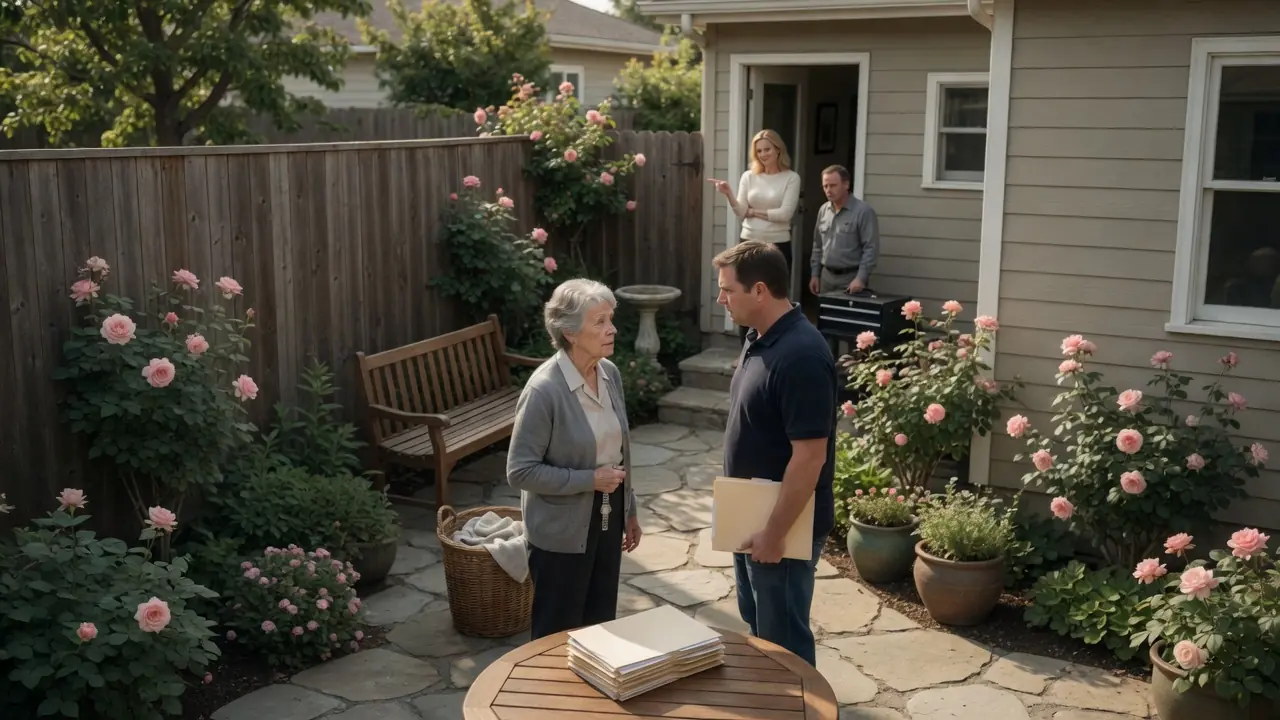
The roses were blooming when my son decided I no longer belonged in my own home. I was sitting in the backyard garden, folding towels into a wicker basket beside my chair, while the late afternoon sun touched the stone patio my husband had laid with his own hands. The birdbath near the fence was full of robins, and the rose bushes along the path were trimmed the way he liked them. For a few quiet minutes, the garden still felt like a place where love had once lived.
Then Josh came through the side gate with a folder in his hand. He did not smile, did not ask how I was, and did not even pause to admire the yard he had played in as a child. Bella followed close behind him, arms crossed, chin raised, wearing the expression of a woman who had already won an argument before it began. I remember thinking they looked out of place among the flowers, like two storm clouds walking across a peaceful painting.
My name is Joanne Miller. I am sixty-eight years old, widowed, and much stronger than my son remembered. That was the first mistake he made that day. He looked at my gray hair, my cardigan, my folded towels, and my quiet face, and assumed I was easy to move. He forgot that quiet women have often survived more than loud people could imagine.
Josh stopped near the patio table and opened the folder. Bella stood beside him on the garden path, tapping one polished shoe against the stone. I looked from my son’s hard face to the papers in his hand and felt a coldness move through me. Whatever they had come to say, they had rehearsed it.
“Five hundred thousand, Mom,” Josh said, his voice hard. “Sign the papers or pack your things. We are done asking nicely.”
At first, I thought I had misunderstood him. The birds kept splashing in the birdbath, and the neighbor’s dog barked somewhere beyond the fence. Everything ordinary continued around us, which made his words feel even more unreal. My son, the boy I had once carried through fevers and nightmares, had just given me an ultimatum in the garden his father planted.
I looked at him carefully. “You are threatening me in the garden your father built with his own hands?”
Josh’s mouth tightened, but he did not look ashamed. Bella gave a small laugh, sharp and dry. “Your husband is gone, Joanne. Stop using dead memories to block the living from moving forward.”
The words struck harder than I expected. Not because Bella had spoken cruelly before, but because Josh stood beside her and let the sentence remain in the air. He did not correct her. He did not tell her to show respect. He only shifted the folder under his arm and looked at me as if my pain were an inconvenience.
I folded the towel in my lap one more time, though it was already neat. My hands needed something to do. “What exactly are you asking me to sign?”
Josh pulled out a paper and placed it on the patio table. “It gives us authority to manage the house and access certain funds. Bella’s debt has to be handled before it destroys our future. You have equity, savings, and property sitting here doing nothing.”
Bella stepped closer. “And before you start playing the victim, remember that we have been patient. You live here alone in a house too big for you, while we are drowning. A real mother would help.”
A real mother.
That phrase had followed me for years in different costumes. A real mother would lend the money. A real mother would sign the document. A real mother would keep quiet. A real mother would sacrifice until there was nothing left of her but gratitude from people who never intended to repay it.
I looked at the paper but did not touch it. “Your wife’s debt is not my debt.”
Josh’s face hardened. “Do not make this uglier than it has to be.”
“They are not eviction papers,” he snapped. “They are practical arrangements.”
Bella smiled without warmth. “Call them whatever makes you feel better. The point is simple. You either help us, or you leave. This house should be useful to people who still have a future.”
That was when something inside me shifted. Not broke, exactly. Broke implies noise, splinters, a sudden collapse. This was quieter, colder, more complete, like a lock turning inside my chest.
I looked at Bella, then at Josh. “No, Bella. I am done mistaking your greed for family.”
For one second, Bella’s smile vanished. Josh stared at me as if I had spoken a language he did not know I possessed. Then his anger came back, fast and practiced. He pointed at the papers on the table.
“You are going to sign this tomorrow,” he said. “One night, Mom. That is all I am giving you. Tomorrow morning, you either cooperate, or we start changing locks.”
“Changing locks,” I repeated.
Bella shrugged. “If you refuse to act reasonably, we will have to protect ourselves.”
“In my house?”
Josh stepped forward. “Do not keep saying that like it solves everything. You are old, Mom. You cannot manage this place forever.”
There it was again, that word. Old. Bella used it like a weapon. Josh used it like a legal argument. To them, old meant inconvenient, confused, expired, ready to be moved aside.
I could have shouted. I could have reminded Josh of every bill I had paid, every meal I had cooked, every sleepless night I had survived for him after his father died. I could have told Bella that her debt was the result of her choices, not my obligation. But I had lived long enough to know that people who come with papers and threats are not looking for truth.
So I did the one thing they did not expect.
I nodded.
Josh exhaled as if I had finally become manageable. Bella’s shoulders relaxed, and that smug little curve returned to her mouth. They thought my nod meant surrender. They thought age and fear had done the work their cruelty started.
They did not know my husband.
Henry Miller had been dead for six years, but in that moment, I heard his voice more clearly than I had in months. He had loved that house, that garden, and me with a practical devotion that showed itself in locked files, careful planning, and warnings I once thought were unnecessary. He used to say that love was not only flowers on anniversaries. Sometimes love was paperwork nobody thanked you for until the storm came.
Years before he died, Henry had taken me to see his lawyer. I complained the whole way there because I hated discussing death, deeds, trusts, and medical directives. Henry only squeezed my hand and said, “Joanne, if anyone ever tries to pressure you over this house, do not argue. Do what we planned.” I had laughed then, because I could not imagine our son doing such a thing.
Now, sitting in the garden with Josh and Bella standing over me, I understood why Henry had insisted.
“One night,” I said quietly.
Josh gathered the papers. “Good. Be ready in the morning.”
Bella leaned toward me. “And do not make this dramatic. We have enough stress without you adding to it.”
They left through the garden gate without saying goodbye. I sat there until the evening cooled around me and the robins flew away from the birdbath. The towels remained folded in the basket, neat and obedient. I looked at them and realized that was how I had trained myself to survive for too long.
Neat. Quiet. Useful. Easy to put away.
I carried the basket inside, locked the back door, and stood in the kitchen for a long moment. The house was silent, but not peaceful anymore. It felt watched, measured, half-claimed by people who had mistaken access for ownership. I made tea because routine steadies the body when the heart is shaking.
Then I went to my bedroom and opened the bottom drawer of my dresser. Under old scarves and a cedar box of letters sat the folder Henry had labeled in his careful handwriting. I took it to the bed and opened it slowly. Living trust. Property protection clause. Financial coercion provision. Charitable transfer instructions.
Henry had written me a letter, sealed inside the folder.
My hands shook when I opened it.
Joanne, if you are reading this because someone is pressuring you about the house, remember this first: you owe no one your safety. Not a child. Not family. Not anyone who speaks the word love while reaching for what protects you. I have done everything I can to make sure you cannot be forced out by guilt, fear, or paperwork. Use it.
I sat on the edge of the bed and cried for the first time that day.
Not because I was helpless, but because Henry had seen me even from the past. He had known I might need protection from people I loved. That truth hurt, but it also wrapped around me like armor. I placed his letter on the bedspread and touched the silver watch on my nightstand.
By nine o’clock, I had made my decision.
I did not pack everything. Women like me know the difference between leaving and fleeing. I took what mattered: Henry’s watch, the trust papers, my birth certificate, bank documents, two changes of clothes, medication, a framed photo from our thirtieth anniversary, and the letters Henry wrote me while he was recovering from surgery. I left behind furniture, dishes, curtains, rugs, and everything Bella had probably already assigned to herself.
At midnight, the rain began. It tapped against the windows lightly, as if asking permission to enter. I placed a single note on the kitchen table: Do not look for me. I need quiet. I did not write explanations, apologies, or instructions.
Explanations invite arguments, and I was finished negotiating my existence.
I walked through the house once before leaving. In the hallway, I paused beside the doorframe where Henry had once measured Josh’s height with pencil marks. Age six. Age nine. Age twelve. Back then, Josh would lean against the frame and demand Henry measure twice because he was sure he had grown more.
I touched the marks gently. “I tried,” I whispered.
Then I locked the door behind me and stepped into the rain.
My car was parked in the driveway under the maple tree. I put my suitcase in the back, placed the trust folder on the passenger seat, and sat behind the wheel with both hands resting on the steering wheel. I expected to feel panic. Instead, I felt a strange, clean emptiness.
For the first time in years, nobody knew where I was going.
I drove to a small motel at the edge of town, the kind of place no one notices unless they need it. The room was plain but clean. I set Henry’s watch on the nightstand, placed the folder beside it, and finally turned my phone face down. It had already begun buzzing.
Josh first.
Where are you? Do not be childish.
Then Bella.
Good. The house already feels lighter.
I read that message once, then turned the phone off. Bella believed absence meant defeat. Josh believed silence meant confusion. They had no idea that every word they sent was becoming evidence.
The next morning, I went to Henry’s lawyer.
Mr. Alden was older now, with silver hair and slower hands, but his eyes were as sharp as ever. When he saw me in the waiting room, he stood immediately. He did not ask whether something had happened. He only said, “It is time, then.”
I handed him the folder.
“They tried to take the house,” I said.
He led me into his office, closed the door, and read the papers with me page by page. The trust was exactly as Henry had described in his letter. If anyone attempted to pressure me into surrendering authority over the property, threaten to remove me, change locks, or manipulate me into signing documents under coercion, the protective clause would activate.
The house would transfer out of personal family reach and into a charitable foundation Henry had helped establish years earlier. The foundation supported elderly women facing financial abuse, housing coercion, or family exploitation. Henry had chosen it because he said no woman should lose her home to someone who learned her weaknesses over dinner. I remembered rolling my eyes when he said it.
I was not rolling my eyes now.
Mr. Alden asked if I had documentation. I gave him Josh’s text, Bella’s message, photos of the papers they brought, and the voicemail Bella left at 7:12 that morning. In it, she said if I did not return by noon, they would begin changing locks and clearing my room. Her voice was sharp, confident, and beautifully incriminating.
Mr. Alden listened once.
Then he looked at me and said, “They have activated the clause.”
I closed my eyes.
I did not feel joy. I did not feel revenge. I felt the relief of a woman who had been standing in front of a locked door and finally heard it open.
The notices went out that afternoon.
By evening, my phone had exploded. Josh called eleven times. Bella called four. Then came texts, each more frantic than the last.
Mom, what did you do?
The lawyer says the house is transferring.
This is insane.
Call me now.
Bella wrote in capital letters. You tricked us. You planned this. You are sick.
I sat in the motel room, drinking tea from a paper cup, and read the messages calmly. They mistook preparation for trickery because they had never believed I was capable of thinking ahead. To them, I was a woman who folded towels and cooked soup and remembered birthdays. They forgot that I had also survived widowhood, managed finances, protected a home, and buried a man who had taught me to prepare for storms.
The next morning, Josh left a voicemail.
His voice was different. Smaller. “Mom, please call me. There has to be a mistake. Bella is upset. We did not mean it like that.”
I almost laughed at the phrase. We did not mean it like that. People always say that when consequences arrive. They meant it exactly like that when they thought I had no defense.
I did not call back.
Instead, Mr. Alden arranged a safe apartment for me through a senior housing network he trusted. Not a facility, not a place of decline, but a quiet one-bedroom apartment with east-facing windows, good locks, and neighbors who respected closed doors. I moved in with my suitcase, Henry’s letters, and his watch. It took less than an hour to unpack.
The first morning there, light came through the window in a clean gold stripe across the floor. I made coffee. No one knocked. No one demanded. No one stood over me with a folder. I sat by the window and breathed like a person who had been underwater for years.
At the house, things unfolded exactly as Henry’s paperwork required.
Representatives from the foundation arrived with legal documents and a timeline. Josh and Bella were informed that the property no longer belonged to them, would not belong to them, and could not be accessed through me. They were given a deadline to remove their belongings and vacate any rooms they had occupied or claimed.
Bella called it theft. Josh called it unfair. The foundation called it enforcement.
I learned later from a neighbor that Bella screamed so loudly in the driveway that people came to their windows. She shouted that family should come first, that I was cruel, that old people should not be allowed to make decisions that hurt the next generation. The neighbor said Josh stood beside her, pale and silent, holding the letter like it might change if he stared long enough.
For the first time, Bella’s anger had nowhere useful to land. I was not there to absorb it. Josh could not redirect it toward me. The house, the money, the emergency fund, the garage access, even the old vintage car Henry had kept running for decades, all of it had slipped beyond their reach because they had tried to grab too much at once.
That was the part I found almost poetic.
They could have remained in my life if they had treated me like a person. They could have had Sunday dinners, help when truly needed, holidays in the garden, and a mother who loved her son despite everything. Instead, they wanted ownership. They wanted obedience. They wanted the house without the woman who made it a home.
Three days after the notice, I answered Josh’s call.
Not because he deserved it, but because I wanted one conversation on my terms. His voice cracked when he said my name. “Mom, did you really do this?”
“No, Josh,” I said softly. “You did.”
He went silent.
“You told me to pay Bella’s debt or move out. You threatened to change the locks. You let your wife speak about me as if I were already gone. I did not take the house from you. I stepped aside and let your choices finish what they started.”
He breathed unevenly. “We are losing everything.”
“You lost it when you decided I was expendable.”
“Mom, please. Bella is falling apart. We cannot handle this.”
I looked at Henry’s watch on my kitchen table. “You should have thought of that before you told me I was tolerated.”
The word hit him. I heard it in the silence.
“I did not mean that,” he whispered.
“Yes,” I said. “You did. That is why it worked so well.”
He began crying then. It was not loud, but it was real. For a moment, I saw the boy he had been. The child with scraped knees, the teenager who missed his father, the young man who had made bad choices and looked to me to soften every landing. My heart hurt for him.
But love and access are not the same thing.
“I hope one day you understand what you did,” I said. “But I cannot be the place where you avoid understanding it.”
Then I ended the call.
Weeks passed.
I did not return to the house. I did not drive by to see whether they had left. Mr. Alden handled everything. The foundation handled the transition. I handled my own healing, which was quieter, slower, and harder than any legal process.
Some mornings, I woke angry. Other mornings, I woke grieving. I missed the garden most. The roses, the birdbath, the stone patio, the way Henry used to drink coffee beside me while pretending not to watch the squirrels dig in the flower beds.
But I did not miss being threatened.
Eventually, I visited the foundation office. They had converted part of the house into temporary housing for older women in crisis, just as Henry’s trust allowed. I expected the sight to break me. Instead, when I saw a woman about my age sitting near the rose bushes with a cup of tea, I felt something loosen in my chest.
The house had not been stolen from me.
It had been rescued from becoming a monument to my humiliation.
A young coordinator showed me the garden. “We kept the roses,” she said. “The board thought they mattered.”
“They do,” I replied.
I touched one bloom gently and thought of Henry. He had loved me with foresight. He had protected me without controlling me. And in the end, his final gift was not the house. It was the ability to walk away from it without being destroyed.
Josh wrote me a letter two months later.
It was not an apology, not really. It was too full of explanations, too careful with blame. He said Bella had been under pressure. He said debt made people desperate. He said he had felt trapped and did not know how to balance his marriage and his mother.
I read it once and placed it in a drawer.
Maybe one day he would write a better one. Maybe not. My life could no longer be organized around waiting for his growth.
Bella never apologized. That did not surprise me. People like Bella do not apologize when manipulation fails; they call failure betrayal. I heard through a cousin that she and Josh moved into a small apartment outside town. Their marriage, without my home to fight over, became exactly what it always was beneath the performance: two desperate people blaming each other for consequences they created together.
I did not celebrate that.
I simply continued living.
My apartment became home in small ways. I bought blue curtains because Henry always liked blue. I planted herbs in pots along the windowsill. I joined a library group, met two widows for coffee on Wednesdays, and began volunteering once a week with the foundation that now owned my old house.
The first time I sat with a woman who had been pressured by her daughter to sign over her savings, she cried into both hands and said she felt stupid. I leaned across the table and told her the truth. “Trusting family does not make you stupid. It makes you human. Protecting yourself after they break that trust makes you wise.”
I heard my own voice when I said it.
That was when I knew I was healing.
One evening, months after I left, I received a small package from the foundation. Inside was a framed photograph of the backyard garden. The roses were in full bloom, the birdbath shining in the afternoon light, the stone patio washed clean after rain. On the back of the frame, someone had written: Your garden is still helping women rest.
I held the picture for a long time.
Then I placed it beside Henry’s watch.
I no longer owned the house, but I owned my choices. I owned my peace. I owned the truth of what happened, without needing Josh or Bella to confirm it. And that was worth more than walls, more than deeds, more than any inheritance they thought they could take by force.
Some people will call what I did revenge.
They are wrong.
Revenge would have been staying to watch them suffer. Revenge would have been shouting, humiliating, and making sure the neighbors saw their fall. I did none of that.
I disappeared because I finally understood that my presence had become the thing they planned to exploit. I stepped away because silence, when chosen freely, can be stronger than any argument. I let the truth work without begging anyone to believe me.
And the truth did work.
My son demanded I pay his wife’s $500,000 debt or leave my own house.
So I left.
But I did not leave empty-handed.
I took my dignity, my husband’s wisdom, and the power they thought I was too old to remember I had.
The house went where it could protect women who needed protection.
Josh and Bella got exactly what they had earned.
And I, Joanne Miller, finally got quiet.