My son stood up during a family dinner and called me a loser to my face.
His mother, my ex-wife, said nothing.
Her new husband only smirked.
I did not say a word either. I simply went home, and by the following Monday, I had begun the process of taking back everything I had ever given my son: the car he drove, the penthouse he lived in, and the company he thought he had built.
My name is Reginald Covington, and at seventy-two years old, I have learned that silence has many shades. There is the silence of peace, the silence of understanding, and the most dangerous silence of all, the one used to hold back a roar inside your chest. That night inside Richard Lawson’s private mansion in Atlanta, I was using the third kind. Richard was my ex-wife Brenda’s new husband, and that house was his favorite stage.
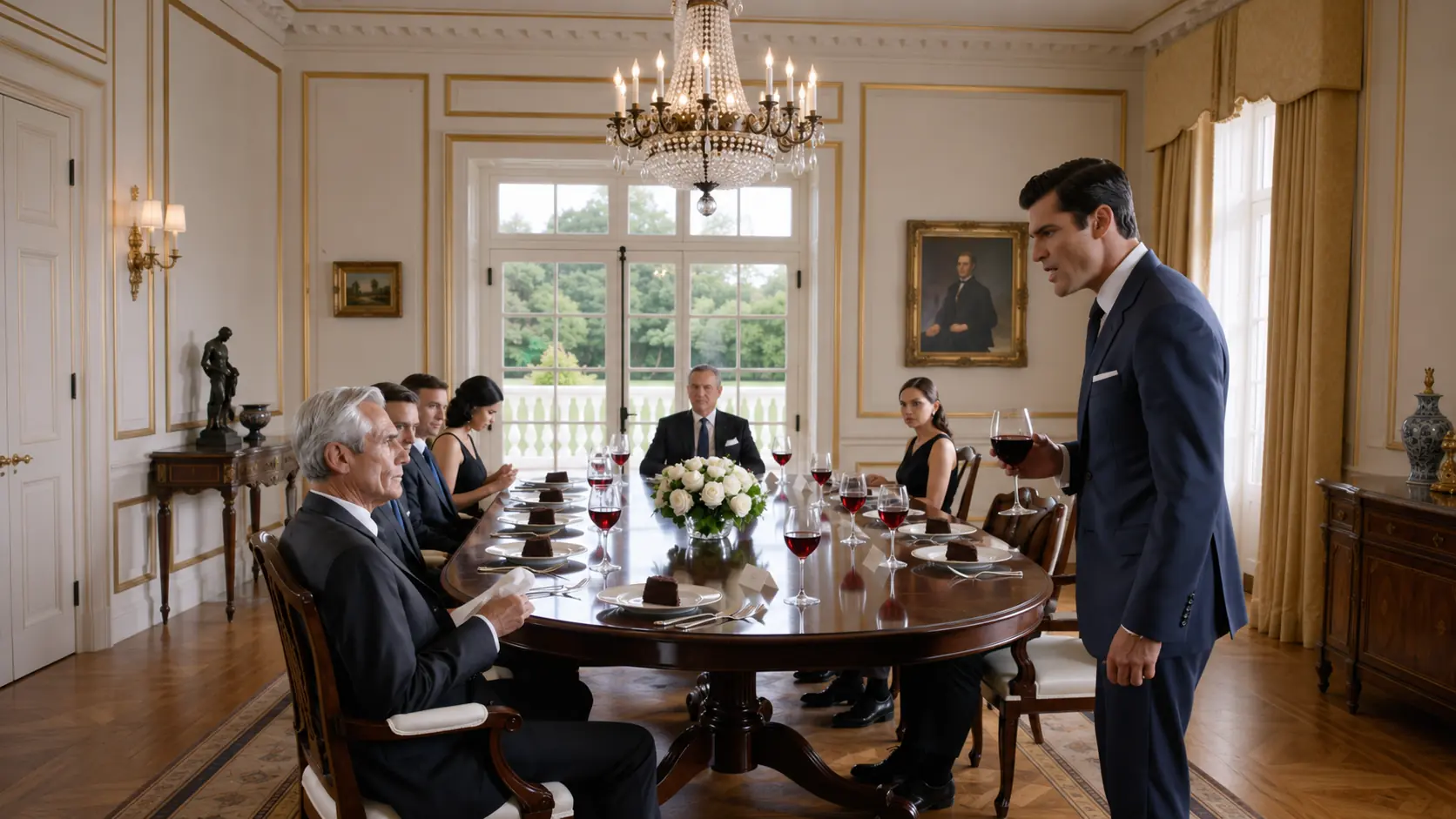
Everything about the dinner was polished, expensive, and tastelessly proud. Crystal chandeliers hung over a long mahogany table, silverware gleamed beside porcelain plates, and every wine glass seemed chosen to remind people of wealth. My old Hart Schaffner Marx suit, which I had owned for twenty years, was perfectly tailored and immaculate, but it looked out of place among the designer jackets, silk dresses, and expensive watches around me. It was a suit of quality, not flash, and in my son Andre’s world, there was no room for anything that did not flash.
I could feel Andre watching me, and I could feel his wife Brittany doing the same. They were not looking at me like family; they were assessing me like an outdated object in a room full of new luxury. Every time I took a sip of water, Brittany’s brow tightened slightly, as if the way I held my glass proved something about my failure. Andre, meanwhile, was performing for Richard.
He leaned back in his chair, one arm draped over the velvet upholstery, the other swirling a glass of red wine. It was a gesture he had copied from Richard, just like he had copied Richard’s tone, Richard’s arrogance, and Richard’s belief that money was the only language worth speaking. “The company is exploding,” Andre announced loudly enough for everyone at the table to hear. “We just closed our second round of funding. Investors are lining up.”
Brittany laughed and said he deserved to upgrade from the BMW 5 Series to the 7 Series. She told him he had worked so hard, and Andre smiled like a king receiving tribute. I remained silent because I knew all about that second round of funding. I knew exactly where every dollar had come from, and it certainly was not from the long line of investors Andre imagined were fighting to support his genius.
Brenda sat across from me with a tight smile on her face. Five years with Richard had changed her. The practical woman I once knew had become someone who worried about whether her handbag was last season and whether her place cards looked expensive enough. She looked at Richard as if he had personally invented success.
“Our son is brilliant, isn’t he, Reggie?” she asked.
It was not really a question. It was a comparison.
Our son is brilliant, unlike you.
I nodded slightly and brought a piece of steak to my mouth, though I tasted nothing. My senses were fixed on the play unfolding before me. Richard waited until Andre finished boasting, then leaned forward with the deep, patronizing voice of a man who enjoyed insulting people politely. “Ambition is everything, Andre. Your father is a good man, a fine engineer, but he lacks that spark.”
He said I built things for other people but had never built an empire for myself. In this world, he said, if you were not building, you were being buried. It was an insult wrapped in a compliment, the kind of thing men like Richard perfected. Andre nodded like a devoted student hearing wisdom from a master.
“Exactly,” Andre said. “I’ve tried to explain that to Dad so many times. He talks about savings and safe investments. It’s so dated.”
Dated. Last time, it had been cautious. Before that, traditional. The words changed, but the contempt never did.
Finally, dessert was served, a seven-layer chocolate cake that probably cost more than my monthly utility bill. Richard signaled to the server and said the check should go on his account, though we were in his own home and the staff already knew every expense was his. He said it casually, but his eyes flickered toward me. It was another performance of power.
That was when Andre stood.
Maybe it was the wine. Maybe it was arrogance. Maybe it was simply the moment he had been waiting for.
His chair scraped against the floor, and the room grew still.
“See?” Andre said, gesturing from Richard to me. “That’s the difference. Dad, you’re a loser. You spent your whole life in that dusty little house, working on construction sites, saving pennies, acting like that made you wise.”
Then he turned toward Richard with admiration in his voice.
“Richard is not like that. He’s a winner.”
The air went thick.
Brittany nodded smugly, as if her husband had just said something brave. Brenda stared down at her plate, and her silence became the final betrayal. Richard leaned back with a satisfied smile, enjoying the cruelty without needing to speak. Several relatives glanced away, pretending not to witness the humiliation happening in front of them.
I looked directly into Andre’s eyes. For one second, I thought I saw the little boy I had taught to ride a bicycle. I thought I saw a flicker of regret, buried beneath the designer suit, the watch, the wine, and the entitlement. Then it disappeared.
I said nothing.
The rage I expected never came. In its place was a cold, sharp clarity. The final thread had snapped. It was over.
Slowly, I placed my white linen napkin on the table beside my untouched cake. I stood up without scraping my chair. My movements were deliberate and measured. I glanced at Brenda, then at Richard, then finally at Andre.
Then I turned and walked out of the dining room.
The heavy door closed behind me, cutting off the sound of their hollow victory. I did not have to say anything. My actions were about to speak for me. Outside, the air was cold, and it cleared my head.
I did not call a car. I walked.
The wealthy Atlanta neighborhood slowly gave way to quieter streets, then to the familiar road leading to my own house. My home stood under an old oak tree, a solid two-story brick house I had designed and helped build myself thirty years earlier. It was not flashy. It was durable, like me.
Inside, everything was in order. The smell of old mahogany and paper from the books on my shelves filled the air. This house was my sanctuary, a world away from the phoniness I had just left behind. I did not turn on the television, and I did not pour myself a drink.
Anger clouds judgment, and that night I needed to be colder than ice.
I went into my study. It was a small room, but everything in it had a purpose. On the walls were blueprints of bridges and buildings I had helped create, real things, things that last. On the corner of the desk was a silver-framed photograph of Andre at five years old, wearing an oversized plastic construction helmet and grinning on my shoulders at a job site.
His eyes in that photograph were full of pride and love.
Where did I lose that boy?
The question did not strike like a sharp pain. It settled like a dull ache that had been building for years. I had been too quiet. I had hoped unconditional love would be enough, but I was wrong. Unconditional love does not mean unconditional sacrifice.
That night, the sacrificing ended.
I sat in my worn leather chair and turned on my old but reliable Dell desktop. The screen glowed, illuminating my face. I did not check personal emails or browse the web. My fingers moved with practiced ease as I opened an encryption program I had installed years earlier.
I typed in a long password no one else on Earth knew.
A simple interface appeared with a list of folders. Their names would have meant nothing to anyone else, but to me, each one was a thread. Covington Holdings LLC. Oakwood Properties LLC. AC Tech Solutions. Seed Funding Agreement. BMW 7 Series Lease Contract. Richard Lawson Consulting Payment Schedule.
Each name was an invisible thread I had used to weave the world my son lived in, the world he thought he had created himself. It was like being the engineer of a bridge. No one sees the rebar hidden inside the concrete, but without it, the entire structure collapses. Tonight, I was going to begin a structural integrity test.
I opened a secure email client. The recipient was already saved: Alicia Warren, a brilliant attorney and a friend I trusted with my life. Alicia was not just my lawyer; she was the architect of the financial fortress I had quietly built. She knew every brick and every number.
The email I wrote was short.
Subject: Initiate Sunset Protocol.
Alicia, we need to meet tomorrow morning. Your office, 8:00 a.m. Begin the dissolution process for all assets related to AC and associated parties. Priority one: the vehicle.
Reggie.
Sunset Protocol was the name we had given it years earlier. It was a contingency plan for a day like this, a day when the sun would set on an empire built on a lie. I hit send, and a soft whoosh echoed in the silent room. It was done.
I felt no satisfaction and no joy. I only felt a strange quiet calm, the calm of an engineer who knows his design is about to undergo the final test. I had built Andre’s life. Now it was time to see if he could stand once the scaffolding was removed.
The next morning, Alicia Warren’s office on the forty-fifth floor overlooked Centennial Park. It smelled of success, expensive leather, and freshly brewed coffee. She greeted me not with a handshake, but with a heavy ceramic mug and a weary smile. “Black, no sugar,” she said. “The way you drink it when you mean business.”
For twenty years, Alicia had been my strategist, my confidant, and the keeper of my secrets. She asked me what the final straw had been, though she already knew enough to guess. I stared into my coffee and told her Andre had said the word. He had called me a loser in public and called Richard a winner.
“And Brenda?” Alicia asked.
“She sat there and let him,” I said.
Alicia’s expression hardened, and then the lawyer in her took over. She asked me to walk her through the assets, starting with AC Tech Solutions. I told her Andre had always had ambition, big ideas, big dreams, and a desire to become the next great tech mogul from Atlanta. What he lacked was discipline, patience, and money.
Six years earlier, he had brought me a half-built software proposal full of buzzwords and projections that had no basis in reality. I knew that if I gave him the money directly, he would burn through it in a year and learn nothing. He did not want a father’s guidance. He wanted a bank.
So I gave him one, just not in the way he expected.
I told him I could not help because my money was tied up in safe, boring retirement funds. He called me old-fashioned and went looking for investors. Alicia and I created a silent trust funded with two million dollars, based in Delaware for anonymity. Then we created a shell venture capital firm called Innovate Future Group and hired a retired professor to be the face of it.
Andre flew to San Francisco, pitched his idea, and walked out with a check. He thought he had been discovered by brilliant West Coast investors. He thought destiny had chosen him. He never once wondered who truly owned Innovate Future Group.
The ownership structure was simple. Sixty percent of AC Tech Solutions belonged to Innovate Future Group, which was wholly owned by my anonymous trust. Andre held twenty percent as CEO, and the remaining twenty percent was reserved for future employees. He was not the owner of the company.
He was its highest-paid employee.
Then we reviewed the symbols of his success. The BMW 7 Series came first. Andre had said he needed it to project success to clients and investors. His personal credit was too thin, so he believed the company had leased it for him. In truth, the lease was held by Covington Holdings LLC, a separate entity Alicia and I had created for asset management.
The contract stated that the vehicle was provided for the use of a designated employee of AC Tech Solutions. The moment Andre no longer qualified as that employee, the car was no longer his to use. The irony was corrosive. My holding company, a name he would not even recognize, had provided the chariot for my entitled son.
Then came the penthouse.
That one hurt more.
After Brenda left me for Richard, she became obsessed with appearances. She filled Andre’s head with the idea that where you lived defined who you were. Andre and Brittany searched for months until they found the penthouse at the Oakwood, a renovated prewar building with classic architecture and modern luxury.
Andre loved it. He complained it was just out of his price range and asked if I could help with the security deposit. I told him no, and I warned him it was reckless to live beyond his means. What I did not tell him was that I had purchased the entire building three years earlier through Oakwood Properties LLC.
When Andre applied for the penthouse, the property management firm contacted him with a special offer. They said they were looking for a high-profile tenant like a tech CEO to add prestige to the building. They offered him an employee incentive lease, nearly rent-free. Andre bragged for weeks that the landlord had been so impressed with him that he received the deal of a lifetime.
He never read the fine print.
No one ever does.
The lease was contingent on his continued employment with AC Tech Solutions. It also allowed the property management firm to terminate with seventy-two hours’ notice for any breach that might bring the building’s name into disrepute. His home, his car, and his company all rested on foundations he did not own.
Everything he thought was his was actually mine.
Alicia asked what my first move would be.
“The car,” I said. “We start with the car.”
She asked if I wanted everything done at once: car, accounts, eviction notice, all by noon Monday. I shook my head. That would be destruction. That would be revenge, and this was not about revenge.
When an engineer brings down a building, he does not simply set off dynamite at the base. That is messy and unpredictable. It sends debris everywhere and hurts innocent people. A true builder performs a controlled demolition.
“You remove the shiny fixtures first,” I told Alicia. “Then the windows. Then the floors. Piece by piece, until only the bare foundation remains.”
I did not want to destroy my son. I wanted to dismantle the false life he was living. I wanted him to stand on the cold, hard foundation of reality and understand what it takes to build something real. Alicia understood. Legally, it was cleaner as well, each action separate and justified as a corporate or property decision.
We would take the car on Monday.
On Tuesday, the corporate accounts would freeze, cutting off his power and Richard Lawson’s consulting payments with it.
On Wednesday, the eviction notice would be delivered.
The rest of that week was perhaps the quietest of my life. I spent Friday and Saturday pruning roses in my garden. Gardening is an exercise in ruthless compassion. You cannot be sentimental about weak or diseased branches because if you let them grow, they poison the whole plant. You cut them back so the plant can grow stronger.
My son had become overgrown with weeds of entitlement and arrogance. I was the gardener doing the hard, necessary work. On Saturday afternoon, Andre called. A week earlier, my heart would have jumped, and I would have answered immediately. That day, I watched his name flash on the screen and placed the phone face down.
An hour later, Brenda called. I did not answer her either. Her silence at the dinner table had been her answer. My silence was now mine.
On Sunday night, at exactly 10:01 p.m., Alicia sent an email.
The message contained only six words.
The first domino has been pushed.
Monday morning began with Andre feeling powerful. He dressed in an expensive Italian suit, kissed Brittany, and took the private elevator down to the garage, expecting to find his gleaming BMW waiting in its reserved space. To him, that car was not transportation. It was proof.
Instead, a tow truck was parked behind it.
Andre barked at the driver, demanding to know what he was doing in a private garage. The driver calmly asked if he was Andre Covington. When Andre confirmed it, the man said he was there to repossess the BMW. Andre laughed because the idea was so absurd his mind refused to process it.
He said the car was paid for through a corporate lease. He said the driver had the wrong vehicle. The driver showed him the paperwork, listing the black BMW 7 Series and the license plate. The order came not from AC Tech Solutions, but from Covington Holdings LLC.
Andre had never heard of it.
He called the leasing company, furious and humiliated. The representative explained that AC Tech Solutions was only the authorized user. Covington Holdings LLC was the legal owner and lessor of the vehicle. As the owner, it had the right to terminate the lease under the agreement.
The front wheels of the BMW rose off the ground as Andre shouted into the phone. The car, the symbol of his success, hung helplessly in the air. Then the tow truck pulled away, taking with it the first pillar of his identity. Andre was left standing in the garage with an empty parking space and the smell of diesel fumes.
On Tuesday, the second pillar fell.
Andre arrived at his office nearly an hour late after being forced to take an expensive Uber across town. He tried to recover his image by stopping at the lobby coffee shop to buy drinks and pastries for his executive team. He handed over his corporate card with the confidence of a man used to being obeyed. The card declined.
He told the barista to run it again.
It declined again.
People in line began staring, and Andre’s face flushed red. He mumbled something about a bank network issue, paid with the cash in his wallet, and stormed away without the drinks. The gesture of generosity had become a badge of shame.
Upstairs, he tried to access the company’s financial portal. His credentials were denied. He tried again. Access denied. Then an email appeared from the directorate of AC Tech Solutions, announcing that the majority shareholders had initiated a comprehensive restructuring and suspended executive-level access to financial accounts, credit lines, and spending authorizations.
Andre stared at the phrase “majority shareholders.”
He had always thought the investors were silent partners. Now they had stripped him of power without even calling him. Then Richard Lawson called, panicked because his monthly consulting fee had not deposited. His mortgage, Brenda’s car payment, and his lifestyle all depended on that money.
The man Andre called a winner sounded terrified.
For the first time, Andre began to understand that his mentor might not be the powerful man he imagined.
On Wednesday, the final foundation was removed.
Andre came home exhausted, humiliated, and shaken. The penthouse, once his fortress in the sky, was the only comfort he had left. Instead, he found Brittany pacing in panic because her card had been declined at the salon and their friends were whispering about his company. She demanded to know whether he was losing everything.
Before he could answer, a sharp knock came at the door.
A man in a gray suit introduced himself as the new senior property manager for the Oakwood. He carried a manila envelope and stepped inside with the calm authority of someone who did not need permission. He served Andre a formal notice of lease termination. The employee incentive lease, he explained, was contingent on Andre’s qualifying employment with AC Tech Solutions.
Since his employment status had been fundamentally altered, the lease was in breach.
Andre had seventy-two hours to vacate.
Brittany broke down. She screamed that all her clothes, shoes, and life were in that apartment. She blamed Andre, his arrogance, and his fight with his father. The property manager left them in the ruins of their beautiful life.
Then Andre saw the small print at the bottom of the notice.
Oakwood Properties LLC.
Another name he did not recognize.
A car repossessed by Covington Holdings. A company controlled by anonymous shareholders. A home taken by Oakwood Properties. It was not bad luck. It was coordinated. It was personal.
And suddenly, Andre knew.
He called me.
When I answered, his voice was venom. “You did this. All of it. The car, the company, the apartment. This was you, wasn’t it?”
I let the silence stretch, then said, “Andre, I think it is time we had a talk.”
He arrived less than thirty minutes later in a cheap Uber, a far cry from the silent glide of his BMW. I waited in my study, the same room where I had launched the protocol. He stormed in with his tie loosened, suit wrinkled, face pale, and eyes wild with panic. For the first time, he looked at my study not as a dusty old room, but as a command center.
I did not stand. I did not shout. I simply told him to sit.
“The yelling is over,” I said. “You have had your say. Now it is time for you to listen.”
I turned my monitor toward him. A folder sat in the center of the screen, labeled The Foundation. I opened the documents one by one.
First came AC Tech Solutions. I showed him the incorporation papers for Innovate Future Group, then the trust documents. I explained that the venture capital firm he believed had discovered him was a shell company created by Alicia Warren for the sole purpose of funding his business.
The anonymous trust that owned it was mine.
I showed him the shareholder agreement proving that Innovate Future Group held sixty percent of AC Tech Solutions. Andre held twenty percent. The rest was reserved for employees. He did not own the company; he was its chief employee.
Then I showed him the BMW lease. The car was held by Covington Holdings LLC, another one of my companies. He had been listed as an authorized user. He had not earned the car. He had been permitted to drive it.
Then came the penthouse. I showed him the deed for the Oakwood building and the incorporation papers for Oakwood Properties LLC. My name was on both. I told him the employee incentive lease was a fiction, a story created by the property management firm to make him feel special.
“You were not a high-profile tenant,” I said. “You were my son living rent-free in my house.”
The blood drained from his face.
But there was one more piece.
I opened the folder labeled Consulting and showed him the contract between AC Tech Solutions and Richard Lawson Consulting. Richard received fifty thousand dollars a month. His only client was Andre’s company. Since Andre’s company was funded by my money, Richard’s lifestyle was also funded by me.
“The winner your mother chose,” I said, “is on the payroll of the loser she left behind.”
That was the final blow.
Andre made a small choking sound. Everything he believed about himself, his success, his heroes, and his enemies collapsed in that room. I closed the laptop. The presentation was over.
“I did not take anything from you,” I told him. “I simply took back what was mine. A loser has to manage his assets carefully, you see.”
For the first time in his adult life, he had the chance to become a real winner on his own. I told him the trust still existed and his name was still in it, but he would not receive another dime until he proved he could build something himself. He needed a real job, real rent, real responsibility, and real humility.
Maybe someday, years from now, he would become the man I had always hoped he would be. Not a winner by Richard’s definition, but a man of substance. A builder. A man who understood that worth is not in what you own, but in who you are when everything is stripped away.
Then I walked out and left him alone with the truth.
The days that followed were the quietest I had known in thirty years. There were no frantic phone calls, no passive-aggressive messages, and no manufactured emergencies requiring my silent financial rescue. The house felt lighter, as if a great weight had been lifted from its foundation. There was only peace.
A week later, I sat on my back porch as evening settled over Atlanta. The air smelled of jasmine, and the crickets had begun their nightly chorus. I held a glass of iced tea, watching condensation drip onto the wooden armrest of my rocking chair. I was alone, but I was not lonely.
Then Brenda called.
I almost did not answer, but curiosity made me press the button.
For a moment, all I heard was frantic breathing. Then she began begging me to help. Richard was ruined, she said. The consulting contract had been everything. The bank was foreclosing on the lake house. Her Mercedes was being taken back. Her country club membership had been suspended.
She blamed me for everything.
There was no apology for what had happened at dinner. There was no concern for Andre. There was only a desperate demand that I put her world back together, the way I always had. She told me I owed her because she was the mother of my son.
I let her run out of steam.
Then I said, “Brenda, that is no longer my problem.”
I ended the call and placed the phone face down on the table. The conversation that had been going on for thirty years was finally over. The slow rhythm of my rocking chair returned. The stars began to appear in the deep purple Georgia sky.
I had reclaimed my dignity.
I had reclaimed my peace.
I had reclaimed my life.
And in that profound silence, I finally felt like a winner.
This chapter taught me a lesson that took seventy-two years to fully understand. For too long, I confused financial support with fatherly love. I thought that by providing a safety net, I was helping my son, but I was only allowing a boy to live in a man’s world without responsibility. True strength is not endless giving; true strength is knowing when to set a boundary.
Sometimes the most profound act of love is to take everything away, forcing someone to stand on the cold, hard foundation of reality.
Only then can they finally learn how to build a life of their own.