My sister arrived from Paris in a whirlwind of expensive perfume and the kind of chaotic, vibrant energy that only follows people who have decided to live life entirely on their own terms.
She brought with her three oversized suitcases, a bottle of wine that cost more than my monthly utility bill, and a collection of gifts that would ultimately dismantle my family.
“For you, Genevieve,” she said, her voice raspy from the transatlantic flight, but still carrying that melodic lilt she’d adopted after 20 years in Europe. She placed a heavy, midnight blue box on my kitchen table. It was tied with a silver ribbon that shimmered under the fluorescent lights of my modest kitchen.
Inside was a handbag. Not just a handbag, a Birkin. The leather was the color of caramel, soft as butter, smelling of old money and craftsmanship. Beside it, she placed a bottle of perfume, a rare vintage scent from a house that no longer existed, and a Swiss watch with a face made of mother of pearl, surrounded by a halo of diamonds.
I stared at them, my hands trembling. I am 68 years old. I am a widow. I live in a drafty Victorian house in the historic district of Savannah, Georgia, where the humidity makes the wallpaper peel and the Spanish moss hangs like gray ghosts from the ancient oaks. My life has been measured in small teaspoons, small savings, small trips to the grocery store, small silences.
“Vivian,” I whispered, touching the cool, textured leather of the bag. “I can’t. Where would I even wear this? I go to the library and the grocery store.”
“You wear it to the grocery store,” Vivian said firmly, popping the cork on the wine with a satisfying thwack. “You wear it to the library. You wear it because you are Genevieve Callaway, and you deserve to hold something beautiful in your hands that isn’t a dishrag or a past-due bill.”
I didn’t know it then, standing in the warm glow of my kitchen with my sister, but those gifts were not just leather and glass. They were a catalyst. They were the match that would burn down the fragile, rotting structure of my relationship with my son.
My son, Lucas, arrived two days later. He didn’t come alone. He brought his wife, Marissa. They drove a leased BMW that was always dusty, and they walked into my house with the air of landlords inspecting a property they were tired of managing.
Lucas is 42. He has my eyes, soft and brown, but his father’s stubborn, square jaw. Somewhere along the way, between law school and his marriage to Marissa, he lost the softness he had as a boy. He became a man of calculations. Every interaction was a transaction. Every hug felt like a down payment on a future inheritance he felt he was owed.
“Aunt Vivian!” Lucas boomed, hugging my sister with a performative enthusiasm that didn’t quite reach his eyes. “We didn’t know you were in town.”
Mom didn’t say a word.
“I wanted it to be a surprise,” I said, wiping my hands on my apron. I had spent the morning cooking shrimp and grits, collard greens, cornbread, the heavy, comforting food Lucas used to love before he started counting calories and social standings.
Marissa drifted into the kitchen. She was a woman of sharp angles and expensive beige clothing. She kissed the air next to my cheek, careful not to smudge her makeup. “The house smells rustic, Genevieve,” she said, her eyes scanning the counters for dust. “Very authentic.”
We sat down to dinner. The conversation was the usual minefield I had learned to navigate over the years. Lucas talked about his firm, about the stress of his billable hours, about the private school tuition for the children they didn’t have yet but were planning for strategically. Marissa complained about the humidity, the traffic, the incompetence of her assistant, and the lack of good service in this town.
I listened. I nodded. I poured the tea. I played the role I had written for myself over the last decade, the quiet, supportive mother, the background character in their vibrant, important lives. I made myself small so there would be more room for them.
But Vivian, she wasn’t playing. She watched them with eyes that had seen the world, eyes that didn’t miss a beat. She swirled her wine and offered only cryptic smiles to their complaints.
After dinner, we moved to the living room. The gifts were still on the side table where I had left them, a shrine to a life I hadn’t lived. The caramel Birkin, the crystal perfume bottle, the diamond watch. They caught the lamplight, glittering like buried treasure.
Marissa stopped mid-sentence, her eyes locked onto the bag. It was a visceral reaction, like a predator spotting a wounded bird in high grass. She walked over to the table, her fingers twitching at her sides.
“Is this,” she started, her voice breathless, stripping away the veneer of boredom she usually wore, “is this real?”
“It is,” Vivian said from the armchair, her voice cool. “I picked it up in Paris last week.”
Marissa reached out and touched the handle, stroking it with a reverence she never showed people. “My god, do you know what the waitlist is for one of these? It’s impossible. You can’t just buy them.”
“I can,” Vivian said simply.
Lucas walked over, standing behind his wife, peering over her shoulder. He looked at the watch. “Patek Philippe?” he asked, a low whistle escaping his lips. “That’s a $20,000 watch, Aunt Viv, easily.”
“It looks better on a wrist than in a shop window,” Vivian said. “They’re for your mother.”
The silence that followed was heavy, thick with unsaid things and sudden, sharp calculations. Lucas looked at me. He looked at the watch. Then he looked at Marissa, a silent communication passing between them that made my stomach turn.
“For Mom?” he said. There was a laugh in his voice, a sharp, incredulous sound that cut me deeper than any insult. “What is Mom going to do with a Birkin? Carry her knitting?”
“I might,” I said, my voice small, trying to make a joke of it, “or my library books.”
“It’s a waste,” Marissa said. She wasn’t looking at me. She was looking at her reflection in the mirror above the mantel, holding the bag against her hip, posing. “No offense, Genevieve, but this bag, it requires a certain lifestyle. It needs to be seen. It needs to be at galas, at openings. Sitting in this dusty house, the leather will rot from the humidity.”
“It’s Italian leather,” Vivian said, her voice sharpening. “It will survive Savannah.”
“It’s not about the humidity,” Lucas said, turning to me, putting on his lawyer voice, reasonable, logical, condescending. “Mom, be realistic. You go to the grocery store and church. That’s it. Walking around with $50,000 of merchandise on you, it’s dangerous. You’ll get mugged. You’ll become a target.”
“I can take care of myself,” I said, straightening my spine against the cushions of the sofa.
“Can you?” Lucas asked. The question wasn’t a query. It was an accusation. “You forgot to pay the water bill last month, Mom. You called me because you couldn’t figure out the new thermostat. You’re getting older. You’re vulnerable.”
He walked over to the table and picked up the watch. “And this perfume? Mom, you’ve worn lavender water since 1980. This is musky. It’s complex. It’s not you.”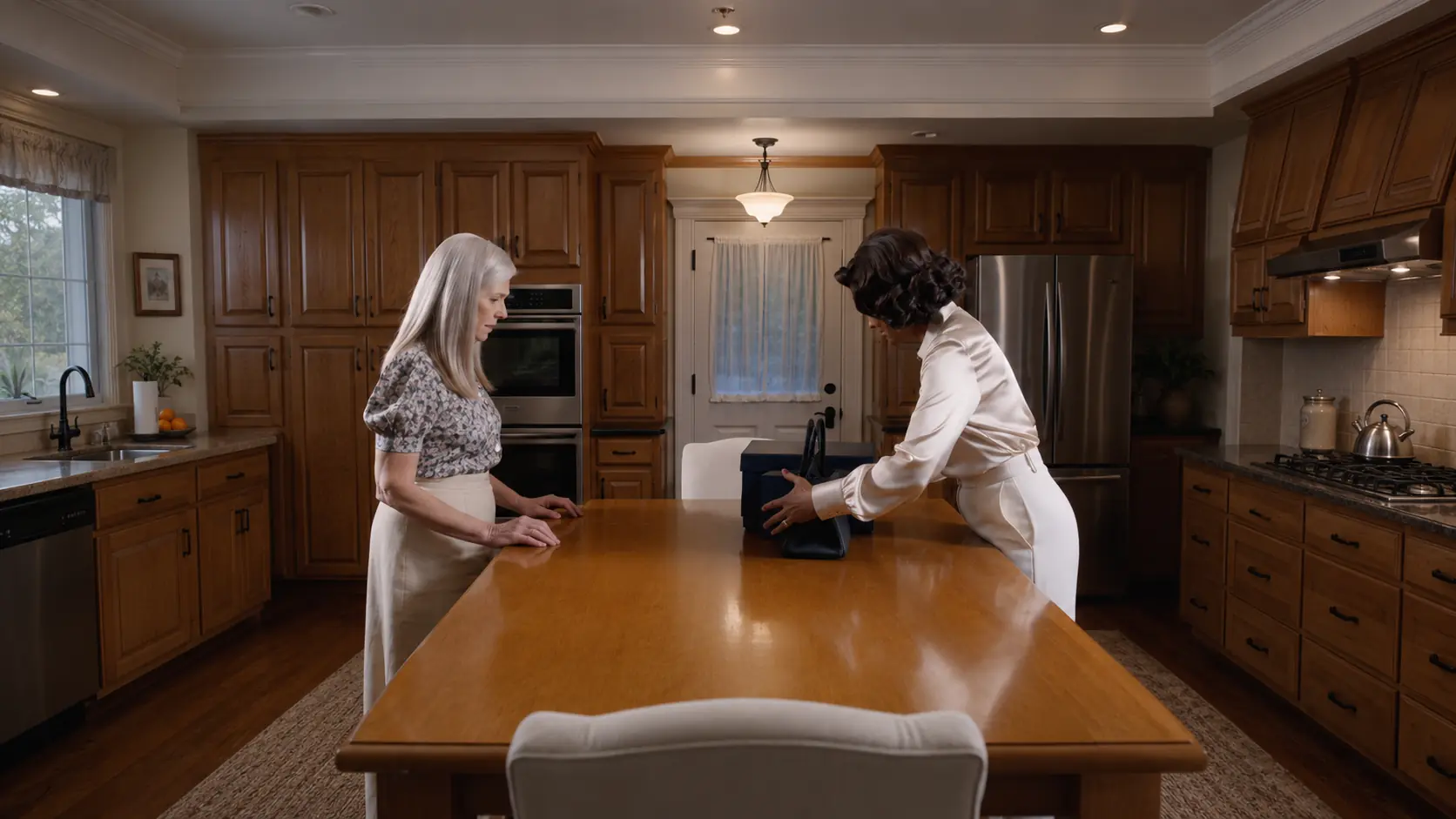
He began to gather the items. He picked up the perfume bottle and placed it inside the open Birkin. He picked up the watch case and slotted it next to the perfume.
“What are you doing?” I asked, standing up. My legs felt weak, my heart hammering a frantic rhythm.
“We’re going to keep these safe for you,” Lucas said, his tone reasonable, the tone one uses with a toddler who has grabbed a sharp knife. “We have a climate-controlled safe at the house. We’ll put them in there. Marissa can take them out for special occasions, keep the leather conditioned. And the watch? I’ll wear it to meetings. It’s a legacy piece, Mom. It should be building value, not gathering dust. Marissa would use them,” he added, glancing at his wife, who was practically vibrating with desire for the bag. “She has the charity ball next month. It would be perfect.”
“They are mine,” I said. My voice was trembling, but I forced the words out. “Vivian gave them to me.”
“And I’m sure Aunt Viv wants them to be appreciated,” Lucas said, smiling at my sister, a smile that didn’t reach his eyes. “Right, Viv? You don’t want them sitting in a closet.”
Vivian stood up. She set her wine glass down on the coaster with a deliberate clink. She walked over to Lucas and stood toe-to-toe with him. She was 5'3", but in that moment, she looked 10 feet tall.
“I gave them to your mother,” Vivian said, her voice low and dangerous. “Not to your wife. Not to you. Put them down.”
Lucas laughed, an awkward, nervous sound. “Come on, Viv. Don’t be dramatic. We’re just being practical. Mom doesn’t need this stuff. It’s almost garish on her. It looks like she’s trying too hard.”
He looked at me then, his eyes pleading for me to capitulate, to do what I always did. “Mom, tell her. Tell her you want us to keep them safe. Tell her you’d rather Marissa get some use out of them.”
He waited. He expected me to fold. He expected me to do what I had done for 40 years, smooth the waters, avoid the conflict, sacrifice my own desires to keep the peace.
I looked at Marissa, who was stroking the bag as if it were a pet. I looked at Lucas, who was holding my dignity hostage in the name of practicality. And something inside me snapped. It wasn’t a loud break. It was the quiet, decisive click of a lock engaging.
“Put the bag down, Lucas,” I said.
The room went silent. Lucas blinked, his brow furrowing. “What?”
“I said, put the bag down. Put the watch back on the table, and take your hands off my perfume.”
“Mom, you’re being irrational,” he said, his voice hardening, a flush creeping up his neck. “I’m trying to help you. You’re acting like a child.”
“I am acting like the owner of this house,” I said, my voice rising, finding a strength I hadn’t used in years, a strength drawn from the very foundations of the home I had maintained alone. “I am acting like a woman who is tired of being treated like an accessory to your life. Those gifts are mine. Whether I wear them to the grocery store or I burn them in the fireplace, they are mine.”
“You’re being selfish,” Marissa spat, her mask slipping, her face twisting into something ugly. “It’s a bag, Genevieve. It’s wasted on you. You look ridiculous with it.”
“Get out,” I said.
Lucas stared at me, his mouth open. “Excuse me?”
“Get out of my house, both of you, right now.”
“Fine!” Lucas shouted. He threw the bag onto the sofa. It landed with a soft, heavy thud. “Fine. Keep your junk. See if we care. But don’t call me when you trip and break a hip and there’s no one to help you. Don’t call me when the roof leaks and you can’t afford to fix it.”
“I won’t,” I said.
He grabbed Marissa’s arm and they stormed out. The front door slammed so hard the windows rattled in their frames. The sound echoed through the old house, a final punctuation mark on a sentence that had been running for too long.
I stood there, shaking. The adrenaline that had held me upright began to drain away, leaving me cold and hollow. I sank onto the sofa next to the bag.
Vivian sat beside me. She didn’t say, “I told you so.” She didn’t offer platitudes. She just wrapped her arm around my shoulders and pulled me close. We sat there in the silence for a long time.
“I’m sorry,” I whispered. “I’m sorry you had to see that.”
“Don’t be,” Vivian said. “I needed to see it, and you needed to do it.”
I looked at the bag. It was beautiful, but it was just a bag. The real weight was the realization of what my son had become. He didn’t see me. He saw a resource. He saw a dwindling asset that needed to be managed. He saw a woman who had outlived her usefulness.
“He thinks I’m helpless,” I said.
“He thinks you’re a bank,” Vivian corrected. “And he’s angry that the vault just closed.”
I didn’t sleep that night. I lay in bed, listening to the wind rattle the eaves, thinking about Lucas. I thought about the boy who used to bring me dandelions, his small hands stained with grass. I thought about the teenager who practiced driving in the church parking lot, terrified of scratching the car. And I thought about the man who stood in my living room and told me I wasn’t worth a leather bag.
I realized then that I had been holding onto a ghost. I had been protecting a relationship that didn’t exist. I was preserving a memory of a son while the reality of him picked my pockets.
The next morning, I woke up with a headache, but also with a clarity I hadn’t felt in years. I went downstairs. Vivian was already up, making coffee.
“We’re going out,” she said.
“Where?”
“To the lawyer.”
We drove to the office of Mr. Abernathy, the man who had handled my late husband Arthur’s will. He was an old man now, with hands that shook, but a mind that was still sharp as a tack.
“Genevieve,” he said, greeting me warmly. “It’s been too long.”
“It has, Charles,” I said. “I need to make some changes to my estate.”
I sat in the leather chair and I rewrote my will. I removed Lucas as the executor. I removed him as the primary beneficiary.
“And the house?” Charles asked. “The historic property in the district?”
“It’s worth quite a bit now. The market in Savannah is booming. Sell it,” I said. “Upon my death, sell it. All of it. The proceeds go to the Savannah College of Art and Design for a scholarship in my name, for women who start over late in life, for women who need a second chance.”
“And Lucas?”
“Leave him the family Bible,” I said. “He needs it more than I do.”
When we left the lawyer’s office, I felt lighter. The house wasn’t a burden anymore. It was just a house. And my money wasn’t an inheritance waiting to be claimed. It was my life waiting to be lived.
“Now,” Vivian said as we got back into the car. “We have one more stop.”
“Where?”
“The airport.”
“You’re leaving?” I asked, panic rising in my chest.
“No,” she smiled. “We are leaving. I booked us two tickets to Paris, first class. We leave tonight.”
“I can’t,” I said automatically. “The house, the garden, who will water the ferns?”
“The house will stand,” Vivian said. “The garden will grow. You have spent 40 years tending to roots, Genevieve. It is time to look at the sky.”
I thought of the empty house. I thought of the silence. I thought of Lucas waiting for me to call, waiting for me to apologize, waiting for me to shrink back down into the shape he found convenient.
“Okay,” I said. “Let’s go.”
We went back to the house. I packed a bag. I packed the Birkin. I packed the watch. I packed the perfume. I wrote a note and taped it to the refrigerator, just in case Lucas came by with his key, which I knew he would.
“Lucas, I have gone to Paris with Vivian. I do not know when I will be back. I have changed the locks, so do not bother trying your key. The gardener has been paid to watch the property. You were right about one thing. I am too old to waste time. I intend to spend the rest of it being exactly who I want to be. Do not look for me. I will call you when I am ready. Mom.”
We locked the door. I dropped my key into my purse. The flight was long, but the champagne was cold. I slept for 8 hours and woke up as the plane was descending over France. The lights of Paris twinkled below us, a sprawling grid of gold against the darkness.
Vivian took my hand. “Ready?”
“Ready,” I said.
We spent a month in Paris. I wore the watch every day. I carried the bag to the bakery, to the museums, to the park where we sat and watched the children sail toy boats. I wore the perfume, and for the first time, I didn’t feel like it was too much. I felt like it was just enough. I felt seen, not as a mother, not as a widow, but as Genevieve.
But the story doesn’t end there, because the thing about taking back your power is that it changes the atmosphere around you. It sends out a signal.
Three weeks into our trip, I received an email from Lucas. “Mom, I went by the house. The locks are changed. Where are you? I saw the note. I don’t understand. Are you okay? Marissa is furious. She says you’re being spiteful. She needed some papers from the safe. Please call me. I’m worried.”
I read it while sitting at a cafe in Montmartre, eating a croissant that shattered into buttery flakes when I bit into it. I took a sip of my coffee. I didn’t reply.
A week later, another email. “Mom, I’m sorry about what I said, about the bag. It was stupid. Things aren’t going well here. The firm is downsizing. Marissa and I are having problems. I just want to know you’re safe. Please.”
I let that one sit for 2 days. Then I replied. “Lucas, I am safe. I am happy. I am eating better than I have in years. I am sorry to hear about your troubles. I hope you find a way to navigate them. I will be traveling for a while longer. Do not worry about the house. It is being taken care of. Genevieve.”
I signed it Genevieve, not Mom.
We traveled from Paris to Florence, from Florence to the Amalfi Coast. I spent money. I bought a silk scarf that cost 300 euros. I bought a painting from a street artist. I drank wine at lunch. I lived.
Six months later, I returned to Savannah. I didn’t tell Lucas I was coming. I took a cab from the airport to my house. The garden was overgrown, wild and beautiful. The house smelled musty, but it smelled like mine.
I hadn’t been home an hour before Lucas’s car pulled into the driveway. He must have had alerts set up on his phone for activity at the house, or maybe the neighbors called him.
I watched him walk up the path. He looked thinner, tired. He didn’t have the swagger he’d had 6 months ago. He knocked. He didn’t try to use a key he knew wouldn’t work.
I opened the door. I was wearing a linen dress I’d bought in Italy. I had cut my hair short. I was wearing the watch.
“Mom,” he said. He looked at me as if he were seeing a ghost. “You look different.”
“I am different,” I said.
“Can I come in?”
I hesitated. The old instinct was there. The urge to open the door wide, to fix him a plate, to soothe his brow. But I remembered the feeling of him taking the watch from my wrist. I remembered the sound of the door slamming. I remembered the silence he had left me in for years.
“We can sit on the porch,” I said.
We sat in the rocking chairs. The humidity was heavy, familiar.
“Marissa left,” he said after a while. “She moved back to Atlanta. We’re getting a divorce.”
“I’m sorry to hear that,” I said. I wasn’t surprised.
“She was really angry about the money. About you cutting us off. She said she didn’t sign up for a husband who couldn’t manage his own family.”
“I didn’t cut you off, Lucas,” I said. “I just stopped letting you bleed me.”
He looked down at his hands. “I know. I know I messed up. I was trying to impress her. I was trying to be the guy who had it all handled. I lost myself.”
“You sacrificed me to do it,” I said. “You treated me like an ATM. You treated me like I was invisible.”
“I know,” he whispered. He started to cry. Not the angry tears of a child who didn’t get his way, but the quiet, heavy tears of a man who realizes he has broken something he cannot fix.
“I missed you, Mom. I missed your cooking. I missed us.”
“I missed you, too,” I said. “But I like who I am now. And I’m not going back to being the woman who hides in her own house. I’m not going back to being small.”
“I don’t want you to,” he said. “I just want to be in your life, on your terms.”
I looked at him. I saw the regret. I saw the exhaustion. But I also saw the man who had stood in my living room and laughed at me. Trust is a mirror. Once it’s broken, you can glue it back together, but you can still see the cracks. You can always see the reflection is distorted.
“We can try,” I said, slowly. “But things are different now. The house, the money, it’s arranged. You aren’t going to inherit millions, Lucas. I’m spending it. I’m living it.”
He nodded. “I don’t care. I don’t care about the money. I just want my mom back.”
“You don’t get the old mom back,” I said, standing up. “You get Genevieve. And she’s a lot harder to push around.”
He smiled, a weak, watery smile. “I think I’d like to meet her.”
“Good,” I said. “Now, I have a book club meeting in an hour. You should go.”
He stood up. He hesitated, then leaned in and hugged me. It was a tentative hug. I hugged him back, but I didn’t hold on too tight.
“Goodbye, Mom,” he said.
“Goodbye, Lucas.”
I watched him drive away. Then I went inside. I picked up the Birkin bag from the table where I had set it down. I checked my reflection in the mirror. The woman looking back at me wasn’t just a mother, or a widow, or an old woman. She was someone new.
I had a meeting with the ladies at the library. I had a story to tell them.
I am Genevieve Callaway. I am 69 years old, and my life is just beginning.