The front bumper of my new Lexus was hanging halfway off the frame when I pulled into my parents’ driveway. One headlight blinked weakly against the night, flickering against the porch like it was trying to stay alive. Pieces of cracked plastic were scattered across the concrete, and the hood sat crooked, bent just enough to make the whole car look wounded. I had owned it for three weeks.
My sister Chloe stood beside the wreck with an iced coffee in her hand, looking as calm as if she had only borrowed a sweater and forgotten to return it. She did not look scared. She did not look sorry. She looked bored, like the whole situation was already inconvenient to her.
Then she smirked at me and said, “Dad will make you forgive me.”
She tossed my keys onto the porch table like they were nothing. My father, standing near the front steps with his arms crossed, did not even look embarrassed. He sighed like I had already become the problem before I said a single word. “Cars can be replaced, Avery. Don’t start drama over family.”
That word again. Family. It had followed me my entire life like a threat disguised as love. Whenever Chloe broke something, lied about something, stole something, or ruined something, that word was used to soften the damage and silence me.
When Chloe wrecked my laptop in college, I forgave her because my mother cried and said sisters were supposed to be bigger than things. When she borrowed eight thousand dollars after her divorce and never paid back a cent, I forgave her because Dad said she was fragile and I was stable. When she pawned our grandmother’s bracelet and claimed she had misplaced it, I swallowed the truth because everyone told me she had been through enough. Somehow, every disaster Chloe created became my responsibility to absorb.
But this car was different. I bought that Lexus myself after almost two years of eighty-hour workweeks, skipped vacations, late nights, early mornings, and weekends spent answering emails while other people lived their lives. No family money helped me. No co-signer signed for me. No one stood beside me at the dealership when I finally held those keys in my hand.
Chloe walked closer, still smiling. “You’re being dramatic already. It’s just a bumper.”
I looked at her for a long moment. My hands were cold, but my face felt hot. I opened my purse and pulled out the folded insurance report I had picked up an hour earlier. Chloe’s smile disappeared the second she saw it.
Not because she cared about the car. Chloe had never cared about consequences until they became public. She cared because paperwork meant there was a record, and records were harder for Dad to erase.
“What’s that supposed to mean?” she asked, folding her arms.
I looked at my father first. “You told me she hit a mailbox.”
“She did,” Dad answered too quickly. “That’s what happened.”
I unfolded the report slowly. The crease down the center was still sharp from the insurance office. I could feel Chloe watching my hands, and for the first time that night, I saw something flicker in her eyes. Not guilt. Calculation.
“That’s strange,” I said, keeping my voice calm. “Because according to the witness statement, Chloe rear-ended another vehicle hard enough to shove it through an intersection.”
Silence swallowed the porch. My mother, who had been standing near the front door in her house slippers, turned toward Chloe. “You said nobody else was involved.”
“There barely was,” Chloe snapped. “The woman stopped short.”
The report trembled slightly in my hand, not from fear, but from anger. “She has two fractured ribs,” I said quietly. “And her son was in the backseat.”
“Avery,” he warned softly, “don’t make this uglier than it needs to be.”
That sentence hit harder than I expected. Not, “Are they okay?” Not, “Why didn’t Chloe tell us?” Not even, “Chloe, what did you do?” Just protect Chloe. Again.
Then Chloe rolled her eyes and muttered the one thing that changed everything. “She shouldn’t have survived the hit anyway.”
The porch went completely silent after Chloe said it. Even the low hum from the kitchen refrigerator inside seemed louder than anyone breathing. My mother stared at her like she had not heard correctly. “Chloe.”
“What?” Chloe snapped defensively. “I’m saying the woman slammed her brakes for no reason.”
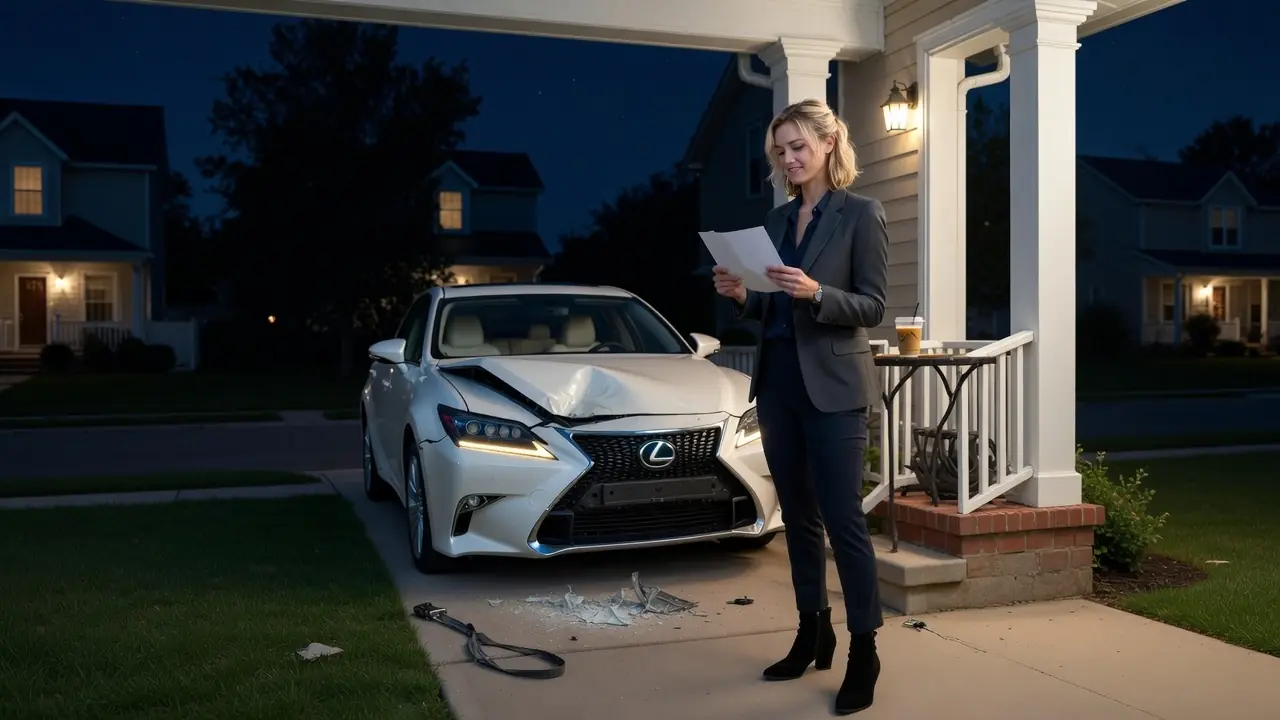
I looked at my sister for a long moment, searching for even a flicker of guilt. There was nothing there. Just irritation that her evening had become inconvenient and disbelief that anyone expected her to feel bad about it.
That was the exact second something inside me finally broke loose. Not loudly. Not in a scream. Quietly, like a rope snapping after years of strain.
I folded the insurance report carefully and slipped it back into my purse. Dad noticed immediately and exhaled like I had finally come to my senses. “Good,” he said. “Now everybody calm down, and let’s handle this privately.”
Privately. That meant Chloe stayed protected while everyone else absorbed the damage. It meant Dad would call someone, Mom would cry, Chloe would deny just enough, and I would be expected to forgive because I was the mature daughter.
I almost laughed. Instead, I pulled out my phone and opened the photo the insurance investigator had emailed me an hour earlier. The image showed Chloe climbing out of my Lexus outside a downtown bar twenty-three minutes before the crash. She had a cocktail glass in her hand.
Dad’s face drained of color. Mom whispered, “Oh my God.”
But Chloe recovered fast. Too fast. She looked directly at me and smiled again, though this time the smile had edges. “You won’t report your own sister.”
I wish I could say I answered immediately. I did not. Some small, exhausted part of me still wanted my family to prove me wrong. I kept waiting for someone, anyone, to finally draw a line for Chloe without forcing me to do it.
Instead, Dad rubbed his forehead and said, “Everybody makes mistakes.”
I felt my heartbeat slow after that. Not from calmness. From clarity. Chloe leaned against the porch railing like she had already won. “See? You’re overreacting again.”
Overreacting. That was the same word they used when Chloe ruined my graduation dinner by screaming at a waiter until security had to walk her outside. The same word they used when she took my emergency credit card and spent nine hundred dollars on clothes because she was “depressed.” The same word they used when she lied, stole, manipulated, cried, and left someone else to clean up the mess.
Every memory connected inside me like shattered glass forming a mirror. I was not family to them. I was cleanup.
I opened my contacts and pressed the investigator’s number. Dad stood instantly. “Avery, don’t.”
My thumb hovered above the screen. “Why not?”
“Because once you do this, there’s no fixing it.”
That almost made me stop. It sounded like a warning, but also like a confession. There had been too many things in our family that only stayed fixed because they were buried.
Then Chloe laughed under her breath. “Please. Dad would never let anything happen to me.”
I looked straight at her while the call connected. “That’s exactly why I have to.”
The investigator answered on the second ring. “Ms. Mercer? Have you made a decision?”
Nobody moved. My father stood frozen beside the porch steps, like speaking too fast might still stop this from happening. Mom had both hands over her mouth now. Chloe stared at me, disbelief slowly replacing confidence.
I swallowed once. “Yes,” I said. “I want my full statement added to the claim.”
Chloe pushed off the railing. “Are you insane?”
The investigator continued calmly, “Including the possible DUI evidence you mentioned earlier?”
Dad’s head snapped toward Chloe. “What evidence?”
I never looked away from my sister. “The bar receipt was inside the car.”
For the first time all night, Chloe’s expression cracked completely. “You searched my purse?” she shouted.
“No,” I answered. “The paramedics found it beside the driver’s seat.”
Mom sat down heavily in the porch chair like her knees had stopped working. The investigator’s voice stayed steady through the speaker. “Ms. Mercer, once this is filed, law enforcement will likely request formal interviews.”
Dad stepped closer to me carefully. “Avery, please.”
He was not angry anymore. He was scared. Because he finally understood this was not going to disappear.
I closed my eyes for one second and heard years of excuses echo through my head. Chloe did not mean it. Chloe was young. Chloe was overwhelmed. Chloe was fragile. Chloe was family.
Then Chloe said the worst possible thing. “If I go down,” she whispered, “I’m taking Dad with me.”
Dad went pale so fast it honestly scared me. “Chloe.”
Mom’s voice shook. “What does that mean?”
My sister looked cornered now, breathing harder, mascara slightly smeared beneath one eye. For the first time in years, she did not look untouchable. She looked reckless and dangerous.
The investigator stayed silent on speaker, probably listening carefully.
Dad pointed at Chloe with a trembling hand. “Don’t start lying because you’re scared.”
She laughed once, sharp and bitter. “Lying?” Then she looked directly at me. “Tell them who bought the car insurance for me after my third accident.”
The porch suddenly felt smaller. Mom turned slowly toward Dad. “Third?”
He avoided her eyes immediately.
A cold feeling crawled up my spine. Chloe kept going, because once people like Chloe start falling, they grab everything around them. “Tell them who called his friend at county records to erase the DUI charge last year.”
Dad exploded. “Enough.”
But it was too late. Every secret hit the air at once like broken pipes bursting behind walls. My mother stood up so abruptly the chair scraped across the concrete.
“You told me she never drove drunk,” Mom said.
“She was twenty-four and scared,” Dad shot back desperately. “I handled it.”
Handled it. That word again. He had handled Chloe’s consequences for so long that none of us knew where her mistakes ended and his cover-ups began.
I stared at him, realizing this had never been Chloe alone. Dad had not just protected her. He had trained her to believe consequences were optional. And every time he saved her, he made me pay for the lesson she never learned.
Then police lights flashed across our driveway.
Blue and red washed over the shattered Lexus like a warning finally arriving years too late. Nobody spoke. Two officers stepped out of the cruiser while another vehicle pulled in behind them.
The insurance investigator had moved faster than I expected. I realized then he must have already flagged the case before calling me back.
One officer approached carefully. “We need to ask a few questions regarding the accident earlier tonight.”
Chloe instantly pointed at me. “She’s exaggerating everything.”
The officer barely reacted. “Ma’am, we already interviewed witnesses from the bar.”
Dad closed his eyes. That tiny movement hurt more than yelling would have because it meant he already knew. He knew the witnesses existed. He knew the truth was bigger than what he had told us.
One officer asked Chloe to step aside. She refused at first, then finally walked toward the driveway with stiff shoulders and shaking hands. Mom sat silently on the porch chair crying into both palms.
I stayed near the front door, numb. The second officer turned toward Dad. “Sir, we also need clarification about prior record interference involving your daughter.”
Dad looked at me then. Not angry. Not betrayed. Just exhausted. Like he finally understood the cost of protecting one child by slowly sacrificing another.
Chloe suddenly screamed from beside the patrol car, panic tearing through her voice. “They found the pills in my purse.”
Mom started crying harder the second those words left Chloe’s mouth. Dad did not move at all. He stood in the driveway under the police lights looking older than I had ever seen him, smaller somehow, like every excuse he had built over the years had finally collapsed at once.
An officer guided Chloe toward the patrol car while she kept twisting back toward us. “Dad, say something.”
He opened his mouth. Nothing came out.
That silence changed everything. Because for the first time in our lives, he was not rescuing her.
Chloe’s panic turned ugly fast. “This is your fault,” she screamed at me. “You wanted this.”
I looked at her through the flashing lights and realized something strange. I did not hate her anymore. I was just tired. Tired of being the responsible daughter while chaos was protected because it cried louder.
The tow truck arrived twenty minutes later. It backed into the driveway with its amber lights turning slowly, and the driver stepped out, looked at the Lexus, then looked at us with the careful expression of a man who had seen too many family disasters attached to damaged cars. Nobody explained anything to him. Nobody needed to.
He hooked the Lexus carefully and started pulling it away from the driveway. The front bumper shifted again, scraping against the pavement with a sound that made my stomach twist. I remembered driving it home from the dealership three weeks earlier, my hands trembling with pride on the steering wheel. I had parked it in my apartment garage and sat inside for ten minutes just looking at the dashboard.
Now it was being hauled away while my sister sat in the back of a cruiser, still blaming me for what she had done.
Mom stood up when the tow truck pulled away. “Avery,” she whispered.
I looked at her. For once, she did not say forgive. She did not say family. She did not ask me to be bigger.
She only said, “I’m sorry.”
I wanted that to be enough. I wanted those two words to heal years of being overlooked, years of watching Chloe get rescued while I got responsibility, years of being treated like the daughter who could handle anything because no one ever asked if I was tired. But apology is not magic. It is only a door, and I was not ready to walk through it yet.
Dad stood near the end of the driveway, watching the tow truck disappear. His eyes were red when he finally turned back to me. “I failed both of you.”
Maybe he did. Maybe that was the most honest thing he had said all night.
“You protected her from consequences,” I said quietly. “And you protected yourself from admitting what she became.”
He looked down.
I continued, because for the first time I was not going to stop before the truth became uncomfortable. “Every time Chloe hurt someone, you made the rest of us smaller so she could stay innocent. You called it love, but it was fear.”
Dad swallowed hard. “I thought I was saving her.”
“No,” I said. “You were teaching her that somebody else would always bleed for her.”
Mom let out a broken sound behind me, but I did not turn. I had spent too many years softening my words because someone else might cry. Not that night. Not anymore.
The officers came back to the porch after Chloe was placed in the cruiser. They asked me to confirm my statement. I gave them everything I had. The insurance report. The photo. The investigator’s email. The timeline. The keys tossed onto the table. Chloe’s words.
I did not exaggerate. I did not make her worse than she already was. The truth was enough.
When one officer asked whether I wanted to press the insurance issue fully, Dad lifted his eyes toward me. Just for a second, I saw the old request in them. Please make this easier. Please save us from the cost.
I looked away from him and signed the statement.
The next morning, my phone rang fourteen times before nine. Dad called. Mom called. An aunt called. A cousin texted, saying I should not air family problems in front of the police. Another relative wrote that Chloe needed help, not punishment.
I deleted most of the messages without answering. Then my mother sent one that made me pause.
“You were right. I am sorry I did not protect you too.”
I stared at it for a long time. Then I put the phone face down on my kitchen table and made coffee.
The Lexus was declared a total loss two days later. The insurance process moved quickly because of the police report, witness statements, and the investigator’s documentation. The other driver remained hospitalized, and her son, thankfully, had escaped with bruises and shock. I sent flowers to the hospital with no name on the card because I did not want thanks. I wanted her to know someone cared.
Chloe called me from jail once. I did not accept the call.
Dad called again the next day. This time, I answered.
His voice sounded hollow. “She’s asking for bail.”
I waited.
“I’m not doing it,” he said.
For a moment, I could not speak. I stood in my kitchen, holding the phone, watching rain slide down the window. “Are you telling me,” I asked carefully, “or asking me to tell you it’s okay?”
He was quiet for several seconds. “Both, maybe.”
“It’s not my job to absolve you anymore.”
“I know,” he said.
I did not believe he fully knew it yet. But maybe, for the first time, he was beginning to.
The investigation uncovered more than the crash. Chloe had unpaid fines, hidden prescriptions, and a long record of incidents Dad had buried through favors, money, and pressure. The county records issue became its own problem. Dad’s friend denied everything at first, then cooperated when evidence surfaced.
My family did not collapse in one night. It had been collapsing for years. That night only turned the lights on.
Three weeks later, Mom came to my apartment alone. She looked smaller than usual, standing in the hallway with a casserole dish in her hands, like she was trying to use an old language neither of us spoke anymore. I almost did not let her in. Then I opened the door.
She set the dish on my counter and looked around. “You have a beautiful place.”
“Thank you.”
She sat at my kitchen table and twisted her wedding ring. “I thought being a good mother meant keeping everyone together.”
I said nothing.
“But I see now that I kept peace by asking you to be quiet.”
That was the first sentence that actually reached me. Not because it fixed anything, but because it named the wound correctly.
“I was angry at Chloe for being reckless,” Mom said. “But I was also afraid of her. Afraid of what she would do if we stopped rescuing her. You were easier to ask. You always listened. You always gave in.”
I looked at her across the table. “That was not strength. That was exhaustion.”
“I know.”
She cried then, but quietly. I let her cry. I did not comfort her immediately. That was new for me.
A month later, Dad came too. He did not bring food. He brought a folder. Inside were copies of every payment he had made for Chloe over the years: insurance, fines, loans, settlements, legal favors, cash withdrawals, repairs, debts. The total made me feel sick.
“I wrote it down,” he said. “All of it. I needed to see what I did.”
“And what did you see?”
He looked at the folder. “That I wasn’t saving her. I was buying silence.”
I closed the folder slowly. “What are you going to do now?”
“I’m cooperating with the investigation.”
That answer surprised me. It also hurt, because it proved he had been capable of choosing truth all along. He had simply waited until there was no easier option left.
Chloe did not forgive me. I did not expect her to. In every message that reached me through relatives, she was still the victim. I had ruined her life. I had embarrassed the family. I had chosen strangers over blood.
Maybe she would believe that forever. Maybe believing it was easier than facing the woman with fractured ribs, the child in the backseat, the pills in her purse, the drink in her hand, and the years of protection that had carried her straight to that driveway.
I stopped defending myself to people committed to misunderstanding me.
Two months after the crash, I bought another car. Not a Lexus this time. Something practical, solid, and mine. I drove it to my parents’ house only once, to pick up a box of old things from the garage.
The driveway looked different in daylight. Smaller. Less powerful. The porch where I had spent years being told to forgive was just wood and concrete. It no longer felt like a courtroom where I was always the defendant.
Mom came outside with the box. Dad stood behind her, quiet. Neither of them asked me to come in. Neither of them asked me to talk to Chloe. That restraint, small as it was, felt like the first honest respect they had ever offered me.
As I loaded the box into my trunk, Dad said, “I understand if you need distance.”
I turned to him. “I don’t need distance. I need boundaries.”
He nodded. “Then tell us what they are.”
So I did. No more asking me to forgive Chloe. No more passing messages from her. No more minimizing what happened. No more using the word family to make me responsible for damage I did not cause.
Mom cried again, but this time she did not argue. Dad did not defend himself. They listened.
That was all I had wanted for years.
The woman Chloe hit survived. Her recovery was painful, but she survived. Her son wrote a letter months later, short and uneven, thanking me for telling the truth. I read it three times and kept it in my desk drawer.
Chloe eventually took a plea deal. Dad’s part in hiding her past became a public humiliation he had to live with, though he avoided the worst consequences by cooperating. Our family name, the thing he had protected for years, was bruised by the truth anyway.
But truth does not destroy what is healthy. It only reveals what was already rotting.
People asked me later if I regretted making the call. They expected some complicated answer about blood, guilt, loyalty, and forgiveness. But the truth was simple.
I regretted not making a call years earlier.
I regretted every time I apologized just to keep peace. I regretted every time I let Chloe laugh, lie, take, break, and walk away because I was afraid of becoming the difficult one. I regretted teaching my family that I would always bend.
But I did not regret that night.
Because that night, under the porch light beside the ruined Lexus, I finally understood something. Being mature does not mean absorbing harm. Being family does not mean covering up cruelty. Being forgiving does not mean protecting someone from the consequences that might finally save another person from being hurt.
Chloe said Dad would make me forgive her. For most of my life, she would have been right. Dad would have asked. Mom would have cried. I would have swallowed my anger, paid the emotional bill, and called it peace.
But that night was different.
That night, I looked at my wrecked car, my smirking sister, my frightened father, and my silent mother, and I finally saw the whole pattern clearly. I was not the family’s heart. I was the family’s shield. And shields eventually crack.
So I made the call.
The Lexus was gone. Chloe was gone. The lies were gone too.
And for the first time in my life, when someone in my family made a mess, nobody asked me to clean it up.