“Ever since she got back from deployment, she’s been completely out of her mind. Please, Your Honor, hand over control of her $3.2 million inheritance to her sister, or she’s going to kill herself with these military delusions.” Those words punched straight through my chest. They came from my own mother’s mouth. She dabbed at fake tears with an expensive silk handkerchief on the witness stand in Cook County Court.
Next to her, my older sister, Chloe, nodded in tragic sympathy, carefully hiding a smug little smile. I’m Emma West, 29 years old. I should be celebrating my birthday this month with a quiet dinner. Instead, I’m being dragged to court by my own flesh and blood. They think the military broke me.
They think I’m weak, easy to manipulate. But they have no idea that just this morning, a highly classified file from the Department of Defense was placed right on the judge’s desk. The air in the Cook County Courthouse smelled like industrial bleach, stale coffee, and desperate lies. It was the kind of smell that sticks to the back of your throat. I sat at the respondent’s table.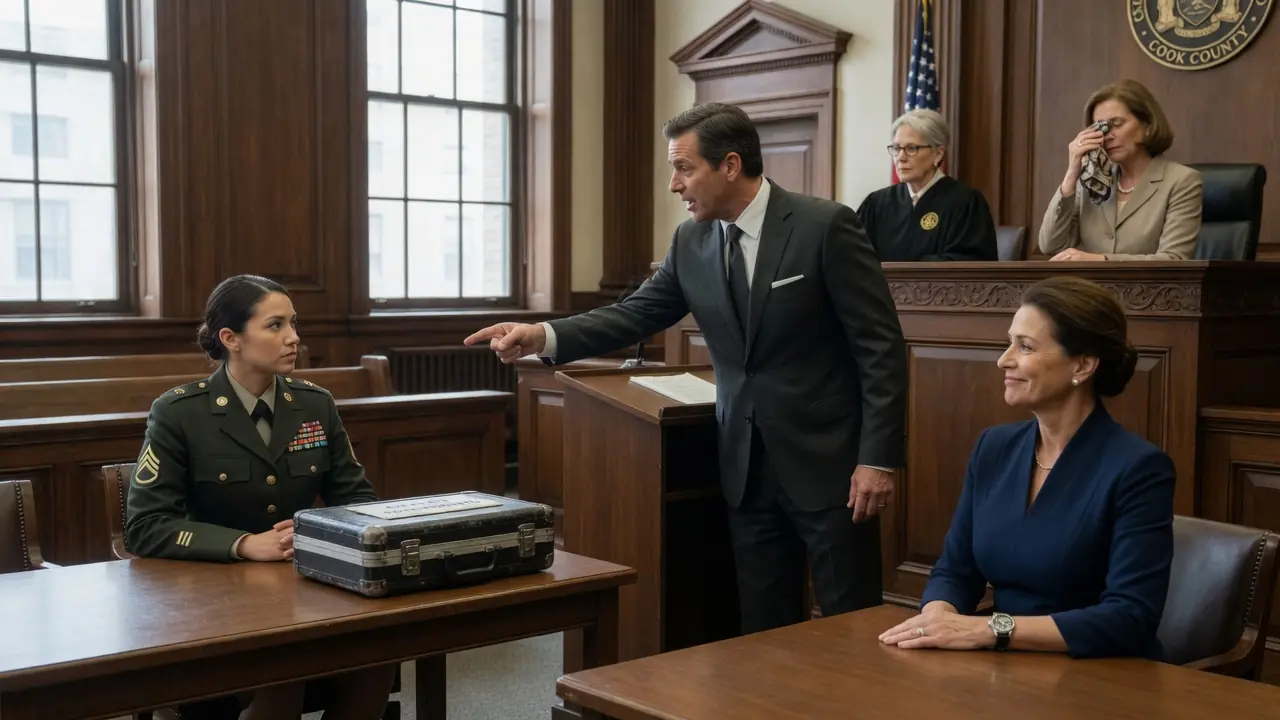
The mahogany surface was freezing under my palms. My mother stepped down from the witness stand, her heels clicking softly on the scuffed hardwood floor. She didn’t look at me. She just kept her head bowed, playing the role of the shattered matriarch to perfection. Marcus Thorne took her place at the center of the room.
He was Chloe’s lawyer. A $5,000 custom Italian suit wrapped around a 50-cent soul. He dropped a thick manila folder onto the podium. Smack. The sound echoed off the high ceiling like a gunshot.
“Your Honor,” Marcus began, his voice slick and practiced, “we are looking at a severe case of combat-induced paranoia: unstable, unpredictable, and a danger to herself.” He fired those words into the room like artillery shells. Paranoid, unstable, danger. He conveniently ignored the facts. He didn’t mention that I had served eight years on active duty with a spotless record.
He left out that I paid my taxes early every single spring, owned my car outright, and had never so much as gotten a parking ticket in Chicago. None of that mattered. Marcus wasn’t here to paint a picture of a functional veteran. He was here to build a monster, a broken psychotic soldier who needed to be locked in a padded room so the keys to her bank accounts could be handed over to her responsible older sister. It was a conservatorship hit job, a legal kidnapping.
I shifted my gaze to the gallery. Chloe sat in the front row, legs crossed at the ankles. She wore a tailored navy blue dress. No designer logos, just that quiet, stealth wealth look that screamed old money. She rested her manicured hand on her own stack of legal pads.
She didn’t glare at me. She didn’t sneer. She just offered me this flat, dead-eyed look of absolute certainty. The look of a predator who already felt the meat in its teeth. Mom slid into the seat next to her and let her head collapse onto Chloe’s shoulder.
Chloe patted her hand. The perfect protective older sister holding the family together. It made my stomach turn. I’ve eaten MREs out of plastic bags while squatting in the dirt. I felt the shock wave of incoming mortars rattle my teeth in my skull.
I survived all of that. But sitting here in an air-conditioned room in my hometown, watching the woman who gave birth to me strip away my basic human rights, that was a different kind of violence. It was a cold, calculated butchery. Next to me, my attorney, Sarah Vance, was furiously scribbling on a yellow legal pad. The scratch of her pen was aggressive, angry.
“Don’t react,” Sarah muttered under her breath, barely moving her lips. “I won’t,” I whispered back. I didn’t scream. I didn’t jump up and call them liars. That was exactly what they were praying for.
If I raised my voice, Marcus would just point his manicured finger at me and say, “See your honor. She’s hostile, unhinged.” So, I did what the military taught me to do. I locked it down. My boots were planted flat on the floor.
My back was straight, a perfect 90° angle against the heavy wooden chair. I breathed in through my nose, out through my mouth. Slower, deeper. In the criminal investigation division, we don’t argue with suspects. We don’t take the bait when they try to provoke us.
We sit in the interrogation room. We stay perfectly still. We let them talk. We let them build their little houses of cards lie by lie until they’re standing right over the trap door. Then we pull the lever.
Marcus kept pacing, weaving a pathetic narrative about how my refusal to attend Chloe’s lavish cocktail parties was proof of my dangerous social isolation. Chloe leaned forward. She pulled a yellow sticky note from her pad, uncapped a gold pen, and jotted something down. She reached over the low wooden divider to hand the note to Marcus. As she stretched her arm out, the tailored sleeve of her navy dress rode up her forearm.
The fluorescent light caught a flash of metal on her wrist. My breath caught in my throat. I stopped blinking. It wasn’t a Cartier. It wasn’t a Rolex.
It was a cheap, heavy mechanical watch. The leather strap was frayed at the edges. The glass face was deeply scratched right above the number four. It was my dad’s watch. The man who drove a beat up Ford 12 years straight.
The man who always smelled like motor oil and cheap aftershave. The man who saw right through Chloe’s fake smiles and my mother’s endless vanity. He was the one who drew a hard financial line in the sand before his heart gave out. And it was his last will and testament that woke the greedy, desperate monster currently sitting across the courtroom. I stared at the scratched glass on Chloe’s wrist, and suddenly the pieces of the puzzle slammed together.
The $3.2 million wasn’t just money to her. It was a score to settle. That watch didn’t belong on her wrist. The deep scratch right above the 4:00 mark. That happened when my dad, Warren West, slammed his arm into the rusted alternator of a broken down delivery truck in the dead of a zero-degree Chicago winter.
He didn’t flinch. He just wrapped his bleeding knuckle in a greasy rag and kept working. Dad was a grinder, a blue-collar ghost in a white-collar world. He built a regional medical supply logistics company out of a single beat up Chevy van. Even when the company hit eight figures in annual revenue, he still drove a 12-year-old Ford sedan until the transmission literally dropped out on the interstate.
He packed a ham and Swiss sandwich in a brown paper bag every single morning. He smelled like Folgers dark roast, Pennzoil, and sweat. He was real, a solid brick of a man. My mother and Chloe, they were something else entirely. They operated in a totally different atmosphere.
I was just the spare part, the shadow in the corner of the house. The quiet kid who learned early on that out of sight meant out of the line of fire. When I turned 21, I packed an olive drab duffel bag and put it by the front door. I had enlisted. I remember standing in the formal dining room that night.
The air was thick with the smell of whatever overpriced catered cedar plank salmon my mother had ordered. Chloe didn’t even look up from her phone when I walked in, wearing my boots. She just rolled her eyes. She dropped her heavy silver fork. Clack.
The sound cut through the room harsh and ugly against the fine porcelain plate. So that’s it. Chloe scoffed, taking a slow sip of her sparkling water. You’re just ditching the family business, running off to do glorified bookkeeping in some dirt bunker. My mother didn’t correct her.
She just cut another piece of salmon and chewed completely indifferent to the insult. I stood there, my spine straight, my hands resting easy at my sides. I couldn’t tell them the truth. I couldn’t tell them I had just been fast-tracked for a top-secret intelligence clearance, that I was going to be tracking terror financing and cartel money for the criminal investigation division. The military doesn’t let you brag about security clearances to civilians over dinner.
So, I ate the insult. I swallowed the label of being just a paper pusher. I walked out that door genuinely believing that if I served my country, if I put my own life on the line, maybe just maybe I would finally earn a shred of respect in this family. I was dead wrong. Four years ago, a massive stroke dropped my dad on the concrete floor of warehouse number three.
He was gone before the paramedics even got the paddles on his chest. A week after the funeral, we sat in a lawyer’s office downtown. The room smelled like stale lemon polish, expensive leather, and old paper. The air in there was thick, suffocating. The lawyer picked up the heavy manila envelope.
The sharp RR rip of the paper seal tearing open sounded like a gunshot in the dead, quiet room. Dad wasn’t a fool. He loved his family, but he wasn’t blind. He knew exactly what Chloe was. He knew she was a shark, but a remarkably incompetent one.
He knew she would try to crush me the second he wasn’t around to stand in the way. The lawyer read the terms flat monotone. Chloe got the company. She was named CEO and CFO. Total control of the logistics empire dad had bled into the dirt to build.
Then came my part. Dad didn’t leave me shares in the company. He knew Chloe would find a legal loophole to freeze me out of dividends. Instead, he liquidated a massive chunk of his personal untouchable assets. He set up an ironclad trust fund, $3.2 million.
The catch was that it matured on my 30th birthday, not a single day sooner. He built a financial blast wall around me, ensuring I had enough to walk away from them forever when the time came. I watched Chloe’s face drop. The smugness vanished, replaced by a dark, ugly red creeping up her neck. She slammed her palm down flat on the mahogany desk.
The wood shuddered. “Are you kidding me?” she hissed, her voice vibrating with pure, unfiltered entitlement. “How is this fair? I’m running the actual business, and she gets a $3 million handout for doing push-ups in the mud.” Mom reached over, rubbing Chloe’s back, whispering soothing garbage into her ear.
I didn’t flinch. I didn’t say thank you. I didn’t argue. I just kept my eyes locked on the blank wall behind the lawyer’s head. Dad had drawn a line, but Chloe took that line as a declaration of war.
She took the big chair at the company. Within six months, she started bleeding it dry. She slashed the essential maintenance budgets for the Midwest warehouses. She laid off the veteran truck drivers dad had kept on payroll for a decade, replacing them with cheap, unreliable contractors. Where did the money go?
California. Chloe funneled the operating capital into vaporware tech startups in Silicon Valley. Shell companies pushing wellness apps that didn’t exist. She was desperate to be seen as a visionary. She bought Prada.
She paid for puff pieces in online magazines. But you can’t fake cash flow. The tech startups went bankrupt one by one. The warehouses started failing state inspections. Whenever I came home on leave, the house felt different.
It smelled like expensive perfume, but there was a distinct rot underneath it. I’d walk past Chloe’s home office and hear the muffled, frantic shouting through the heavy oak door. The suppliers had stopped calling. The aggressive collection agencies had started. She was drowning.
She didn’t know how to hustle, how to build, or how to survive a real storm. She only knew how to spend. And she was burning through dad’s legacy like cheap kindling. A narcissist with a drained bank account is the most dangerous animal on Earth. The company was hemorrhaging money and the corporate auditors were circling.
Chloe was backed into a corner. She needed liquid cash to cover the massive gaping holes she’d blown in the company’s ledger. She needed it fast. And I had $3.2 million sitting behind a timer. A timer she decided she couldn’t wait for.
She just needed to find a way to pick the lock. Or better yet, destroy the person holding the key. Chloe’s financial firewall didn’t just crack. It shattered. The final notices piled up on her heavy mahogany desk. thick, ugly envelopes from logistics suppliers, final demands, pay up or we cut off the supply chain.
A normal person would declare bankruptcy. They would take the hit, swallow their pride, face the music, and start over. But narcissists do not do shame. They do crime. While I was sitting in a windowless sub-level SCIFA secure facility at the Department of Defense, staring at dual monitors and tracing cartel money, moving through offshore accounts, my sister was doing the exact same thing to our father’s legacy.
She turned a legitimate blue-collar medical supply business into her own personal ATM. She needed to feed the beast. The lifestyle, the leased Porsches, the Malibu rent, the VIP tables. The mechanics of her fraud were pathetic and sloppy. In the criminal investigation division, we watch cartels use complex crypto tumblers and layered shell corporations across three continents.
Chloe used a basic Google search. She set up three shell companies out in California. No offices, no employees, just three metal P. O. boxes in a run-down strip mall right next to a dry cleaner. She generated fake invoices and billed them back to our father’s company in Chicago.
Strategic consulting fees, market expansion, analytics, brand synergy, Total garbage. She kept the wire transfers small. She sliced them up just under the $10,000 federal reporting threshold. Smurfing, we call it. The dirty money slipped right through the corporate accounts, bypassed the standard checks, and landed directly into her personal slush fund.
She used the cash to pay off her maxed-out black cards, keep the lights on at her fake startups, and buy the illusion that she was still a winner. The deficit reached $1.8 million. Red numbers bled all over the company ledgers. Back in Chicago, the corporate office started to sound different. The heavy rhythmic hum of forklifts loading trucks in the yard was replaced by the grinding, high-pitched squeal of the heavy-duty paper shredder in the executive suite.
Chloe kept that machine running hot, destroying vendor contracts, erasing history. The hallway outside her office smelled like expensive floral perfume, masking the sharp metallic scent of burned out shredder motors. But you cannot outrun a federal tax deadline. You cannot outrun an annual audit. Tax season closed in like a vice.
David Lynn, dad’s head accountant, started pulling the quarterly ledgers. David was old school. He wore cheap off-the-rack suits, used a heavy 10-key calculator, and never missed a single decimal point. He had worked for my father for 20 years. He knew what the margins were supposed to look like.
He saw the California invoices. He saw the massive cash bleed. He saw the missing purchase orders. David walked right into Chloe’s office. He dropped a stack of flagged accounts on her desk.
He demanded the original vendor contracts. Chloe didn’t explain. She didn’t apologize. She fired him on the spot. “Pack your desk.
You’re done,” she told him, not even looking up from her phone. She had a man who gave two decades of his life to our family escorted out of the building by a security guard who made 12 bucks an hour. But firing the accountant did not fill the $1.8 million crater she blew in the concrete floor. The corporate auditors were still coming. The IRS was looming.
She needed liquid cash to plug the hole, and she needed it before the third quarter closed out. Desperation makes people sloppy. It makes them look for soft targets. Her eyes landed on the single biggest pile of untouched cash left in the family. My trust fund.
$3.2 million sitting safely behind a legal wall, just waiting for my 30th birthday. Nine months before I turned 30, Chloe made her move. She didn’t call me. She didn’t ask for a loan. She bypassed me entirely.
She logged onto a laptop, hid behind a basic VPN, and drafted a formal amendment to the trust, a legal document that would immediately transfer total control of the funds to her, citing my extended military absence. Then she forged dad’s signature. She traced his handwriting from an old birthday card, scanned it, and slapped it onto the bottom of the PDF. She fired it off to the bank’s trust department in Delaware. She probably sat back in her leather chair, holding her breath, waiting for the multi-million dollar wire to clear and save her skin.
She thought she was a genius. She thought she beat the system. She forgot that major banks used digital certificate verification. The bank’s legal department took one look at the metadata on the file. The document was created 4 years after my father’s death.
The digital signature lacked the required cryptographic hash. The IP address pinged back to a coffee shop in Santa Monica. Denied. The heavy red ink on the rejection letter was a brick wall she couldn’t talk her way out of. The bank flagged the submission.
Direct theft failed. Paper fraud failed. The compliance officers locked down my trust tighter than a drum and placed a suspicious activity monitor on the account. Chloe backed away from her computer. The paper trail was completely burned.
It was too risky to try forging documents again. She realized she couldn’t steal the money by forging a dead man’s name. She had to take it directly from the living. She needed the bank to willingly hand her the keys without a fight. And the only way a bank would ever surrender a grown woman’s trust fund to a sibling is if the primary beneficiary was declared legally incompetent to handle her own affairs.
She didn’t need a fake signature anymore. She needed a doctor. Sarah Vance’s office wasn’t in some glass high-rise downtown. It was on the second floor of a weathered brick building in the South Loop, right above a noisy dry cleaner. The air in the stairwell smelled like industrial starch and old iron.
I walked in and took the seat across from her. I didn’t cry. I didn’t shake. I pulled my official military service record and the bank’s rejection letter out of my tactical bag and dropped them flat on her scratched oak desk. Thud.
Sarah was a bulldog. She specialized in white-collar defense and corporate fraud. She didn’t offer me a tissue or a sympathetic smile. She picked up the file, her eyes darting across the pages. Fast, brutal, calculating.
She tossed it back down. Your sister is an absolute idiot, Sarah said. She’s desperate, I corrected. Same thing in my line of work. Sarah leaned forward, folding her hands.
Listen to me, West. We do not fight narcissists with feelings. Your family is going to use tears. They are going to use public sympathy. They are going to play the victims.
We are going to crush them with metadata transaction logs and tax codes. Understood. Understood. I pulled out my checkbook and wrote her a retainer. Five figures.
I tore the check loose and slid it across the desk. It was a bitter, jagged pill to swallow. I thought about the combat hazard pay I had saved. The months eating cold rations in the dirt. All of it going into a lawyer’s bank account just so I could exist as a free woman in my own hometown.
I was literally paying a complete stranger thousands of dollars to build a legal blast wall to protect me from the very people who were supposed to love me unconditionally. Blood is thicker than water. Sure, but money talks and greed screams. I needed the inside man. The drive out on Interstate 55 was gray and unforgiving.
Chicago traffic always is. I watched the brake lights bleed red across the wet asphalt. I was a CD agent. My daily job was hunting down federal fraud tracking terror financing across the globe. And here I was building a criminal case file on my own sister.
The irony tasted like copper in my mouth. I pulled into a run-down diner off the highway. The parking lot was nothing but cracked asphalt, broken glass, and weeds pushing through the cement. I slammed the rusted, heavy door of my truck shut. The diner smelled like burnt bacon grease, cheap bleach, and overbrewed drip coffee.
I slid into a cracked vinyl booth in the back corner. The formica table was sticky under my forearms. David Lynn walked in 10 minutes later. He used to wear sharp off the rack Macy’s suits. He used to stand tall, proud of his position as dad’s head accountant.
Now he looked like a deflated tire. His shoulders were hunched. His eyes darted toward the exits. Chloe hadn’t just fired him. She had stripped a proud, hard-working man of his dignity.
He sat down across from me. He kept his trench coat on. I slid a heavy ceramic mug of black coffee toward him. It clattered against the table. Then I pushed a plain manila folder right next to it.
What is this, Emma? He asked. His voice was thin, raspy. Three P. O. boxes in California, I said.
Keeping my voice low and flat. Consulting fees, market analytics, a $1.8 million bleed from dad’s operating account. David opened the folder. He stared at the printed spreadsheets. His hands, usually so steady, on a 10-key calculator, started to shake.
The skin around his knuckles went bone white. He slammed his flat palm onto the table. The coffee spilled over the thick rim of the mug, staining the paper napkins brown. I knew it. David hissed his teeth clenched.
I told her the margins were completely fabricated. I demanded to see the original vendor contracts. She didn’t even look at me. She just had security throw me out like a common thief. 20 years I gave your father. 20 years. Firing you didn’t fix her problem, David.
I said she’s broke. The IRS is coming for the annual audit. And now she’s trying to break into my trust fund to cover her tracks. David looked up. The fear and humiliation in his eyes vanished, replaced by a hard, cold anger.
The kind of quiet anger that actually gets things done. She underestimated me, David said softly. She thought because I’m old, because I prefer paper ledgers, that I don’t understand network servers. She locked me out of the main system. The second I was out the door, he reached into the deep inside pocket of his faded coat.
He pulled out a thick industrial-grade metal hard drive. He slid it across the sticky table. It was heavy, freezing cold. I pulled the system logs the night before I confronted her. David said, “Every single approval, every fake invoice.
I have the IP addresses, her digital signatures stamped on every dime of that dirty money.” This is the kill shot, I said, staring at the metal box. I captured the MAC address from her personal laptop. David didn’t blink. It’s airtight.
I will swear on a stack of Bibles in open court. I looked at the drive. Then I looked at David, an old accountant stripped of his pension and a bulldog lawyer I just met in a dusty office. These two complete strangers cared more about my father’s legacy and my own survival than my own mother did. They were my shield.
My chosen family in this foxhole. We had the weapon. We had the data. We just had to wait for Chloe to make a mistake. I reached out.
My fingers brushed the freezing metal casing of the hard drive. Right at that exact second, my phone vibrated against my ribs. A harsh mechanical buzz cutting through the quiet diner. I pulled it out of my tactical jacket. The screen lit up in the dim booth.
Mom. I stared at the name. The woman who stood by while Chloe looted Dad’s grave. The woman who watched me leave for the military and called it a vacation. She never called me on a Tuesday afternoon.
Never. I didn’t know it yet, but that buzzing piece of glass in my hand wasn’t just a phone call. It was the trigger to a trap they had already set. A trap so vicious I wouldn’t see the teeth until it snapped shut on my neck. I stared at the caller ID in the dim light of the diner booth.
Mom, I shouldn’t have answered. I was a trained investigator. I knew the timing was too perfect, too convenient, but I’m still human. I swiped the green icon and held the cold glass to my ear. Emma, honey.
Mom’s voice floated through the speaker, thick like cheap syrup. It made the hair on my arms stand up. I’ve been so worried about you. She didn’t ask how my job was going. She didn’t ask if I had eaten dinner.
She went straight for the soft tissue. She asked about my sleep. She brought up dad. She used that soft trembling tone that mothers use when they want you to drop your guard. Then Chloe’s voice cut in.
She was on speaker phone in the background. Light, breezy, dangerous. You know, M. Chloe said, “You always seem so on edge lately. Do you ever feel like people are out to get you?
Your military friends must make you feel like everyone is an enemy. I should have hung up right there. I should have recognized the tactical probing. But the diner was quiet. The coffee was bitter.
And for a split second, I wanted to believe that they actually gave a damn. I wanted to believe that under all the vanity and the fraud, they were still my family. So, I answered honestly. I told them about the insomnia. I told them about the mandatory therapy sessions on base after my deployment.
I talked about the adrenaline dumps that hit me at 2 in the morning. Real raw symptoms of serving your country. The line went completely silent for a moment. Then mom sighed a heavy theatrical sound. Emma, she said softly.
We want you to talk to someone, a professional. Just a family wellness check over video for us, please. They didn’t want to help me. They were gathering ammunition. The next evening, I sat in my sterile minimalist apartment and logged into a Zoom link.
Dr. Julian Cross appeared on my screen. He wore a tweed jacket and sat in a room lined with leather bound books. He looked like central casting for a distinguished psychiatrist. But his eyes were flat dead and entirely uninterested. The call lasted exactly 52 minutes.
Cross didn’t ask for my military medical records. He didn’t request a release form from my base therapist. He didn’t care about my combat history. He just clicked a heavy ballpoint pen against his mahogany desk. Click clack click clack.
A harsh repetitive rhythm. He didn’t conduct an evaluation. He conducted an interrogation. Do you often believe your sister is trying to steal from you, Emma? He asked.
His tone wasn’t clinical. It was leading. I don’t believe she is, I answered, keeping my voice level. I have the financial ledgers that prove she is. Click clack.
Fascinating. Cross muttered, not writing a single word down. And this obsession with ledgers. Does it keep you isolated in your apartment? Do you struggle to maintain a normal social life?
The trap jaws snapped shut in my head. I saw the whole board. This isn’t a therapy session, I said. I reached forward and killed the connection. The screen went black, but the damage was already done.
The knife was already against my throat. They took those 52 minutes and butchered them. Over the next 3 weeks, Chloe went on a campaign. She weaponized my honesty. She called our aunts our uncles, my father’s old business partners.
She played the heartbroken sister. Emma is so sick. She told them she’s obsessed with imaginary crimes. She thinks I’m stealing. It’s the PTSD.
It’s paranoia. She sits alone in her apartment polishing her boots and tracking fake money. They took the disciplined quiet life of a military investigator and rebranded it as the dangerous isolation of a lunatic. They took the sleepless nights of a veteran and labeled it severe psychiatric instability. They didn’t just want my money.
They needed to destroy my credibility so that no one would ever believe a word I said about the missing $1.8 million. 6 weeks before my 30th birthday, a Monday morning, I was walking down the long fluorescent lit hallway of the federal building heading toward the SCIF for a classified intelligence briefing. The air smelled like ozone and floor wax. A man in a cheap shiny gray suit stepped out from an al cove. He didn’t say a word. He just shoved a thick, heavy manila envelope hard against my chest.
“Emma West, you’ve been served,” he mumbled, turning on his heel and walking away fast. I stopped dead in the hallway. I didn’t open it immediately. I could feel the weight of it in my hands. The heavy recycled paper.
I ripped the flap open. Petition for emergency conservatorship filed in Cook County Circuit Court. petitioner Chloe West. Attached to the back was a sworn medical affidavit signed by Dr. Julian Cross. I scanned the bolded text. Severe persistent paranoia.
Delusional fixations regarding family finances. Incapable of managing personal affairs. Immediate risk to self. My chest tightened. The air in the hallway suddenly felt thin.
I pulled out my phone and logged into my banking app. The screen loaded. A red banner flashed across the top. Account frozen. Pending legal order.
The $3.2 million gone. Locked behind a judge’s gavel. But Chloe wasn’t done. She didn’t just want the trust fund. She wanted to neutralize me completely.
My commanding officer stepped out of the SCIF doors, his face hard as granite. He looked at the envelope in my hands, then looked me dead in the eye. Agent West, he said, his voice dropping an octave. I just got off the phone with DoD security. A family member filed a formal report stating you are suffering from severe untreated psychiatric delusions.
I stood perfectly still, my boots rooted to the lenolium floor. Your security clearance is suspended effective immediately, he said, holding out his hand. Hand over your badge. I drove back to my apartment in complete silence. No radio, no podcasts, just the heavy rhythmic thump of the tires hitting the expansion joints on the Kennedy Expressway.
The air inside the cab of my truck was stale. I didn’t have my badge. I didn’t have my clearance. I unlocked the dead bolt to my apartment and pushed the heavy door open. The place was dark, sterile.
It smelled like lemon pledge and cold air conditioning. I dropped my keys on the counter. The metal clanged sharply against the granite. Across the room on the small table near the window, a tiny red LED light was pulsing. Blink, blink, blink.
The answering machine. I walked over. The hardwood floor creaked under my boots. I didn’t turn on the overhead lights. I just stood there in the dark watching the red light pulse.
I hit the play button. The machine beeped. A sharp mechanical sound. Then static. Then her voice, “Emma, it’s mom.”
She sounded awful. Her voice was thick, wet, with tears trembling like a leaf. It wasn’t the slick, confident tone she used at country club lunchons. It was the desperate, pleading wine of a cornered animal. “Honey, please, you have to stop fighting this.
You have to drop the lawyer.” I stood perfectly still, my jaw clamped shut. The muscles in my neck tightened like steel cables. “I know what’s happening.” The voice on the machine continued hitching with a heavy sob.
I know about the audit. I know what your sister did. I know she took the money, Emma. The words hit me like a physical blow to the stomach. She knew.
She actually knew. I know you aren’t sick. Mom cried, her voice echoing off the bare walls of my living room. I know you’re not crazy, but Emma the IRS is looking at the corporate accounts. If the company goes under, the bank is going to foreclose on the house.
My house. Where are your father and I supposed to? I mean, where am I supposed to go? I stopped breathing. Just let the conservatorship go through, she begged.
Let Chloe use your trust to cover the missing funds until the audit is over. When the heat dies down, I will make her pay you back every single scent. I swear on your father’s grave. Please, Emma, don’t make a scene in court. Don’t humiliate us in front of everyone.
Just let her have it. Click. The machine beeped again. End of message. The red light stopped flashing.
The room went completely black, save for the orange glow of the street lights filtering through the blinds. I didn’t move. I didn’t cry. I had been shot at in combat zones. I had felt the concussive force of IEDs shake the dirt loose from the roof of my bunker.
But none of that violence, none of those physical threats hurt as much as the silence that followed that voicemail. My mother knew the truth. She knew Chloe was a thief. She knew I was a decorated investigator. She knew I was currently sitting under federal review my entire career hanging by a thread because of a fake psychiatric hold.
And she did not care. She was willing to sacrifice me. She was willing to put a straitjacket on her own daughter, strip away my legal rights, and destroy my military career, all to save a five-bedroom McMansion in the suburbs. She was willing to feed me to the wolves. So Chloe didn’t have to face the consequences of her own staggering incompetence.
That is what an enabling mother does. They don’t protect the victim. They protect the abuser because it keeps the illusion of the perfect family intact. I was just the collateral damage, the scapegoat, the spare part. Family wasn’t a safe harbor.
It was a noose. I reached out and hit the save button on the machine. The recording locked into the digital memory. a hard piece of evidence. Then I pulled my cell phone out of my pocket. The screen flared bright in the dark room.
I opened my contacts. I scrolled down to mom. I didn’t call her back to argue. I didn’t scream into the phone demanding to know how she could do this to me. You don’t negotiate with terrorists and you don’t argue with enablers.
They will just drag you down into the mud and beat you with experience. I hit edit. I hit delete contact. Confirm. The name vanished from my phone.
The cord was cut, clean, final. I walked into my bedroom. I pulled a heavy black tactical duffel bag out from under the bed. The heavy nylon zipper rasped loudly in the quiet room. I threw in three changes of clothes, my encrypted laptop, the manila folder from David Lynn, the heavy metal hard drive with the system logs.
I packed tight, efficient military squares. I wasn’t a victim anymore. I wasn’t the quiet kid standing in the corner of the dining room taking insults. I was an investigator with the United States military and I was holding a royal flush. I zipped the bag shut.
I threw it over my shoulder. I walked out of the apartment and locked the deadbolt behind me. They wanted to play a legal game. Fine. But I wasn’t going to play by their rules anymore.
I was going to burn the whole board to the ground. I rented a cheap motel room in Cicero out by the train yards. 50 bucks a night. Cash. The room smelled like stale cigarette smoke and cheap pine cleaner, but it was secure and it had decent Wi-Fi. I didn’t sleep.
I didn’t eat. I just pushed the small laminate table to the center of the room, closed the blackout curtains, and went to work. Chloe and my mother thought they were dealing with a paper pusher. A low-level grunt who filed logistics reports in a dusty supply room. They had no idea what a senior investigator for the criminal investigation division actually did for a living.
I didn’t just look at numbers, I hunted them. I stripped apart global moneyaundering operations. I tore through encrypted offshore accounts to find the exact IP address of the guy holding the match and my sister. My sister was an amateur playing a professional game. I cracked open my encrypted military grade laptop.
The blue light washed over the dark room sharp and cold. I plugged in the heavy metal hard drive I got from David Lynn. The system hummed clack clack clack. My fingers hit the keys fast, hard muscle memory. I didn’t need a search warrant.
David had full authorization when he backed up those files. I ran a standard forensic extraction tool over the company’s ledger. It took exactly 14 minutes to map the entire $1.8 million bleed. Chloe had sliced the money into thousands of microtransactions, smurfing, trying to keep everything under the radar. But David’s system log captured the MAC address of the device that approved every single one of those fake invoices.
It wasn’t the company server in Chicago. It was an Apple MacBook Pro registered to Chloe West. The IP addresses pinged off public Wi-Fi networks in Santa Monica, Beverly Hills, and West Hollywood. She wasn’t just stealing. She was leaving digital fingerprints on every single dollar.
I took a sip of lukewarm black coffee. It tasted like ash. I kept digging. I needed to break the conservatorship trap. I needed to prove the fraud was directly linked to the psychiatric hit job.
I pulled up the fake trust fund amendment the bank had rejected. The one with dad’s forged signature. I ran a deep metadata extraction. People think when you delete a file name or a date, it’s gone. It’s not.
Digital forensic software strips a file down to its skeleton. The data populated on my screen. Date created 96 days after the recorded death of Warren West. Authorowner C West_ADMIN. Original file name Emma_Control_draft_v1. doc.
I stared at the screen. She didn’t even bother to rename the source file before she converted it to a PDF. She was so arrogant, so sure she was the smartest person in the room that she practically signed a confession in the code and dad’s signature. The hash values proved it was a lowresolution JPEG cropped from another document and pasted over the signature line. It was a felony, pure and simple.
But I needed the final nail. I needed the doctor. I sent a secure encrypted message to Sarah Vance. Track the billing for Dr. Julian Cross. find the invoice. Two hours later, my laptop pinged.
Sarah sent over the financial routing slip. Dr. Julian Cross didn’t bill my mother. He didn’t build Chloe’s personal checking account. That would have left a normal paper trail. Instead, he build $18,000 to Pacific Crest Consulting, one of the three fake shell companies Chloe set up in California.
She used stolen company money to pay a hired gun psychiatrist to declare me insane. But that wasn’t even the worst part. Sarah managed to subpoena the digital properties of the psychiatric affidavit cross submitted to the court. The one that claimed I was a severe danger to myself. The one that cost me my security clearance.
I opened the metadata file for the doctor’s report. I looked at the timestamp. My jaw locked. My knuckles turned white against the edge of the desk. File created.
October 14th, 2:15 p. m. File last modified. October 14th, 2:45 p. m. My Zoom call with Dr. Cross didn’t start until 4 p. m. on October 14th. He wrote the diagnosis before he ever spoke to me.
The entire 52-minute call was a sham, a performance. He had already cashed the $18,000 check, and the verdict was already typed, signed, and ready to be filed with the court. I leaned back in the cheap motel chair. The plastic creaked under my weight. I felt a cold, hard knot form in the pit of my stomach.
It wasn’t sadness. It wasn’t even anger anymore. It was absolute lethal clarity. I had them. I had the bank fraud.
I had the embezzlement. I had the extortion. And I had the medical malpractice all wrapped up in neat, irrefutable digital packages. I spent the next 3 hours organizing the files. I printed hard copies.
I loaded everything onto a secure encrypted flash drive. I took the digital voice recorder with my mother’s confession on it and placed it inside a heavy steel briefcase. I walked into the motel bathroom and turned on the harsh overhead light. I looked in the mirror. I didn’t look like a victim.
I didn’t look like a broken veteran. I pulled my class A military uniform out of the garment bag. I didn’t wear it to the diner. I didn’t wear it to Sarah’s office, but I was going to wear it today. I put on the crisp white shirt.
I tied the black tie perfectly. I pulled on the heavy green jacket. I checked the alignment of my ribbons. Every single metal, every single commenation I had bled for sitting exactly 1/8 of an inch above the pocket seam. I ironed the creases in the trousers until they were sharp enough to cut glass.
I packed the steel briefcase. Clack clack. I snapped the heavy metal latches shut. I walked out of the motel room into the freezing Chicago morning. I drove downtown.
I walked through the heavy glass doors of the Cook County Courthouse. The air smelled like industrial bleach and stale coffee. I pushed open the heavy oak doors of courtroom 4B and walked down the center aisle. I took my seat next to Sarah Vance. The mahogany table was freezing under my palms.
I placed the steel briefcase on the table and then I sat perfectly still, my back perfectly straight, watching my mother cry, fake tears on the stand, waiting for the exact right moment to pull the pin on the grenade. Back in courtroom 4B, the smell of bleach, the heavy mahogany table, Marcus Thorne, Chloe’s $5,000 lawyer, stood at the center podium. He was practically vibrating with smug satisfaction. He looked at the judge, then pivoted toward the gallery, playing to an audience of none. Your honor, I would like to call our expert witness to the stand, Dr. Julian Cross.
Cross walked up the center aisle. He wore the same tweed jacket from the Zoom call. He placed his hand on the Bible, swore to tell the truth, and took his seat. He adjusted a silk tie. He cleared his throat.
Marcus lobbed him softball questions. Cross read from his affidavit in a flat practice drone. He hit all the buzzwords. Paranoid ideation, severe isolation, a clear and present danger to her own financial and physical well-being. Immediate conservatorship required.
Down in the gallery, Chloe placed her manicured hand over her chest. She let out a small jagged breath, perfectly simulating a sister who was just utterly exhausted from carrying the burden of my illness. Mom reached over and squeezed Chloe’s arm. I didn’t move. My hands were folded flat on the steel briefcase in front of me.
I let them perform. I let them build the gallows. Thank you, doctor, Marcus said, flashing a crisp white smile. He turned to our table. Your witness.
Sarah Vance didn’t bring a legal pad. She didn’t bring a pen. She just stood up and walked toward the witness stand. The leather soles of her shoes scraped loudly against the hardwood floor. Dr. Cross.
Sarah began her voice hard. No pleasantries. How long did you evaluate my client? Cross shifted in his seat. The leather groaned under his weight.
It was a comprehensive telehealth session. We covered extensive ground regarding her mental state. I didn’t ask for a review of the session, Sarah snapped. I asked for a duration. How long?
Cross swallowed. A hard dry swallow. 52 minutes. 52 minutes, Sarah repeated, letting the number hang in the dead air of the courtroom. During those 52 minutes, did you request my client’s active-duty military medical records? No. The family provided sufficient background.
Did you request her psychological evaluations from the Department of Defense? No. Did you ask to see a pay stub, a tax return, or a single piece of evidence regarding the financial delusions you claim she suffers from? “I am a psychiatrist, Ms. Vance, not an accountant,” Cross said, trying to puff his chest out. Her family informed me she was a low-level clerk, a paper pusher.
Her claims of investigating massive financial crimes were clearly symptoms of a grandiose delusion. Sarah stopped pacing. She turned and looked dead at him. So based on 52 minutes over a webcam without reviewing a single medical or financial record, you determined an active-duty soldier was legally incompetent. Cross gripped the edges of the wooden witness box.
His knuckles turned white. In my professional medical opinion, yes. In the gallery, Chloe shifted her weight. She didn’t like the tone of the room. The air was getting too tight.
She leaned forward, pulled that bright yellow sticky note from her pad, and uncapped her gold pen. She scribbled two words: Pacific Crest. She pushed the note over the wooden divider toward Marcus. She was so arrogant, so entirely convinced that this was already over that she was giving her lawyer instructions on which shell company to route my trust fund into. Right there in open court, I saw the bright yellow square.
Sarah saw it, too. Sarah didn’t even blink. She just turned her back on Cross and walked back to our table. I have no further questions for this witness, Sarah said. Marcus practically deflated with relief.
He reached for the yellow sticky note. Cross started to stand up, wiping a thin layer of sweat from his upper lip. However, your honor, Sarah continued her voice echoing off the high ceiling. She reached down and popped the heavy metal latches on my steel briefcase. Clack, clack.
She pulled out a thick stack of paper, bound stamped with heavy red federal seals. The defense would like to submit exhibit A into evidence, Sarah said. Marcus frowned. Objection, your honor. We haven’t been provided with any new discovery documents.
These aren’t discovery documents, Mr. Thorne, Sarah said, handing the stack to the bailiff. These are subpoenaed federal records, specifically the digital metadata from Dr. Cross’s medical affidavit cross-referenced with financial wire transfers provided by the Federal Bureau of Investigation. The color completely drained from Cross’s face. He froze halfway out of the witness chair. The bailiff handed the stack to Judge Kesler.
She was a hard-lined woman in her 60s who didn’t tolerate games in her courtroom. The room was dead silent. The only sound was the harsh dry rustle of heavy paper. As Judge Kessler turned the pages, she read the first page, then the second. Then she flipped to the bank routing slips.
Her jaw tightened. Judge Kesler slowly closed the file. She took off her reading glasses and set them down on the bench. She didn’t look at Marcus. She didn’t look at Dr. Cross.
She leveled a stare directly at the gallery. Straight at Chloe. Ms. West. Judge Kesler said, her voice dropping to a dangerously quiet register. “Do you have absolutely any idea what your sister actually does for a living?”
Judge Kesler didn’t raise her voice. She didn’t have to. The sheer weight of her question sucked all the air out of the room. Ms. West. she repeated, her eyes locked onto Chloe in the gallery. “Do you have absolutely any idea what your sister actually does for a living?”
Chloe let out a nervous breathy laugh. She uncrossed her legs. Her hand drifted up to the collar of her navy dress, tugging at it slightly. She’s a clerk, your honor. Chloe stammered the smooth stealth wealth facade cracking.
She does low-level paperwork, filing, logistics. It’s grunt work. Judge Kesler turned her gaze away from the gallery and looked down at me. For the record, the judge commanded, “State your full name, rank, and current operational title.” I pushed my chair back, the wooden leg scraped hard against the floor.
I stood up. I didn’t slouch. I didn’t lean on the heavy mahogany table. I planted my boots, flat, squared my shoulders, and looked directly at the woman who had spent my entire life trying to erase me. “Emma West,” I said, my voice ringing out, sharp and metallic, and echoing off the high ceiling.
“Senior financial fraud investigator, Criminal Investigation Division, United States Army. I currently hold top-secret clearance and am tasked with tracing and dismantling international money-laundering networks for the Department of Defense.” The silence in courtroom 4B was absolute. Chloe’s jaw actually dropped. The blood completely drained from her face, leaving her skin looking like wet chalk.
She stared at me, her eyes wide, processing the fact that the quiet, submissive punching bag she had dismissed for 29 years was a federal hunter. “The woman you are trying to declare legally incompetent,” Judge Kesler said her voice dripping with ice, is currently managing the oversight of hundreds of millions of dollars in federal intelligence budgets. Marcus Thorne, the $5,000 lawyer, flinched as if he had been slapped. The heavy gold fountain pen slipped from his fingers. It hit the hardwood floor and rolled under the defense table.
He didn’t bend down to pick it up. If she is so deeply paranoid, Ms. West, the judge continued picking up the stack of papers Sarah had submitted. Can you explain why the digital metadata proves that this fraudulent trust amendment was created on your personal laptop in California and why the original source file was saved under the name Emma control_draft_v1. Marcus physically recoiled from Chloe. He took two fast steps to his left, creating a visible gap between himself and his own client.
In the legal world, a forged signature is bad. Forging a signature to steal $3 million while committing perjury in a conservatorship hearing that is radioactive. Your honor, I had no knowledge of these documents. Marcus stammered, throwing his client under the bus without a second thought. Sarah Vance didn’t let up.
She signaled the bailiff. A projector screen rolled down from the ceiling behind the witness stand. Your honor, with the court’s permission, I will now display the system logs extracted by the company’s former head accountant, David Lynn, Sarah said. The screen flared bright white. A massive flowchart appeared.
It wasn’t just a list of numbers. It was a digital autopsy. The chart clearly traced a massive red $1.8 million artery bleeding directly out of my father’s logistics company. The money branched off into three smaller veins pouring straight into the PO boxes of the California shell companies. And right at the bottom, stamped next to every single fraudulent wire transfer was Chloe’s digital authorization signature.
These logs, Sarah stated her voice projecting to the back row of the gallery. Prove that Chloe West systematically embezzled $1.8 million. When the annual audit approached, she attempted to steal my client’s trust funds to cover her tracks. When she failed to forge the bank documents, she hired Dr. Cross. Sarah hit a button on a remote.
The screen switched to a single high-resolution image. It was a bank routing slip, $18,000, transferred directly from Pacific Crest Consulting to the private clinic of Dr. Julian Cross. Dr. Cross sat frozen in the witness box. He looked like a man strapped to an electric chair, waiting for the switch to be thrown. He opened his mouth to speak, but no sound came out.
He just stared at the massive projection of his own financial treason. Dr. Cross wrote the diagnosis before he ever spoke to my client. Sarah said, delivering the final blow to the hired gun. The metadata confirms the affidavit was drafted and saved hours before the 52-minute video call even began. Chloe was hyperventilating now.
Her chest heaved. She looked at our mother, expecting her to fix it, expecting her to throw herself on the sword to protect the golden child. “Mom tried.” She stood up, gripping the wooden railing of the gallery. Her face was frantic.
“Your honor, please.” Mom cried out her voice shrill and desperate. “This is a misunderstanding. Emma is confused. She’s unwell.
We are just trying to help her.” She was doubling down. Even with the evidence projected on a ten-foot screen, she chose the lie. She chose the house. I didn’t get angry.
I just reached into the steel briefcase on the table. I pulled out the heavy digital voice recorder. I set it on the mahogany table. I pressed a single button. Click.
The courtroom speakers crackled. And then my mother’s own voice, weeping, selfish, and utterly damning, filled the massive room. I know about the audit. I know what your sister did. I know she took the money, Emma.
Mom froze, her hands clamped over her mouth. I know you aren’t sick. I know you’re not crazy. But Emma, the IRS is looking at the corporate accounts. If the company goes under, the bank is going to foreclose on the house.
Just let her have it. The recording stopped. The silence that followed was suffocating. Sarah Vance slowly turned and looked directly at the woman standing in the gallery. You were perfectly willing, Sarah said, her voice low and laced with absolute disgust, to trade the freedom of a United States soldier for the deed to your house.
Mom’s knees gave out. She collapsed back onto the hard wooden bench burying her face in her hands. She sobbed, but this time the tears were real, not because she was sorry, but because the illusion was finally dead. The country club, the mansion, and the fake perfection—all of it burned to ash in less than 10 minutes. Judge Kesler didn’t say another word.
She grabbed her heavy wooden gavel. Crack. The sound shattered the tension in the room like glass. “Petition for conservatorship is denied with extreme prejudice,” Judge Kesler barked signing the order with a hard aggressive slash of her pen. “Dr. Cross, you are remanded to the custody of the bailiff pending an immediate investigation by the medical board.
And as for you, Ms. West—” The heavy oak doors at the back of the courtroom suddenly slammed open. Two men in dark suits stepped through the heavy oak doors. They didn’t pause. They didn’t look around. They walked straight down the center aisle of courtroom 4B.
They flashed gold shields clipped to their belts. Federal Bureau of Investigation. Marcus Thorne, the shark lawyer, didn’t try to defend his client. He didn’t even say goodbye. He just grabbed his $5,000 leather briefcase, kept his head down, and practically sprinted for the side exit.
Rats always know when the ship is going down. Chloe finally snapped out of her shock. The pristine stealth wealth facade shattered completely. She shot up from her chair in the gallery, her navy dress twisting as she backed away from the agents. “Don’t touch me,” Chloe shrieked, her voice cracking, echoing off the high ceiling.
“You don’t understand. I run a company. I’m the CEO.” The lead agent didn’t care. He grabbed her arm, spun her around, and slammed her wrist together.
Clack, clack. The sound of the steel handcuffs locking into place was sharp. Cold. “Chloe West,” the agent said, his voice flat and bored, “you are under arrest for wire fraud, identity theft, and embezzlement of corporate funds. You have the right to remain silent.”
She didn’t remain silent. She kicked. She screamed. She spat curses at me. Her face twisted into an ugly red mask of pure rage.
The agents just dragged her out the door. Her designer heels scraped uselessly against the hardwood floor. I didn’t smile. I didn’t gloat. I just closed my steel briefcase and latched it shut.
I walked out of the courtroom. The hallway smelled like stale air and old floor wax. The heavy fluorescent lights buzzed overhead. Footsteps pounded on the marble floor behind me. Fast, desperate.
Emma, wait. Mom caught up to me near the elevators. She grabbed the sleeve of my green military jacket. Her hands were shaking violently. Mascara ran down her cheeks in dark, ugly streaks.
“Why didn’t you just tell me?” she sobbed, digging her nails into the fabric. If I had known you were a federal agent, if I had known you had the proof, we wouldn’t be here. We are a family, Emma. Why didn’t you just tell the truth from the start? I looked down at her hand, gripping my sleeve.
I didn’t yank it away. I just reached over and peeled her fingers off my uniform one by one. I took a half step back, reestablishing the exact physical distance I kept from hostile suspects in interrogation rooms. You didn’t ask for the truth, I said, my voice low and dead flat. You didn’t ask because Chloe’s lie kept a roof over your head.
You knew she was stealing from Dad’s company. You knew I wasn’t crazy. You made a choice. I was terrified, she cried, reaching for me again. I stepped back.
I know, I replied. Your fear explains what you did, but it doesn’t erase it. You were willing to put a straitjacket on me to save your house. The elevator bell chimed. The heavy steel doors slid open.
“Emma, please,” she begged, her voice breaking into a pathetic whine. “You can’t just walk away. I have nothing left. I’m not walking away from a family,” I said, stepping into the empty car. “As of today, I don’t have one.”
I hit the lobby button. The doors slid shut, cutting off her sobs. I walked out of the Cook County Courthouse and pushed through the heavy glass doors. The Chicago sun was blinding, harsh, and bright. I took a deep breath.
For the first time in 29 years, the air tasted clean. The justice system grinds slow, but it grinds fine. 18 months later, the hammer finally dropped. Chloe didn’t get a plea deal. The metadata and the system logs David Lynn provided were bulletproof. She was convicted on seven counts of federal wire fraud and forgery.
The judge sentenced her to 9 years in a federal penitentiary. No early parole for white-collar crimes. Mom didn’t go to prison, but she lost the one thing she actually cared about. The corporate auditors gutted the logistics company to pay back the vendors Chloe screwed over. The bank foreclosed on the five-bedroom McMansion.
Mom was evicted. She got six months of house arrest in a cramped one-bedroom apartment on the south side for accessory to fraud. Dr. Julian Cross lost his medical license. He pleaded guilty to perjury and medical malpractice to avoid jail time. He’s currently working as a shift manager at a discount tire shop.
And me, on my 30th birthday, the legal hold on my father’s trust fund expired. $3.2 million cleared into a private account under my sole control. Dad’s legacy was safe. I didn’t buy a Porsche. I didn’t buy a mansion in California.
I took a large chunk of that money and established a legal defense fund, a private organization dedicated entirely to providing bulldog attorneys like Sarah Vance to military veterans who are being financially abused or gaslighted by their own families. We use forensic accountants. We use data. We crush the abusers before they can even file the paperwork. My father was a grinder.
He built his life with his bare hands. I made sure his money went toward protecting people who actually know the meaning of sacrifice. The military taught me a lot of things. How to track dirty money, how to read a suspect, how to stay perfectly calm under fire. But the most important lesson I learned didn’t happen in a combat zone.
It happened in a freezing courtroom in Chicago. Nobody gets to weaponize your pain. Nobody gets to use your scars against you. Sometimes walking away and burning the bridge isn’t an act of revenge. Sometimes it’s just clearing out the rot so you can finally build something real.