My sister became pregnant with my husband's child. Then, she revealed it through a microphone in front of 300 guests right in the middle of my 10th wedding anniversary celebration. My sister stood at the microphone in her red dress, her voice filling every corner of the ballroom, and I watched her smile like she had already won. She had been rehearsing that smile for months, maybe longer. I didn't know yet exactly how long.
I only knew what I had learned in the last 4 months, which was enough to destroy her, Eric, and everything the three of us had pretended to be to each other. 300 guests, my parents in the front row, my husband of 10 years frozen at the head table with champagne still in his hand and a look on his face I had never seen before. Not guilt, exactly, more like a man who has been standing too close to an explosion and is only now realizing it has already gone off. Natalie said four words into that microphone and the entire room went silent.
"I'm pregnant with Eric's baby. " And I stood completely still because I had known those words were coming for 4 months, 2 weeks, and 6 days. I had planned for them. I had built something around them. Careful, quiet, exact, the way you build a trap, not a reaction. What she didn't know was that I had the red folder.
My name is Lauren Hargrove. I'm 38 years old. I spent 11 years as a compliance analyst at Mercer Financial before moving to a senior risk management role at a private equity firm, where I review contracts, audit disclosures, and identify the places where people think they've hidden something and haven't. I am very good at my job. I have been married to Eric Hargrove for 10 years.
We met when we were 26 at a conference in Chicago. He was a structural engineer. He was funny and calm, and he remembered everything I told him, and he made coffee the right way, and I thought, "This is the man. " I thought that for a long time. My sister Natalie is 3 years younger than me. She is the kind of beautiful that people comment on before they say hello.
Tall, dark-haired, with our mother's cheekbones and a laugh that carries across a room. We were never the kind of sisters who were best friends. We were the kind who were close enough to love each other and far enough apart to never fully trust each other. I had always attributed that distance to personality differences. I understand now it was something else entirely.
Natalie has a son. His name is Oliver. He is 12 years old. His father was a man named Derek who left before Oliver was born and has never come back. I had always felt deep sympathy for Natalie about that.
I understood it as the defining wound of her adult life. I am telling you this now because it matters. It matters more than the affair, more than Eric, more than the anniversary party or the red folder or even what Natalie said into that microphone. But we'll get to Oliver. First, we have to start at the beginning, which means we have to start with the perfume.
It was a Tuesday in November, a little after 7:00 in the evening. Eric came home from what he said was a late meeting. Kissed me on the cheek, went upstairs to change. I was in the kitchen finishing the dishes when I noticed it. Not perfume exactly, something floral underneath sweat and fabric.
The kind of thing that lingers on a collar when someone has been close to you, physically close, face to neck close, for long enough to transfer. I noticed it. I filed it. Two days later, he came home from the gym. I hugged him in the hallway and smelled it again.
A gym bag should smell like rubber and dried sweat and maybe those antibacterial sprays they use on the mats. It should not smell like someone's perfume. I said nothing. The third time was a Friday. He said he'd been at drinks with a coworker.
The smell was stronger, closer, more recent. I went to bed that night and lay very still in the dark and thought, "I am not imagining this. I know what I smell. I know what it means. The question is not whether, the question is who. " The next morning, I made an appointment with a private investigator named Grant Miller.
Grant Miller runs a three-person firm out of a suite in Midtown. He spent 15 years as an investigator with the DA's office before going private. He is methodical, thorough, and deeply unimpressed by the situations people bring to him, which I consider a professional asset. I had been referred to him by a colleague whose business partner had embezzled nearly $400,000 before Grant found the paper trail. I sat across from him on a Wednesday afternoon and told him what I needed.
He asked precise questions. He took notes in a black moleskin. He did not reassure me that I was probably wrong. I appreciated that. "Two weeks," he said.
"Give me two weeks. " He called me on day 14. "You need to sit down, ma'am. " "I already am. " "The woman is your sister. " I said nothing for a moment. I looked at the wall of my office, the framed certifications, the compliance awards, the photo of Eric and me at our fifth anniversary in Portugal. I looked at all of it and I thought about how a room can contain a whole life and still mean nothing. How long?
I said, "At least 8 months based on what I've documented, possibly longer. Send me everything. " Ms. Hargrove, send it to the secure portal. I'll call you when I've reviewed it. I hung up.
I walked to the bathroom. I ran cold water over my wrists until my hands stopped shaking. I looked at myself in the mirror for a long time, and then I made a decision. Not yet. 4 months.
I kept going to Sunday dinners at my parents' house. I sat across from Natalie and passed her the bread and asked about Oliver's school and listened to her talk about her yoga classes and her new apartment, and I smiled, and I nodded, and I did not once let anything slip. I kept pressing Eric's blue shirt every morning, his favorite. I kept making his coffee. I kept asking about his projects.
I kept reaching for his hand at restaurants the way I always had. He thought everything was normal. He had no idea I was watching him the way I watch financial disclosures, looking for the pattern underneath the presentation. Every Sunday Natalie hugged me at the door. Every Sunday she smelled faintly of something that was mine.
I hugged her back every single time. I'm not going to pretend that was easy. I cried in my car. I cried in the shower. I sat at my desk at work sometimes and stared at a risk report and thought, "I have been betrayed by the two people I was most certain would never do this. " There is a specific kind of grief in that.
It sits differently in your chest than regular grief. It doesn't feel like loss. It feels like the floor has a false panel in it that you have been walking over your entire life. There were moments where I almost broke. In December, 3 weeks into my waiting period, I came home from work to find Eric had ordered Thai food, my favorite, the peanut noodles from the place on Amsterdam Avenue, and he had set the table properly with the good napkins, and was waiting for me with a bottle of wine open.
He looked at me across the table and said, "I know I've been distracted lately. I want you to know I see you. " I had to excuse myself to the bathroom after that. I sat on the edge of the tub and breathed. Then I went back out and ate the noodles and talked to him about his bridge project and thanked him for dinner and cleared the plates. Because the cruelty of that moment was real.
He wasn't entirely a monster, and they never are, and that is the part that nobody ever tells you. But it did not change the documentation in Grant's portal. It did not change what I smelled on his collar. It did not change Natalie's place at Sunday dinners, the particular quality of her attention when Eric was in the room, the way she always managed to be near him without appearing to try. I watched her try not to look at him, and I watched him try not to look at her, and I understood.
This was not a casual thing. This was something they had been building, something they had been tending, and I had been living in the middle of it without knowing for eight months at least, probably longer, like a person living above a gas leak who couldn't smell the particular frequency of the threat. In January, Eric suggested we cancel our anniversary party. It feels like a lot, he said, with everything at work. Maybe we just do dinner, something quiet.
I've already put down the deposit, I said, and people are looking forward to it. He paused. You sure? I'm sure, I said. I watched his face.
He was afraid of something. I couldn't tell if he was afraid the party would somehow expose him, or afraid that everything was fine and his guilt was making him see shadows. Either way, he wasn't going to cancel the party I had spent two months planning, and Natalie wasn't going to let an opportunity like that pass. She never had been able to resist a stage, but I had decided on the shape of this. I had decided what it needed to look like and what it needed to do.
I was not going to blow this on a screaming match in Natalie's kitchen. I was not going to throw Eric's clothes into the yard. This was going to be something that couldn't be walked back from, couldn't be explained away, couldn't be reframed as the crazy wife having an episode. I was going to give them a stage, and then I was going to take it back. I planned the anniversary party.
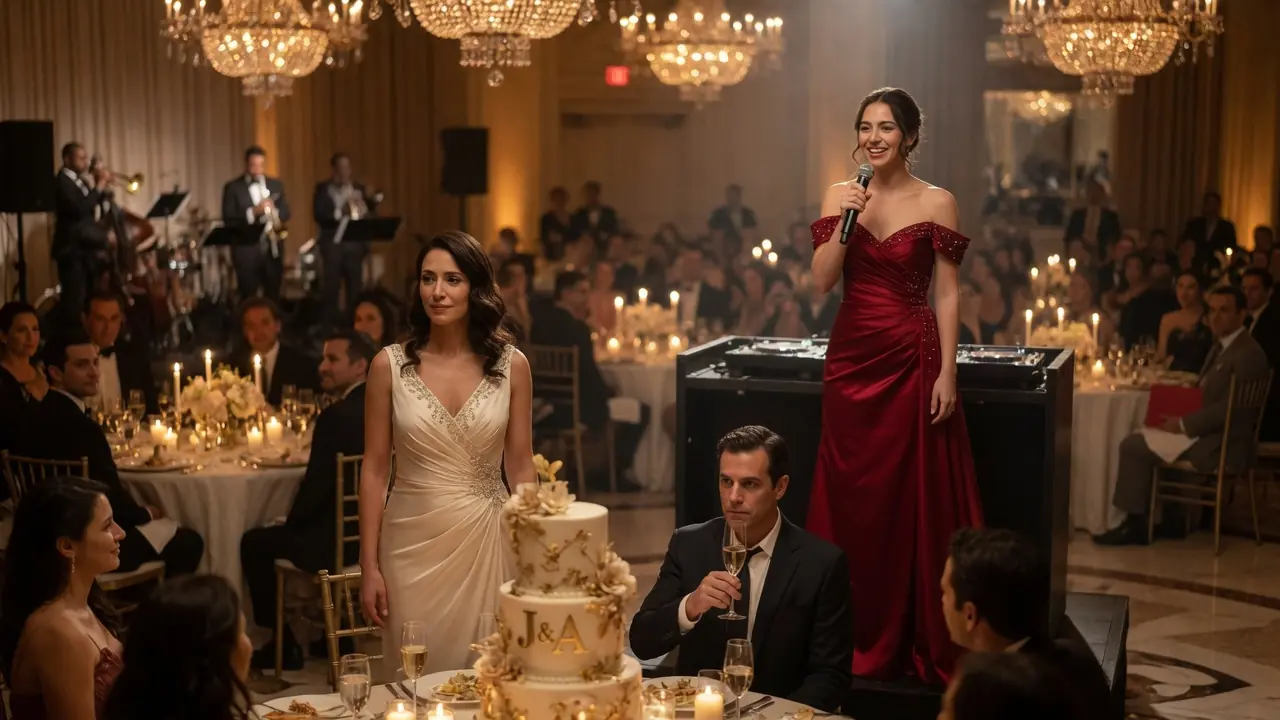
The venue was the Grand Regent Ballroom on 6th Avenue. I chose it because of the acoustics. It carries sound beautifully, and because it seats 300, and because I had always wanted our 10th anniversary celebration to be something people remembered. I hired Margo Events. I personally selected the centerpieces.
I chose the live band, a seven-piece jazz ensemble called The Parlor Seven, and approved the setlist. I commissioned a three-tier cake with our initials in gold leaf. I had monogrammed napkins made with the letter H for Hargrove, because I am that kind of detail-oriented. I called Grant two weeks before the event and told him what I needed from him. He was quiet for a moment.
That's an unusual request, he said. I know. Will you do it? Yes. There's something else, I said.
I need a second DNA analysis. I'll send you the sample I have. Another pause. A second one on who? A 12-year-old boy, I said.
His name is Oliver. I need to explain Oliver. I need to explain it carefully because it is the part of this story that I've never told anyone. Not my therapist, not my attorney, not even my mother. And it is the part that undoes everything I thought I understood about the last 12 years of my life.
When I was 26, I was pregnant. I was 6 months along. Eric and I were engaged. We had already bought the apartment. We had already picked a name, Clara, for my grandmother.
I was already in love with her in the specific and total way that you fall in love with someone you have never met. And then, at 26 weeks, something went wrong. My OB, Dr. Rachel Okonkwo, called it a placental abruption. It happened fast.
I was in surgery before I fully understood what was happening. Clara was born alive. She lived for 11 hours. I was told she died before I was fully out of anesthesia. Natalie was at the hospital.
My parents were there. Eric was there. They all told me the same thing. She was gone. They were so sorry.
It was the defining catastrophe of my life. The thing that changed everything before it. I believed for 12 years that I had buried my daughter. But here is the thing about grief that I know professionally. People do not always tell you the truth about what they have lost.
They tell you what they can bear. I had been going through old photos a year ago, clearing out a closet, the kind of mindless domestic archaeology you do without really expecting to find anything. And I came across a photograph from Natalie's first birthday party for Oliver. He was 1 year old. He is sitting on Natalie's lap, laughing at something out of frame.
He has my father's jaw, the exact sharp angle of it, the specific proportions. And on his chin, a small birthmark, slightly left of center, the same one I have on mine. I looked at that photograph for a long time. And then I did what I do at work when something doesn't add up and I can't let it go. I started pulling the thread.
I went back to Dr. Rachel Okonkwo, who has been in practice for 27 years and is the kind of physician who keeps meticulous records. I made an appointment under the pretense of requesting my full medical file for a new insurance policy. She had her office manager pull everything. I went home and read every page.
The abruption had happened. Clara had been born. She had lived for 11 hours in the NICU under the care of a neonatologist named Dr. Patel. All of that was documented.
What was also documented, two nurses had flagged something in their shift notes, not in the official record. In the handwritten supplementary notes that some nurses still keep as personal documentation and that are technically part of the file but rarely reviewed. One of the notes read, "Family contact requesting records access raw infant unusual circumstances consult with supervisor. " That note was dated 3 days after Clara's birth, 1 day before her death. I brought those notes to a healthcare attorney named Pamela Reyes who has been practicing medical law for 22 years and handles cases involving birth records, adoption, and what she carefully refers to as irregular pediatric circumstances.
I sat in her office and walked her through everything, the photo, the birthmark, the jaw, the nurse's note. Pamela Reyes did not blink. "You want a DNA analysis," she said. "I have a sample," I said. "Oliver is 12.
He played at my parents' house 2 weeks ago. My mother still saves the cups the grandchildren use. " I had taken the cup. I had sealed it in a freezer bag. I knew exactly what I was doing. "You also want to know what your legal rights are," she said.
"Before you act on whatever this test tells you. " "Yes, that's very smart," she said. I also retained a divorce attorney named Marcus Webb who had been recommended to me by a colleague and who has a reputation for the kind of meticulous financial preparation that turns contested divorces into foregone conclusions. Marcus is 44 years old, former litigation partner, currently runs his own boutique family law firm. He spent 3 weeks reviewing the documentation Grant had assembled as well as the joint financial records I provided. He's been drawing down the joint vacation account," Marcus told me.
"Incremental withdrawals, 3,200 here, 2,500 there, going back 14 months. " "For her? " I said. "Almost certainly. Restaurant charges, hotel stays, a few retail purchases, nothing obviously traceable on its own. But collectively," he turned his laptop to show me the spreadsheet, "it tells a story. " "It does," I said. I did not tell Marcus yet about Oliver.
I did not tell anyone about Oliver. I was waiting for the envelope. Grant called me 4 days before the party. "Both results are in," he said. "The paternity test on Oliver first," he told me.
I sat with that for a long moment. The number was there. 99.97% probability of maternity. The lab was Helix Genomics in New Jersey, one of the three largest independent DNA labs in the country. Dr.
Mark Strauss, laboratory director, had signed the report. I had already looked him up. 21 years running paternity and genealogy analysis, expert witness in 11 court cases, a man with institutional weight behind every signature he puts on a document. In the silence, I thought about my mother, about the 11 hours Clara lived, about Natalie, 23 years old, showing up at a hospital as my support system when she was already pregnant with Oliver. I thought about the timeline.
I thought about how carefully it would have had to be arranged, how many people would have had to agree to it or been paid or been afraid. I thought, this is bigger than an anniversary party. The second test, I said, on the baby. Grant told me the baby Natalie was carrying was not Eric's. I exhaled slowly.
Who is the father? A man named Jason Caldwell, 34, works in Natalie's building. She listed him on the invitation herself. You can check the RSVP spreadsheet. He had been invited to my anniversary party.
I actually did laugh then, just once, a short and quiet sound. The audacity of that, to invite the real father to the party where you plan to announce the baby as someone else's. To have all of that in motion at once and still believe you were the most prepared person in the room. She doesn't know you have the paternity results, Grant said. She thinks it's Eric's.
No, I said, she doesn't know. Are you going to tell me the full plan? I already told you the plan, I said. You sit at the back table in the gray suit. You bring the red folder.
You don't open it until I ask you to come up. The one for the current pregnancy. Yes, not the other folder. I paused. The other one stays in my coat pocket.
Grant was quiet for a moment. I could hear the particular silence of a man who has seen a great many things and is choosing his words carefully. Ms. Hargrove, when you're ready for that folder, and I don't mean tonight, my resources extend to other investigative areas, documentation, chain of custody, hospital access, whatever Pamela Reyes needs for a civil action. I know, I said, I know you can help with that.
But I need to open it first. I need to know before I decide what to do with it. That makes sense. Does it? I said, she's 12 years my daughter and I've never held her.
I want to be sure I'm deciding from the right place. Grant was quiet again for a moment. Then, you will be. The night of the party, I wore ivory. I had my hair done.
I ate a small dinner beforehand because I didn't think I would be able to eat at the party and I didn't want to feel fragile. I drove myself to the venue and arrived 30 minutes early and walked the room once alone with the house lights still up, checking everything. The tables were perfect. The napkins were perfect. The cake was perfect.
The band was doing their sound check in the corner, the horn section running scales, the bassist adjusting his monitor. I stood at the head table and looked at the room and thought, I built all of this. I chose every element. I am the architect of everything you're about to see. Eric arrived 20 minutes later looking handsome in his dark suit.
He kissed me and said I looked beautiful. I thanked him. I smiled at him. I was thinking about the joint account withdrawals, $3,200 at a time. Natalie arrived in the red dress at 7:15.
She hugged me hard at the door and kissed my cheek and said right into my ear, I love you so much, sis. She smelled like his cologne. You look beautiful, I told her. She did. She always had.
By 9:00 the room was full and warm. The band had been playing for 2 hours. The champagne had been flowing. People were dancing, laughing, the kind of party where everyone keeps saying they don't want it to end. I watched from the edge of the room.
I watched Eric hold court with my uncle by the bar. I watched Natalie circulate laughing, touching people's arms, being lovely and magnetic the way she always was. I watched a dark-haired man at a table near the center of the room, Jason Caldwell, whom I had never met in person, check his phone and laugh at something the woman next to him said. I watched Grant in his gray suit at the back table. He caught my eye once and did not nod, did not smile, just held the look for a moment.
He had the red folder under his arm. At 9:17, Natalie walked to the DJ booth. I had been expecting it. I had not been certain when, but I had known it was coming. She had not driven 2 hours to my anniversary party in a red dress for nothing.
She took the microphone right out of the DJ's hand. The music stopped. The room went quiet in that particular way, not sudden silence, but a wave of it, starting near the DJ booth and rippling outward until 300 people were all turned in the same direction. I have something to say to everyone here. My mother's face shifted from mild confusion to something careful and contained.
My father set down his drink. I'm pregnant with Eric's baby. She paused. She let it land. She had rehearsed this.
I could hear the rehearsal in it, the controlled breath before the pause, the slight lift of the chin. And then she turned and found me in the crowd and smiled. It was a triumphant smile, the smile of someone who has been waiting with great patience for the moment they could finally be bigger than you. My mother's wine glass hit the marble floor and shattered. The sound of it was clean and bright in the silence.
I stood up slowly. I smoothed my dress. I began to walk toward her. People were staring at me, 300 of them, waiting for me to cry, waiting for me to scream or run or collapse against a table, waiting for the performance of someone being destroyed. I walked to the front of the room at a normal pace.
My hands were steady. My face was neutral. Put it down, Natalie. No. She raised her chin.
The microphone made her voice fill the room. Everyone deserves the truth. She looked at me with something that might have been pity if it weren't so sharp. You couldn't give him a family, she announced, not to me, to the room. I can.
He chose me, Lauren. Her voice dropped almost to something intimate. You lost. Just accept it. This time I won.
This time. Something about those two words. I filed them away. We would come back to them. Are you finished?
I said. Because I need you to look at the back of the room. She turned. Grant was already moving. He walked from the back table toward the front of the room at a measured pace, unhurried, the way professionals walk when they know they don't need to hurry.
He did not make eye contact with anyone except me. Natalie's smile faltered. Who is that? I held out my hand. She gripped the microphone.
I pulled it from her hand, not rough, not a struggle, just steady and final. The man who's been holding something for me for 4 months. Grant opened the red folder. He removed one document, a sealed laboratory report, official letterhead, the kind of thing that looks exactly like what it is and cannot be confused for anything else, and handed it to me without ceremony. I held it up so Natalie could read it.
Her eyes moved across it. I watched her read. That baby isn't Eric's, I said. My voice was completely level. The microphone made it fill the room.
Natalie went pale. The father is in this room right now. I let that sit for 3 seconds. Three full seconds of silence in which 300 people did not make a sound. Three tables from where you're standing.
His name is Jason, your co-worker, the man you personally put on the guest list. Every head in the room turned at once in the direction I was looking. At the center table, a dark-haired man shot to his feet so fast his chair scraped back hard on the marble and nearly tipped. He didn't run. He just stood there, pale and fixed, staring at Natalie across the room.
She stared back. Their faces said everything. Somewhere in the room I heard a sound from Eric, a low sound. I didn't look at him. I had looked at him for 10 years and I was finished.
The microphone was still in my hand. I set it down on the cake table. I picked up the champagne glass I had set aside earlier. I turned to walk away and I stopped because my hand was in my coat pocket and my fingers had found the envelope that had been in that pocket for 3 weeks. I looked at my mother.
She was watching me. Her face was white. Her hands were very still on the table. She knew the envelope existed, not this specific envelope. She had no way of knowing about that, but she had always been afraid of something.
I understood that now. The fear had always been there in her face when she looked at me and then at Natalie and then back at me. I had always read it as maternal worry. I had been wrong. I looked at Natalie.
She was still standing at the front of the room. Her red dress, her beautiful face. Jason Caldwell still standing three tables away, not moving. She looked diminished. She looked like someone who had played a very long and very complicated game and had just discovered she had been playing a different game than she thought.
"Sis," I said quietly. The microphone was off. Only the people nearest to us could hear me. That was fine. This wasn't for the room.
"What? " she whispered. I held up the envelope. Her eyes moved to it. "Oliver is 12 years old," I said. "He was born the exact same week you told me my daughter had died. " The blood left her face completely.
"He has Dad's jaw," I said. "He has the birthmark on his chin. My birthmark. " I kept my voice low and even. "I have a DNA test in this envelope. I've been carrying it for 3 weeks. " She was shaking her head very slowly.
It was not a denial. It was the gesture of someone watching a structure they built over many years come down. "I haven't opened it yet," I said, "because once I do, that is a different conversation from everything that happened tonight. That is a conversation with Pamela Reyes in the hospital and possibly the police. That conversation doesn't happen in this ballroom.
I put the envelope back in my pocket. So, here's what I want you to think about tonight, I said, while you figure out how to explain to Jason that he's going to be a father, while Eric tries to remember if he has a lawyer, while you work out what to say to Dad, who is sitting right there and who I think already suspects something and has spent 12 years not letting himself know it. I glanced at my father. He had not moved. His face was a man looking at something he had been avoiding.
Think about Oliver, I said. Think about what he deserves to know and then call me. I took my champagne glass and walked to the exit doors. The Grand Regent Ballroom has a terrace off the east side that faces the park. I pushed through the door and stood in the October air and drank my champagne and listened to the muffled sounds of 300 people trying to understand what had just happened.
It was a beautiful night, clear and cold and very still. I did not feel triumphant. I want to be honest about that. I felt something quieter and harder. The particular kind of exhaustion that settles after you have been holding something very heavy for a very long time and you have finally been allowed to set it down.
I thought about Clara. I thought about her 11 hours. I thought about whether she had been held, whether someone had held her in that NICU before whatever happened, whatever Natalie arranged, whatever my mother may or may not have known. I thought about a nurse writing a careful note in the margins of a shift report because something felt wrong and she wanted it documented. I thought about Oliver, asleep somewhere tonight, 12 years old, with my father's jaw and my birthmark and no idea what the next year of his life was going to look like.
I thought about the envelope in my pocket and I thought, whatever is in here, he is a child. He did not choose any of this and what I do with this is about him, not about me. That was the decision I had not yet made, the one I had been carrying for 3 weeks. The balcony door opened behind me. I didn't turn around.
My father's footsteps. I knew them. I had known them my whole life. He stood beside me. He looked out at the park for a long moment, a long moment in which I could feel the weight of what he wasn't saying pressing against the space between us like something physical.
Finally, he said very quietly, how long have you known? About Eric and Natalie? 4 months. And the other thing? The city lights reflected off the park below.
A cab moved slowly along the avenue. Someone's music carried faintly from an open window in the building across the way. "I've had suspicions for a year," I said. "The DNA test for 3 weeks. " He didn't say anything. "I haven't opened it," I said.
He nodded. "Dad," I turned to look at him. "What happened in that hospital? " He looked older than he had ever looked to me. The particular aging that happens when a secret finally finds the air. "Your mother was afraid," he said.
"She was afraid you were too young and that Eric wasn't ready and that you were going to be alone with a baby and Natalie was Natalie had made a mistake and she needed He stopped. "That isn't an excuse. I know that. " "No," I said, "it isn't. " "Your daughter lived," he said. "I need you to know that. She was healthy.
She was" His voice broke. "She's healthy. She's been healthy her whole life. " I put my hand in my coat pocket and felt the envelope. "I know," I said. We stood there together for a while longer, my father and I, in the October air.
Behind us, through the ballroom doors, I could hear the party ending in the way that things end after something irreversible. Not all at once, but slowly, with a kind of bewildered confusion, the way a tide goes out. I took the envelope out of my pocket. I held it for a moment. Then I opened it.
6 months later, the legal proceedings are ongoing. Pamela Reyes filed a civil action in February against the hospital and two named individuals. I am not permitted to say who those individuals are while the case is active, but Pamela says the documentation is strong and the nurse's supplementary notes have been authenticated. The hospital is being deliberately unhelpful, which Pamela says is expected and which she has handled before. There are two former NICU nurses who have agreed to speak with investigators.
There is a paper trail. There is always a paper trail if you know where to look. And I have been a very thorough reader my whole life. My divorce from Eric was finalized in April. Marcus Webb is very good at his job.
The joint account withdrawals were logged as exhibit C in the financial disclosure. The hotel records were exhibit F. I kept the apartment. Eric signed over his interest in the joint investment portfolio in exchange for a faster resolution. He has not reached out to me since the papers were signed.
I don't think about him as much as I expected to. The grief I carry isn't really about him. It never was. Natalie has not called me. I did not expect her to.
She and Jason Caldwell are, I don't know the word, in contact, figuring out what they are to each other. She is 7 months pregnant. My mother keeps me updated, which is its own complicated thing. Oliver has been told, carefully and in stages, by a family therapist named Dr. Christine Aldworth, who has 20 years of experience in pediatric trauma and parental identity disclosure.
She works out of an office on the Upper West Side with plants in the windows and a corner chair that he apparently always sits in. He knows that I am his biological mother. He knows that there was a hospital and a decision that was made and that it was wrong. He doesn't know all of the specifics yet. Dr.
Aldworth says he is processing it the way 12-year-olds process enormous things, in bursts, then weeks of apparent normalcy, then another burst. He has a lot of feelings about his mother, about Natalie. So do I, actually, and mine are complicated and I am not going to resolve them quickly. He asks about me sometimes. Dr.
Aldworth passes that along. We haven't met yet, not formally, not as what we actually are to each other. That is coming. The timing is hers to control, not mine. Jason Caldwell has retained his own attorney.
He is involved. He is trying. I don't have opinions about him yet. My parents and I are in therapy together, the three of us, with a woman named Dr. Beatrice Holland, who has a very direct manner and doesn't let anyone be comfortable for long.
It is not a comfortable process. My father talks more than my mother. My mother cries sometimes and then apologizes for crying and Dr. Holland tells her she doesn't need to apologize. I bring a book to every session and never open it.
It is a habit I developed during those 4 months when I was waiting and there was nothing to do but be patient. Right now, I'm reading Middlemarch. I recommend it. There is a thing about revelation, real revelation, the kind that restructures everything, that no one tells you beforehand. It doesn't feel like clarity.
It feels like standing in a room where all the furniture has been moved and you have to learn the space again from scratch. You keep reaching for things that aren't where you put them. You keep having the ghost sensation of the layout you knew. I am learning the new layout. I am doing it without hurrying.
And in my coat pocket, folded carefully, I still carry the DNA results from the Helix Genomics Lab. Not because I need to look at them again. I have read them so many times the paper has a crease across the center from folding and unfolding. I know what they say. I carry them because Oliver is 12 years old and he didn't choose any of this.
And the thing I decided on that terrace in October is the thing I am still deciding every single day. How to do this gently enough that he survives it. How to do this thoroughly enough that the truth is never buried again. How to be someone's mother when you have been kept from it for 12 years. When you have mourned them and carried the mourning inside you like a permanent stone.
When the only proof you had was a photograph of a jaw and a birthmark and you had to build the rest yourself from scratch. One decision at a time. He has my grandmother's name as his middle name, Clara. Natalie gave it to him. I don't know if she chose it deliberately or if it was just a name she loved and she never quite let herself think about why.
I think about that sometimes. I think she knew in some part of herself that she never let speak too loudly that she had done something that could not be repaired. And I think she carried that. I think carrying it made her worse over time, not better. The way unfaced things always do.
I'm not interested in her guilt, but I think about Oliver carrying a piece of my grandmother's name through his whole life and I think something in her was trying to give something back. It's not enough. It doesn't come close to enough, but it is the thing I come back to when the grief gets very heavy. When I think about 11 hours in a NICU and a nurse who wrote a careful note in the margins.
When I think about 12 years of a Sunday dinner table and a hug at the door and perfume that wasn't mine. I come back to the name and I think she's been mine this whole time. I just didn't know where to find her. Now I do.