My eight-months-pregnant neighbor showed up at our front door just after midnight with one arm hanging at an unnatural angle and blood running from her split lip.
She was barefoot.
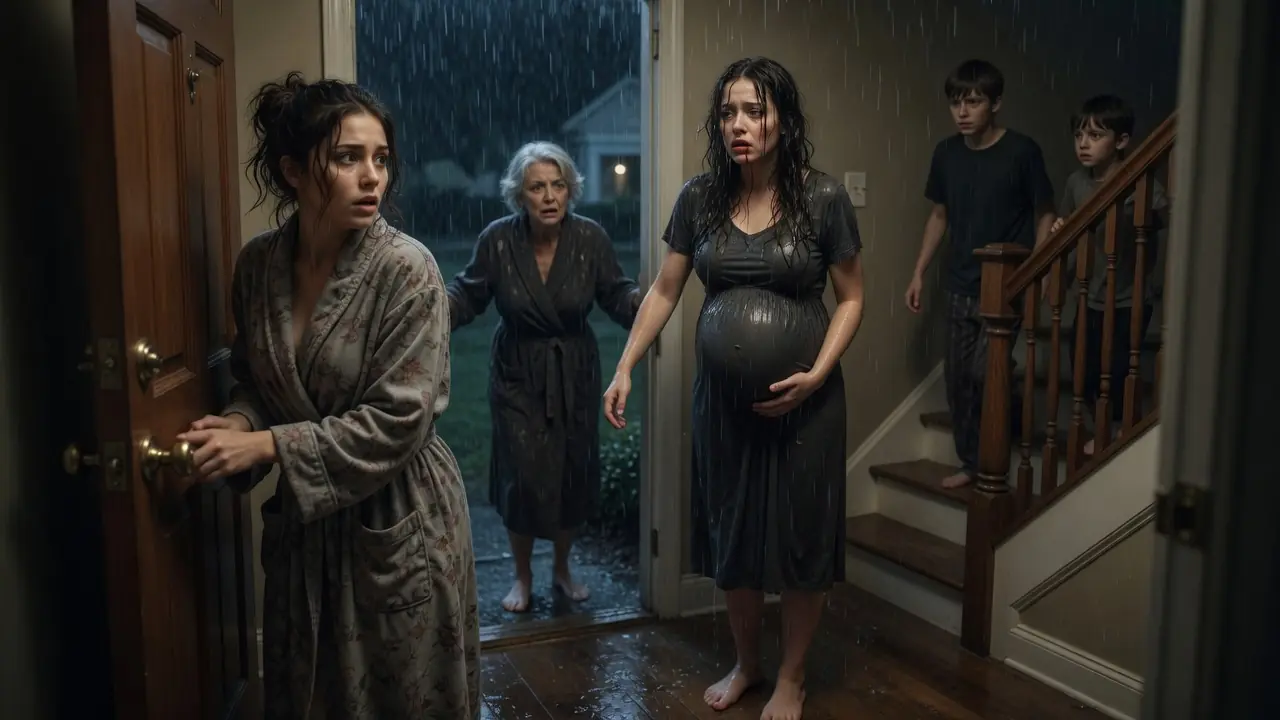
Rainwater streamed from her hair, soaked through the thin cotton nightgown stretched across her belly, and gathered in a dark puddle beneath her feet. She had one hand pressed protectively over her unborn child while the other arm remained pinned against her side, swollen and useless.
“Please,” she gasped. “Please don’t let him find me.”
I had barely taken one step toward her when my mother-in-law shoved past me.
Marjorie looked the woman up and down with cold disgust.
“Get away from my house,” she snapped. “We don’t shelter trash.”
My neighbor’s name was Leah Morrison.
She lived three doors down with her husband, Grant, in the pale-yellow house with white shutters and a perfectly trimmed lawn. They had moved into our neighborhood six months earlier, and from the outside, they appeared to have the kind of life people envied.
Grant drove a polished black SUV, wore expensive suits, and waved to everyone as he left for work each morning. Leah rarely came outside except to collect the mail or water the hydrangeas. Whenever I saw her, she smiled quickly and disappeared back inside.
That night, there was no smile.
Only terror.
“Marjorie,” I said, stepping between them. “She needs a hospital.”
“She needs to go home and deal with her husband,” Marjorie replied.
Leah flinched at the word husband.
“He broke my arm,” she whispered.
Marjorie’s face did not change.
“Then you should have chosen better.”
My husband, Nathan, appeared at the top of the stairs wearing sweatpants and a faded college T-shirt. He looked from his mother to Leah and froze.
“What happened?”
“Nothing that concerns us,” Marjorie said.
Leah swayed.
I caught her before she fell.
The moment my hands touched her shoulders, she cried out in pain. Her skin felt icy despite the warm summer air, and beneath my palm, her body trembled hard enough to shake us both.
“Call 911,” I told Nathan.
“No!” Leah screamed.
The force of it startled all of us.
She grabbed the front of my robe with her good hand.
“No police. Please. He knows people. He’ll find me before they even finish asking questions.”
Marjorie folded her arms.
“There. You see? She doesn’t want real help. She wants attention.”
I turned on her.
“She is injured and eight months pregnant.”
“And we have a child sleeping upstairs.”
My seven-year-old son, Caleb, stood behind Nathan on the landing.
He clutched the wooden railing, his eyes wide.
Marjorie pointed toward him as though his presence proved her argument.
“You want to bring this chaos into his home?”
“This is my home,” I said.
Her mouth tightened.
Marjorie had been living with us for four months, ever since a fall in her apartment left her with a fractured hip. Nathan and I converted our downstairs office into a bedroom, rearranged our work schedules, and endured her constant criticism because she was family.
But she had a habit of saying “our house” whenever she wanted authority and “your house” whenever she wanted distance from responsibility.
Leah’s knees buckled again.
I guided her toward the entry bench.
“We need to get you somewhere safe.”
“I can’t go to the hospital under my name,” she whispered.
“Why?”
She looked toward the street.
Through the rain, headlights moved slowly past our house.
Leah ducked instinctively.
The vehicle continued down the block.
Nathan came downstairs and shut the curtains.
“Was that him?”
“I don’t know.”
His voice softened.
“Leah, did Grant do this?”
She nodded.
“Has he hurt you before?”
Another nod.
Marjorie made an impatient sound.
Nathan looked at his mother.
“Please stop.”
“She is going to drag this family into something dangerous.”
“She already is,” Leah whispered.
We all turned toward her.
“What does that mean?” I asked.
She stared at Marjorie.
For a moment, something passed between them.
Recognition.
Not the ordinary kind between neighbors.
Something sharper.
Marjorie’s face lost a little color.
“I don’t know what she’s talking about.”
Leah looked down.
“I need to leave.”
“No,” I said. “You can barely stand.”
She pushed herself up anyway.
Marjorie opened the door.
“Then let her.”
Rain blew across the floor.
Leah stood at the threshold with her back curved around her belly. She looked so small despite being heavily pregnant, a frightened woman being sent back into the dark by someone who had decided her suffering was inconvenient.
I thought about Caleb watching from the stairs.
I thought about what lesson he would carry if I remained silent.
I grabbed my winter coat from the hallway closet and wrapped it around Leah’s shoulders.
Then I stepped outside with her.
“Rachel,” Nathan called after me.
“Take Caleb upstairs.”
“What are you doing?”
“Helping her.”
Marjorie stared at me from the doorway.
“If you leave with that woman, don’t bring her trouble back here.”
I reached into the pocket of my coat hanging beneath Leah’s chin.
My emergency cash was there.
Two hundred dollars.
It was the last money we had until Nathan’s paycheck arrived on Friday. We needed it for groceries, gas, and Caleb’s asthma medication.
“There’s a twenty-four-hour motel near the bus station,” I whispered. “Use my name if you have to. Call this number when you’re safe.”
I wrote my cell number on the back of a grocery receipt.
Her fingers closed around it.
“I can’t take your money.”
“Yes, you can.”
“You don’t understand.”
“Then explain when you’re safe.”
Her face twisted.
“I’m sorry.”
“For what?”
She looked past me toward Marjorie.
“For coming here.”
A car turned onto our street.
Leah panicked.
She stumbled down the walkway and disappeared between two houses before I could stop her.
I stood in the rain, listening for a scream.
None came.
When I returned inside, Marjorie slammed the door behind me.
“You gave her money.”
“Yes.”
“Our money.”
“My money.”
“You do not earn enough to throw cash at every woman who refuses to leave a bad man.”
The cruelty of that sentence left me speechless.
Nathan stepped between us.
“Mom, go to your room.”
She stared at him.
“You’re choosing her over me?”
“I’m choosing basic human decency.”
Marjorie’s face hardened.
“One day, you will understand why I did what I did.”
She limped toward the downstairs bedroom and shut the door.
Nathan turned to me.
“Did you get a plate number?”
“No.”
“We should still call the police.”
“She begged us not to.”
“She has a broken arm.”
“I know.”
“And Grant may be looking for her.”
“I know.”
He lowered his voice.
“Rachel, what if he comes here?”
I looked toward the stairs.
Caleb was gone, but his bedroom door remained open.
Fear entered me belatedly.
“I don’t know.”
Nathan locked every door and checked the windows twice. We called the local domestic violence hotline without giving Leah’s full name. The advocate advised us to contact emergency services if she returned or if we believed her life was in immediate danger.
We barely slept.
At five-thirty, my phone rang.
The number was blocked.
I answered immediately.
“Leah?”
Only breathing came through.
“Are you safe?”
A man’s voice spoke.
“Where is my wife?”
I sat upright.
Nathan opened his eyes beside me.
“Who is this?”
“You know who I am.”
Grant’s voice sounded calm.
That frightened me more than shouting would have.
“I haven’t seen Leah.”
“Don’t lie to me, Mrs. Bennett.”
My stomach tightened.
“How do you know my name?”
“You live three doors from me. I know everyone on this street.”
Nathan sat up.
I put the call on speaker.
Grant continued.
“My wife is ill. She becomes confused when she stops taking her medication.”
“You broke her arm.”
A pause.
“She told you that?”
“She arrived bleeding.”
“Leah hurts herself.”
Nathan leaned toward the phone.
“Do not contact us again.”
Grant laughed softly.
“Nathan. I’m glad you’re there.”
My husband froze.
Grant knew his name too.
“She is carrying my child,” Grant said. “If you help her hide, and anything happens to that baby, you will be responsible.”
“You’re responsible for what happened to her,” I replied.
“Be careful making accusations.”
The line went dead.
We called the police.
Two officers arrived twenty minutes later. We told them everything, including Leah’s injuries and Grant’s call.
One officer, a broad man named Benson, took notes. The other remained near the window, looking toward the Morrison house.
“Have you seen Mrs. Morrison enter a vehicle?” Benson asked.
“No.”
“Do you know where she went?”
“No.”
“Did she say where the assault occurred?”
“At home, I assume.”
“You assume?”
“She said her husband broke her arm.”
Benson’s expression remained neutral.
“We’ll speak with Mr. Morrison.”
“Will you search for her?”
“We’ll issue an alert to hospitals and patrol units.”
“She was barefoot and injured.”
“We understand.”
But his tone suggested something else.
Routine domestic dispute.
Unverified accusation.
No body, no visible suspect, no urgency.
Before leaving, Benson said, “Mr. Morrison claims his wife has a history of psychiatric episodes.”
“You already spoke to him?”
“He called before you did.”
That silenced us.
“He reported her missing at twelve-thirty,” Benson continued. “He said she became violent and left after striking him.”
“Did you see any injuries on him?”
The officer did not answer directly.
“He provided medical documentation regarding her condition.”
“What condition?”
“We cannot disclose that.”
I felt suddenly trapped inside Grant’s version of reality.
“Officer, she had a visibly broken arm.”
“We have no medical confirmation.”
“I saw it.”
“We’ve documented your statement.”
After they left, Nathan closed the door.
“They believe him.”
“I know.”
“Why?”
“Because he called first.”
Marjorie entered the hallway, fully dressed despite the early hour.
“Because he is telling the truth.”
I turned slowly.
“What did you say?”
She avoided my eyes.
“You know nothing about that woman.”
“And you do?”
Marjorie walked toward the kitchen.
“People like Leah create disaster, then convince everyone they’re victims.”
Nathan followed her.
“Mom, how do you know her?”
“I don’t.”
“You looked at each other last night like you did.”
“You’re imagining things.”
“Grant knew our names,” I said.
“We’re neighbors.”
“He knew Nathan was listening before Nathan spoke.”
That stopped her.
Only briefly.
“He probably heard you.”
“Through the phone?”
Marjorie opened the refrigerator.
“This is becoming ridiculous.”
Nathan shut the refrigerator door.
“Tell us the truth.”
His mother’s expression became cold.
“I already did.”
For the next six days, Leah disappeared.
No hospitals admitted anyone matching her description. Police found no trace of her at local shelters, bus stations, or motels.
Grant spoke to reporters from his front lawn.
He wore a pale-blue shirt, no tie, and the expression of a grieving husband.
“My wife is eight months pregnant and emotionally fragile,” he said into the cameras. “I just want her and our baby home safely.”
He showed a photograph of Leah smiling beside a Christmas tree.
The news report mentioned her history of “severe anxiety and self-harm,” citing family sources.
No one mentioned the broken arm.
When I called the station, Officer Benson said the investigation remained open.
“Have you searched Grant’s house?”
“We cannot discuss investigative steps.”
“Did you see blood?”
“Mrs. Bennett—”
“Did you examine him for injuries?”
“Please let us do our job.”
Each day, Grant’s story grew stronger.
A neighbor told reporters she once heard Leah screaming inside the house. Another claimed she had seen Leah wandering barefoot months earlier.
None mentioned Grant’s anger.
None mentioned the bruises I had sometimes noticed beneath Leah’s long sleeves.
I began doubting myself.
Not about the injuries.
About everything surrounding them.
Had Leah manipulated me?
Could her arm have been hurt some other way?
Had fear made her story appear clearer than it was?
Nathan saw the doubt.
“Don’t do that,” he said.
“Do what?”
“Let his certainty erase what you saw.”
“But what if she is mentally ill?”
“She can be mentally ill and still be abused.”
I looked toward Marjorie’s closed bedroom door.
“She knows something.”
“Yes.”
“What?”
“I don’t know.”
Marjorie barely left her room during the week.
She ate meals alone and stopped correcting the way I loaded the dishwasher, which frightened me more than criticism.
On the seventh morning, she burst into our bedroom without knocking.
Her face was white.
Not pale.
White.
She held a folded newspaper in one hand and shook so violently that the pages rattled.
Nathan sat up.
“Mom?”
Marjorie looked at me.
Then she whispered the sentence none of us expected.
“Leah is my daughter.”
The room became perfectly still.
Nathan stared at his mother.
“What?”
Marjorie lowered herself into the chair near our dresser.
“My first child.”
Nathan laughed once, sharply.
“That’s not possible.”
“It is.”
“You have one child.”
“No.”
Her eyes filled.
“I had a daughter before you.”
I pulled the blanket around myself.
“Why did you call her trash?”
Marjorie flinched.
“I panicked.”
“You knew she was being abused.”
“I knew what she was capable of.”
Nathan stood.
“She showed up with a broken arm.”
“You don’t understand.”
“Then help us understand.”
Marjorie placed the newspaper on the bed.
A small article near the bottom of the page announced that police had found an abandoned vehicle belonging to Leah Morrison near a reservoir outside town.
Blood was discovered in the back seat.
No body had been recovered.
“I thought Grant would take her home,” Marjorie said.
“You wanted him to take her?” I asked.
“He promised me he would manage her.”
The wording made my stomach turn.
“Manage her how?”
Marjorie began crying.
“I met Grant before he met Leah.”
Nathan’s face tightened.
“What does that mean?”
“He contacted me six years ago.”
“Why?”
“He was looking for her birth family.”
I stared at her.
“You gave Leah up for adoption.”
“Yes.”
Marjorie was seventeen when she became pregnant. Her parents sent her to a maternity home in another state, where she delivered a baby girl and signed adoption papers before seeing the child’s face for more than a minute.
She returned home and was told never to speak of it.
Years later, she married Nathan’s father and had a son.
“I searched for Leah after my husband died,” Marjorie said. “I found that she had been adopted by a family in Ohio and changed her name after college.”
“Did you contact her?”
“No.”
“Why not?”
“She had a life.”
Nathan paced near the bed.
“Then how did Grant find you?”
“He said he was helping Leah research her biological family.”
“He contacted you without telling her?”
“At first.”
“What did he want?”
“Medical history.”
Marjorie described their first meeting at a restaurant.
Grant was charming, attentive, and deeply concerned about Leah’s anxiety. He claimed she had episodes of paranoia, rage, and self-injury.
“He asked whether mental illness ran in my family,” she said.
“Does it?” I asked.
“My mother suffered from depression.”
“That’s all?”
Marjorie looked away.
“My sister was hospitalized twice.”
Grant used those details to convince Marjorie that Leah’s behavior came from inherited illness.
Over time, he called more often.
Whenever Leah accused him of controlling her finances, isolating her, or hurting her, Grant contacted Marjorie first.
“He said she had begun inventing abuse stories,” Marjorie whispered.
“And you believed him,” Nathan said.
“Yes.”
“Did you ever speak to Leah?”
“Twice.”
“What did she say?”
“That Grant was dangerous.”
Nathan stared at his mother in disbelief.
“And you still believed him?”
“He had documents. Hospital records. Police reports.”
“Real ones?”
“I thought so.”
“What happened when Leah moved into our neighborhood?” I asked.
Marjorie wiped her face.
“Grant arranged it.”
The room went cold.
“He knew you lived here,” Nathan said.
“Yes.”
“Why would he move near us?”
“He said familiar family might stabilize her.”
“Did Leah know you were her mother?”
“Not when they moved.”
“When did she find out?”
“Three months ago.”
I remembered Leah’s quick smiles, her retreat from the sidewalk, and the strange recognition in her eyes at our door.
“She came to see you,” I said.
Marjorie nodded.
“She confronted me while you were at work.”
“What did she want?”
“To know why I had been speaking with Grant behind her back.”
“What did you say?”
“That I was trying to help.”
“Did she believe you?”
“No.”
Leah told Marjorie that Grant had used her adoption history to isolate her.
He claimed her birth mother agreed she was unstable.
He recorded calls with Marjorie and played edited pieces during arguments.
“He made her think you chose him over her,” I said.
Marjorie began sobbing.
“I did.”
The brutal honesty silenced us.
“Why did you reject her at our door?” Nathan asked.
“I thought she had attacked him.”
“She was bleeding.”
“Grant called me ten minutes before she arrived. He said Leah had struck him with a lamp and fled.”
“You knew she was coming?”
“No.”
“But when she arrived, you believed his story over what you saw.”
Marjorie covered her face.
“I was afraid she would destroy your family too.”
Nathan stepped backward.
“She is my sister.”
“Yes.”
“And you let her walk into the night injured because you wanted to protect me from her.”
“I thought—”
“You thought you had the right to decide which child deserved protection.”
Marjorie’s shoulders shook.
I wanted to hate her.
Part of me did.
But beneath the cruelty stood a seventeen-year-old girl trained to believe shame should be hidden, later manipulated by a man who understood exactly how to use it.
Understanding did not excuse her.
It made the betrayal more complicated.
“We have to tell the police,” I said.
Marjorie’s head lifted sharply.
“No.”
“What else are you hiding?”
“Grant will know I spoke.”
“He already knows you’re connected.”
“You don’t understand what he can do.”
Nathan picked up his phone.
“Then tell us before I call.”
Marjorie’s face crumpled.
“Leah gave me something.”
“When?”
“The afternoon before she came here.”
“What?”
“A flash drive.”
“Where is it?”
“In my room.”
Nathan left immediately.
Marjorie grabbed his wrist.
“You cannot give it to the police.”
“Why?”
“She said there were officers on Grant’s payroll.”
I remembered Benson’s calm dismissal and the speed with which police accepted Grant’s psychiatric narrative.
“What is on the drive?” I asked.
“She wouldn’t tell me. She said if anything happened, I should give it to a federal investigator or a reporter.”
“And you hid it?”
“I was afraid.”
Nathan pulled free.
“We have spent a week wondering whether my sister is dead while evidence sat in this house.”
Marjorie stood.
“I didn’t know if it was real.”
“You didn’t want it to be real.”
He walked downstairs.
We found the flash drive taped beneath the bottom drawer of Marjorie’s dresser.
Nathan wanted to open it immediately.
I stopped him.
“If Grant has someone monitoring access, plugging it into our computer could alert him.”
“That sounds paranoid.”
“So did Leah.”
We contacted a domestic violence organization in another county. An advocate connected us with an attorney named Dana Ruiz, who had previously worked as a federal prosecutor.
Dana arrived that afternoon with a cybersecurity specialist.
They copied the drive using an isolated computer.
What appeared on the screen changed the investigation completely.
Leah had collected hundreds of files.
Photographs of bruises.
Audio recordings of Grant threatening her.
Copies of bank records showing he had transferred money from her inheritance into shell companies.
Emails between Grant and a psychiatrist who provided false evaluations without examining her.
Police reports written before incidents allegedly occurred.
And recordings of his conversations with Marjorie.
In one, Grant said, “Leah needs to understand that even her real mother knows she is unstable.”
Marjorie replied, “I never said she was unstable.”
“You said mental illness runs in the family.”
“My sister was ill. That does not mean Leah is.”
Grant’s voice became colder.
“You wanted to protect your son, didn’t you?”
“Yes.”
“Then keep Leah away from him. If she gets close, she will poison his family the way she poisons everything.”
The recording ended.
Marjorie looked physically sick.
“He edited out my objections.”
Dana opened another folder.
Inside were files connected to several women.
Not only Leah.
Grant had been married before.
Twice.
His first wife died in what police classified as an accidental fall.
His second disappeared after filing for divorce. Grant claimed she moved overseas, but no verified records placed her outside the country.
Leah had been investigating him for more than a year.
“She knew he might kill her,” I whispered.
Dana nodded.
The final audio file was recorded the night she came to our door.
Grant’s voice shouted in the background.
“You think your mother will save you? She didn’t want you when you were born, and she doesn’t want you now.”
A crash followed.
Leah cried out.
Then Grant said, very calmly, “When I’m finished, everyone will believe you did this to yourself.”
The recording stopped.
Nathan walked out of the room.
I followed him to the backyard.
He stood near the fence, breathing hard.
“My mother sent her away.”
“Yes.”
“She came to us because she thought one person in this family might believe her.”
“You did.”
“Too late.”
“We don’t know that.”
He turned toward me.
“There was blood in the car.”
“She escaped once already.”
“With a broken arm, eight months pregnant, and two hundred dollars.”
The money.
I suddenly remembered something.
The motel.
I called the motel near the bus station.
The night clerk said no woman matching Leah’s description had checked in under my name.
“Can you search the room records from last week?”
“I’m not authorized.”
I asked for the manager.
After explaining that the police were searching for a missing pregnant woman, he checked.
One room had been paid in cash by a woman using the name Rachel Bennett.
My name.
“She stayed?” I asked.
“One night.”
“Was she alone?”
“The clerk remembers a man coming around three in the morning.”
My heart stopped.
“What man?”
“She thought he was a paramedic. He wore medical scrubs.”
Grant owned no medical uniform that I knew of.
But his brother, Eric, worked as an emergency-room technician.
The drive contained messages between them.
Eric had searched hospital systems for Leah’s records, accessed confidential medical information, and helped Grant track shelter admissions.
Dana called the federal agent she trusted.
Within hours, the case moved beyond the local police.
Grant’s house was searched that evening.
He was not there.
Neither was Eric.
In the garage, investigators found restraints, sedatives, and traces of Leah’s blood.
They also found a hidden room behind a storage wall.
Inside were identification documents belonging to Grant’s former wives.
The local police chief held a press conference announcing that Officer Benson had been placed on leave pending investigation.
His bank records showed regular payments from one of Grant’s shell companies.
Marjorie watched the news from our sofa.
Every new fact seemed to age her.
“I handed her back to him,” she whispered.
Nathan did not comfort her.
Neither did I.
Some pain must be witnessed without being relieved.
The search expanded across three states.
Investigators traced Eric’s phone to a cabin near the reservoir where Leah’s car was found.
Federal agents surrounded the property before dawn.
Grant was arrested while trying to leave through the woods.
Eric surrendered inside.
Leah was not there.
The cabin contained blood, medical supplies, and a makeshift delivery area.
Investigators believed Grant intended to force an early birth and then claim Leah died during a psychiatric episode.
But there was evidence someone had escaped through a bathroom window.
A strip of bloodstained fabric caught on a nail.
Bare footprints led toward the trees.
Search teams followed them to the reservoir, where they disappeared near the water.
For two days, divers searched.
No body was found.
Hope became torture.
On the third day, a park ranger reported that food and blankets had disappeared from an emergency shelter six miles north of the cabin.
Dogs tracked a scent toward an abandoned church.
Nathan and I waited at home with Marjorie while agents searched.
At four in the afternoon, Dana called.
“They found her.”
I stopped breathing.
“Alive?”
“Yes.”
Nathan sat down hard.
Marjorie made a sound that seemed pulled from somewhere below speech.
“Is the baby alive?” I asked.
“Leah is in labor.”
We drove to the federal hospital under escort.
Leah had survived four days in the woods with a broken arm and a deep cut along her thigh. She reached the emergency shelter, treated herself with supplies stored there, and hid because she believed Grant still controlled local law enforcement.
When rangers found her, her contractions were three minutes apart.
Doctors rushed her into surgery.
Marjorie stood outside the operating room, staring at the doors.
“I should leave,” she said.
Nathan looked at her.
“Why?”
“She won’t want me here.”
“That should be her decision.”
The sentence carried everything.
Marjorie nodded and sat.
The surgery lasted an hour.
A nurse emerged smiling.
“Mother and baby are stable.”
I began crying.
Nathan wrapped his arms around me.
Marjorie remained still.
“Boy or girl?” she asked.
“A boy.”
“Can we see her?”
“Only one visitor at first. She asked for Rachel Bennett.”
Marjorie closed her eyes.
I entered alone.
Leah lay in a hospital bed with her arm stabilized and bandages across her face. She looked exhausted, bruised, and more alive than anyone I had ever seen.
A tiny baby rested inside a clear bassinet beside her.
“You found the drive,” she said.
“Yes.”
“My mother kept it?”
“Yes.”
Leah laughed weakly.
“I didn’t think she would.”
“She almost didn’t.”
“I know.”
I moved closer.
“Why did you use my name at the motel?”
“Because I wanted someone to know I had tried to trust you.”
My eyes filled.
“I’m sorry you were alone.”
“You came outside.”
“It wasn’t enough.”
“It was more than anyone else did.”
She looked toward the baby.
“I used the money for the motel and a rideshare. Eric found me because he had access to the motel cameras.”
“How did you escape the cabin?”
“Grant underestimated what a woman will do when he threatens her child.”
Her voice held no pride.
Only truth.
“He sedated me, but not enough. When Eric left to get supplies, I hit Grant with a lamp and climbed through the bathroom window.”
Even injured and pregnant, she ran through miles of woods.
“I kept thinking about your coat,” she said.
“My coat?”
“It smelled like laundry soap.”
She smiled faintly.
“It reminded me that there were houses where people washed clothes, made dinner, and didn’t have to calculate whether every sound meant danger.”
I took her hand carefully.
“What happens now?”
“Now I testify.”
“Grant is going to prison.”
“He always said no one would believe me.”
“They do now.”
Leah looked toward the door.
“Is Marjorie here?”
“Yes.”
Fear and anger crossed her face.
“She called me trash.”
“I know.”
“She chose him.”
“Yes.”
“Does she feel bad?”
“Yes.”
“That isn’t enough.”
“No.”
Leah studied me.
“You don’t defend her.”
“I understand some of what happened to her. That does not undo what she did to you.”
Tears slid toward her ears.
“I wanted her to open the door.”
“I know.”
“I spent thirty-six years imagining my mother.”
I squeezed her fingers.
“She cannot become that imagined woman.”
“No.”
“But perhaps she can become something else, if you decide she gets the chance.”
Leah looked at her baby.
“What did she name me?”
“What?”
“When I was born.”
I had never asked.
I returned to the hallway.
Marjorie stood immediately.
“Is she all right?”
“She asked what name you gave her.”
Marjorie’s face collapsed.
“Grace.”
Nathan looked at his mother.
“You named her?”
“For the one minute they let me hold her.”
Marjorie pressed both hands against her chest.
“I whispered Grace because I hoped the world would give her what I couldn’t.”
Leah heard the answer through the partly opened door.
“Tell her to come in,” she said.
Marjorie entered slowly.
She stopped several feet from the bed.
Leah looked at her.
“You called me trash.”
Marjorie began crying.
“Yes.”
“You knew he hurt me.”
“I believed his lies because they protected me from admitting what I had done.”
“You gave me away.”
“Yes.”
“And then you did it again.”
The sentence broke something in the room.
Marjorie sank into the visitor’s chair.
“Yes.”
She did not explain.
Did not mention being seventeen.
Did not mention her parents, shame, Grant’s manipulation, or fear for Nathan.
For once, she allowed the harm to stand without surrounding it with reasons.
“I am sorry,” she said.
Leah’s face tightened.
“I don’t forgive you.”
“I understand.”
“I may never call you Mom.”
“I understand.”
“You don’t get to hold him.”
Marjorie looked toward the baby.
Pain crossed her face.
“I understand.”
Leah closed her eyes.
“But you can sit there until I wake up.”
Marjorie lowered her head.
“I will.”
It was not reconciliation.
It was the smallest possible opening.
A chair beside a bed.
Permission to remain without being welcomed closer.
Grant’s trial began nine months later.
The evidence revealed a pattern spanning nearly two decades.
He targeted women with family fractures, mental health histories, inheritances, or limited support systems. He isolated them, controlled their records, and built evidence portraying them as unstable.
His first wife’s “accidental” fall was reclassified as homicide.
His second wife’s remains were found beneath concrete at a property owned by one of his companies.
Officer Benson pleaded guilty to accepting bribes and falsifying reports.
Eric testified against his brother in exchange for a reduced sentence.
Grant never admitted guilt.
During trial, he watched Leah with the expression of a man offended that something he owned had spoken without permission.
Leah testified for three days.
She described the financial control, beatings, false medical records, pregnancy threats, and the night she ran to our house.
Grant’s attorney tried to use Marjorie’s rejection against her.
“Your own biological mother believed you were dangerous, correct?”
Leah looked toward the jury.
“My biological mother believed the man who had spent years manipulating her.”
“Did she call you trash?”
“Yes.”
“Doesn’t that suggest your behavior caused concern?”
“No.”
Leah’s voice remained steady.
“It suggests shame can make people cruel, and abusers know exactly how to use that.”
The jury convicted Grant of murder, attempted murder, kidnapping, fraud, and multiple counts of assault.
He received life without parole.
Eric served six years.
Benson received eight.
After the trial, reporters called Leah brave.
She hated the word.
“Brave makes it sound like I had a choice,” she told me.
“You had choices.”
“Between dying quietly and surviving loudly.”
“That is still a choice.”
She looked at me.
“Sometimes I wish people would call me tired instead.”
So I did.
Leah moved into a small apartment across town under a confidential address. She named her son Samuel after the park ranger who found her.
I helped with childcare while she attended therapy and court hearings.
Nathan repaired furniture for her apartment.
Caleb adored the baby and told everyone Samuel was his “half-cousin-a-little-uncle,” because the family relationship confused him.
Marjorie moved out of our home.
The decision was Nathan’s.
“You need to build a relationship with Leah that does not use our house as proof you have changed,” he told her.
She accepted it.
For the first time in her life, Marjorie entered therapy.
She also joined a group for birth mothers who had surrendered children under coercive adoption practices.
Leah did not attend with her.
She created separate boundaries.
They exchanged letters for almost a year before meeting again.
Marjorie wrote without asking questions.
She described the maternity home.
The name Grace.
The single minute she held her daughter.
She also admitted the parts that had nothing to do with being seventeen.
Her jealousy when Leah appeared.
Her fear that Nathan would love his sister and judge his mother.
Her relief when Grant offered an explanation that made Leah responsible for every uncomfortable truth.
Leah answered only twice.
The first letter said:
Your pain explains why you gave me away. It does not explain why you sent me back to a man who hurt me.
Marjorie replied:
You are right.
The second letter came six months later.
Samuel took his first steps today. You may see the video, but do not post it or call yourself his grandmother publicly.
Marjorie watched the video thirty-seven times.
She followed the rules.
That mattered.
My relationship with Leah changed too.
For months, I treated her like someone who might shatter.
She finally confronted me.
“Stop asking whether I’m okay every ten minutes.”
“I worry.”
“I know.”
“You almost died.”
“I didn’t.”
“You were kidnapped.”
“I remember.”
“I’m trying to help.”
“You’re trying to make sure helping me that night was enough to turn the story good.”
The truth stung.
“I don’t think the story is good.”
“Part of you wants to be the woman who saved me.”
“I did help.”
“Yes.”
She looked directly at me.
“But I saved myself too.”
I nodded.
“You did.”
“And Marjorie failed me, but she is not the only reason I was trapped.”
“I know.”
“Grant hurt me. The police protected him. Doctors believed his records. Friends stopped calling because I canceled plans.”
Her voice softened.
“No single hero. No single villain except the man who chose to abuse.”
I stopped checking on her constantly.
Instead, I asked what she wanted.
Sometimes she wanted childcare.
Sometimes a ride.
Sometimes nothing.
That was harder than rescue.
It was also more respectful.
Two years after the night at our door, Leah invited us to Samuel’s birthday party.
The gathering was small.
Nathan, Caleb, Dana, two advocates from the shelter, and several women Leah met in a survivor group.
Marjorie was not initially invited.
An hour before the party, Leah called her.
“You can come for cake,” she said.
Marjorie arrived exactly on time carrying no gift.
Leah had told her not to bring one.
She stood near the doorway until Leah pointed toward a chair.
“Sit.”
Marjorie obeyed.
Samuel toddled across the room, stopped in front of her, and offered half a crushed cracker.
She looked at Leah before taking it.
Leah nodded once.
Marjorie accepted the cracker with both hands as though it were something sacred.
No one called the moment forgiveness.
It was not.
It was permission to receive a cracker.
Families are rebuilt through smaller things than people expect.
At the end of the evening, Leah found me washing dishes.
“You still buy emergency coats in July?” she asked.
I laughed.
“That coat was the first thing I grabbed.”
“I kept it.”
“You did?”
“The police returned it with my belongings.”
“It was ruined.”
“I washed it.”
“Why?”
She looked toward Samuel.
“Because when I thought I was going to die in the woods, I wrapped it around my stomach.”
My throat tightened.
“I told him there was at least one house where someone opened the door.”
I dried my hands.
“Marjorie closed it.”
“You came outside.”
“I should have stopped you from leaving.”
“You couldn’t have.”
“I could have called an ambulance.”
“I would have run.”
“I could have hidden you.”
“Grant might have hurt your family.”
“There was no perfect choice.”
“No.”
Leah smiled faintly.
“That took me years to understand.”
I looked toward the living room.
Marjorie sat alone while Samuel played nearby.
“Do you think you’ll ever forgive her?”
“I don’t know.”
“Do you want to?”
“Some days.”
“And others?”
“I want her to remember exactly what she did every time she closes a door.”
“That sounds exhausting.”
“It is.”
She leaned against the counter.
“My therapist says forgiveness isn’t the same as access.”
“She sounds smart.”
“She charges enough.”
We laughed.
The laugh felt ordinary.
That was its gift.
Five years have passed since the night Leah arrived barefoot in the rain.
Samuel is in kindergarten now.
He loves dinosaurs, hates peas, and believes every police officer knows his mother personally.
Leah works for a legal organization helping survivors correct false medical and police records created by abusive partners.
She never describes herself as fearless.
She says fear kept her alive.
Nathan and Marjorie speak regularly, but their relationship is different.
He loves his mother.
He no longer protects her from consequences.
Caleb is twelve and understands that his grandmother made a terrible choice. He also understands she is trying to become someone who chooses differently.
Marjorie and Leah meet once a month in a public café.
Sometimes they talk for an hour.
Sometimes fifteen minutes.
Marjorie never arrives late.
She never asks to hold Samuel.
She waits until he chooses her.
Last Christmas, he called her Grandma Marjorie for the first time.
She went into the restroom and cried where no one could see.
Leah knew.
She let her have the privacy.
As for the last two hundred dollars, Leah tried to repay me many times.
I refused.
Then one morning, I found an envelope taped beneath our mailbox.
Inside were two hundred dollars and a note.
This isn’t repayment. It’s for the next person who reaches your door.
Nathan and I used the money to start an emergency fund with the local shelter.
We called it the Open Door Fund.
Marjorie offered to contribute.
Leah agreed under one condition.
Her name could not appear publicly.
Marjorie accepted.
The fund has helped seventeen women with motel rooms, transportation, medication, and replacement documents.
Seventeen people who needed something practical before they could begin rebuilding the rest of their lives.
People often ask what they should do if someone arrives asking for help.
I tell them to call trained professionals, protect children in the home, avoid confronting an abuser, and understand that danger can spread.
But I also tell them something simpler.
Look at the person in front of you.
Not the story the abuser told first.
Not the diagnosis used as a weapon.
Not the mistakes she may have made or the life you think she should have left sooner.
Look at her.
That night, Leah stood at our door with a broken arm, a bleeding mouth, and one hand over her unborn child.
The truth was visible.
Marjorie looked past it because believing Grant protected her from shame.
I nearly let authority, family obligation, and fear stop me too.
I did not save Leah.
Not alone.
I opened the door after someone else tried to close it.
Then she ran through the dark and saved herself.
Sometimes that is what help means.
Not carrying someone all the way to safety.
Simply refusing to become another person who sends her back.