My parents wanted to give my house to my brother and justified it by saying that he has children and a family while I do not and therefore I do not deserve it. I'm Ethan Miller, 31 years old, and if you had told me 10 years ago that I'd be the proud owner of a small three-bedroom house in the suburbs of Minneapolis, I probably would have laughed in your face. I didn't come from money. I didn't inherit anything. There were no surprise trust funds or generous relatives dying with a will in my favor. What I had was a warehouse job, a beat up Honda Civic, and an almost obsessive determination to own something that was mine.
For five straight years, I lived like a monk. No traveling, no vacations, no eating out unless it was from a drive-thru on a double shift. I brought my own coffee and a thermos because even that $2 cup from the gas station felt like a betrayal to my budget. My Friday nights were spent on budgeting spreadsheets, meal prep, and watching YouTube videos on how to reseal windows because, hey, someday I'd need that. I clipped coupons. I tracked every expense. And I only bought new clothes if something had a hole in it big enough to make me look homeless.
The thing is, this dream of mine, it wasn't shared, not even close. My dad, Donald, was the kind of man who viewed home ownership as a ball and chain. Houses are just trouble, he'd say anytime the topic came up. More yard to mow, more things to break, more reasons to get stuck. He was proud of the fact that he and my mom had been renting the same place for almost two decades. They saw it as freedom. I saw it as never really putting down roots.
My mom Karen wasn't much better. She didn't shoot down the idea, but she didn't support it either. When I told her I was close to buying, all she said was, "Will you be painting the guest bedroom beige or gray?" That was her idea of support. Thinking ahead to how the place would look when she came over. And yet, I kept going. I stacked overtime hours like I was building a staircase out of them. I skipped holidays with friends. I drove that Civic until it coughed smoke like a dragon, and the mechanic told me fixing it would cost more than its blue book value. Still, I said no to car payments and yes to the bus.
Every sacrifice was a step closer to my goal. And then, finally, last winter, it happened. I closed on a modest three-bedroom house in Crystal, just north of Minneapolis. It wasn't a mansion. The siding needed a little love. The lawn out front had a weird bump like someone had buried a boulder under there. And the garage door squealed every time it opened like it was auditioning for a horror movie. But it was mine. Mine.
I remember standing in the living room the day I moved in, surrounded by boxes and takeout containers and just soaking it in. It had that weird mixture of paint fumes and dust that screamed fresh start. The carpet was a little too beige. The ceiling fans were ugly. And the windows let in just enough draft to remind me I wasn't in a luxury condo. But it was beautiful. I had a backyard, uneven, sure, but I could mow it. A kitchen, small, but I could cook in it. And two extra bedrooms that I could turn into whatever I wanted.
I slept on a mattress on the floor that first night, staring at the ceiling. And I don't think I've ever felt more accomplished in my life. My parents came to visit about a month after I moved in. I'd just finished putting up shelves in the living room and staining a secondhand coffee table I'd found on Craigslist. I'd even installed smart bulbs because I'm that kind of nerd. I wanted to show them what I'd built, what I'd sacrificed for.
But the second they walked in, I knew I wasn't going to get the reaction I'd hoped for. My dad's first words were, "Looks like you've got yourself a money pit." He said it while poking the baseboard near the front door. As if he could smell termites through his shoes. My mom just wandered in and immediately asked, "Did you go with eggshell white in the hallway? I always thought that color made rooms feel cold."
I tried to hide how much it stung. I really did. But after all that effort, after all that hustle, I guess a small part of me had hoped they'd look around and say, "Well, damn, Ethan, you really did it." Instead, I got a list of critiques and a suggestion to maybe get a rug for the living room so it doesn't feel so bare. That night, after they left, I sat out on my porch with a cheap beer and stared at my lawn, that uneven, lumpy lawn that I was already planning to level out in the spring. I felt numb. I had expected pride, maybe even joy. But what I felt was something closer to exhaustion and a little bitterness.
It happened the Sunday after one of those routine family dinners, the kind I never particularly looked forward to, but felt too guilty to skip. I'd been over at my parents' place, sitting through another meal of overcooked roast and underseasoned potatoes, pretending everything was normal. We didn't argue, not exactly, but there was always a tension, a kind of low-grade hum under the surface, especially whenever the topic of my house came up.
My dad would ask if I'd finally fixed the front steps or whether I was going to reseed the lawn this year. My mom would sigh about how the guest room still hadn't been painted. And Matt, my older brother, would just sit there with that smug, knowing look he always wore when he thought he had the upper hand. That dinner ended like most of them. Me helping clean up while Matt and Clare relaxed on the couch. Dad complaining about how the dishwasher made everything cloudy and mom pointing out water spots on the glasses. Nothing new.
I drove home afterward, unlocked my front door, and felt that familiar wave of relief when I stepped inside. My space, my air. I didn't think twice about the dinner again. Not until a week later. It was a Monday night and I had just finished work. I was on the couch still in my boots debating whether I had the energy to reheat some leftover stir fry when the phone rang. It was Dad. He didn't waste time with pleasantries. "Your brother Matt has kids. Ethan," he said, his voice steady like he'd been practicing the line. "He needs your house more than you do. You should give it to him."
I thought he was joking. Genuinely, I sat there with the phone pressed to my ear, waiting for the punchline. But there wasn't one. Silence. Just that flat, expectant pause like he was waiting for me to say, "Sure, Dad. Sounds reasonable." "What?" I finally managed. "He has a family," Dad said like that explained everything. "You're just one person. That house would mean more to him."
I didn't even know how to respond. My mind was scrambling, trying to piece together what the hell I was hearing. This wasn't a favor. This was an instruction, a demand. Then he added, "We can talk more about it over dinner." That Saturday, I went over. I shouldn't have, but something in me needed to hear it face to face. Needed to believe I'd misheard. Maybe he meant borrow, not give. Maybe they wanted help with a down payment. Anything but what it sounded like.
But no, I walked in and the vibe was different right away. Matt and Clare were already there, sitting on the couch like they owned the place. Clare was holding one of their kids on her hip and tapping away at her phone with her free hand. Matt grinned at me like he already knew something I didn't. We sat down to dinner and it was weirdly formal, like they'd all agreed not to start the conversation until after dessert. We talked about work, the kids, Clare's new job, the weather.
Then finally, just as I put down my fork, Dad cleared his throat. "Let's stop pretending," he said. "You know what we need to talk about." I didn't say a word. "Matt and Clare have outgrown their apartment," he continued. "It's too small. The kids don't even have their own rooms." Clare nodded like it was the most obvious thing in the world. "We've been thinking," Dad said. "Your house. It makes sense for them. It's already a family home, backyard, bedrooms, safe neighborhood, everything a young family needs. And frankly, Ethan, you don't need all that space."
I just sat there stunned. It wasn't even about the house. It was the way they said it. Like I was in the way. Like my effort, my sacrifices, my name on the mortgage meant absolutely nothing. Matt was grinning. I swear to God. He actually leaned back in his chair and stretched like he was already settling in. Clare gave me this little smile and said, "It's just logical, Ethan. You live alone. You'll find something else."
My mom had been quiet up until then, pushing peas around her plate with her fork. Then she looked up at me. Sharp. She leaned in slightly and said so quietly I almost missed it. "If you refuse, you'll regret it." Those words hit harder than anything else in that room because they weren't said in anger. They weren't said like a threat. They were said like a fact, a prophecy. Like she was already disappointed, already making peace with cutting me off.
I didn't answer them. I didn't yell. I didn't flip the table or scream or demand to know what the hell was wrong with all of them. I just stood up, walked to the door, and left. I sat in my car in their driveway for a long time. Engine off, hands on the wheel, staring at the steering column, and trying to process what had just happened. Not one of them had defended me. Not one had said, "But Ethan worked for that house." Not even a hesitation. Just a collective casual decision to erase 5 years of sacrifice.
As I drove home, all I could think was how many hours I'd worked overtime, how many nights I'd eaten peanut butter sandwiches, how many trips I never took, and for what. So my brother could move in with his kids and act like he earned it. So my parents could pat themselves on the back for helping the family. When I pulled into my driveway, I sat there staring at my porch light glowing against the siding. My siding. My damn house. And I knew right then and there, I wasn't giving them a damn thing.
The next morning, I was still trying to make sense of everything when my phone rang. It was just after 9, and I hadn't even made it to the kitchen for coffee yet. I picked up without checking the number, expecting it to be a work call or maybe one of those fake car warranty scams. But the voice on the other end was calm, professional, and way too serious for a Monday. "Hello, Mr. Miller. This is Stephanie from First Northern Bank's mortgage department. I'm calling to confirm some changes that were submitted this morning regarding the ownership and mortgage account on your property."
For a second, I didn't understand what she meant. I blinked a few times, rubbed my temple, and said, "I didn't submit anything." There was a pause, then a soft, polite tone that had warning bells ringing in my head. "I see. Well, we received a request early this morning to update the ownership records on your mortgage account, and the submitted documents indicated a transfer of ownership from you to a Matthew Miller. It included a signed authorization form and several notarized attachments."
My stomach dropped. I couldn't even speak for a moment. Stephanie continued, "As part of our policy, any change of ownership requires identity verification and signature validation. We flagged this for internal review because the signature on the authorization form did not match the one on your original loan documents. We suspected a possible issue and wanted to confirm directly with you."
I was already walking to my desk, heart pounding, phone pressed tight to my ear. "I didn't authorize any of that," I said. "I never signed anything. I never agreed to transfer anything to anyone, especially not Matt." "Thank you for confirming," she said. "Given your response and the inconsistencies we found, we've already escalated the matter to our fraud prevention team. You'll receive an official incident report shortly, and we recommend filing a police report as well."
I could barely process what she was saying. "You're telling me someone tried to steal my house using my name?" "Yes," she said, still calm, still maddeningly collected. "It appears there was a clear attempt to commit mortgage fraud. The request was submitted electronically using a scanned signature. The notarization on the documents also looks suspicious, and we believe it may have been forged." Then she added, "The part that really made my blood run cold. The intended new owner listed on the transfer is Matthew Miller."
I didn't say anything. I couldn't. I was staring at the framed copy of my mortgage pre-approval hanging over my desk like it was a joke now. 5 years of saving, of grinding, of going without. Reduced to a couple of forged papers and a signature that didn't even look like mine. Stephanie offered to send copies of the fraudulent documents to my email and I told her yes immediately. Less than 5 minutes later, they were sitting in my inbox.
I opened them with shaking hands. My name was there in black ink only. It wasn't my writing. The letters were stiff, weirdly spaced, like someone had tried too hard to copy it from memory. And there it was in the box labeled new legal owner, written out with full confidence. Matt Miller. I stared at it for a long time. It wasn't a misunderstanding. It wasn't a suggestion anymore. It was a theft. A straight-up premeditated attempt to take from me what I'd spent half a decade building. And the worst part, I knew exactly who helped him.
I called my mother before I could talk myself out of it. I was still staring at the forged documents on my screen, still feeling that sick, crawling sensation in my chest, like the floor had tilted, and I was the only one slipping. My fingers were trembling as I hit her contact, and the dial tone seemed to echo louder than usual in my ear. She picked up on the second ring, her voice soft and pleasant, like she was answering a call from an old friend on a sunny afternoon. "Hi, honey," she said cheerfully, like nothing was wrong, like the past 24 hours hadn't happened.
I didn't waste time. "Did you know someone tried to change the ownership on my mortgage? That someone forged my signature and sent it to the bank this morning?" There was a pause, brief, calculated, but not surprised. She exhaled, not like someone caught off guard, but like someone tired of pretending. "Ethan, you're too selfish to understand what family is." Just like that. No denial, no confusion, just those words delivered calmly like I disappointed her again by not handing over the keys with a smile.
I stood there in my living room, jaw clenched so hard my teeth hurt, trying to make sense of what I just heard. "Selfish?" I asked. "Are you out of your mind? Someone committed fraud in my name. This isn't about helping anyone. This is theft." Her tone didn't shift. If anything, it grew even more condescending. "Matt has responsibilities. A wife, children, real pressure. You have no idea what that's like. You sit there in that house alone and act like it's some kind of badge of honor."
I felt like someone had punched me in the chest. Not because it hurt, but because it was so brazen, so matter of fact. "That house," I said slowly, "was something I worked for. I bled for it. I sacrificed years for it. You were there, remember? You called it boring. You asked about the guest room. You didn't help me. You didn't even support me." "And look where that got you," she replied. "You think owning something means you've won. But real family steps up when it matters. Real family shares."
That's when it hit me. All those years of brushing it off as favoritism. All the small slights. All the times Matt was forgiven before I was even heard. It wasn't favoritism anymore. It was something deeper, something uglier. I wasn't just the second son. I was the outsider, the one they could lean on when they needed something and ignore when they didn't. I didn't say another word. I just listened to the silence on the line, then quietly hung up. There was nothing else to say.
I walked back to my desk, sat down, and stared at that scanned fake signature, knowing this wasn't just about the house anymore. This was about finally understanding where I stood and where I didn't. By the time I hung up with my mother, I knew exactly what I was dealing with. This wasn't about family dynamics anymore or some misguided attempt to guilt trip me into generosity. This was a coordinated effort to take something that didn't belong to them. They weren't going to stop. They had crossed every line that mattered, and they didn't even blink.
If they were willing to forge my signature, if they were willing to go behind my back and try to legally rip my house out from under me, then they were capable of more. And I wasn't about to wait around and see how far they'd go. I spent the rest of that morning researching attorneys. I wasn't looking for someone who would just send a strongly worded letter. I needed someone who specialized in civil litigation, fraud, and wasn't afraid to get aggressive when the situation called for it.
That's how I found Tom Wallace. His name kept popping up in cases involving real estate fraud, family disputes, and high conflict litigation. Everything about his profile told me he wasn't interested in handholding. He was there to win. I called his office and got through to his assistant, who asked a few screening questions before transferring me to him directly. Tom had a firm voice, professional, but not robotic. And as soon as I started explaining the situation, I could tell he was listening closely.
I walked him through the entire thing. The forged documents, the attempted transfer of ownership to my brother, the matching last names, the fact that I hadn't signed a damn thing, and that the bank had flagged it as likely fraud. When I finished, there was a brief pause before he said, "You're right to take this seriously. What you're describing isn't just a family dispute. It's a felony level forgery and a deliberate attempt to commit real estate fraud. This isn't something that gets talked out over dinner. This is a case."
I felt something settle in my chest when he said that. Not comfort exactly, just confirmation. I wasn't being dramatic. I wasn't imagining it. This was real. Tom asked me to forward all the documents from the bank, including the scanned signature, the transfer request, and any communication I had with them. I sent it all over within 10 minutes. He reviewed it while we stayed on the call, and when he came back, his voice was sharper. "There's no question this is forged. Sloppy, too. Whoever did this thought they could get away with cutting corners. But what's really damning is that they submitted it electronically with a digital notary stamp that doesn't check out. That's traceable. If they used a fake notary identity, that's a whole separate crime. If they convinced someone to pose as a notary, then we have a conspiracy on our hands."
I didn't even know what to say. Hearing someone talk about my own family in legal terms like that, conspiracy, fraud, forgery, it made my skin crawl. But at the same time, I knew I needed to hear it. I needed someone to look at this situation without emotion, without history, and call it what it was. Tom laid out the next steps. We'd start with a cease and desist letter to both Matt and my parents, formally notifying them that any further attempts to tamper with the title or mortgage would be met with legal action.
Simultaneously, he'd initiate the paperwork to file a civil complaint for attempted fraud and identity theft. If necessary, we'd involve law enforcement, especially if we could confirm who faked the notary records. Then he said something that really stuck with me. "This kind of thing only happens when people are absolutely sure you won't fight back. That ends now." I nodded. Even though he couldn't see me. For the first time in days, I felt like I had something solid under my feet again. I wasn't just going to defend what was mine. I was going to make sure they knew exactly how far they'd crossed the line. And I wasn't going to do it quietly.
It was a week after I hired Tom Wallace, and things had finally started to feel like they were moving in the right direction. The cease and desist letters had been delivered. Tom had already begun prepping the civil case. I had a folder full of evidence, my communications with the bank, and copies of the forged documents. For the first time in this entire nightmare, I felt like I had some protection, like the law was finally on my side.
And then someone set my garage on fire. It happened just after midnight on a Thursday. I was asleep when I heard what sounded like an explosion, followed by the sharp crackle of flames. I jumped out of bed and saw the orange glow through the curtains before I even made it to the front door. The fire was already tearing through the garage, flames dancing along the roof line, thick smoke billowing into the sky. I could feel the heat from the front steps.
I ran outside barefoot, my heart pounding so hard I thought it would split open. Neighbors were already coming out of their houses. Some shouting, someone on the phone with 911. I stood there and watched as everything inside that garage, my old pickup truck, my tools, the mountain bike I'd saved up for, was swallowed up by fire. The fire department arrived within minutes, but the damage was done. The roof collapsed before they could get the hoses fully going. The truck was nothing but a melted skeleton. The workbench I'd built by hand. The shelves I'd lined with every tool I'd collected since high school, all gone.
When they finally got the flames under control, the garage was just a blackened shell. I sat on the curb in a daze while one of the firefighters came over. He was a stocky guy in his 50s. Soot streaked across his jacket and he spoke with that calm professionalism you only get from seeing too many of these things. "You're lucky the fire didn't reach the house," he said. "Wind was blowing just enough in your favor, but I got to tell you, this wasn't electrical. No lightning, no faulty wires. There's clear evidence of accelerant. We found a melted plastic container and traces of gasoline at the base of the garage door. This was no accident. It's arson."
I don't know how long I sat there after that. I felt sick, numb, but more than anything, I felt something click into place, something cold and clear. This wasn't desperation. This wasn't a misunderstanding. This was war. The next day, I got the call from the fire investigator. They had checked my home security system, which I'd upgraded a year ago when the neighborhood started seeing a rise in petty thefts. One of the outdoor cameras had a clear view of the garage and the driveway. It had caught everything.
Matt pouring gasoline around the base of the garage like he was watering a garden. Calm, focused, dressed in a hoodie and gloves. But I'd know the way he moved anywhere. And standing a few feet behind him, keeping watch near the corner of the house, was my mother. She didn't look worried. She didn't look like she'd been dragged into anything. She looked calm, almost bored. She checked her phone once, looked around the street, then nodded in his direction. A moment later, the screen flared with light as the gasoline went up in flames. They didn't even run.
The footage was timestamped, high resolution, clear enough to see the label on the gas can. The investigator didn't even have to say it. He just asked if I recognized the people in the video. I told him yes. That was the moment I stopped thinking of them as my family. 3 days after the fire, when I was still dealing with insurance adjusters and smoke-damaged memories, I found an envelope in my mailbox with no return address. The handwriting was old-fashioned, blocky, and careful, like someone who hadn't written anything by hand in a long time. It was addressed to me, just my name, nothing else.
I opened it right there on the porch, expecting some kind of hate mail or maybe another veiled threat from someone who thought they were doing my family a favor. Instead, it was a letter, a real one, written in ink on lined paper, folded cleanly down the center. It started with a name I hadn't thought about in years. "My name is Harold Flanders. I used to be a friend of your father's. We went fishing together, worked at the same plant back in the 80s, and I was there when both you and your brother were born. I've stayed out of your family's business for a long time, but after hearing what's been happening, I can't keep quiet anymore."
I sat down right there on the steps to read the rest. He wrote about how 13 years ago, he had been doing side work as a notary, mostly small stuff for friends and acquaintances. One day, my mother showed up at his door with a folder full of papers and a story. She said I had filled out the forms already, but couldn't make it in person because I was too busy with school. She asked him to notarize a student loan application on my behalf. The amount was $12,000. The loan was under my name, but the money was used to pay for Matt's final year of college after he lost his athletic scholarship.
Mr. Flanders wrote that he hadn't thought much of it at the time. He trusted her, trusted the family. He said she had my social security number, my basic information, everything filled out, just needed his stamp. He didn't ask too many questions. He didn't think it mattered. But now watching everything unfold, the forged mortgage, the arson, the look in my mother's eyes on the news, he realized what he'd helped her do. "I know this won't fix anything," he wrote, "but I want to take responsibility for the part I played. I've included a copy of the original notary record and the loan details I still had in my files. I kept them out of habit. I thought maybe one day it would matter."
He closed the letter with an apology. No excuses, no begging for forgiveness, just a simple, tired sentence that stuck with me long after I folded the paper back up. "I didn't know who I was helping." I brought the letter inside and laid it out on my desk next to the burnt photo of my old truck I'd pulled from the wreckage. Then I opened my credit report again, something I hadn't done in months.
When I first applied for a mortgage, I'd been surprised to find a blemish on my record, an old student loan that had gone into default before I ever started college. I'd assumed it was a clerical error. The loan had eventually been paid off, but it had tanked my score for years and forced me to take a higher interest rate when I bought the house. Now I knew why. My mother had forged my name 13 years ago. She'd stolen my identity before I was even old enough to understand what that meant. And she'd done it for Matt.
Everything snapped into focus with that letter. It wasn't just about the house. It never had been. This had been going on for more than a decade. Quietly, systematically. I wasn't just an afterthought in my own family. I was a resource, a name to use when it suited them, a safety net, a backup plan, someone to drain when they didn't want to deal with the consequences of their own failures.
I called Tom Wallace immediately. When he picked up, I didn't even say hello. I just said, "You're not going to believe what just showed up in my mailbox." By the end of that week, everything had changed. The letter from Mr. Flanders was the final piece I hadn't even known I needed. Until then, I'd been reacting, putting out fires, literally and figuratively, trying to stay one step ahead of whatever stunt my family pulled next. But now, I had proof. Not just suspicion, not just a gut feeling, actual, documented, timestamped proof.
I cleared off my dining room table and laid everything out like evidence in a crime drama. The CCTV footage that showed Matt with the gas can and my mother standing just feet away watching, the letter from Mr. Flanders with the notary copy from 13 years ago that tied my mother to the fraudulent student loan in my name, the forged mortgage transfer documents from the bank, copies of the cease and desist letters Tom had already filed. And maybe most important of all, a voice memo I'd recorded the night after the forged paperwork came to light. It was from a call I'd had with my father.
I hadn't planned to record it, but something told me to start the moment I picked up. He was furious, shouting, barely coherent at times. But the line that stood out, clear, sharp, undeniable, came right in the middle. "Sell the house, Ethan, or we will destroy you." I had played that part over a dozen times since then. It didn't sound like a man negotiating. It didn't sound like a father frustrated by a family dispute. It sounded like a threat. And now, sitting at my table, surrounded by everything they'd done, I finally understood the full picture. They didn't see me as a son. They saw me as an obstacle.
I brought everything to Tom Wallace's office the next morning. He had a private conference room in the back of the building. Glass doors, quiet, sterile air. As I unloaded the documents and laid them out, I watched his expression shift from interest to focus and then to something harder. He listened to the audio twice, studied the handwriting on the forged mortgage transfer, read Mr. Flanders letter all the way through without interruption. Then he sat back in his chair, steepled his fingers, and said, "All right, we're going to hit them from every angle."
The legal strategy he laid out was aggressive, calculated, and thorough. Fraud charges stemming from the mortgage attempt, including identity theft, false representation, and the forged notarization. Separate civil claims for property damage from the arson with the video footage as the cornerstone. Criminal charges tied to the arson itself, which he said would likely involve the police and fire department's ongoing investigation. And now with the student loan revelation, a retroactive fraud complaint tied to long-term financial damage impacting my credit, my mortgage interest rate, and my ability to obtain loans.
And then, he added, tapping the audio recording with his pen, we add threats of coercion and extortion. This line alone could move the needle in a criminal case. We went through every document together, double-checking for anything we might have missed. He recorded everything digitally, backed it up twice, and asked me to store physical copies in a fireproof lockbox, which I bought that same day. That afternoon, I signed paperwork authorizing Tom to initiate civil proceedings and refer the matter to the district attorney's office.
It felt surreal, putting my own last name on a legal complaint aimed directly at the people who raised me. But at the same time, it felt right. Not vengeful, not emotional, just necessary. For the first time since this started, I wasn't bracing for the next blow. I was delivering it. I didn't tell Tom I was going. He would have told me to wait, to let the legal process take care of it, to stay clean and safe and patient. But I couldn't.
I couldn't keep pacing around my house, breathing in the stench of burned plastic from the garage, checking the locks three times a night, knowing they were sitting comfortably in their home like nothing had happened. There were things I needed to say to their faces. There was a line I had to draw myself. I packed the documents into a plain cardboard box, copies of the bank fraud papers, the CCTV footage burned to a disc, a printed copy of the letter from Mr. Flanders, the audio transcript for my father's threat. On top, I placed a fresh copy of the property transfer form. It was filled out in full, naming me as the new legal owner of their house. All it needed were two signatures.
I slid my phone into my jacket pocket and started the voice recorder. I made sure the screen was dark and the microphone was facing out. I wasn't there to provoke anything. I just wanted the truth recorded if they tried to deny it later. I showed up just before dinner. Their porch light was already on. I didn't knock. I walked up and rang the bell once. The door opened almost immediately.
My mother stood there in a pale cardigan, her hair tied back, eyes narrowed like she'd been expecting someone. Just not me. "You shouldn't be here," she said. "I won't stay long," I replied. "Just long enough to settle this." She stepped back slowly and I walked inside. The house looked the same as it always had. Crowded furniture, the same pictures on the wall, the faint smell of canned green beans. My father was in the living room, feet up on the recliner, a beer in one hand and the remote in the other. Matt was leaning against the archway, arms crossed like he was already bracing for something.
I set the box on the kitchen table without saying a word, and opened the lid. Then I pulled out the folder and laid the transfer form on top. "You sign this and I don't press charges," I said. "You give me your house and I take this evidence and hand it to my lawyer instead of the police." My father laughed. Short, sharp, ugly. "You think you can come into my house and threaten me?" "I'm not threatening you," I said. "I'm offering you a choice. You tried to burn mine down. You tried to steal it. You faked my name on a loan over a decade ago. I've got it all on paper, on video, and on tape. You said you'd destroy me. I'm giving you a way to walk away with something still left."
My mother walked up to the table slowly, her face twisted like she'd swallowed something rotten. She didn't say anything at first. She picked up the pen, glanced over the document, and then looked up at me. "You've always been dramatic," she said, her voice cold and thin. "You never understood sacrifice." "Neither did you," I replied. She signed first her name, then the date. She pushed the form toward my father, her hand trembling slightly, but her expression never wavered.
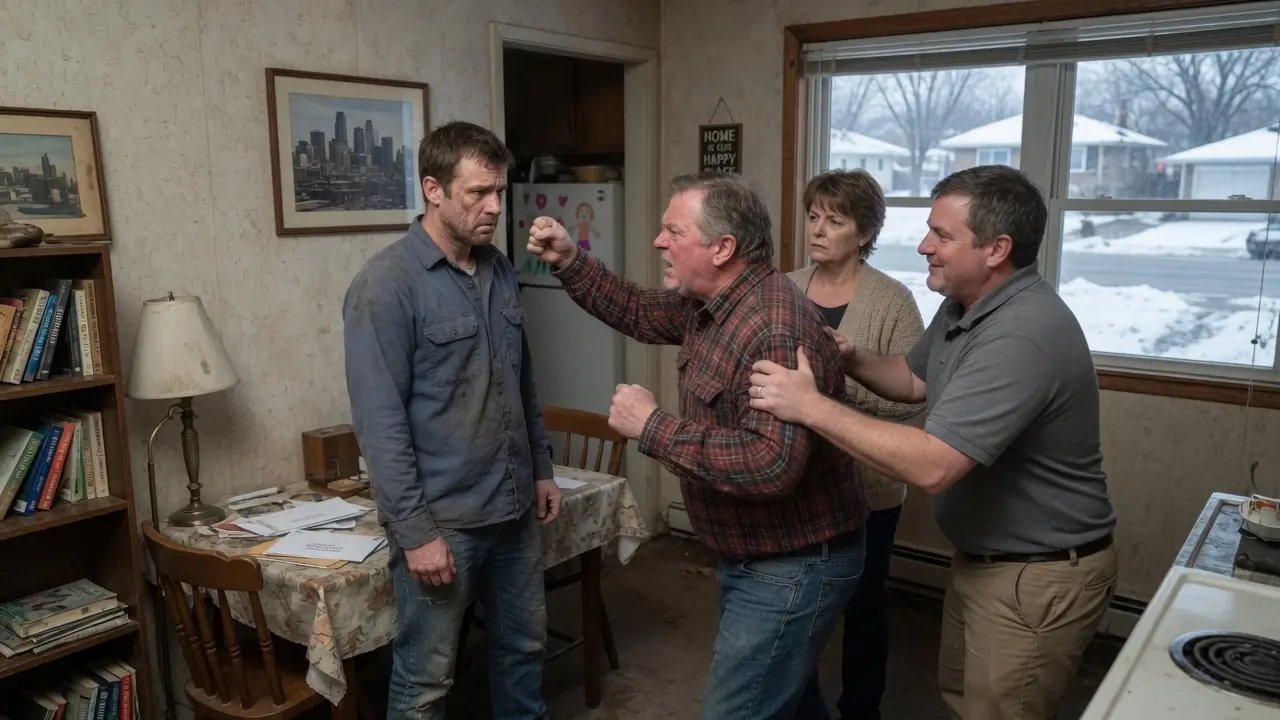
He looked at the paper, then at me, his face twisted, red blooming across his cheeks, his jaw clenching like he was holding back a scream. Then he lunged. It wasn't a slow build. One moment he was in the chair, the next he was across the room, fist cocked back, swinging. But Matt grabbed him, arms locked around his chest, dragging him backward, yelling, "Dad, stop! Stop it!" The old man struggled against him for a few seconds, cursing, shouting, veins bulging in his neck. But Matt didn't let go.
He looked over at me, out of breath, eyes wide with something I hadn't seen in a long time. Fear. I stood there still and quiet. Phone recording every second. I didn't flinch. I didn't speak. Eventually, my father sagged under Matt's grip, panting, glaring, teeth bared. "Get out," he growled. I picked up the signed form, slipped it into the folder, and tucked it under my arm. "You brought this on yourselves," I said. Then I turned and walked out the door, shutting it behind me like I was closing a chapter that had needed ending for years.
Two weeks after I walked out of their house with that signed form in hand, I sat at my desk and opened a blank post on one of those long-form anonymous archive sites, the kind people use when they want to tell the truth and have receipts to back it up. I didn't write it in anger. I wasn't shaking with rage or looking to make a scene. I was calm, focused, and I told the story exactly how it happened. I laid it all out from the beginning. The years of cold treatment, the suggestion that I give up my house, the forged documents, the attempted transfer of ownership, the arson, the threats, the audio recording.
I uploaded still frames from the security footage, the letter from Mr. Flanders, scans of the fake mortgage transfer, the notary record for the old student loan, a clip of my father's voice snarling. "Sell the house or we will destroy you." Everything. I blurred no names, redacted nothing. I told the truth and let it sit in the open where it belonged. I clicked publish.
By the next morning, it had spread like gasoline to a flame. Someone shared it on a popular legal subreddit. Then it hit Twitter. TikTok got a hold of the audio. Local news stations started getting tagged. Within 48 hours, my parents' names were trending. Not just in our city, but beyond. The footage of Matt dousing my garage in gasoline made its way into a hundred reaction videos. The audio of my dad's threat was played over and over in edits that made him look exactly like what he was, a bully caught with his mask off.
Neighbors stopped waving at them. Some left flyers on their porch that said things like, "Shame" in block letters. I got texts from old family friends who hadn't spoken to me in years, saying they were horrified. Relatives on my mom's side. People I hadn't seen since childhood publicly distanced themselves online. Someone even dug up old family photos and posted side by sides showing just how far they'd fallen.
And then Clare left. She took the kids and moved in with her sister in Duluth. I heard about it before Matt even called me. She didn't leave a note, just packed bags one morning and was gone by lunchtime. She posted a brief message on Facebook that read, "I will always protect my children, even from family." Matt called the next day. I let it go to voicemail the first time. The second time, I answered. His voice was raw. Quiet. "Ethan, please. I didn't think it would go this far. You don't understand."
I cut him off. "No, Matt. You don't understand. I gave you every chance. I let it go when they talked down to me. I walked away when they tried to steal from me. I didn't say a word when you torched my garage. But you stood by them. You let them drag me through it. You helped them." He started to cry. I didn't even feel sorry. "My kids," he said. "Clare took them. I can't even see them. Please, can we talk?" But there was nothing left to say. I ended the call without another word. And for the first time in years, I slept without checking the locks.
I sold their house within 3 months. It wasn't hard. Market was decent, and the location still pulled in buyers who didn't know or care about the story. I kept it quiet, used a third party agent, signed everything electronically. The money came through, and I didn't even feel anything when it hit my account. I used part of it to pay off the legal fees, the remainder of the arson repair, and maybe most bitter of all, the old student loan that had followed me like a shadow for over a decade. The one my mother took out in my name. $12,000 plus interest, gone in seconds, erased like it had never existed.
The rest of the money sat in my account untouched. I didn't celebrate. There was no champagne, no trip, no sudden feeling of freedom. I had what I wanted. The house was legally mine, the title clean and locked down. No one could touch it. No one could take it. Every signature had been verified, every document filed, every inch of the damage repaired.
But the silence inside those walls started to wear on me. It was different now. Colder, not physically, but in that way silence sometimes wraps itself around you when there's no one left to talk to. My friends tried to reach out to reconnect, but I kept them at a distance. I didn't know how to explain that the house felt heavier now, like a trophy from a war no one really wins. I'd cleaned the soot off the floor, repainted the garage, restored the fence where the fire had curled the wood, but the echo inside the hallway when I walked from the bedroom to the kitchen still sounded hollow. Final.
Sometimes I catch myself looking at the dining room table like I was expecting someone to be sitting there. Not them exactly, just someone. That's the thing no one talks about when you cut out toxic people. You remove the infection, but you also tear out the parts of you that grew around it. That routine, that need, that sense of familiarity. I didn't miss them, but I missed something. Some version of home I thought I might one day have before all this. Before I knew what they were capable of.
There were no more calls, no more knocks at the door, no more threats, just the hum of the refrigerator, the creak of the floorboards, the sound of the world going on without them. And me sitting in a house I fought to keep, wondering what it really meant to win. Family is not about blood. It's about trust. And they broke it. That's the simplest way I can say it. Everything I believed growing up, that blood makes you loyal. That parents always want what's best for you. That siblings have your back. Crumbled the second they saw something they wanted more than they wanted me in their life.
It wasn't a mistake. It wasn't a misunderstanding. It was a choice repeated, calculated, and brutal. I don't regret defending myself. I don't regret fighting back. But I do look back now and see what it cost. Not just the house repairs or the legal bills. Not just the long nights sitting at the table surrounded by evidence. It cost me a part of myself I didn't realize I was burning through bit by bit, step by step.
When you're at war with the people who made you, even victory feels like a funeral. If you're reading this and you've ever had to question your own family's intentions, trust your gut. Protect yourself. Build your boundaries like brick walls and bolt the gates if you have to. But don't become like them. Don't lose your sense of decency just because they lost theirs. Don't start treating everyone like an enemy just because someone with your last name turned out to be one.
Leave something for yourself, a piece of softness, a room in your life that no one else can enter and ruin. Because even when you win the war, especially when you win the war, you're going to need something left. Otherwise, all you're left holding is the ashes. That's my story.