Hey, what's going on guys? It's pleasure to crime. I'm your narrator Diego Corrado. Comment down below what country and or city you're watching from. Let's get on with this video, all right?
Hope you guys enjoy. At 3:17 on a rainy Thursday morning, my kitchen sink began breathing. Not draining, breathing. Each bubble rose like something buried alive. Then the toilet overflowed, the basement alarm screamed, and a smell older than language climbed the stairs.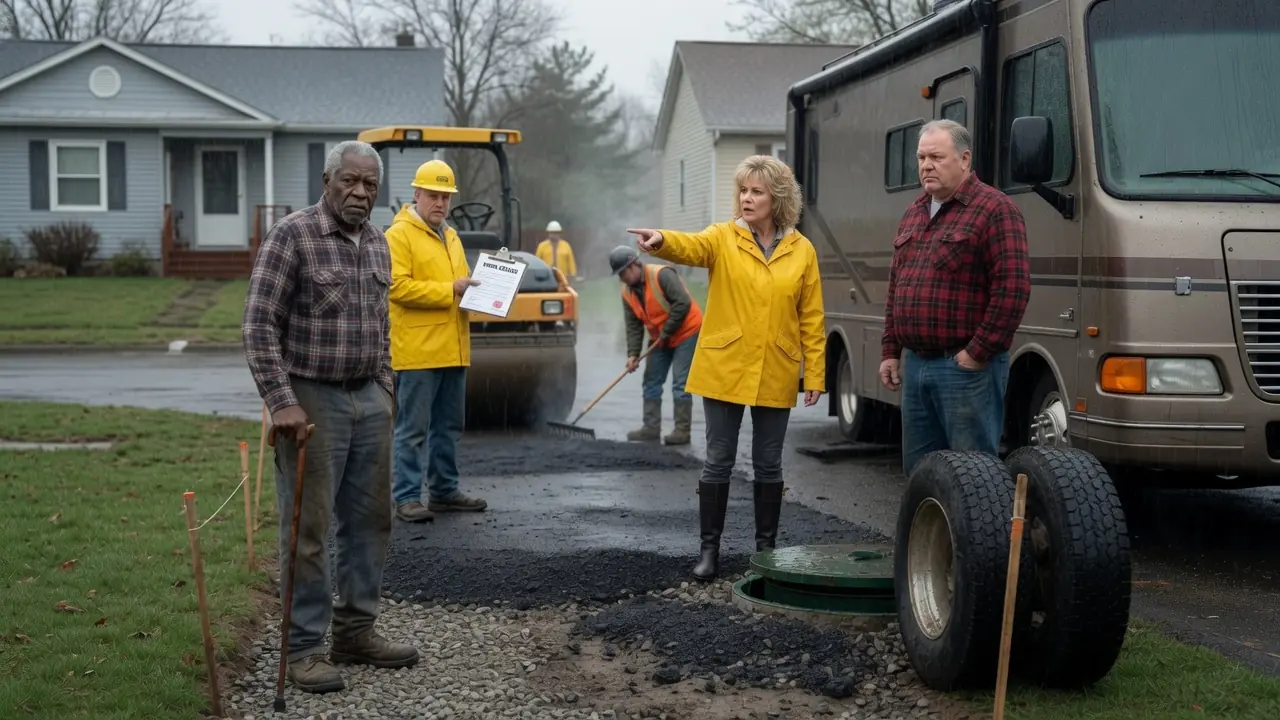
Through the window beneath the yellow security light, I saw Lorraine's brown RV resting on fresh asphalt beside my house. Its rear tires sat exactly where my septic access had been. That was when the past week rearranged itself completely. Six days earlier, I returned from physical therapy leaning on my cane, expecting silence. Instead, machines crowded the narrow strip between our homes.
My late wife, Celeste, used to say I study problems like they confessed. So, I didn't shout. I photographed the property stakes, the crew's truck, the fresh asphalt, and the RV's position. Then I carefully asked the foreman for his work order. His smile vanished when he saw my name on the survey.
Lorraine interrupted, insisting she had verbal permission from me from months earlier. The lie was clever because it borrowed a truth. Months before, Lorraine had asked whether guests could turn around near my side gate during a barbecue. I said yes once. She transformed that courtesy into permanent access, then told the paving company the strip belonged to her.
Russell avoided my eyes. The foreman shut down his roller, but half the lane was already sealed. Lorraine planted herself before the machine and demanded completion, claiming delay would cost her vacation deposit. I showed them the iron marker dividing our lots. The new asphalt crossed four feet onto mine and covered the riser leading to my septic tank.
The foreman swore Lorraine had marked the boundary herself. She replied that underground systems were outdated junk and that I should join city sewer someday. I explained the nearest municipal connection ended two miles away. Russell laughed and said one little lid couldn't matter. Beneath us 1,200 gallons of consequences waited patiently.
The crew left after documenting everything, but Lorraine refused to move the RV. She had planned a 6-week road trip and wanted it loaded near her garage. I warned that the vehicle weighed more than the soil above the tank was designed to carry. She called me dramatic. Russell slapped a tire and said American steel had survived worse. I looked at the slight depression forming around the buried lid in her Celeste voice, "Problems always whisper before they scream. " I called the township, my septic contractor, and the paving company's insurer.
The township inspector could not arrive until Monday. My contractor though, Andre, advised me not to use much water and absolutely not to let the RV move across the tank again. I delivered that warning in writing. Lorraine tore that envelope without opening it. Then she backed the RV 6 ft to prove nothing would happen.
The asphalt fixed, a hairline crack appeared thin as a clock hand nearby. That night rain came hard enough to erase footprints, but not decisions. Water entered the cracked pavement collecting where the riser had been sealed beneath the asphalt. The RV's weight shifted the damaged lid. Inside my house, every flush pushed a waste toward an airing passage.
At night, the shower slowed. At two, the toilet murmured. At 3:17, the kitchen sink breathed. By 3:22, sewage crossed my basement floor towards boxes containing Celeste's letters, photographs, and her unfinished blue quilt. I moved faster than my knee allowed.
With one hand on the cane and the other carrying boxes, I climbed through the smell and alarm. I saved the photographs first, then the letters, then the quilt. Water darkened the bottom stair. Outside, Lorraine's RV remained polished and dry, a brown monument to convenience. I called emergency services because contaminated water had reached an electrical outlet.
Firefighters cut power while sanitation crew finally arrived wearing masks and white protective suits. Lorraine emerged in a silk robe furious about the flashing lights. She demanded the crews move their trucks because they blocked her RV. The fire captain asked whether she owned the paved strip. She said yes without hesitation. I handed him the stamp survey.
Russell finally whispered her name, warning her to stop. She doubled down, claiming I had altered the boundary document. Then the ground beneath the RV's rear wheel collapsed 3 inches, releasing a cracking sound everyone heard. The sanitation supervisor ordered the RV evacuate from the area. Lorraine tried to climb inside and drive it away, but the inspector stopped her fearing the lid might fully collapse.
A heavy recovery truck lifted the rear axle while workers placed steel plates beneath it carefully. When the RV rose, the asphalt sagged like burned skin. Underneath the septic riser was already shattered, the tank lid fractured, and the outlet pipe displaced. The damage had been hidden, but never uncertain. By sunrise, my basement was stripped to concrete.
Fans roared where Celeste's sewing table had stood. Andre excavated the driveway and exposed the broken system. His preliminary estimate was $11,400 for emergency pumping, replacement lid, riser, pipe repair, excavation, and safe backfill. Remediation added $3,800. The survey update and permit fees added in another $800. $16,000 exactly.
Before anyone discussed the ruined flooring, damaged drywall, or the precious, irreplaceable memory boxes I had failed to lift. Lorraine's first strategy was denial. Her second was accusation. She told the insurer my septic system had already failed and I had a position to access beneath her driveway the trapper. Unfortunately for her, I had inspection records from 8 months earlier, photographs showing that the original gravel line, and the paving crew's work order bearing her signature.
The foreman also preserved her hand-drawn property line. She had moved it four feet with the red marker as casually as moving history. Her insurer denied coverage for intentional misrepresentation, but opened a liability investigation against her personally. The paving company repaired my access immediately, then pursued Lorraine for the cost because she had supplied false ownership information. Russell came alone that evening.
He looked ten years older than he had beside the RV. He admitted Lorraine already knew the access belonged to me. She believed I would accept the pavement as an improvement and never risk conflict over something already finished. Russell offered $4,000 if I signed a note calling the rest ordinary maintenance. I asked whether Lorraine knew he was there. His silence answered.
I refused. Then explained that fraud does not become compromised because it arrives quietly. He stared at Celeste's quilt drying across chairs. Finally, he confessed the road trip had already consumed their savings. The RV was financed, the paving was financed, and their confidence had been purchased with debt they expected me to absorb.
The township hearing occurred 3 weeks later. Lorraine arrived carrying a binder thick enough to resemble her evidence. Inside were vacation invoices, photographs of the RV, and neighborhood messages praising the new pavement. None addressed ownership. I presented the survey, septic inspection, emergency reports, contractor invoices, and her unopened written warning, still torn across the middle.
The hearing officer studied the envelope for several silent seconds. Lorraine had not merely ignored the risk. She had physically rejected the chance to understand it. The order required Lorraine and Russell to reimburse $16,000 within 90 days, remove every inch of the asphalt crossing my boundary, restore drainage, and pay township penalties. A separate civil agreement covered my basement deductible and damaged property.
The road trip vanished first, then the brown RV appeared online for sale, photographed from an angle that hid the scrape beneath its rear panel. Lorraine blamed me publicly, but the paving foreman plainly posted, "We paved where she falsely told us. " The strangest consequence was not financial. Without the RV, their driveway looked enormous, an empty stage after the actors had forgotten their lines. Russell began doing the restoration work himself under township supervision. Each morning, he removed the asphalt one square at a time.
Lorraine stopped coming outside. From my porch, I watched the black surface disappear from the original boundary return. Time didn't reverse, but evidence of her decision slowly traveled backwards, from pavement to gravel to bare earth. On the final day, Russell uncovered the old stone Celeste had placed beside the septic access years ago. It was painted blue with one word in her handwriting, "Breathe. " He cleaned it and handed it to me without speaking.
I set it beside the new riser. The basement would never be exactly the same, and neither would the neighbors. Yet, the stone survived pressure, sewage, machines, and Lorraine's attempt to bury what she found inconvenient. Some truths simply wait underground. Months later, during a storm, I stood in the kitchen and listened.
The sink drained cleanly. The toilet remained silent. Rain tapped the window while the new access cover shone beside the restored gravel. My cane rested against the counter and Celeste's quilt hung upstairs. Lorraine's house was dark.
The RV was gone. She owed $16,000 because she paved over a lid. But the real cost was simpler. She believed buried things stopped existing. They gathered weight beneath us.