The first bag of garbage appeared on Daniel Harper’s porch on a Monday morning in early April, wedged neatly against the front door as though someone had delivered it there on purpose. He knew it did not belong to him because he lived alone, took his trash to the curb every Thursday evening, and had not eaten any of the spoiled seafood, coffee grounds, disposable diapers, or rotting vegetables leaking through the thin plastic. At sixty-three, Daniel had dealt with enough unpleasant surprises to know that anger usually became expensive when it arrived before information, so he photographed the bag before putting on gloves and carrying it to his own trash bin. He assumed some teenager had made a stupid joke and went inside without giving it another thought.
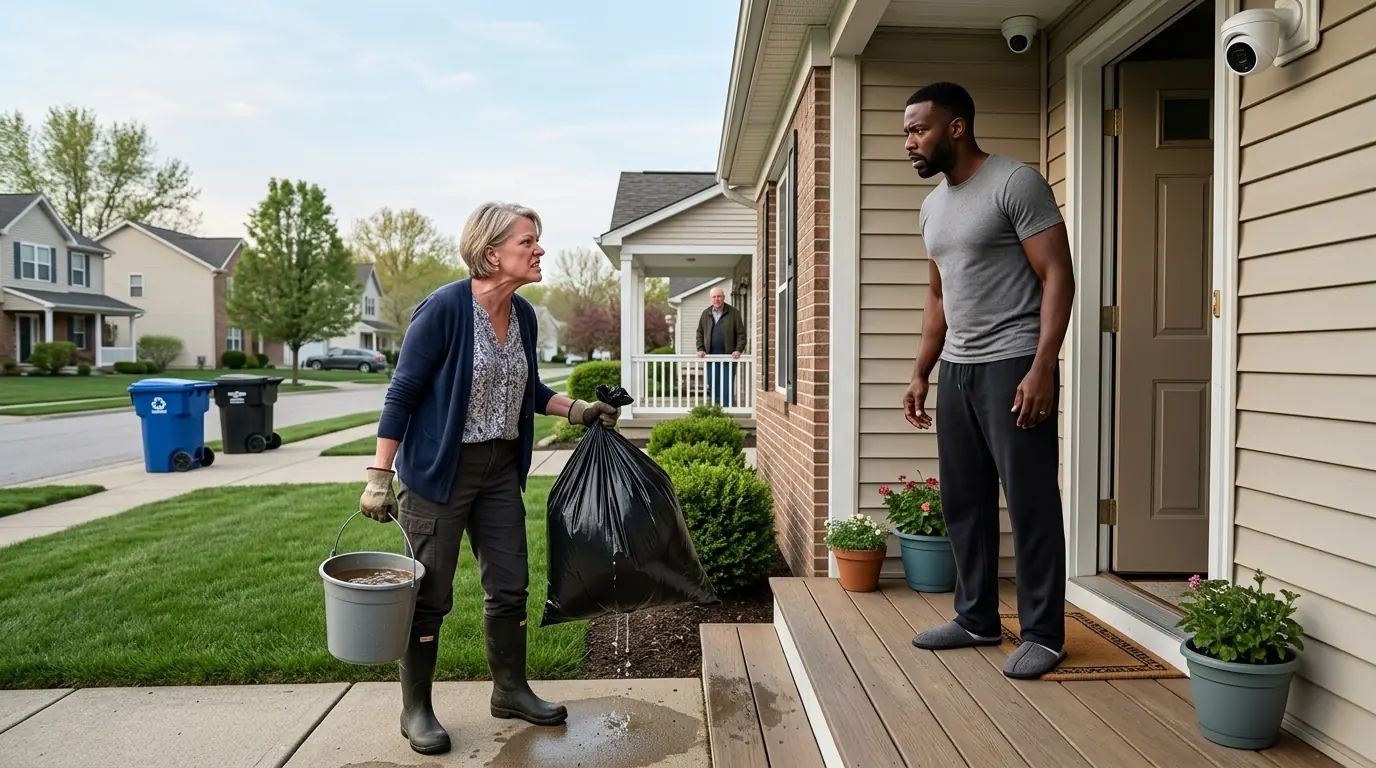
The second incident happened four days later, except this time there was no bag. A gray stream of foul-smelling water ran from the top step across the porch boards, carrying hair, dust, food residue, and something that smelled like an old mop bucket left behind a restaurant kitchen. Daniel stood with his morning coffee and stared at the stain spreading toward the rocking chair his late wife had chosen two summers earlier. Whoever had poured it there had done so deliberately enough to cover almost the entire width of his entrance.
Daniel cleaned it before breakfast. He scrubbed the porch with disinfectant, rinsed the boards twice, and moved the rocking chair into the garage while everything dried. His wife, Marlene, had died fourteen months earlier after thirty-seven years of marriage, and the little white house on Briarwood Lane had been the final home they purchased together before her illness changed every plan they had made. Daniel could replace wood, repaint railings, or wash away dirty water, but he could not tolerate the thought of someone casually damaging the few things Marlene had touched during her last good summer.
The Harpers had moved to Cedar Grove, a quiet suburban neighborhood outside Richmond, Virginia, three years before Marlene died. Daniel had spent thirty-one years maintaining buses for the regional transit authority, while Marlene worked as an elementary-school secretary and somehow remembered the birthdays of hundreds of children who had long since forgotten hers. They saved carefully, raised two daughters, paid college tuition in painful installments, and bought the Briarwood house only after both girls were established on their own. Marlene called the porch her retirement office because she spent more hours reading there than Daniel had ever spent inside an actual office.
The neighbor on Daniel’s left was Cynthia Bell, sixty-six, divorced, energetic, and deeply involved in almost every activity the neighborhood produced. She organized holiday decorating contests, served on the Cedar Grove homeowners association board, supervised a private social-media group, and possessed the unusual ability to know who had replaced a roof before the roofing company finished unloading its ladders. Cynthia had been pleasant enough when Daniel and Marlene moved in, though the pleasantness always carried the feeling of an inspection. Marlene once whispered after Cynthia left, “That woman does not have conversations, Danny, she conducts inventory.”
Daniel had laughed then. After Marlene died, Cynthia brought a casserole and remained fifteen minutes longer than he wanted, asking whether he planned to stay in the house alone, whether either daughter might move back, and whether maintaining the yard would become difficult. Daniel assumed she was trying, awkwardly, to be helpful. He thanked her and said he intended to remain where he was.
Three months later, a real-estate agent named Peter Lang called unexpectedly. Peter said he represented an investor interested in purchasing several homes around Briarwood Lane and could offer Daniel substantially above what he had paid. Daniel told him the house was not for sale. Peter responded that people often changed their minds when they saw numbers on paper.
An offer arrived anyway. It was generous enough that Daniel’s older daughter Nicole read it twice when he showed her during Sunday dinner. The amount was nearly forty percent higher than the price Daniel and Marlene had paid only three years earlier. Nicole asked whether he had considered taking it.
“No,” Daniel said. Nicole looked around the kitchen.
“Mom loved this place.” Daniel nodded.
“So do I.” Nicole smiled.
“Then there’s your answer.” Daniel threw the offer into a drawer and forgot about it.
The garbage started two months later. Daniel did not connect the events because one involved anonymous filth and the other involved ordinary real estate. He had no reason to imagine anyone would contaminate a porch to influence a property sale. Most people, he believed, were not that committed to other people’s business.
The third incident changed his mind about the garbage being random. Daniel returned from the grocery store and found two ripped bags spread across his steps, with paper towels, food scraps, cat litter, and broken cardboard scattered almost decoratively from one railing to the other. Nothing had landed on the sidewalk or driveway. Whoever dumped it wanted the mess seen exactly where Daniel would have to step through it.
He called the non-emergency police number. Officer Megan Doyle arrived forty minutes later, took photographs, and asked whether Daniel had enemies. Daniel laughed because the word sounded ridiculous in connection with a retired bus mechanic whose most serious current dispute involved a hardware store refusing to honor a coupon.
“Any neighborhood problems?” Megan asked. Daniel thought about Cynthia.
“Nothing worth calling a problem.” Megan gave him the incident number.
“Camera would help.” Daniel nodded.
“I’m buying one today.” He did.
Daniel installed a doorbell camera above the front door and another small camera beneath the corner of the porch roof. He positioned both carefully, checked the nighttime image, and made sure the field of view did not intrude unnecessarily into Cynthia’s windows or private areas. Nicole helped connect the alerts to his phone. Daniel went to bed almost looking forward to solving what had become an irritating mystery.
Nothing happened for eleven days. Then, at 5:42 on a Wednesday morning, the porch camera detected movement. Daniel woke at six thirty, saw the notification, and opened the recording while standing beside his bed.
A figure wearing a long raincoat, baseball cap, and large gardening gloves entered from the side of the porch. The person carried a five-gallon bucket, paused beneath the camera with their head deliberately lowered, and poured dark water across Daniel’s front steps. The recording showed no face clearly enough for identification.
Daniel replayed it five times. The person seemed older, moving carefully rather than quickly, and the height suggested an adult woman or shorter man. What bothered him most was the confidence. Whoever it was knew exactly where the cameras were.
He sent the recording to Officer Doyle. She responded that it established intentional trespass and dumping but still did not provide a reliable identification. Daniel asked whether fingerprints could be collected from the porch railing. Megan explained realistically that a neighborhood vandalism complaint involving an outdoor surface touched by residents, visitors, delivery workers, and contractors would not produce the kind of forensic investigation television had trained people to expect.
Daniel understood. He had spent thirty-one years working around machines and knew real systems operated with limited time, money, and people. He did not expect detectives to dust every porch in Virginia because someone had emptied a mop bucket.
He expected the person to stop once cameras appeared. Instead the harassment became more careful.
Trash bags were now placed beyond the cameras’ clearest angles. Dirty water appeared along the porch edge rather than directly beneath the lens. Someone dumped a bucket of decomposing leaves against his front steps, then another load containing old newspapers soaked in something that smelled like grease.
Daniel moved the cameras. The person changed direction.
He added a camera facing the driveway. The dumping came from the side yard.
He installed a motion light. The person began coming shortly before sunrise instead.
By June, Daniel had accumulated seventeen separate video clips. None captured a complete face, but several showed the same body type, similar gloves, and an unusual blue plastic bucket with a white handle.
Daniel began looking around the neighborhood differently. Every blue bucket in an open garage caught his attention. Every person wearing gardening gloves became briefly suspicious.
He hated that. The harassment was turning him into exactly the sort of neighbor he had never wanted to become.
Then the homeowners association sent him a violation notice. It said multiple residents had complained about unsanitary conditions, trash accumulation, unpleasant odors, and liquid runoff from Daniel’s front porch. Daniel read the letter twice before laughing aloud.
He carried the notice next door to Cynthia because she served on the board. She opened her door halfway and looked at the paper without inviting him inside.
“You’ve had some complaints,” she said. Daniel stared.
“The garbage is being dumped on my property.” Cynthia shrugged slightly.
“People only see what’s there.” Daniel held up his phone.
“I have police reports.” Cynthia replied, “Then perhaps the police should solve it.”
Daniel felt his patience narrowing. “I clean everything within hours.”
“Sometimes hours are enough for people to notice.” He looked at her.
“Did you file one of the complaints?” Cynthia smiled without warmth.
“Board matters are confidential.” Daniel went home more suspicious than before.
The HOA gave him ten days to correct what it described as recurring sanitation issues. Daniel wrote a response enclosing police incident numbers, still photographs, and screenshots from the videos. He requested that the violations be withdrawn and asked whether the association had security footage covering the street.
The board acknowledged receiving his response. No one answered his question about neighborhood cameras.
A second real-estate offer arrived three days later. Peter Lang increased the proposed purchase price by another twenty-five thousand dollars. Daniel called him.
“I told you I’m not selling.” Peter sounded calm.
“I understand.” “Then why are you sending offers?”
“The client remains interested.” Daniel asked who the client was.
Peter said he was not authorized to disclose the identity at that stage. Daniel replied, “Then tell your client to stop wasting postage.”
Peter laughed politely. “Circumstances change.”
Daniel looked through the front window at his stained porch. “Mine haven’t.”
The next week, someone dumped two full kitchen bags in front of his garage. Daniel found them before sunrise because the smell woke him through an open bedroom window. One bag contained spoiled meat and hundreds of flies.
He called police again. This time Officer Doyle arrived with another officer and spent nearly an hour reviewing camera positions. She suggested Daniel install a temporary trail camera low along the side fence where the person appeared to approach.
Daniel bought two. He hid one inside a birdhouse Marlene had painted yellow years earlier.
Five mornings passed quietly. On the sixth, his phone recorded the clearest footage yet.
The person entered from between Daniel’s property and Cynthia’s hedges. A raincoat again covered most of the body, but as the figure bent to lift a garbage bag, the baseball cap shifted and a brief side profile became visible.
Daniel stopped breathing. He knew the nose.
He knew the short gray hair beneath the cap. He knew the silver-framed glasses.
He walked to his kitchen window and looked toward Cynthia Bell’s house. Her curtains were open.
Cynthia stood at her sink drinking coffee. Daniel watched her for several seconds, then closed the blind.
Nicole wanted him to confront her immediately. Daniel refused.
“You know it’s her,” Nicole said over the phone. Daniel answered, “I know what the video appears to show.”
“Dad.” “I’m giving it to police.”
“She’s been doing this for months.” “Which is exactly why I’m not going over there angry.”
Nicole sighed. “Mom would already be standing on her porch.”