Not gentle rain. Not the kind that helps you sleep.
It was the kind that swallowed the entire street behind sheets of gray water, shook the gutters, and made every passing headlight look like a warning.
I was standing in the kitchen washing dishes when I heard frantic pounding at the front door.
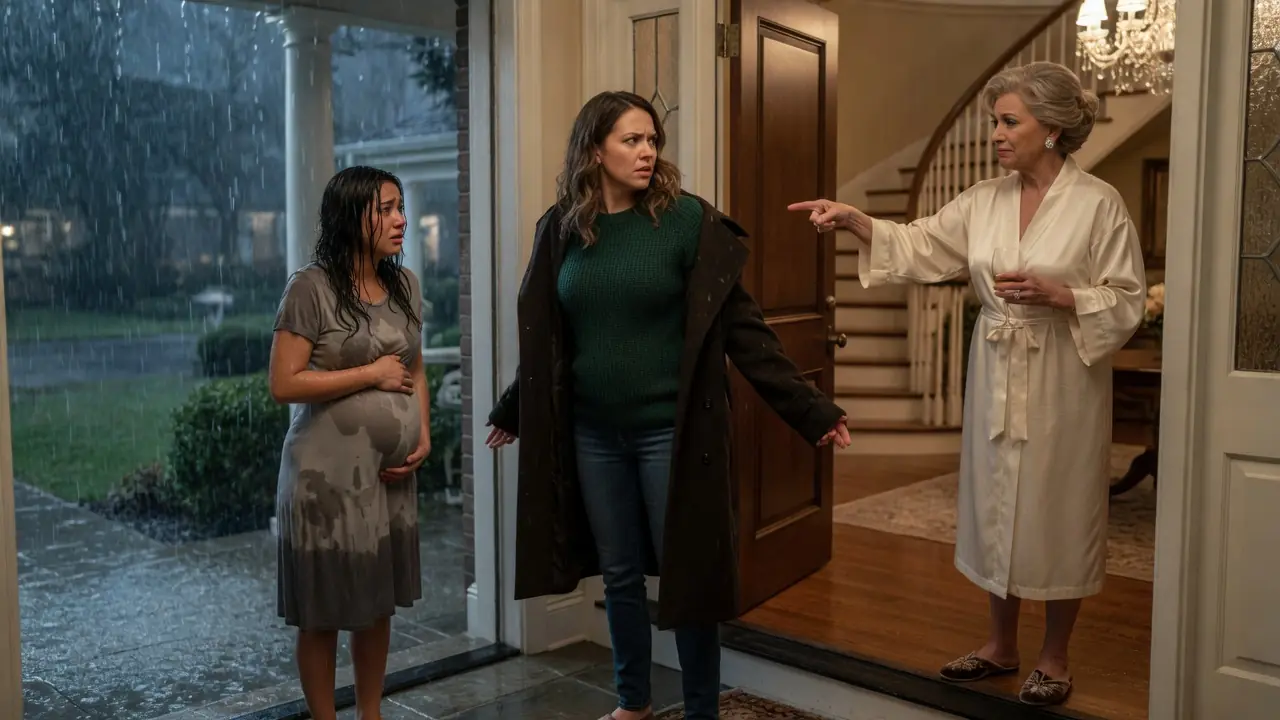
At first, I thought someone had been in a car accident. The knocking wasn’t steady. It came in desperate bursts, followed by silence, then started again.
I dried my hands and hurried into the hallway.
The second I opened the door, my heart nearly stopped.
Maya stood on the porch.
She was eight months pregnant, barefoot, and soaked to the skin. One side of her face was swollen purple. Blood clung to her split lip, and her left arm hung at an angle that made my stomach turn.
Broken.
She looked terrified. Not embarrassed. Not dramatic.
Terrified.
“Please,” she sobbed. “Please help me.”
Before I could answer, my mother-in-law appeared behind me.
Gloria stood beneath the chandelier in a silk robe, holding a glass of white wine. She took one look at Maya and curled her lip in disgust.
“Oh, absolutely not.”
I turned toward her.
“Gloria—”
“This house is not a shelter for cheap women,” she snapped. “Tell her to leave.”
Maya flinched as though Gloria had struck her.
Something inside me hardened.
Gloria had always been cruel in quiet, carefully polished ways. She was the type of woman who disguised insults as honesty and believed wealth was proof of moral superiority.
She could humiliate a waiter with a smile, criticize my clothes while pretending to offer advice, and remind me that I was living in her home whenever I disagreed with her.
After my husband, Daniel, lost his job, we had moved into Gloria’s enormous house temporarily to save money. She called it generosity, but generosity was never supposed to be mentioned so often.
Maya represented everything Gloria despised.
She was young, poor, unmarried, and visibly pregnant. She rented the small duplex next door and worked double shifts at a diner. Rumors spread through the neighborhood about the baby’s father disappearing.
Gloria repeated those rumors whenever Maya’s name came up.
But standing there, watching that injured woman shake in the rain, I didn’t care about neighborhood gossip or what mistakes Maya might have made.
No human being deserved this.
“She needs an ambulance,” I said.
Gloria crossed her arms. “She needs consequences.”
The sentence made my blood boil.
Maya lowered her head. For one terrible second, I saw shame replace the fear in her eyes.
Abused people are often taught to believe that asking for help is proof of failure. One cruel response can be enough to send them back to the person who hurt them.
I wasn’t going to let that happen.
I stepped onto the porch.
The rain soaked through my sweater instantly. Maya began crying harder when I wrapped my coat around her shoulders.
“Did he do this to you?” I whispered.
She nodded.
“Is he nearby?”
“I don’t know. I ran.”
I looked at her bare feet. They were cut and bleeding.
“Come inside.”
Before we could move, Gloria blocked the doorway.
“No.”
I stared at her.
“She is injured and pregnant.”
“And she is not stepping into my home.”
“Gloria, she could lose her baby.”
“That is not our responsibility.”
Daniel appeared at the top of the stairs, disoriented and half-asleep.
“What’s happening?”
“Your wife is inviting trouble into my house,” Gloria said before I could answer.
Daniel looked past her and saw Maya.
His expression changed immediately.
“We need to call the police.”
“No police,” Maya cried. “Please. He knows people. He said no one would believe me.”
Gloria’s fingers tightened around her wineglass.
It was such a small movement that I almost missed it.
At the time, I assumed she was irritated.
Later, I would understand that she was afraid.
I called an ambulance, but Maya panicked when she heard the dispatcher mention police. She stepped backward into the rain and begged me not to reveal where she was.
She said she knew of a hospital across town where someone had helped her before. She only needed enough money to get there and somewhere safe afterward.
Gloria refused to let me use her car.
“If you leave with her, don’t expect me to welcome either of you back tonight.”
Normally, I swallowed my pride in Gloria’s house.
Not that night.
I opened my purse and removed the emergency cash I had been saving—the last two hundred dollars I had until payday.
I slipped it into Maya’s hand.
Her eyes widened.
“I can’t take this.”
“Yes, you can.”
“You need it.”
“Right now, you need it more.”
I ordered a rideshare and entered the hospital as the destination. While we waited, I photographed Maya’s injuries with her permission and sent the pictures to a new email account she created on my phone.
“If your phone disappears, these will still exist,” I told her.
She stared at me.
“Why are you helping me?”
“Because you asked.”
The car arrived several minutes later.
As Maya climbed into the back seat, she grabbed my hand.
“You saved me.”
“No,” I said. “You saved yourself the moment you knocked.”
The vehicle disappeared into the storm.
When I went back inside, Gloria was waiting in the foyer.
“You have no idea what you’ve done.”
“I helped an injured woman reach a hospital.”
“You invited her problems into this family.”
“Her problem is a man who beat her.”
Gloria’s face became strangely still.
“Women like that always have a story.”
“And women like you always have a reason not to listen.”
She slapped me.
The sound echoed through the foyer.
Daniel stepped between us immediately.
“Mom!”
Gloria stared at her own hand, as if even she hadn’t expected herself to do it.
Then she turned and walked away.
She didn’t speak to me for three days.
Daniel apologized repeatedly for freezing at the doorway. I told him I understood the shock but not the silence. He was thirty-four years old, yet around his mother, he became a frightened boy trying not to provoke her.
That night forced us to admit something we had avoided for years: Gloria’s house wasn’t rescuing us. It was keeping us dependent.
Daniel began applying for every job he could find. I started looking at apartments we could barely afford.
Meanwhile, I tried to contact Maya.
Her phone had been disconnected.
The hospital would not share information, and no one answered at the duplex next door. Its curtains remained closed, and the parking space outside was empty.
I feared the worst.
Exactly one week later, Gloria burst into our bedroom just before midnight.
She didn’t knock.
For the first time since I had known her, she looked genuinely afraid.
Not irritated. Not judgmental.
Afraid.
Her face was pale, and her hands shook so badly that she nearly dropped her phone.
“Daniel,” she gasped. “Turn on the television.”
We followed her downstairs.
Every local news station was covering the same breaking story.
A wealthy real estate developer named Richard Blackwell had been arrested following allegations of domestic violence, assault, financial fraud, and witness intimidation.
Then the television showed Maya’s face.
My stomach dropped.
Reporters said Blackwell’s pregnant girlfriend had escaped one of his private residences and sought medical treatment with a broken arm, facial injuries, and symptoms of early labor.
Maya had survived.
So had her baby.
Hospital staff documented the injuries and contacted a domestic violence advocate. The photographs stored in Maya’s email account helped establish when the assault occurred.
Richard Blackwell wasn’t merely wealthy. His companies controlled hotels, commercial buildings, residential developments, and political donations across several states.
He was worth hundreds of millions of dollars.
According to the report, he had hidden his relationship with Maya for nearly a year by placing her in a duplex owned through one of his shell companies.
The duplex next to Gloria’s house.
Once Maya became pregnant and asked him to acknowledge the child, the abuse escalated. Investigators were now reviewing allegations involving several other women.
Then the reporter revealed why the case had expanded beyond domestic violence.
Maya had escaped with copies of financial records connected to offshore accounts, fraudulent property transfers, and money-laundering schemes.
Gloria slowly sat down.
Daniel looked at her.
“Mom, why do you look like that?”
She swallowed.
“Because Richard invested in my company.”
The room went silent.
Gloria owned an upscale interior design and development firm. Her clients included hotel owners, athletes, politicians, and wealthy investors.
Richard Blackwell funded almost forty percent of her newest projects.
With his assets frozen, her developments could no longer move forward. But lost funding wasn’t Gloria’s greatest problem.
Every business connected to Richard was about to be examined.
Including hers.
Within forty-eight hours, reporters began requesting statements. Lawyers called throughout the day. Two investors withdrew, and the bank suspended a line of credit connected to a luxury condominium project.
Gloria sat at the kitchen table surrounded by documents, crying over the possibility of losing everything.
For years, I had watched her judge struggling people as if hardship were proof of bad character.
Now she was learning how quickly security can disappear.
Three days later, Maya returned.
This time, she wore a sling and had a healing cut across her lip. Beside her stood a domestic violence advocate and two attorneys.
Gloria nearly dropped her coffee when she saw them.
One attorney placed a sealed notice on the table.
They weren’t there to arrest Gloria. They were formally notifying her to preserve all contracts, emails, payment records, and communications involving Richard Blackwell.
“I didn’t know what he was doing,” Gloria whispered.
“You signed multiple agreements,” the attorney replied.
“They were legitimate investments.”
“That will be determined after the records are reviewed.”
Daniel stared at his mother.
“Is there something you haven’t told us?”
“No.”
Maya looked directly at Gloria.
“You knew who I was.”
I turned toward her.
“What?”
Maya’s voice trembled, but she didn’t look away.
“The night I came here, she recognized me.”
Gloria’s face drained.
I remembered the way her hand tightened around the wineglass when Maya said her abuser knew powerful people.
“How would Gloria know you?” I asked.
Maya reached into her advocate’s folder and removed a photograph.
It had been taken months earlier at a charity gala. Richard stood in the center with one arm around Gloria.
Maya was visible behind them.
“Richard brought me to two private dinners,” she explained. “He introduced me as his assistant. Mrs. Hale saw him grab my arm at the second dinner. She saw the bruises.”
Gloria shook her head.
“I didn’t know what they meant.”
“You asked Richard whether I was becoming a problem,” Maya said.
The words landed like stones.
One of the recovered emails contained Gloria’s message to Richard:
Your young assistant looked upset tonight. Make sure she understands discretion. We cannot afford unnecessary attention before the contracts close.
Gloria hadn’t turned Maya away because she believed poor women deserved consequences.
She turned her away because she knew exactly who Maya was.
She feared that allowing Maya inside would connect the abused woman to her house, her company, and the deals she had signed with Richard.
Her cruelty hadn’t been ignorance.
It had been self-protection.
Daniel stood so abruptly that his chair scraped across the floor.
“You left a pregnant woman outside because you were protecting a business deal?”
“I was protecting this family.”
“No,” he said. “You were protecting yourself.”
Gloria looked at me for help.
For once, I had nothing to offer her.
Over the next year, the truth emerged gradually.
Investigators found no evidence that Gloria had participated in Richard’s violence, but they discovered that her company had processed suspicious consulting payments and inflated invoices linked to his shell companies.
Some documents had been signed without proper review. Others contained warnings Gloria had ignored because Richard’s money kept her projects alive.
She avoided criminal charges by cooperating with investigators and surrendering records. But civil penalties, lawsuits, canceled contracts, and frozen financing destroyed her company.
Several properties were sold. The mansion was eventually listed to cover debts.
Daniel and I moved into a small two-bedroom apartment before the house was sold. The kitchen was narrow, the plumbing rattled, and our secondhand couch barely fit through the doorway.
But for the first time in years, I could breathe.
Maya gave birth to a healthy baby girl named Elena.
I visited them at the hospital. Maya looked exhausted, but when she placed her daughter in my arms, her face softened.
“You believed me when no one else did,” she said.
I looked down at the sleeping baby.
Her fingers were wrapped around the edge of the blanket, impossibly small and determined.
“You were brave enough to ask for help,” I replied. “I only opened the door.”
Maya shook her head.
“You came outside after the door was closed. There’s a difference.”
Years later, those words still stay with me.
Opening a door is easy when everyone agrees someone deserves help.
Character is revealed when helping costs you comfort, approval, money, or a place to live.
Maya eventually opened a small café downtown with support from a survivor assistance program. She named it Elena’s Table.
Daniel and I visit often. He found steady work and began therapy to understand why he had spent so much of his life confusing obedience with love.
Gloria lives in a modest apartment now. Our relationship is limited. Losing her company humbled her, but consequences don’t automatically create compassion.
Real change requires honesty, and Gloria still struggles to say the simplest sentence:
I saw suffering and chose myself.
I don’t hate her.
But forgiveness doesn’t require pretending that cruelty was a misunderstanding.
Sometimes I still think about that stormy night—the pounding on the door, Maya’s bare feet, the blood on her lip, and the two hundred dollars trembling in her hand.
Gloria called her trash.
But Maya was the one carrying evidence powerful people had tried to bury. She exposed a violent man, protected future victims, and forced an entire network of respectable businesses to answer for what they had ignored.
The woman Gloria considered worthless revealed the rot beneath her marble floors and designer chandeliers.
That is the danger of judging people by what they have.
Wealth can hide corruption behind polished doors. Poverty can hide extraordinary courage beneath a soaked coat.
And sometimes the person society looks down on is the only one brave enough to carry the truth into the light.