Seven months after my wife’s funeral, the doctor told me I had stage-four cancer. I made three phone calls. Within twenty-four hours, all three of my children were at my door, calling me Dad with voices so soft I almost believed them. They made soup, touched my shoulder, and asked if I needed anything.
But when I said I had not signed a will yet, the room went silent. The next morning, they packed their bags. My eldest son turned his back on me and said, “You are selfish. You are sitting on all that money and will not sign a paper. You want to take it to the grave?” Then they drove away without goodbye.
Five days after the doctor told me I might have six months to live, my three children walked through my front door for the first time in two years, and the first question out of Sterling’s mouth was not about my health. But I am getting ahead of myself. It began on a Monday afternoon in November. The Austin Clinic smelled like antiseptic and fear.
Dr. Reynolds could not have been older than thirty-five. He pointed at the imaging on his screen with clinical detachment. “Mr. Harrington, stage four. The imaging is quite clear.” His voice was flat, like he was telling me the coffee machine was broken.
I sat there, Thaddius Harrington, sixty years old, retired senior trust officer from Manhattan Private Bank. I had spent three decades managing estates and watching families implode over inheritance, and my hands did not tremble. That terrified me more than the diagnosis. I drove home on autopilot.
Three miles out, my legs started feeling weak. I pulled over on Route 360 and stared at the photo taped to my dashboard. Evelyn was fifty-eight in that picture, laughing at something I had said at the Texas Hill Country Winery. Her hair was graying, and her eyes were sharp.
She had been gone since April. Suicide. Overdose of her anxiety medication. The note she left was three sentences. “I cannot do this anymore. I am sorry. Please take care of Grace.”
Grace was our sixteen-year-old granddaughter, Sterling’s daughter, and the only one who still called just to talk. I sat in that car for twenty minutes, then made three phone calls. “I need to tell you something,” I said to each of them. “Can you come home?”
Sterling answered first. “Dad, I am coming home right away. I love you.” Margot answered second. “Dad, I am coming home right away. I love you.” Beckett answered last. “Dad, I am coming home right away. I love you.” Three identical responses, like they had rehearsed.
Sterling Harrington, my eldest son, was thirty-five. He arrived Tuesday morning in an Audi that cost more than most people’s annual salary. He had spent his career in Dallas real estate investment, convincing investors to trust him with money they would never see the same way again. When he hugged me, I smelled expensive cologne and something sharp underneath it, anxiety masked by confidence.
“How are you feeling?” he asked, though his eyes were already scanning the foyer, cataloging paintings, furniture, and the Persian rug Evelyn had bought in 2019. Margot Harrington, my daughter, was thirty-two. She arrived Tuesday afternoon with Whole Foods bags and designer sunglasses perched like a crown. She had built a career in Austin’s tech startup scene as a marketing consultant, convincing people to buy things they did not need.
Beckett had always been the anxious one, eyes darting toward exits even in his own father’s living room. He worked in Houston doing financial consulting he had never fully explained. His hug was too tight, too desperate. “I am here,” he said. “Whatever you need.”
For five days, they performed perfectly. Sterling made coffee every morning, black with one sugar, a detail that surprised me because he had not made me coffee in a decade. Margot cooked soup with gentle hands. Beckett massaged my shoulders while we watched television.
It was nauseating, not because it was not kind, but because it felt rehearsed, like a script titled How to Care for Your Dying Father. Their eyes kept wandering. Not to me, but to the house, to the study where I kept financial documents, and to the hallway leading to the master bedroom where Evelyn’s jewelry box sat untouched. They were appraising, cataloging, taking inventory.
I had spent thirty years in trust banking, watching families destroy themselves over money. How did I miss the signs in my own children? Friday evening, Sterling brought it up over dinner with a casual tone, like he was asking about the weather. “Dad, have you thought about the estate, just so we can help you plan properly?”
Margot chimed in from the kitchen, her voice soft. “We do not want you stressed about paperwork. You should be focusing on your health.” Beckett added too casually, “Does he even have a safe in here?” That last one was meant to be under his breath, but I had learned to listen for things people did not mean to say out loud.
I set down my fork and looked at Sterling, then Margot, then Beckett. “I have not made a will for anyone yet,” I said slowly. The change was instantaneous. Sterling’s smile froze. Margot’s hand stopped halfway to her water glass. Beckett’s shoulders went rigid.
Three faces drained of color in perfect unison, like someone had pulled a plug and let all the warmth run out. Something tightened in my chest that had nothing to do with dying. It was the feeling of recognizing a stranger wearing your child’s face. Sterling recovered first and said, “Of course, no rush. We just want to help when you are ready.”
But the mask had slipped. Just for a second, just long enough to see what was underneath. Cold. Calculating. Impatient. They stayed another hour, made more coffee, talked about nothing, then left one by one with promises to return soon and hollow reassurances about being there for me.
I stood in my empty house, surrounded by furniture, photographs, and thirty years of accumulated life, and realized something that made my blood run colder than any diagnosis. I was counting the days until the diagnosis killed me. They were counting too, but we were counting for very different reasons. In that moment, watching three faces drain of color because I would not sign my life away, I realized my children were not here to help me die with dignity.
They were here to make sure I died on schedule. That realization hit me fully at 9:30 p.m. on Thursday when I was going to get water and heard my son’s voice coming from the study. It was low and urgent, the kind of whisper people use when they are planning something they know is wrong. I stopped in the hallway, my hand still on the banister.
Sterling did not know I was there. “Vance, we need to move faster,” he said into his phone, his voice tight with tension. “Emergency guardianship. We need a doctor to sign off on cognitive decline. Can we get around Edward Rawlings?”
My heart started pounding so hard I could hear it in my ears. “How long will the paperwork take?” Sterling continued. “He is not going to cooperate. We need someone who can make it stick. Yes, Desmond Whitaker. Can you get me a meeting?”
I stood there against the wall, feet refusing to move. My phone was in my pocket. I pulled it out with shaking fingers and typed the name Desmond Whitaker. Then I closed the search and put the phone away. I did not confront him.
I walked back to the living room, picked up the book I had been reading, and stared at the same page for twenty minutes without processing a single word. Emergency guardianship. Cognitive decline. A doctor to sign off. They were not just waiting for me to die.
They were planning to declare me incompetent, take control of my assets, and lock me away while they dismantled everything Evelyn and I had built over thirty-five years. And they thought I would not notice. Friday was a masterclass in performance. Sterling made breakfast, scrambled eggs with cheese the way I used to make them when he was eight.
Margot arranged flowers in a vase Evelyn had loved. Beckett sat beside me on the sofa, remote in hand, asking what I wanted to watch like I was a child who needed supervision. I smiled, thanked them, ate the eggs, and watched. I watched the way Sterling’s eyes lingered on the framed Rothko print in the study, the one worth forty thousand dollars that Evelyn had bought at auction in 2017.
I watched the way Margot casually opened the drawer in the hallway table, the one where Evelyn used to keep our passports and birth certificates. I watched the way Beckett took photos of the living room with his phone, subtle but not subtle enough, fingers swiping to capture every angle. They were cataloging, appraising, planning the estate sale before I was even cold. I had held each of them as infants and memorized the weight of their tiny bodies against my chest.
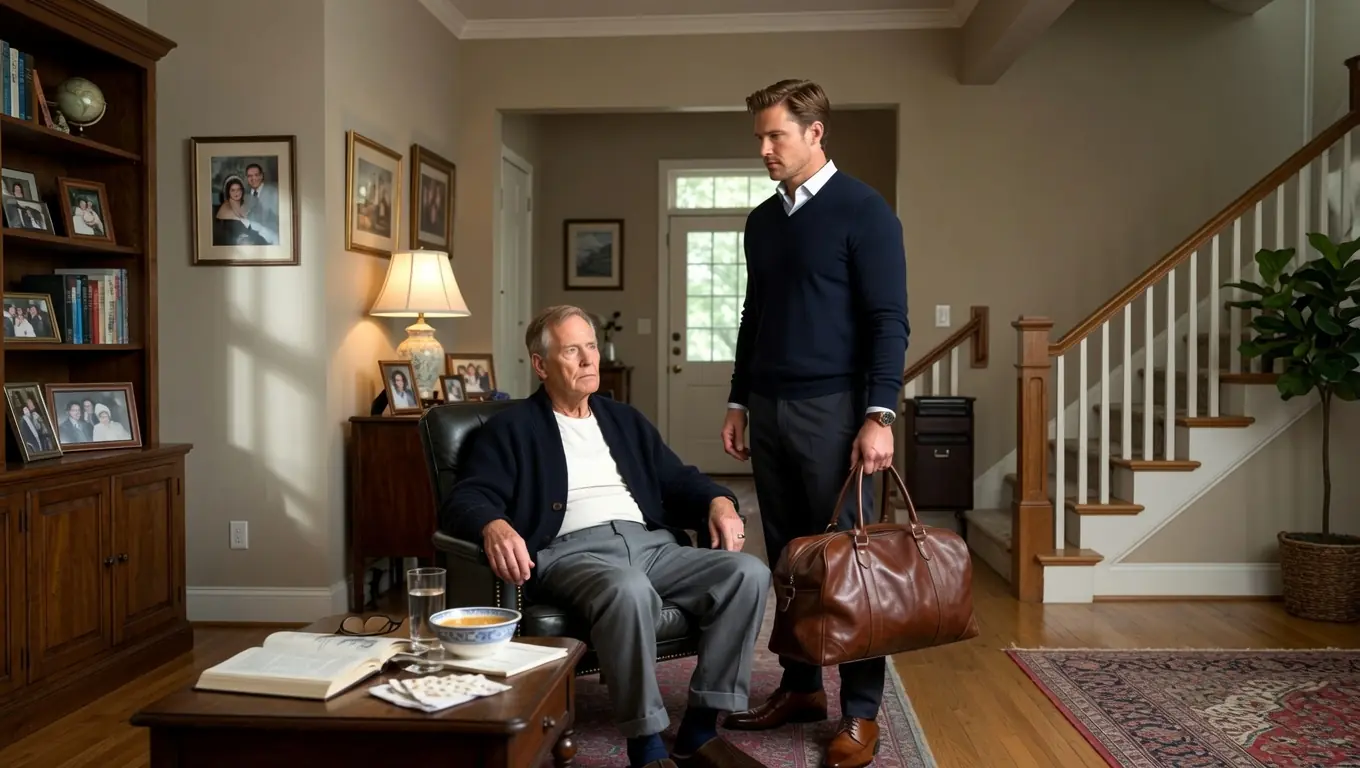
When did those children disappear? Who were these strangers wearing their faces? Saturday morning, I saw the suitcases. Sterling’s leather duffel was by the front door. Margot’s rolling carry-on was in the hallway. Beckett’s backpack was already on his shoulder.
I made coffee and took my time with it. I let the silence stretch until it filled the room like smoke. “We need to head out,” Sterling said finally, not looking at me. I set down my mug. “Already?”
“Work,” he said. “You know how it is.” I nodded. “Of course. Thank you for coming.” That was when his mask cracked.
Sterling turned his back to me, throwing words like weapons. “You know what, Dad? You are selfish. You are sitting on all that money and will not sign a paper. You want to take it to the grave?” Margot crossed her arms and leaned against the doorframe. She did not refute a word.
Beckett sat down beside me, his voice softer but his eyes just as cold. “Dad, we drove here for you. The least you could do is…” He stopped. “The least I could do,” I repeated slowly, tasting each word. “Yes, the least.”
Sterling grabbed his duffel. Margot collected her suitcase. Beckett stood without meeting my eyes. Fifteen minutes later, three cars pulled out of my driveway. No goodbye. No look back. Just the sound of expensive engines fading down the street while I stood at the window and watched.
Across the street, Vera Sutton was watching too. Vera was seventy-two and had lived next door for nine years. She noticed everything from her porch, especially when three expensive cars arrived unannounced and left without anyone saying goodbye. She was holding a small spiral notebook, and I watched her write something down with careful precision before glancing up at my window.
Our eyes met. She did not wave. She just gave a small nod, like she understood something I had not said out loud. Then she went inside, and I was alone. I do not know how long I stood there.
Long enough for the sun to shift angles. Long enough for the coffee in my mug to go cold. Then I walked back to the living room and sat down on the floor. Not on the sofa. On the floor, back against the worn leather, knees pulled up like I was a child hiding from a storm.
My eyes were stinging. Not because my children had just abandoned me. Not because they had called me selfish and walked out without a backward glance. I cried because I missed my wife. Evelyn would have known what to do. She always did.
When Sterling got arrested for drunk driving at nineteen, she was the one who made him face consequences instead of paying his way out. When Margot’s startup failed and she showed up asking for money to try again, Evelyn was the one who said no and meant it. When Beckett called from Houston in tears, saying he had made a terrible mistake with a client’s funds, Evelyn was the one who told him to fix it himself. She had seen this coming. I knew she had.
That note she left, “Please take care of Grace,” was not just about protecting our granddaughter from grief. It was about protecting her from them. The house felt wrong after they left. Not empty, but hollowed out, like someone had reached inside and scooped out everything that made it a home. But I was not empty.
I sat there on the floor for a long time after the sound of their cars faded, the ticking clock above the stove marking seconds I no longer cared about counting. My phone was still in my pocket. The name was still in my search history. Desmond Whitaker. Vera’s notebook was across the street, documenting the exact moment my children decided money was worth more than family.
The first lesson in using darkness is knowing who to trust with the light. The first person I called after my children abandoned me was not a lawyer or a detective. It was Edward Rawlings, the man who had been my closest friend for thirty years and the only doctor I had ever completely trusted. Sunday evening, I drove to Texas Central Hospital without calling ahead.
Edward’s office was on the third floor, the one with the window overlooking the parking lot where we used to smoke cigarettes during his residency before Evelyn made us both quit. The light was still on. I knocked. He opened the door, took one look at my face, and stepped aside. “Coffee?” he asked.
Dr. Edward Rawlings was sixty-one. He had been my closest friend since the days when one of us chose medicine and the other chose finance, both young men convinced we would change the world. Now he poured coffee from a machine that had seen better decades, hands steady in the way that comes from delivering bad news for forty years. He did not ask why I was there.
He handed me a mug, black with one sugar, because he remembered. Then he sat across from me in the worn leather chair that had molded to his shape over the years. “Tell me,” he said. So I did. I told him about Monday afternoon at the clinic, the stage-four diagnosis, and the young doctor’s flat voice.
I told him about the three phone calls and the three identical responses. “I am coming home right away. I love you.” I told him about Sterling making coffee, Margot cooking soup, Beckett massaging my shoulders, and five days of performance so perfect it made my skin crawl. “They asked about my estate before they asked about treatment options,” I said. “That is when I knew.”
Edward refilled my coffee without comment. His face was doing that thing doctors’ faces do when they are listening to symptoms and cataloging them internally, sorting the serious from the survivable. “Thursday night, I overheard Sterling on the phone,” I continued. “He was in my study talking about emergency guardianship, about getting a doctor to sign off on cognitive decline.”
Edward’s hand paused midpour, just for a second, then continued. “And you overheard Sterling mention emergency guardianship?” he asked carefully. “And a name,” I said. “Desmond Whitaker. I do not know who that is, but Sterling was asking how to get around you.”
That was when Edward’s expression changed. Not dramatically, not obviously, but I had known this man for three decades. I had been there when his daughter was born. I had held his hand at his wife’s funeral six years earlier. I could read the shift in his eyes the way you read a weather change in the air.
He knew something. “What happened after you overheard the call?” Edward asked, his voice level. I told him about Friday’s continued performance, Saturday morning’s suitcases, and Sterling turning his back and calling me selfish for sitting on money and refusing to sign. I told him about three cars leaving my driveway without goodbye while Vera Sutton watched from across the street and wrote everything down in her spiral notebook.
“They counted on me being too sick to notice,” I said. “Too weak to care. Too dead to stop them.” The coffee in my mug had gone cold. Edward’s office smelled like antiseptic, old paper, and the faint ghost of cigarette smoke that never quite left despite thirty years of trying.
In thirty years of friendship, Edward had never once lied to me. But sitting there, watching his face close like a door, I realized there is a difference between lying and choosing not to speak. “Thaddius,” he said slowly, setting down his own mug with unusual care, “before you do anything, before you hire a lawyer, before you confront anyone, I need you to come in for a full workup.”
I blinked. “Edward, I already have the results.” “I know,” he said, cutting me off. His voice was firm in a way I had only heard a handful of times. “But humor me. Tomorrow morning, seven a.m. I am clearing my schedule.”
“Clearing? It is Sunday night,” I said. “You are asking me to come in Monday morning for tests I have already had done?” “Yes.” “Why?” He looked at me for a long moment, his eyes the color of slate after rain, gray and unreadable.
“What are you not telling me?” I asked. Edward stood, walked to the window, and looked out at the parking lot where my car sat under the fluorescent lights. When he turned back, his face had shifted into something I had seen him wear at funerals, but never directed at me. “Come in tomorrow,” he said simply. “Seven a.m. Non-negotiable.”
I wanted to push, to demand, to use three decades of friendship as leverage to pry the truth out of whatever careful box he had locked it in. But the thing about knowing someone that long is you also know when pushing will not work. “Okay,” I said. “Seven a.m.” The drive home took twenty-three minutes.
I know because I watched every single one tick past on the dashboard clock, gripping the steering wheel so tightly my knuckles turned white against the dark leather. The November air was cold enough to see my breath. The roads were empty except for the occasional truck hauling cargo through the night. The house was waiting silent, hollowed out, full of furniture and empty of family.
But none of that was what made my hands shake. It was Edward’s voice. That careful, deliberate, unreadable tone. The way he had paused when I mentioned the diagnosis. The way he insisted on tests I had already taken. Whatever Edward suspected, I would find out in less than twelve hours.
I found out at 7:03 a.m. Monday morning. The words came out of the doctor’s mouth slowly, one by one, each syllable impossible. “Mr. Harrington, your lungs are completely clear. There is no malignancy. None.” My ears started buzzing like someone had detonated something inside my skull.
I was sitting in the diagnostic wing at Texas Central Hospital. Edward stood beside me, arms crossed, face carefully neutral. The doctor speaking was Dr. Helena Marsh, chief of diagnostic medicine, a woman in her late fifties who had spent thirty years learning how to deliver news that changed lives in an instant. She was holding imaging results, mine, from tests they had run that morning starting at seven a.m.
Blood work, chest CT, full body scan, everything was clean. “That is not possible,” I said. My voice sounded far away, like it was coming from someone else’s mouth. “The clinic said stage four. They showed me the imaging.”
Dr. Marsh set down the scans with careful precision. “Mr. Harrington, I need to explain something. The clinic where you received your initial diagnosis experienced a ransomware attack on November first. Their entire imaging system was compromised for six days before they discovered it.” The room smelled like antiseptic and fear, always fear, soaked into the walls of hospitals like paint.
“Compromised,” I repeated. “The malware corrupted patient files,” Dr. Marsh continued. “It generated false positives. Dozens of patients received incorrect diagnoses. The clinic is conducting a full review and personally contacting everyone affected.” She turned her laptop toward me.
On the screen, the clinic director appeared via video call, his face pale and drawn like he had not slept in days. “Mr. Harrington,” he said, bowing his head, “I cannot express how deeply sorry we are. This should never have happened.” He started talking about new protocols, reporting the breach to authorities, and reimbursements. I cut him off. “How many others?”
He blinked. “Excuse me?” “How many other patients received false diagnoses?” “Forty-three,” he said quietly. “So far.” Forty-three people. Forty-three families. Forty-three lives turned inside out because of corrupted code and a digital nightmare.
I was one of them, except I was not dying. My hands started trembling. Dr. Marsh pushed a glass of water across the desk toward me. I did not pick it up. “You are certain?” I asked. “Completely,” she replied.
“We ran every test twice and cross-referenced with three separate imaging systems. Your lungs are healthy. Your blood work is normal for a man your age. There is no cancer.” Edward had not said a word. He was watching me with those slate-gray eyes, reading my face the way he had been reading patients’ faces for forty years.
“You suspected,” I said to him. “I suspected,” he confirmed. “When you described how quickly your children arrived, how organized they seemed, I requested your original files from the clinic. The timestamps were off. The image quality was corrupted. I have seen ransomware attacks before, and this had the markers.”
The clinic director was still apologizing on the screen. Dr. Marsh was explaining follow-up appointments and counseling resources for patients who had received false terminal diagnoses, but I was no longer listening. The implications were crystallizing in my mind like ice forming on glass, sharp and clear and cutting. I had received the diagnosis Monday afternoon, November sixth.
I made three phone calls to Sterling, Margot, and Beckett. By Tuesday morning, all three were at my door. By Thursday night, Sterling was on the phone discussing emergency guardianship and someone named Desmond Whitaker. By Saturday, they had called me selfish and abandoned me when I would not sign documents I had never seen. Five days. They had been poised, waiting, ready.
There is a specific kind of clarity that arrives when relief and rage collide. Suddenly, I could see the last five days with perfect, brutal precision. Every false smile and calculated question stood exposed like bones under X-ray light. They were not reacting to my diagnosis. They were executing a plan.
My hand moved toward my phone, fingers already typing the J in Sterling’s name. Edward’s hand came down over mine. “Not yet,” he said quietly. I looked up at him. “I need to call.” “Not yet,” he repeated, his voice firm.
Dr. Marsh excused the clinic director from the call. The screen went dark. She stood, gathered her files, and left Edward and me alone in the diagnostic room with its white walls, fluorescent lights, and clean scan results that said I was not dying. I should have felt relief, joy, and gratitude for whatever cosmic accident had given me my life back.
Instead, my hands were shaking harder than they had when I received the terminal diagnosis. But not from fear this time. From anger. Cold, precise, surgical anger. “They came five days after the diagnosis,” I said.
My voice sounded different, colder, like something inside me had shifted into a register I had never used before. “Five days. They were waiting.” “Which is exactly why you do not call them now,” Edward replied. I looked at the scan results. Clean lungs. Healthy tissue. No masses. No death sentence.
I picked up the paper and folded it carefully, once, then twice, until it was small enough to fit in my inner jacket pocket, the one closest to my heart. “What do you become when the people who are supposed to love you reveal they were only waiting for you to die?” I asked it out loud. Edward did not answer. I tucked the folded results into my jacket and felt the paper’s weight against my chest, warm from my body heat.
“I am healthy,” I said slowly, testing the words. “No one needs to know that yet.” Edward’s expression shifted. Not surprise. Something closer to recognition, like he had been waiting for me to arrive at that exact conclusion. “What are you thinking?” he asked.
“I am thinking,” I said, standing up, feeling my legs solid beneath me, strong and alive and nowhere near dying, “that my children just spent five days performing grief and planning theft because they believed I had six months to live and thirty million dollars to leave behind.” I buttoned my jacket. The scan results crinkled slightly against my chest. “They have no idea they were actually watching something far more dangerous.”
Edward stood and placed a hand on my shoulder. He squeezed once. “Be careful,” he said. “Too late for that,” I replied. I left the hospital with a secret folded against my chest, and for the first time since Evelyn’s funeral, I did not feel like a man waiting to be buried.
I went home Monday evening with no idea what to do with the truth yet. The house was dark and quiet, the kind of silence that settles into empty rooms and stays there waiting. I walked upstairs to the bedroom Evelyn and I had shared for thirty-five years. Her jewelry box still sat on the dresser. Her reading glasses still rested on the nightstand beside a bookmark holding her place in a novel she would never finish.
I do not know what made me open the secret drawer. Maybe grief. Maybe rage. Maybe the universe’s sense of timing, which has always been cruel. Under the silk cloth in Evelyn’s secret drawer was a brown envelope with her shaky handwriting across the front. “For Thaddius only. Read when I am gone.” My hands were already trembling before I broke the seal.
Inside was a letter, three pages in blue ink, dated April seventh, the day before she died. I sat down on the bedroom floor, back against the bed frame, and started reading. “Thaddius,” it began. “If you are reading this, I am gone, and there are things you need to know that I could not say while I was alive.” Her handwriting grew shakier as the letter continued.
Some words were smudged, as if she had been crying while she wrote. “The night of my stroke, I called Beckett. He answered. I could barely speak, but I told him I needed help. He said, ‘Ambulances are expensive, Mom. Just rest.’”
My vision blurred. I called Margot next. Evelyn had written that Margot said, “You always overreact. Take an aspirin.” Then Evelyn tried Sterling last, but he did not answer. Later, she discovered why.
Three months earlier, Sterling had purchased a life insurance policy in Evelyn’s name for one-point-five million dollars. The beneficiaries were Sterling, Margot, and Beckett. Evelyn had found the paperwork in his study the week before she died while looking for tax documents. I stopped breathing as I read the next lines. “All three of them have medical power of attorney. It was their legal obligation to seek emergency care. They chose not to. They let me have the stroke. They let me take the pills. They let me die.”
The letter went on, detailing how she had discovered the policy, dates, account numbers, the name of the insurance company, everything documented with the precision of someone who knew no one would believe her without proof. The final line was smudged so badly I could barely read it. “Never give them your assets. I love you.” I had heard the phrase heartbreak my entire life without understanding it.
It was literal, sitting there clutching Evelyn’s letter. Something in my chest felt like it was tearing apart fiber by fiber. I pressed the pages against my chest and bent my head forward in the darkness. For the first time in years, I cried. Not the quiet, dignified tears you shed at funerals.
These were loud, ragged sobs of a sixty-year-old man weeping alone in an empty house. The sound echoed off walls that had heard laughter, arguments, and thirty-five years of marriage, and now would only ever hear silence. I cried for Evelyn, for Grace, and for the children I had raised who had become monsters I did not recognize. I cried until there was nothing left.
Then I picked up the phone. Edward answered on the second ring, his voice groggy because it was one in the morning. “I found a letter,” I said. “From Evelyn.” He was immediately awake. “Read it to me.”
So I did. Every word. My voice broke on certain lines, went flat on others, and cracked completely when I reached the part about the insurance policy. When I finished, Edward was silent for a long moment. “I need to call Celeste,” he said finally, his voice tight. “Now.”
Five minutes later, we had a three-way conference call with Celeste Ashford. She was forty-seven and had spent two decades in financial law, though the precise nature of her practice had never been fully explained, even to Edward. She listened to the letter without interrupting. When I finished, I heard papers rustling on her end.
“The insurance contract,” she said slowly. “I have suspected this for months. I just did not have evidence.” “You suspected my children were planning to kill me for insurance money and you did not say anything?” My voice came out colder than I had ever heard it. “I suspected fraud,” she corrected. “I had no proof. Now we do.”
Edward broke in. “What are you thinking, Thaddius?” I looked at the letter in my hands, at Evelyn’s shaky handwriting and the smudged ink where her tears had fallen. “I am still dying,” I said. The words came out mechanical and calculated. “At least that is what they are going to believe.”
“That is dangerous,” Edward warned. “Evelyn did not get to be safe,” I said. My voice cracked on her name. That night, I became something I had never been before. Not a grieving widower. Not a betrayed father. A man who had learned that the opposite of love is not hate. It is arithmetic.