My husband fell in love with the neighbor and said she made him feel like a real man, but he had no idea she was using him for something much worse. My husband started walking the neighbor’s dog three months before I realized the neighbor didn’t have a dog. That is the kind of detail that makes you question absolutely everything you thought you knew about your own life, your own marriage, and your own supposed ability to read people and situations.
The first time I saw them together through the kitchen window on a Saturday morning, I felt a small pang of something I couldn’t quite name. He was laughing at something she had said, his head thrown back the way it used to be when we first started dating. Before work and routine filed down the sharp edges of everything, she was walking beside him with a small brown terrier on a leash, gesturing animatedly, her accent making even simple words sound exotic and important. He looks happy, I thought. And then when was the last time I made him laugh like that?
I pushed the thought away and went back to my case files. I am a divorce attorney and have been for almost a decade now. I have spent countless thousands of hours sitting in my office listening to people describe in excruciating detail how their partners deceived them. How they missed signs that now seem glaringly obvious in retrospect. How they built entire lives on foundations that turned out to be nothing but quicksand waiting to swallow them whole.
I always thought I was fundamentally different from those clients. I always thought my professional training, my carefully cultivated cynicism, and my daily immersion in the absolute worst of human behavior had somehow inoculated me against that particular brand of dangerous blindness. Turns out I was just as vulnerable as everyone else who had ever sat in my office clutching tissues and wondering how they could have been so stupid. Maybe even more vulnerable because my confidence in my own judgment meant I never saw it coming, not even for a single moment.
Her name was supposed to be something Eastern European, something that rolled off the tongue with soft consonants and long melodic vowels. She told us she was originally from Ukraine, a small town near Kiev. That she had come to America about three years ago with a husband who seemed charming and romantic at first, but gradually turned controlling, then emotionally abusive, then physically violent in ways that left marks she had to explain away with increasingly creative excuses about clumsiness and accidents.
The first time I really talked to her, she was standing in the hallway holding a bag of groceries and crying. My husband was at work. I was home early for once, nursing a headache after a particularly brutal deposition. I heard sounds through the door. I opened it and there she was. I am sorry, she said, wiping her eyes quickly. I did not mean to disturb you. Are you okay? She laughed, but there was no humor in it. My husband called. He found my new phone number somehow. I do not know how he does it. No matter how many times I change everything, he finds me.
I should have recognized the script. I had heard versions of it hundreds of times in my office from women whose husbands actually were abusive. But hearing it over tea in my own kitchen, watching the tears fall, seeing the fear in her eyes, it felt different. It felt real. How did you end up here? I asked. I researched neighborhoods, she said. Safe buildings, good neighbors. When the apartment across the hall opened up, I knew it was a sign. You and your husband seem like such good people. I could tell just from watching you in the elevator.
I did not ask how long she had been watching. She moved into the apartment directly across the hall from us in early spring when the trees outside were just starting to bud. I remember thinking how striking she was when we first met in the elevator that Tuesday evening. Tall and angular with cheekbones that could cut glass and an accent that made everything she said sound like poetry. My husband noticed her immediately. Of course he did. Everyone in the building noticed her.
What I did not realize at the time was that she had noticed us first. Long before she ever signed that lease, she had been watching, studying, preparing her approach with the precision of a surgeon planning a complicated operation. The friendship started innocently enough. The way these devastating things always do when you are telling the story afterward and trying to identify where exactly everything went wrong. She needed help carrying heavy boxes up the stairs because the elevator happened to be broken that particular weekend for maintenance.
She did not understand how the building’s unnecessarily complicated laundry system worked and kept losing quarters in machines that ate her money without washing her clothes. She was confused about the recycling schedule and had gotten a formal warning from the building manager about putting the wrong materials in the wrong bins. My husband stepped in immediately to solve each of these small problems. He is always been that way. The kind of man who stops to help strangers change tires in the rain. Who believes fundamentally in helping others even when it costs him something.
It is one of the things I loved about him. It is also what made him the perfect target. I was working sixty-hour weeks that spring, sometimes considerably more, desperately trying to make partner at the firm before I turned forty. I was handling three major divorces simultaneously, each one more emotionally complicated and legally contentious than the last. And I barely had time to eat a proper dinner most nights, let alone manage the mundane details of neighborly interaction.
When my husband mentioned casually one morning that they had started taking daily walks together while I slept in after yet another late night at the office, I thought it was sweet, healthy, even. He needed more exercise, and I was clearly too busy and exhausted to be his workout partner. When she started cooking elaborate dinners for him on the many nights I worked late, I thought it was unexpectedly generous of her. She was new to the city, obviously lonely and isolated, grateful for the friendship we had offered.
When he gave her the code to our apartment security system because she kept locking herself out of her own place and needed somewhere safe to wait for the building manager to arrive with spare keys, I thought it was entirely practical. She lived right across the hall. We saw her literally every day. What could possibly go wrong with such a small convenience? My mother was the first person to say something was wrong. She came to visit for a long weekend in May and within forty-eight hours she was pacing my kitchen with that look on her face. The one that has been warning me of trouble since I was a child.
Your husband talks about that woman constantly, she said, keeping her voice low. Every conversation circles back to her. Mom, they are friends. She is going through a hard time. She turned to face me. He knows her coffee order. He knows her favorite color. He knows what time she goes to bed and what makes her cry. He knows more about her childhood than I know about yours. That is not fair, is it? She set down her coffee cup. When is the last time he talked about you that way to anyone?
I did not have an answer. I am not saying he is having an affair, she continued. But something is not right. A woman does not look at another woman’s husband the way she looks at him unless she wants something. She is married. Her husband is abusive. She is scared of him. Have you met this husband? No. But have you seen any proof he exists? A photo, a police report, anything at all? I started to answer, then stopped. I had not. Everything I knew about him came from her stories, her tears, her carefully detailed accounts of abuse.
I have seen this before, my mother said quietly. My friend, do you remember her? She lost everything to a man who pretended to need help. He was patient. He was convincing. And by the time she realized what was happening, it was too late. That is different. Is it? She left two days later. I was relieved to see her go, which should have told me something. I did not want to think about what she had said. I did not want to examine why her questions made me so uncomfortable.
Three days after she flew home, my phone rang. It was from a private investigator. My mother had hired him without telling me, which normally would have infuriated me. But he was not calling to report an affair. He was calling about something stranger. I have been watching her for a week, he said. Something is off. What do you mean? She enters your building at odd hours. Two or three in the morning. Sometimes she meets with people in parking lots around the neighborhood. A man, a woman. Neither matches any description of the husband she is supposedly hiding from. And she has been studying your mailbox, your parking spot, your schedules, taking notes. This is not casual interest. This is surveillance.
Maybe she is paranoid. I said abuse victims can become hypervigilant. I have been doing this for fifteen years. I know what paranoia looks like. This is not paranoia. This is planning. I thanked him and hung up. Then I sat at my desk for a long time staring at my office wall, trying to process what he had told me. I told myself he was overreacting. His job was finding problems, so he found them everywhere. But something had shifted, a seed of doubt. And once it was there, I could not ignore it.
Over the next few weeks, I started watching more carefully. I noticed how often his phone buzzed with messages from her. How he angled his screen away from me. How he talked about her problems like they were his responsibility. One evening, I came home early and heard them laughing in the hallway outside our door. The sound stopped when she saw me. Just for a second, something flickered across her face. Surprise, calculation, recovery. Then she smiled, that warm smile and said she had just been borrowing some olive oil. She is such a good cook, my husband said as we went inside. She is teaching me how to make authentic Ukrainian dishes. That is nice, I said.
And it was nice in theory, but I kept thinking about that flicker on her face, that split second of something that was not warmth at all. The investigator called again a week later. She has a partner, he said. A man. They have been seen together multiple times at a hotel outside the city. Not romantically. They appear to be working on something. And there is a third person, a woman who seems to be directing things from a distance. What kind of things? That is what I am trying to figure out. But whatever it is, it is organized, professional. These are not random meetings.
I should have told my husband. I should have confronted the situation directly. Instead, I watched and waited, building a case the way I had been trained to do, looking for evidence, waiting for the moment when I would have enough to know for certain what I was dealing with. I should have known that by the time you have enough evidence, it is usually too late. The night everything finally and irreversibly fell apart started like any other Thursday in our ordinary lives.
I had had a brutal day in court, a custody battle that had gotten significantly uglier than anyone expected when the opposing husband’s attorney introduced damaging evidence we had not anticipated and could not adequately counter. I came home about two hours earlier than I had originally planned because I simply could not stand being in the office anymore. I could not stand looking at those files for another minute while replaying every mistake I had made. I remember the exact moment I opened the front door. The apartment smelled like garlic and wine, rich and warm and welcoming. Candles were lit on the dining table, the good expensive ones we saved for special occasions and anniversaries.
For a split second, I thought maybe my husband had planned something romantic. A surprise dinner. An attempt to reconnect after months of me being absent. Then I saw them. My husband and the neighbor were sitting across from each other, plates of homemade pasta between them like some kind of romantic dinner for two. She was crying, showing him a bruise on her upper arm that she said her husband had given her just the night before. According to her detailed story told between theatrical sobs that now seem so obviously performed in retrospect, he had somehow found her despite all her precautions. Cornered her alone in a parking garage near where she supposedly worked part-time, grabbed her roughly, twisted her arm behind her back, told her in threatening whispers she would never escape him, no matter how far she ran or how many people tried to protect her from him.
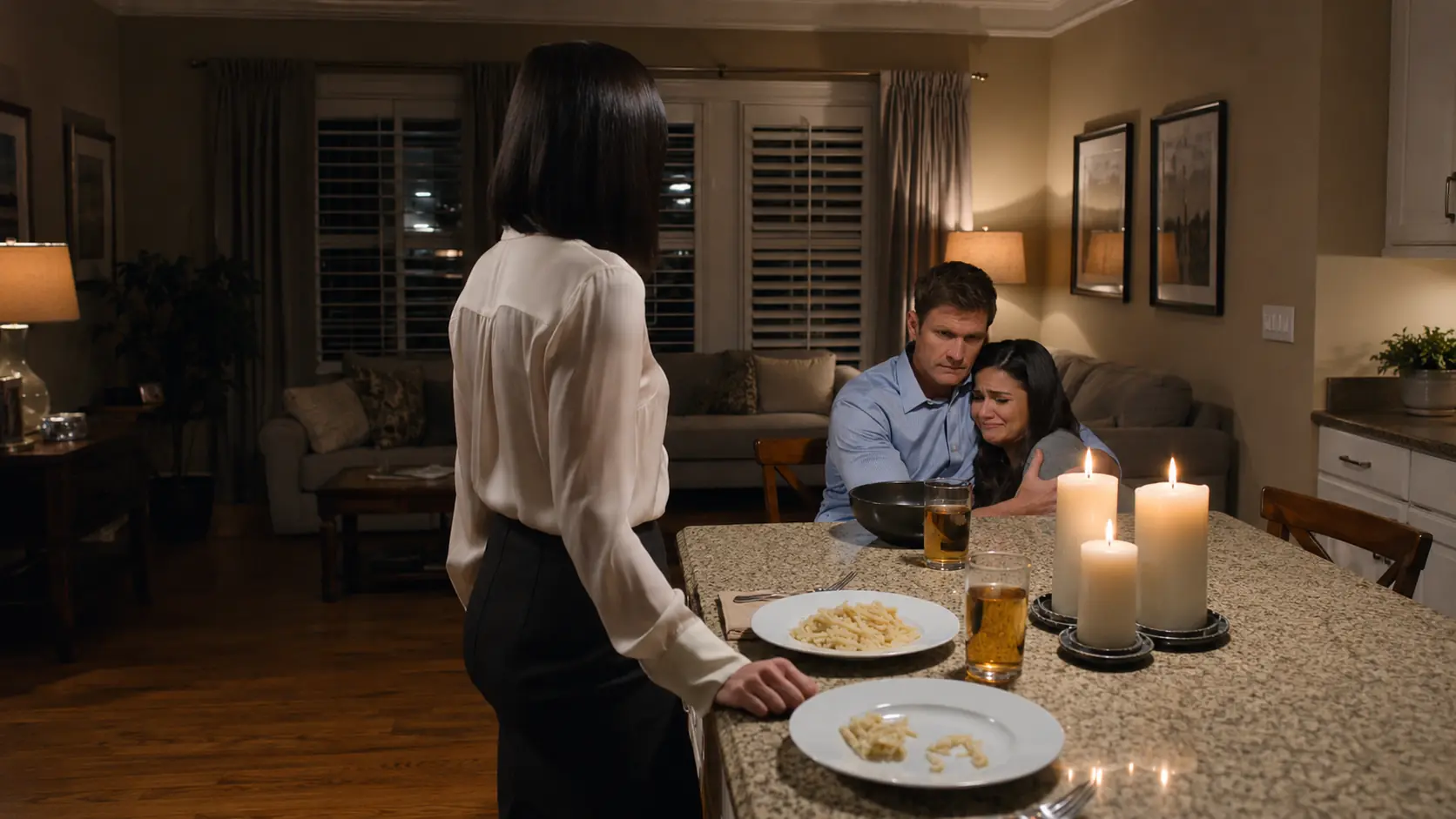
My husband was holding her hand tenderly across the table, looking at her with this fierce protective intensity that I had not seen directed at me in years, maybe ever, if I am being completely honest with myself. And something cold and heavy settled in my chest, watching them together like that. Something that felt less like jealousy and more like sudden, terrible, unwelcome clarity about what had been happening in my own home for months. I walked over to the table and sat down beside them. She looked up at me with those practiced tears streaming down her face. Tell me again what happened. What? I said from the beginning. She launched into the story, her voice trembling. He found me in the parking garage. He grabbed me, twisted my arm behind my back. He said I would never get away from him. When did this happen? I asked. Last night. Around eight.
But you told my husband two days ago that you had been home all day with a migraine. She blinked. That was different. That was before. And your husband? He is left-handed, right? You mentioned that. But this bruise, the grip pattern, it is from a right hand. The tears stopped just for a second, but I noticed something flickered behind her eyes. A calculation happening in real time. I pulled out my phone and showed her the screen. His Instagram. Geo-tagged photos from a conference in Berlin. Posted yesterday. How exactly did he corner you in a parking garage when he has been in Germany all week? The neighbor’s carefully constructed face changed when she realized I was catching on to the inconsistencies in her story. It was subtle, just the briefest flicker behind her eyes, but I had spent years reading people in courtrooms and depositions, and I knew exactly what I was seeing. The mask was slipping.
Whatever elaborate performance she had been giving for the past four months, she was starting to lose control of her carefully constructed narrative. My husband, bless his oblivious and well-meaning heart, did not notice anything wrong at all. He was still holding her hand comfortingly, still gazing at her with that intoxicating mixture of concern and something darker, still completely invested in the story she had been selling him like it was gospel truth delivered from on high. My phone buzzed insistently in my pocket. A text from the investigator my mother had hired. Someone just entered your apartment building using your personal security code. Mail, unfamiliar, went directly to the fourth floor without hesitation.
I felt something cold run down my spine like ice water, settling into my stomach with a weight that made it hard to breathe normally. The fourth floor was where my home office was located. The office where I kept case files, client information, confidential documents that could destroy people’s lives and marriages and financial futures if they fell into the wrong hands. Information that unscrupulous people would pay enormous amounts of money to access for various illegal purposes. I excused myself from the table as calmly as I could manage, said I needed to use the bathroom and instead walked quietly down the hallway toward my office door. My heart was pounding so hard I could hear it clearly in my ears like a drum.
Part of me honestly expected to find nothing at all. To discover that the investigator had been wrong or paranoid or simply watching the wrong building entrance, but the door to my office was standing open, just slightly ajar, when I knew with absolute certainty I had closed and locked it that very morning. A man I had never seen before in my entire life was standing at my desk in the dim light. A professional-looking camera in his hands, methodically photographing the documents I had carelessly left out that afternoon. Case files, financial records, settlement negotiations, information that my clients had entrusted to me with the reasonable expectation of complete professional confidentiality.
For a moment, I just stood there frozen in the doorway, my brain stubbornly refusing to process what my eyes were clearly and unmistakably seeing. Then I screamed. Not a strategic scream, not a calculated reaction designed to achieve a specific outcome, just a raw primal sound of violation and fury that brought my husband running from the dining room within seconds. The next several hours were chaos. The police came quickly. The man with the camera was arrested, still holding evidence of what he had been doing. The neighbor tried to run for the stairs and was stopped by officers in the hallway. I watched them put her in handcuffs.
She looked at me as they led her past. And for just a second, the mask dropped completely. There was no fear in her eyes. No regret, just cold calculation, like a chess player who had lost a game and was already planning the next one. You would have figured it out eventually, she said. They always do. At the police station, the detective let me watch through the one-way glass as they questioned her. I needed to see it. I needed to understand. The accent disappeared first. One moment she was the frightened Ukrainian immigrant, the next she was speaking in flat, unaccented English. How long have you been running this operation? the detective asked. I want a lawyer, she said. But she was smiling.
The truth came out in pieces over the following weeks. There was no abusive husband. Never had been. The accent was fake, perfected over years of practice. She was not from Ukraine, was not an immigrant, was not a victim of anything except her own choices. She was part of a professional crew that targeted people with access to valuable information. Her partner, the man with the camera, was her actual husband. The coordinator who had fled before police arrived was the mastermind who had selected targets and handled the sale of stolen data.
They did not want my husband. They did not want my money. They did not even want me. What they wanted was sitting in filing cabinets in my home office. Information about wealthy people going through bitter divorces, hidden assets, offshore accounts, shell companies, settlement strategies, the kind of information that is worth a fortune to the right buyer, an angry spouse trying to gain leverage, a competitor looking for weaknesses, identity thieves, blackmailers. My clients had trusted me with their most dangerous secrets, and I had been keeping those secrets in an apartment where a stranger had the security code.
They had been watching me for months before she ever moved in. They knew my schedule, my cases, my weaknesses. They knew my husband was lonely, that I worked too much, that he needed to feel heroic in ways our stable marriage did not provide. Every detail of their friendship had been manufactured. The vulnerability, the intimacy, the trust, all of it designed to get access to my files. The bruises were makeup, the tears were acting. The dog my husband walked every morning belonged to someone else, borrowed to create opportunities for contact.
What made it worse was that my husband had not technically cheated. He had not slept with her or kissed her, but he had given her everything else. His time, his attention, his emotional energy, his trust. He had shared things with her that he had not shared with me in years. And when I tried to explain why that hurt almost as much as physical betrayal, he looked at me with genuine confusion, like he truly did not understand what he had done wrong. The professional fallout was immediate and devastating. I had to report the breach to my firm the next morning, sitting in the senior partner’s corner office, explaining that client information had been compromised because a con artist manipulated my husband into giving away our security code.
The meeting lasted two hours. Every question felt like an accusation. How long did you know this woman? Four months. And you never suspected anything? I had concerns. I was investigating. Investigating. He wrote something on his notepad rather than say changing your security code or alerting us to a potential threat. I did not know what the threat was. I thought it might be personal. Instead, it was professional. And now our clients are exposed. There was nothing I could say to that. He was right.
The forensic team spent three days in my home office cataloging which files had been exposed. They photographed everything, asked questions about my filing system, my security protocols, why I kept certain documents at home instead of in the firm’s secure storage. I had never thought about it before. Everyone took work home. That is what you did when you were trying to make partner. But I had also never been targeted by professional criminals before. The worst part was calling my clients. The partners offered to handle it through official channels, but I insisted on doing it myself. I owed them that much.
The first call was to a woman whose husband had hidden millions overseas. We had spent months building that case, documenting every offshore account, every shell company, every fraudulent transfer. If that information got out, her entire divorce strategy would collapse. I trusted you, she said when I finished explaining. I told you things I have never told anyone. My children’s social security numbers, my hidden accounts, everything. I know. I am so sorry. Sorry does not help me if my husband’s lawyers know what we know. No, it does not. She fired me that afternoon. I did not blame her.
The second call went to a business owner in the middle of contentious custody negotiations. His ex-wife had accused him of financial fraud. We had been building a defense based on documents that were now potentially compromised. How did this happen? he demanded. You are supposed to protect this information.
That is your job. I know. I trusted you with my life, my kids’ lives, and some what? Some con artist got into your files because your husband gave away your security code? Yes. Long silence. Then I should sue you for negligence. He did not ultimately, but he transferred his case to another attorney and reported me to the state bar. The ethics complaint was eventually dismissed, but not before six months of anxiety and three separate interviews with investigators.
The third client was more understanding. He was an older man, a retired executive whose wife had walked out after forty years of marriage. He had seen enough of life to know that bad things happen to good people. I am not going to pretend this does not concern me, he said when I told him. But I have read about these operations. They target smart people, careful people. The shame is not in being fooled. It is in how you handle it afterward. Thank you.
I will transfer my case to another attorney here. No offense intended. None taken. He paused. For what it is worth, I think you will come back from this. I have watched you work. You are good at what you do. One mistake does not erase that. It was the kindest thing anyone said to me during those first terrible weeks. I held on to it during the long nights when I could not sleep. When I lay awake cataloging every mistake I had made, every sign I should have seen.
My path to partnership was suspended indefinitely. I was removed from sensitive cases, relegated to routine matters. Colleagues who had smiled at me now avoided eye contact. I heard whispers, fragments of conversations that stopped when I approached. The rumor mill worked overtime. Was I careless or complicit? Had I known about my husband’s relationship? Was the whole thing some kind of insurance fraud? The theories got more elaborate the longer the investigation dragged on. I could not even blame them. The irony was not lost on me. A divorce attorney who could not see the manipulation in her own home.
Every night I lay awake replaying those four months, searching for the moment I should have seen through it all. The signs were everywhere once I knew what to look for. The investigation expanded over the following weeks as law enforcement dug deeper. Our neighbor and her partners were not amateurs.
They had been running variations of this scheme for years, moving from city to city, targeting professionals with access to valuable confidential information. A doctor in another state had lost his medical license after they stole patient records that were later sold to identity thieves. A financial adviser watched his firm collapse when client portfolio information leaked to competitors. A corporate attorney nearly went to prison for what prosecutors initially thought was insider trading before investigators realized he had been victimized by the same crew.
The woman who posed as my neighbor had been doing this for more than four years. She could read people instantly, identify vulnerabilities, become whatever they needed. For my husband, that meant being helpless and grateful. Someone who made him feel strong and heroic. For other victims, she had played different roles. A struggling single mother, a grieving widow, a frightened immigrant. Whatever persona got her through the door.
The coordinator, who had selected targets and sold the stolen information, escaped before police arrived that night. International warrants were issued. Agencies coordinated across borders. But she was smart and careful. The investigators told me she was probably already setting up the next phase of her operation somewhere else. The chances of catching her seemed frustratingly slim.