My name is Henry Holloway, and I was sixty-three years old when I finally learned that patience can become a prison.
For forty-two years, I had been married to Margaret, the love of my life, the woman who could read a person’s soul before they finished their first cup of coffee. She was smarter than I was in almost every important way, especially when it came to people. I built businesses, bought properties, and studied markets, but Margaret studied hearts. When she died, I thought grief would be the hardest thing I had to survive.
I was wrong.
Losing Margaret revealed something far colder than loneliness. It revealed what my own son had become when her gentle presence was no longer there to shame him into decency. Leonard was thirty-five, my only child, the boy I had once carried on my shoulders at baseball games, the young man Margaret had believed would eventually remember who he was. But six months after I buried his mother, Leonard stood by while his wife treated me like a burden he was embarrassed to carry.
Lucy was thirty-two, beautiful in the expensive artificial way that never happened by accident. Platinum blonde hair, polished nails, designer clothes, glossy makeup, and a smile that turned warm or cold depending on what she thought someone was worth. From the first night Leonard brought her home, Margaret and I had seen something behind her charm. She laughed at my jokes, praised Margaret’s cooking, and complimented our family photos, but her eyes kept drifting toward the jewelry cabinet, the original paintings, and the Persian rug that had belonged to Margaret’s grandmother.
Later that night, while we washed dishes, Margaret whispered, “Something feels off.”
She was right. She was almost always right.
Instead of confronting Leonard, we decided to test the situation quietly. Margaret and I had spent decades building wealth, but we chose to hide it from Lucy. We let her believe we were comfortable but modest retirees, the kind of older couple who had a nice home but not much else. If Lucy truly loved Leonard, money would not matter.
That test did not chase her away.
It made her play the long game.
Over the years, Lucy slowly convinced Leonard that his parents were declining, too proud to ask for help, and in need of financial guidance. Leonard began managing small accounts for us, then paperwork, then property decisions. He thought he was taking control of everything. What he did not know was that our lawyer, James Morrison, was moving real wealth safely beyond his reach every step of the way.
Margaret had prepared for the worst long before I was emotionally ready to admit the worst might come.
We owned real estate across multiple states, investment accounts, business interests, and a beautiful villa in Tuscany that Margaret had fallen in love with before she died. Our net worth was more than eight million dollars, though Leonard and Lucy believed I was living almost entirely on Social Security. The tragedy was not that they did not know the truth. The tragedy was that their behavior became crueler because they thought I had nothing left to offer.
After Margaret died, Leonard and Lucy moved me into a small apartment in a worn rental building they claimed was one of their investment properties. It was barely eight hundred square feet, with thin walls, an unreliable heater, old cabinets, and upstairs neighbors who seemed to rearrange furniture every night at three in the morning. They acted as if they had saved me from homelessness. Every visit came with a reminder that I should be grateful.
I played along.
Part of me was too broken by grief to fight. Part of me wanted to see how far they would go if they believed I was helpless. Margaret’s last words to me had been, “Don’t let them win, Henry. Promise me.” I had promised, but promises made beside a deathbed are hard to carry when the bed is empty and every room still smells like the person you lost.
For six months, I watched.
Leonard rarely came alone. When he did, he looked tired, impatient, and uncomfortable, as if visiting me were an obligation he resented but could not completely abandon. Lucy came more often, not because she cared, but because she enjoyed reminding me who she thought held the power. She never knocked. Why would she? In her mind, even my air belonged to her and Leonard.
One cold Monday morning, I was sitting at the small kitchen table with a half-empty cup of coffee and a stack of bills in front of me. I could have paid those bills a hundred times over, but in the life Leonard and Lucy believed I lived, they were proof that I was struggling. I heard Lucy’s heels before I saw her. The sharp click of them on the hallway tile was always a warning.
“Henry, we need to talk,” she said from the doorway.
“Good morning to you too, Lucy,” I replied.
She rolled her eyes and stepped inside without closing the door. She was wearing a cream coat, a black designer dress, gold earrings, and the smug expression of someone who had rehearsed a speech on the drive over. She pulled out her phone and began scrolling through a list, as if she were about to present evidence in court. “Leonard and I have been talking. We think it’s time you started contributing more to your living expenses here.”
I set my coffee cup down carefully.
“I thought helping with utilities was enough for now,” I said.
“That was before we realized how much extra you’re costing us,” she replied. “The water bill is up. The electricity is through the roof because you keep the heat on during the day. You need to be more responsible.”
“I’m an old man, Lucy. I need warmth.”
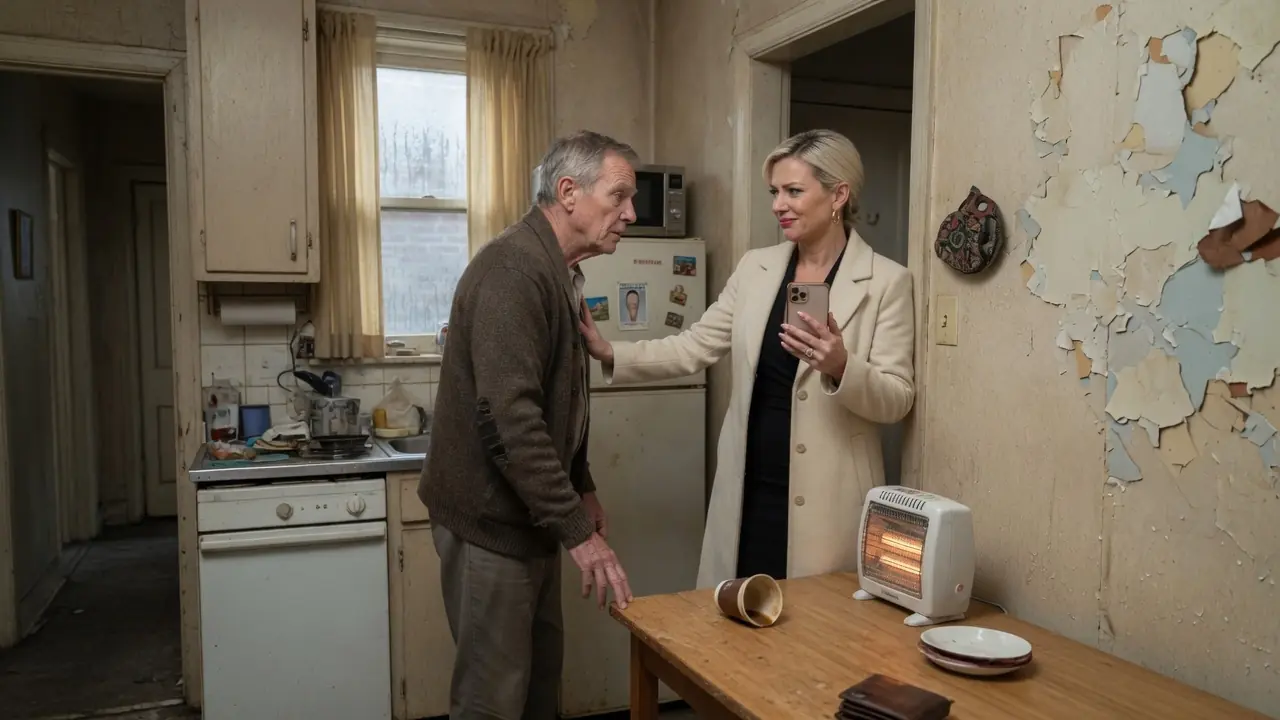
“And we need you to stop acting like everything is free.” Her eyes finally met mine, cold and bright. “We’ve decided you need to start paying five hundred dollars a month in rent, plus your share of all utilities.”
Five hundred dollars.
I almost laughed.
The watch partly hidden under my old cardigan cost more than their car payments for several years. The apartment building she thought Leonard controlled was mine through a company she had never heard of. The house she lived in was mine. The insurance policy she probably dreamed about had been quietly monitored by James for years.
But I kept my face neutral.
“Lucy,” I said softly, “you know I’m living on Social Security now. Margaret’s medical bills wiped out everything we saved.”
The lie came easily because Margaret and I had practiced it for years.
“That’s not our problem,” Lucy said. “You’re a grown man. Figure it out.”
I looked at her for a long moment. This was the moment I had been waiting for, though I wished I had not needed it. “What if I can’t come up with that kind of money?”
She shrugged, examining her nails. “Then maybe it’s time to look into senior living facilities. Some of them are probably fine.”
The threat hung in the air.
She wanted me gone. She had probably wanted me gone since the moment Margaret died, maybe long before. With Margaret alive, Lucy had never been brave enough to push too hard. But now my wife was buried, my son was weak, and Lucy believed I was poor.
So I gave her one final test.
“I understand,” I said quietly. “Could I borrow fifty dollars for groceries this week? Just until my next check comes in.”
Her face changed instantly.
The polite mask disappeared, and what was underneath was ugly enough to end every doubt. “Are you kidding me?” she snapped. “You want us to give you money on top of everything we already do for you?”
“It’s just fifty dollars, Lucy. I’ll pay it back.”
“With what? Your imaginary savings?” Her voice rose. “You’re nothing but a burden, Henry. A useless old parasite who can’t even take care of himself.”
She stepped closer.
Then she shoved me hard enough that I stumbled back against the kitchen counter, knocking my coffee cup sideways and sending the bills sliding across the table. Pain shot through my hip as I caught myself against the edge of the counter. For a second, neither of us moved. Lucy looked startled, but not sorry.
“Go work,” she said, her voice low and sharp. “Stop being a pathetic old man and contribute something for once in your worthless life.”
Then she turned and walked out, leaving the door wide open behind her.
I stood there for several minutes, breathing slowly, letting the silence return. My body hurt, but something deeper had finally gone still. For six months, I had waited to see if there was any decency left in the family Leonard had built. That moment gave me the answer.
I walked to the bathroom, looked at myself in the mirror, and smiled.
Not because I was happy.
Because the test was over.
I took photos of the bruise forming along my cheek and jaw, making sure the injury was documented without making a scene. Then I sent a message to James Morrison, the lawyer Leonard and Lucy did not even know existed.
James, we need to accelerate our timeline. Can we meet tomorrow?
His reply came within minutes.
Of course, Henry. Everything all right?
I looked at my reflection, at the tired eyes and the old cardigan and the man Lucy had mistaken for helpless.
Everything is perfect, I typed. It’s time.
That evening, I sat in the little living room with an ice pack pressed to my face and thought about Margaret. I remembered the first dinner with Lucy, the way Margaret had watched her without letting her smile slip. I remembered the quiet talks we had later, when we realized Lucy might be more interested in value than love. I remembered the day Margaret suggested we hide everything.
“She needs to choose Leonard without knowing what he might inherit,” Margaret had said. “And Leonard needs to choose us even if he thinks we have nothing.”
It had been a painful test.
Leonard failed slowly.
At first, he simply became distant. Then he began repeating Lucy’s words as if they were his own. He said Margaret and I had to be realistic. He said we needed to simplify. He said expensive medical care, long-term planning, and property decisions had to be handled responsibly. What he meant was that Lucy had convinced him we were a drain on their future.
The worst moments came during Margaret’s final illness.
Lucy complained about hospital visits, medical bills, lost time, and how much stress it placed on Leonard. My son never defended his mother with the force she deserved. He still came to the hospital, still kissed Margaret’s forehead, still cried when the machines grew quiet. But I could see the pressure behind his eyes, the way he was already calculating what caring for a sick parent had cost him.
Margaret saw it too.
She died hoping he would remember himself.
I spent the next morning in James Morrison’s office on the thirty-second floor of a downtown building, dressed in my worn cardigan and discount-store slacks. James stood when I entered, and his face tightened the moment he saw me. He had known me for more than twenty years. He had watched Leonard grow up. He had attended Margaret’s funeral.
“What happened?” he asked.
“My daughter-in-law decided I needed a lesson in respect.”
“Please tell me you documented it.”
I handed him my phone and the urgent care report I had gotten the day before. James studied the photos, his jaw clenched. “Good. If needed, this supports a restraining order or civil claim.”
“It won’t come to that,” I said. “By the time I’m done, they’ll be too busy dealing with their own problems to bother with me.”
James looked at me for a long moment, then opened the thick file on his desk.
“You’re ready to pull the trigger on everything?”
“Past ready.”
For the next hour, James reviewed the financial fortress Margaret and I had built. Seventeen properties across three states. Two apartment buildings. A shopping center. A vacation home in the Hamptons that Leonard had never heard of. A stock portfolio worth millions, royalties from Margaret’s accounting firm, and several business investments that had grown beyond our early expectations.
The current total net worth was 8.7 million dollars.
I sat in that leather chair, thinking of Lucy demanding five hundred dollars from me while standing inside a life my money had silently supported.
“The beautiful thing,” James said, “is that Leonard has no legal claim to any of it. His name is on one small checking account. Everything else is in trusts, corporate holdings, or protected accounts.”
“And the house?”
“Sarah has four cash offers,” James said. “The highest is 1.4 million. Buyers want to close next Friday and take possession immediately.”
“That’s the one.”
He nodded. “Then Leonard and Lucy will be out within forty-eight hours of closing.”
The house was the one they considered theirs, the house where Leonard had grown up, the house Lucy had redecorated as if my wife had never existed. They believed they controlled it because they lived there. Legally, it had always been mine.
“What about the insurance policies?” I asked.
“Cancelled as of yesterday,” James said. “The two-million-dollar life insurance policy naming Leonard is gone. The disability policy is gone. The will has been rewritten exactly as requested.”
“How much does Leonard receive?”
“One dollar. Lucy receives nothing. Everything else goes to charity, except the trust maintaining Margaret’s grave site.”
One dollar.
I should have felt guilty.
I did not.
James hesitated before continuing. “There’s one more thing. The apartment building where you live is also yours.”
I looked up sharply.
“You bought it through one of the shell companies eighteen months ago,” he reminded me. “Margaret wanted to observe how Leonard and Lucy treated you when they thought you depended on them.”
The absurdity hit me all at once. I was paying rent to Leonard through a management system I owned. The money went in a circle back to accounts under my control. Leonard thought he was my landlord. In reality, he had been a performer on a stage Margaret had designed.
“I want eviction notices prepared,” I said. “For the house and for the apartment building.”
James studied me. “This is nuclear, Henry.”
“They made their choice when Lucy put her hands on me. I’m making mine.”
We finalized the plan that day.
The house would close Friday afternoon. Notices would be served Saturday. I would leave the country before either of them could reach me. My destination was Tuscany, to the villa Margaret had loved from photographs and letters, the one she made me promise to buy before she died.
The property sat near Montalcino, surrounded by vineyards and olive groves. Margaret had dreamed of restoring its gardens and spending our old age there among stone walls, good wine, and quiet mornings. She never lived to see it. I would go for both of us.
The following Friday, I sat in James’s conference room and signed the papers that sold the house out from under Leonard and Lucy.
The buyers were a young couple with twin toddlers, excitedly discussing the backyard where Leonard had once played as a child. I should have felt sadness at losing that place. Instead, I felt relief. A house stops being home when the people inside it forget what love cost to build.
The sale closed at 2:15 p.m.
I accepted the cashier’s check for 1.4 million dollars.
That evening, I wrote the letter.
It took three hours because I wanted it clear, controlled, and impossible to misunderstand. Not a tantrum. Not a plea. A verdict.
Leonard and Lucy,
By the time you read this, I will be gone.
The house you have been living in was sold today to a young family who will take possession Monday morning. You have forty-eight hours to remove your belongings.
You believed you were taking care of your poor, struggling father. The truth is that your mother and I have watched you for years, waiting to see who you really were when you thought there was nothing to gain.
Lucy, from the moment you entered our home, you calculated value. You saw jewelry, art, property, and inheritance before you saw family.
Leonard, you allowed your wife to treat me like a burden because it was easier than standing up to her. You let her convince you that I was pathetic, useless, and dependent on your charity.
Your mother and I accumulated a net worth of approximately 8.7 million dollars. We owned properties, investments, and business interests you knew nothing about.
The apartment building you thought you collected rent from belongs to me. The house you thought was yours belonged to me. The life insurance policy that would have paid Leonard two million dollars has been cancelled.
The will has been rewritten. Leonard, you inherit one dollar. Lucy, you inherit nothing.
This is not because I hate you. This is because Margaret asked me not to let cruelty win.
I folded the letter and placed it in an envelope with both their names.
On Sunday morning, I drove to the house one last time. Leonard and Lucy’s BMW sat in the driveway. They were home, probably still asleep after another expensive dinner they would later call a necessary break. I used my key to enter through the kitchen door, the same door Margaret and I had used for thirty years.
The house looked familiar and foreign at once.
I placed the envelope on the kitchen island beside Lucy’s designer coffee cups. Then I walked through the rooms one last time. The living room where Leonard took his first steps. The den where we watched games. The dining room where Margaret hosted Thanksgiving until Lucy decided our traditions were too old-fashioned.
In Leonard’s old bedroom, I stopped.
His trophies were still there. Certificates hung on the wall. Evidence of a boy loved deeply by parents who believed kindness could be taught and would remain. Somewhere between that room and adulthood, my son had learned to stand silent while his wife shoved his father and called him worthless.
I left the house key on the counter beside the letter and drove away at exactly ten in the morning.
My flight to Florence was not until late that night, but I had one stop left.
Margaret’s grave sat beneath an oak tree in Forest Hills Cemetery. I knelt beside the stone and told her everything. The letter. The house sale. The will. The villa. I told her I had kept my promise and that they would never hurt either of us again.
A flock of birds lifted from the tree above me.
I chose to take it as a sign.
The next day, when the plane descended through the clouds over Italy, I saw rolling hills, cypress trees, ancient stone buildings, and vineyards stretching into sunlight. At customs, the officer looked at my passport and asked, “Business or pleasure?”
“Home,” I said.
The word surprised me with how true it felt.
Maria Benedetti, the woman who managed the villa, met me at the airport. She was in her early fifties, with kind eyes, strong hands, and a smile that made me feel expected rather than tolerated. She embraced me as if I were family and called me Signor Enrico. On the drive to the villa, she told me Margaret had written to her many times about gardens, restoration, and dreams for the property.
“Your wife had beautiful dreams for this place,” Maria said.
My throat tightened.
The villa appeared around a bend in the road like a painting made real. Honey-colored stone, green shutters, red roof tiles, lavender along the walkway, grape vines climbing the walls. For the first time in months, I felt awe push grief aside.
Inside were polished stone floors, exposed beams, antique furniture, a massive kitchen, a library, and a bedroom balcony overlooking vineyards and olive groves. That evening, Maria served pasta with tomatoes from the garden, fresh bread, local cheese, and wine made from grapes grown on my land. We ate on the terrace as the sky darkened and the first stars appeared.
I told her everything.
She listened without judgment.
When I finished, she said, “This is not revenge, Signor Enrico. This is rebirth.”
I slept better that night than I had in months.
No thin apartment walls. No neighbors. No Lucy. No Leonard. No waiting for the next insult. Only wind through olive trees and church bells marking the hours in the distance.
The next morning, my phone showed seventeen missed calls from Leonard.
There were messages too. His first voicemail was frantic, demanding to know what was happening and why people were saying they had bought the house. Lucy’s message came next, shrill with rage, threatening lawsuits and calling me every cruel name her panic could reach. The third message was Leonard again, quieter this time.
“Dad, please,” he said. “We can work this out. We’re family.”
I turned off the phone.
They had remembered family only after consequences arrived.
Months passed in Tuscany.
I learned the rhythm of the land. I helped during the grape harvest, clumsy at first, then better. I walked the olive groves. I restored Margaret’s garden with rosemary, lavender, basil, and tomatoes. People greeted me with respect not because they wanted my money, but because decency was simply how they moved through the world.
Lucy called once through the villa phone.
She sounded smaller than I had ever heard her. She said things were bad. She and Leonard had moved in with her mother. Leonard had lost his job from stress. They could not afford rent. She insisted Leonard had not known about the money, as if that mattered.
“What Leonard knew,” I said, “is that you treated his father like garbage, and he stood there quietly.”
She asked what it would take for forgiveness.
I looked out over the vineyards and thought about the eight years they had been given to choose decency.
“Nothing,” I said. “The damage is done.”
Then she asked about Leonard’s inheritance.
That told me everything I needed to know.
I hung up and never answered her again.
Later, James sent documents showing Leonard and Lucy had tried to challenge my will, claiming I was mentally incompetent. The case was ridiculous. James had medical evaluations, legal records, and every document arranged with the precision Margaret always admired. Their challenge collapsed before it became anything serious.
I began donating money in Margaret’s memory.
Five hundred thousand dollars went to pediatric cancer research. More went to an animal shelter, literacy programs, and scholarships for young women studying accounting. Each donation felt like a conversation with my wife. Every dollar helped someone who needed it instead of rewarding people who had wasted love.
Six months after arriving in Tuscany, I received a letter from Leonard.
He said he and Lucy were divorcing. He said he finally saw what she had done to our family. He wrote that he was ashamed, that he was not asking for money or forgiveness, and that he understood why I left. He said he hoped I was happy wherever I was.
I read the letter three times.
Then I sat in Margaret’s garden and thought about the boy Leonard had been. I thought about the father I had been. I thought about justice, mercy, and the difference between rescuing someone and helping them begin again after they finally accept responsibility.
That night, I wrote to James and changed Leonard’s inheritance from one dollar to fifty thousand.
Enough to help him start over.
Not enough to erase the consequences.
It felt right.
At sixty-three, I learned that starting over is not only for the young. Sometimes it takes most of a lifetime to understand that love without respect becomes a cage. Family without loyalty becomes a burden. And peace is worth more than any inheritance ever written on paper.
Margaret’s garden bloomed in the Tuscan sun.
The olive trees grew heavy with fruit.
The vineyards promised another good harvest.
One evening, I sat on the terrace with a glass of wine made from my own land and raised it toward the stars.
“Thank you, Margaret,” I whispered. “You taught me when to hold on, and when to let go.”
The wind carried my words across the valley.
For the first time since losing her, I did not feel abandoned.
I felt free.