Vincent Crawford came home at seven o’clock on a Thursday night with a migraine pressing behind his eyes and twelve hours of work still clinging to his shoulders. He was thirty-one, a senior software engineer, and that day had been one long string of broken code, rushed meetings, client complaints, and last-minute fixes no one else wanted to own. All he wanted was a quiet apartment, a clean kitchen, and maybe ten minutes where nobody needed anything from him. Instead, he opened the door and immediately smelled old takeout.
The apartment was his, legally and financially. His name was on the lease, his paycheck covered the three-thousand-dollar rent, his card paid the utilities, the internet, the groceries, the streaming services, and almost every comfortable thing inside those walls. Shirley Laurie had moved in a year earlier after her freelance social media work became inconsistent, and Vincent had told himself supporting her was part of building a future together. He had never wanted to make her feel small for earning less, so he paid quietly and hoped effort would someday balance out in other ways.
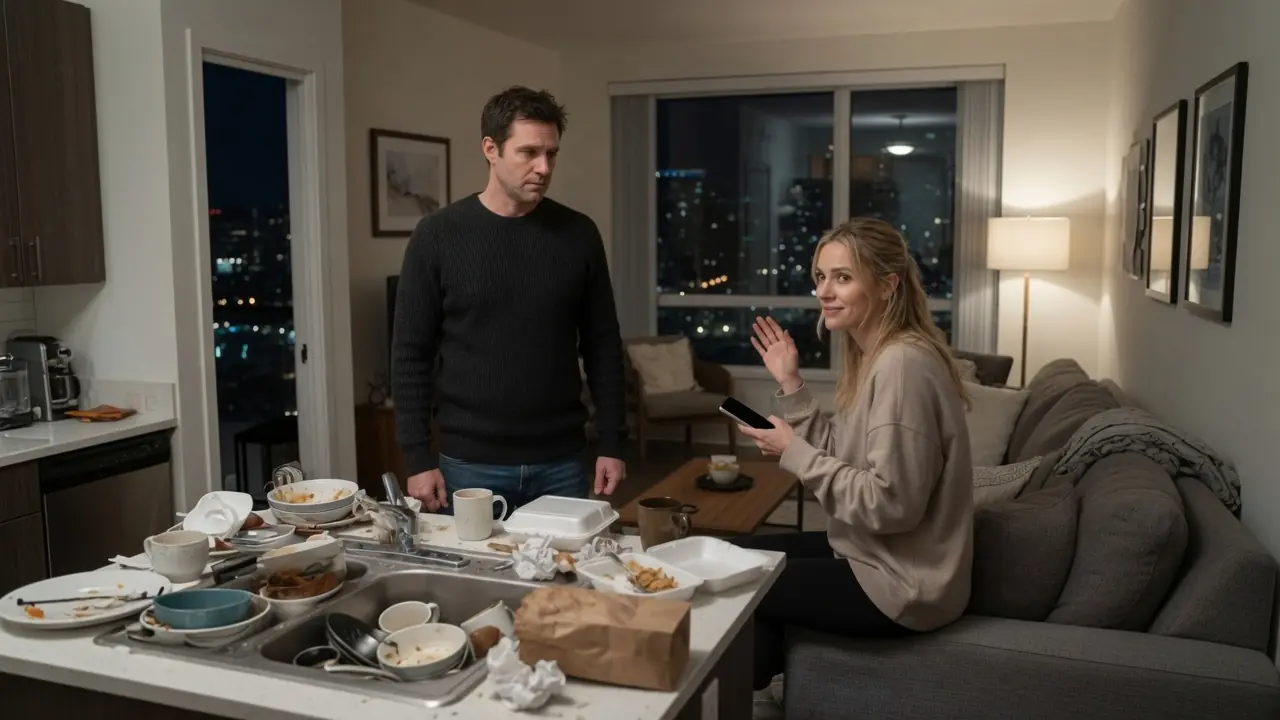
But the kitchen looked like a warning he had ignored too many times. Dirty coffee cups crowded the sink, plates were stacked with dried sauce crusted along the edges, and half-eaten takeout containers sat open across the quartz counter. A sticky ring from a smoothie cup marked the island, and crumbs scattered near the stove told him she had eaten more than once without cleaning anything. Shirley had been home since two in the afternoon.
She sat sideways on the gray sofa with one leg tucked beneath her, phone glowing in her hand, scrolling through TikTok with the volume loud enough to cut straight through his headache. Her blonde hair was tied loosely, her oversized lounge sweater slipped off one shoulder, and she looked perfectly comfortable inside the mess she had created. Vincent stood near the kitchen counter for several seconds, letting the sight settle. Then he took a slow breath.
“Hey,” he said, keeping his voice neutral. “Did you happen to clean up the kitchen today?”
Shirley sighed like he had asked her to rebuild the apartment by hand. She did not look up from her phone at first. Her thumb kept moving, her face lit blue-white by the screen. “No,” she said flatly. “I was busy, and I didn’t feel like it.”
Vincent looked at the counter, then back at her. “Okay. Could you help me clean it now before we figure out dinner?”
That was all he asked. Not a lecture, not a complaint about money, not a long speech about how tired he was or how much he carried. Just help me clean the kitchen before dinner. In a normal relationship, it should have been a small request.
Shirley snapped her head up as if he had insulted her. Her face hardened with immediate irritation, the kind that told Vincent she was already choosing anger because accountability would cost too much. She rolled her eyes, waved one hand dismissively toward the mess, and gave a short laugh. “I am not your maid, Vincent.”
Vincent stared at her. “I did not say you were.”
“You are acting like it.” She sat up straighter, phone still in one hand like a prop in a performance. “You come home and immediately start complaining because every little thing is not perfect for you.”
“I asked for basic help in the apartment I pay for,” Vincent said.
Her eyes narrowed. “There it is.”
“There what is?”
“The money thing,” Shirley said, smirking like she had caught him. “You always find some way to remind me this is your apartment.”
Vincent felt his jaw tighten. The truth was that he almost never reminded her of that, and she knew it. He had swallowed the imbalance for months, cooked around her schedule, cleaned around her moods, and paid for comfort she treated like a right. But every time he came close to saying the arrangement was unfair, Shirley turned the conversation into an accusation against him.
He put one hand on the edge of the counter, grounding himself. “This is not about money. It is about respect.”
Shirley laughed again, sharper now. “Oh my God, you are so dramatic.”
“I worked twelve hours today.”
“And I had things to do too.”
Vincent looked at the mess again. “Like what?”
Her face flashed with offense. “Excuse me?”
“What were you busy with?”
She stared at him as if the question itself were unforgivable. “I do not have to give you a report of my day like I’m your employee.”
“I am asking why the kitchen looks like this after you were home all afternoon.”
That was when Shirley reached for her favorite weapon. Vincent saw it coming half a second before she said it. Her expression shifted from irritated to smug, the way it always did when she believed she was about to regain control. She leaned back against the sofa, lifted her phone slightly, and pointed it toward him.
“If you do not like how I do things,” she said, “we can just break up.”
The apartment went quiet around him. The TikTok video still played in her hand, some stranger laughing through the speaker, but Vincent stopped hearing it. He stood in the middle of his own kitchen, surrounded by her dirty dishes, her takeout boxes, her mess, her entitlement, and finally understood the pattern with complete clarity. She had said versions of that sentence before.
When he asked about splitting groceries, she hinted maybe they were not compatible. When he asked her to contribute to utilities, she said maybe he would be happier alone. When he wanted a serious conversation about effort, she said maybe they should end things if he was so unhappy. Every time, he backed down, apologized, softened, or changed the subject because he loved her and because he was afraid of losing the relationship.
But fear can only work as leverage while the other person still believes the relationship is worth saving at any cost. Standing there that night, Vincent realized the cost had become too high. He was paying rent, buying food, covering bills, carrying stress, cleaning messes, and still being threatened whenever he asked for the smallest sign of partnership. Something cold and steady clicked into place inside him.
He looked at her and said one word.
“Okay.”
Shirley blinked. “Okay, what?”
Vincent’s voice was calm. “Okay. If that is what you want, we are done.”
For a second, she looked surprised. Then she smirked, proving she still thought she understood the rules of the game. “Good,” she said, turning back to her phone. “Then stop complaining.”
Vincent watched her for a moment longer. She genuinely believed she had won. In her mind, he had accepted the threat as a warning, swallowed his frustration, and returned to his assigned role as the quiet provider who kept the peace. What she did not understand was that he had taken her seriously for the first time.
That night, Shirley acted like nothing had happened. She ordered herself spicy Thai food using the card linked to Vincent’s account, ate it on the sofa, and complained because the restaurant forgot extra sauce. She did not ask if he wanted any. She did not ask about his day, did not apologize for the kitchen, and did not acknowledge that she had casually threatened to end their relationship over dirty dishes.
Vincent made himself a cold turkey sandwich and ate it standing at the counter. Shirley glanced at him once and smiled. “See?” she said. “Problem solved.”
He almost laughed.
Later, Shirley went to bed as if the night had ended normally. Vincent did not follow her. He sat on the sofa in the dark with his laptop open, the apartment finally quiet except for the low hum of the refrigerator. Then he began making a list.
Lease, in his name. Electricity, in his name. Internet, in his name. Streaming accounts, in his name. Authorized credit card access, connected to him. Smart home apps, shared calendars, location tracking, delivery accounts, spare keys, emergency contacts.
He moved through the list with surgical precision. He changed passwords for Netflix, Hulu, Amazon Prime, and the grocery delivery account. He removed her devices from the smart thermostat and logged her out of the shared Wi-Fi management app. He opened his banking app and canceled the authorized user card she kept in her purse.
By midnight, he had scheduled a locksmith for the next morning. The earliest available slot came with a rush fee, and he paid it without hesitation. Then he walked into the bedroom to grab a blanket. Shirley shifted in the dark, half asleep, and mumbled, “Love you.”
Vincent did not answer.
He slept on the couch and, for the first time in months, slept deeply.
Morning came with the sound of the shower running. Shirley hummed to herself as if the night before had never happened, as if breakups were just dramatic punctuation marks she could erase by sleeping through them. Vincent sat fully dressed on the couch in jeans and a dark sweater, coffee already made, his face calm. When Shirley walked into the living room wrapped in a white towel, she stopped short.
“You okay?” she asked.
“Yeah,” Vincent said. “Just up early.”
She studied him for a second, suspicious but not concerned. Then she shrugged and moved through her usual morning routine. She brewed his expensive coffee, set up her makeup mirror on the dining table, complained about a toxic client, asked whether he had seen her black heels, and checked her phone every few seconds. Vincent answered politely, briefly, without emotion.
At 9:12, Shirley grabbed her bag and headed for the front door. “I have a networking brunch,” she said. “Then I might be late tonight. Do not wait up.”
“I won’t,” Vincent said.
She kissed him on the cheek automatically. “Don’t be grumpy later. You know how you get.”
Then she left.
The moment the door clicked shut, Vincent stood. The locksmith arrived five minutes later, an older man named Mike with a blue work shirt and a quiet, knowing face. He saw the apartment, the tension in Vincent’s posture, and the empty bags waiting near the closet. “Breakup situation?” he asked.
Vincent nodded.
Mike slid his tools from the case. “Good call,” he said. “People say things they do not mean right up until someone finally believes them.”
While Mike worked on the lock, Vincent packed Shirley’s belongings. He did not throw anything, damage anything, or act out of spite. He folded her clothes, gathered her shoes, packed her makeup bags, chargers, hair tools, ring light, notebooks, and the decorative items she had slowly spread through his space. Three duffel bags and two suitcases were lined neatly near the door by noon.
The new deadbolt clicked into place with a sound that felt final. Mike handed Vincent two brass keys. Vincent paid him, thanked him, and stood by the door for a moment after he left. The apartment did not look transformed yet, but it already felt different.
By one o’clock, Vincent had removed Shirley from the last shared accounts. Location sharing off. Calendar access removed. Payment cards disconnected. Saved passwords changed. Every invisible thread tying her daily convenience to his life was cut cleanly and quietly.
Then he sat on the couch with a book and waited.
At 6:47 p.m., his phone lit up on the coffee table.
Hey, I’m outside. Why isn’t my key working?
Vincent read it once and did not reply.
By 6:52, the phone was vibrating nonstop. Calls, texts, voicemails, more calls. The messages came faster as her confusion turned into anger. What the hell is this? Vincent, answer me. Stop being dramatic and open the door.
At 7:03, the first knock came. Not polite. Not uncertain. Hard, sharp, entitled. The kind of knock that assumed the door would open because it always had before.
“Vincent!” Shirley shouted from the hallway. “Open this door right now.”
Vincent stayed seated.
His phone lit again. You cannot just lock me out. This is my home too.
That one almost made him smile. Almost.
He picked up the phone and typed one sentence.
You said we could break up.
The hallway went silent for half a minute.
Then the pounding returned, louder and frantic. “Are you seriously doing this over dinner?” Shirley yelled, loud enough for the neighbors to hear. “Over a kitchen?”
Vincent stood and walked to the door. He did not unlock it. He did not touch the deadbolt. He simply stood close enough for her to hear his voice through the wood.
“No,” he said calmly. “I am doing this over absolute disrespect.”
There was a pause. When Shirley spoke again, her voice had changed completely. Softer. Smaller. Calculated. “Vincent, come on. I didn’t mean it like that. You know how I talk when I’m annoyed.”
“That is the exact problem,” Vincent said. “You say terrible things because you never expect consequences.”
“So what?” she snapped, the softness vanishing. “You just decided this by yourself?”
“Yes,” he said. “Just like you did.”
Another long silence filled the hallway. Then her voice came back as a whisper. “You are actually breaking up with me.”
“I already did.”
She did not knock after that.
Vincent listened to her footsteps move slowly down the carpeted hallway. When they faded, he returned to the couch and turned off his phone. The apartment was quiet, but not empty. For the first time in a year, it felt like his.
The next morning, sunlight filled the living room. Vincent turned his phone back on and found seventeen missed calls and a wall of text messages. The first ones were furious. Then defensive. Then wounded. Then pleading.
This is insane.
You are overreacting.
Please answer.
I did not think you would actually do this.
That last one stayed with him for a moment. It was the truth beneath every tactic she had ever used. She had never thought he would take her words seriously. She had treated the relationship like leverage because she trusted his fear more than his boundaries.
Around noon, Shirley left a voicemail. He listened while drinking coffee at the kitchen island.
“I was just mad,” she said, voice tired and cracked. “You always know I talk like that. You are really going to throw everything away over something so stupid?”
Vincent deleted it.
There it was again. Stupid. As if basic respect were optional. As if asking someone to clean their own mess was an unreasonable demand. As if threatening to end the relationship was just a small inconvenience he should absorb and forget.
An hour later, there was another knock. This one was softer. Hesitant.
“Vincent,” Shirley said through the door. “I do not have anywhere to go tonight.”
Vincent closed his eyes. That sentence might have broken him a month earlier. He would have opened the door, let her cry, accepted an apology, and watched the pattern restart within days. But physical distance had already broken the spell.
He walked to the door and rested his palm flat against the wood. “You told me we could break up.”
“I did not think you meant it,” she whispered.
“I did.”
Silence.
“I’ll do better,” she said. “I’ll clean. I’ll help. I’ll make dinner. Just let me come home.”
Vincent stepped back from the door. “I’m not interested in promises. I’m interested in peace.”
She stood there for another minute, waiting for him to soften. He did not. Eventually, he heard her leave.
For the next two days, Vincent’s life became quiet in a way that felt almost unreal. He went to work, came home, cooked for one, and slept diagonally across the bed. He did not wake up tense. He did not dread the next argument. He did not wonder what mood would be waiting for him on the sofa.
Late on the second night, curiosity made him turn his phone back on. Thirty-four missed calls. More messages than he cared to count. Some were angry, accusing him of being cruel and unstable. Others were soft, full of apologies and promises. The final one read: Please. I’m sorry. I’ll make dinner. I’ll do better. Just let me come home.
Vincent stared at it longer than the rest. Not because he believed it, but because he understood it. This was not transformation. This was panic. This was what happened when leverage failed and comfort disappeared.
He placed the phone face down and went to sleep.
By the third day, mutual friends began texting him. Shirley had started telling people he had locked her out over a joke. A joke. Vincent read the messages without responding to most of them. He had spent too long explaining himself to someone who only listened when consequences arrived, and he had no interest in auditioning for public opinion.
That afternoon, Shirley came again.
Vincent checked the peephole. She looked different this time. Her hair was pulled back, no makeup, wearing an old hoodie that used to belong to him. She looked smaller, not physically, but emotionally, as if the certainty had finally drained out of her.
“Vincent,” she said softly. “Can we please talk?”
He did not open the door.
“I know I messed up,” she said. “I should not have said that. I was tired. I did not mean it.”
“You say things you do not mean because you do not expect consequences,” Vincent replied.
“I did not think you would take it seriously.”
“That is the problem. I did.”
Her voice cracked. “I do not understand how you could just flip like this.”
Vincent leaned his shoulder against the wall. “I did not flip. I finally stopped bending.”
The hallway went quiet.
“I’ll change,” Shirley whispered. “I swear.”
Vincent believed she believed it in that moment. But he also knew the pattern too well. Promises when comfort is threatened. Tears when access is removed. A temporary reset followed by the same disrespect once stability returned.
“I am not doing this again,” he said.
“So that is it?”
“Yes.”
She waited one more minute. Then she turned and walked away.
That evening, Vincent cleaned the entire apartment. Not out of nervous energy, not to erase her, but because he wanted to live in a place that reflected him again. He threw out old takeout containers, wiped the counters, cleared the fridge of expensive organic things he never liked, and moved the furniture back to where it had been before her preferences slowly took over every corner. The apartment seemed to exhale with him.
He cooked a hot dinner that night. Nothing fancy, just chicken, rice, and vegetables. He ate at the dining table with the television off and his phone facedown. No loud videos. No judgment. No threat hanging in the air disguised as sarcasm.
Around midnight, one final message arrived from Shirley.
I can’t believe you’re really okay with this.
Vincent looked at it for a long time. She still thought this was about winning. She thought peace was stubbornness, silence was cruelty, and boundaries were punishment. She could not understand that the absence of chaos felt better than being loved badly.
He typed a response, deleted it, and locked the screen.
When he woke the next morning, there were no new messages.
That was when he knew she had finally understood. Not the breakup, not the locks, not the silence, but the terrifying fact that he had stopped reacting. Her greatest weapon had always been the fear that she might leave. Once he accepted the leaving, the weapon became useless.
Months later, Vincent would tell friends the story simply. Shirley threatened a breakup over dirty dishes, and he said okay. People laughed at the bluntness of it, but Vincent always knew the kitchen was not the real issue. The dishes were only the last visible piece of something much larger.
The real issue was being treated like a hostage inside his own relationship.
A partner who threatens to leave every time accountability appears is not looking for understanding. They are looking for control. They want fear, apology, silence, and surrender. They want you to prove you are worth staying for while they never prove they are worth keeping.
Vincent had spent a year paying for everything and apologizing for needing anything.
That ended the night Shirley offered a breakup like a weapon.
He accepted it like freedom.
And he never regretted changing the locks.