The morning Tessa told me I did not get to have opinions about her plans, I was standing in my own kitchen holding a coffee mug. Not our kitchen, though I had let myself call it that for months because I wanted us to feel like a real couple building a real life. It was my kitchen, inside the one-bedroom condo I bought three years earlier with money I saved slowly, carefully, and without anyone else’s help. Tessa stood directly across from me with a packed duffel bag at her feet, already dressed to leave, already annoyed that I had the nerve to remember the weekend we had planned together.
My name is Jordan Miller, and I was twenty-nine when I learned that being easygoing can become an invitation for someone else to take over your life. I worked as a civil engineering technician for a transportation firm in Denver, which was not glamorous, but it was stable. My days were full of bridge reports, road plans, design revisions, and deadlines that made my shoulders ache. When I bought the condo, it felt like the first adult thing in my life that was fully mine.
Tessa Vaughn came into that space like weather. She was twenty-seven, beautiful, confident, and impossible not to notice. She taught Pilates, posted wellness content online, and had the kind of polished energy that made people believe she had answers to problems they had not even named yet. When we first started dating, I liked that about her.
She was exciting in the places where I was steady. She knew new restaurants, new workouts, new coffee shops, new rooftop bars, and new language for every emotion. I was the guy who made lists, paid bills early, and fixed loose cabinet handles on Saturday mornings. She used to call that “grounding,” and I took it as a compliment.
By the time she moved into my condo, the compliment had changed shape. She no longer said I was grounding. She said I was predictable. Then predictable became boring, and boring became the word she reached for whenever I asked for something simple, like a night without her friends taking over the living room.
Her friends were Ava, Brooke, and Lila. I called them the hummingbirds privately because they never stopped moving, filming, talking, rearranging, suggesting, correcting, and buzzing through the condo like it belonged to them. They were not terrible people at first, or at least I tried not to see them that way. They were loud, self-assured, and always holding iced drinks with complicated names.
The problem was that they became part of my home without ever being invited by me. Three or four nights a week, I would come home from work and find ring lights in the living room, tripods in the hallway, yoga mats rolled across the floor, and half-open packages of protein powders and skincare samples covering the kitchen counter. Tessa called it her creative space. I called it my condo, but mostly in my head.
I told myself it was temporary. Tessa was building her brand, and building things took sacrifice. I knew that better than most people, because every bridge drawing I touched had to consider weight, stress, pressure, and balance. What I did not understand then was that relationships needed the same kind of engineering.
For eight months, I bent around her life. If the living room was being used for content, I worked in the bedroom. If the kitchen counter was full of product samples, I made dinner on a cutting board balanced near the sink. If her friends were over late, I put on headphones and pretended not to hear them laughing about their followers, their bodies, their energy, and sometimes me.
The first time Tessa called my job boring in front of them, I laughed because I thought it was teasing. Ava had asked what I did, and before I could answer, Tessa waved one hand and said, “He works with traffic stuff. It’s very responsible and very beige.” Everyone laughed, including me. Later, I realized I had laughed to keep from looking hurt.
The second time, we were having dinner, and Tessa was talking about a possible brand partnership with a supplement company. I asked a practical question about contracts, because contracts matter when money changes hands. She smiled at me like I had said something adorable. “Jordan, babe, this is creative business. Not everything is a spreadsheet.”
Brooke laughed and said, “Engineer boyfriend energy.” Tessa corrected her. “Technician, not engineer.” Then she looked at me and added, “He gets sensitive about that.” I was sitting right there.
I should have said something then. I should have told her that reducing my work to a joke in my own home was not cute. Instead, I cleared plates and told myself she did not mean it badly. That was another mistake I kept making: treating repeated disrespect like accidental phrasing.
The week everything broke, I had been working late nights on a bridge design deadline. I was exhausted, but I wanted one normal weekend with Tessa. Not content, not friends, not filming, not a wellness retreat disguised as a vacation. Just the two of us.
I bought tickets to an Avalanche game because she had mentioned months earlier that hockey games looked fun in person. I made a dinner reservation afterward at Tavernetta, a place she had once said felt romantic without trying too hard. I told her twice during the week. She smiled both times and said, “Sounds fun.”
Friday morning, I woke up early, made coffee, and felt almost excited. Tessa came out of the bedroom in black leggings, a beige athletic top, white sneakers, and a loose ponytail. Her duffel bag was already packed. She was scrolling through her phone while walking, which meant the decision had been made before I was included in the conversation.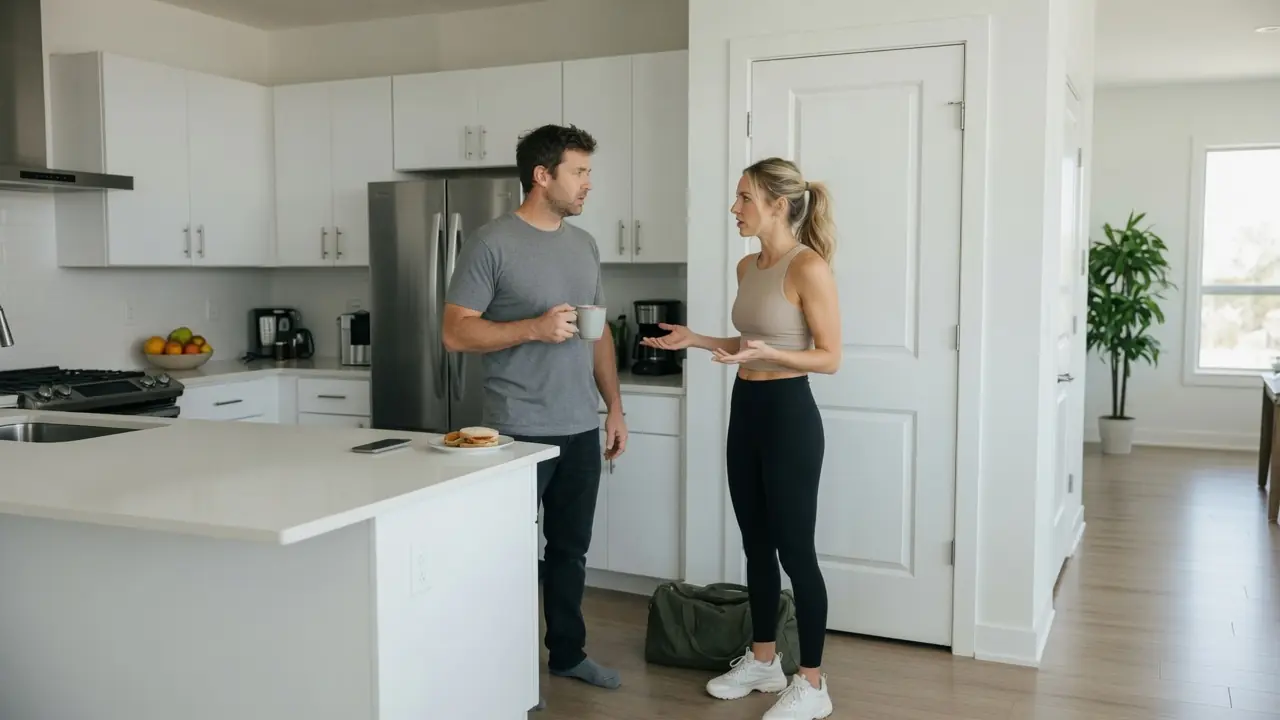
“So,” she said, not looking up, “the girls found this amazing A-frame in Breckenridge for the weekend. Last-minute opening. We’re leaving in an hour.”
She blinked like she had forgotten I existed in the planning process. “Oh, right.”
“And dinner reservations.”
“Can you sell the tickets?” she asked. “Or take someone else?”
I set the coffee pot down slowly. “Tessa, I planned this weekend for us.”
That was when she finally looked at me. Not with guilt. Not even with surprise. She looked irritated, as if my plans were clutter she now had to step around.
“Jordan, you don’t get to have opinions about my plans,” she said. “We’re not married. I’m not asking for your permission.”
The room went very still.
I had heard sharper words in my life, but not many that landed so cleanly. It was not just what she said. It was the tone. Flat, dismissive, final. Like she had been waiting for the right moment to pull that sentence out and place me beneath it.
I looked at the duffel bag by the doorway. I looked at the clean counters I had wiped down the night before, already half-covered again with sample bottles she had not put away. I looked at the woman who lived in my condo, used my internet, filled my rooms with her friends, and now told me I had no voice because I was not her husband.
“You’re right,” I said quietly.
She frowned. “What?”
“We’re not married.”
Something flickered across her face, but she covered it with a laugh. “Don’t be weird about this. It’s one weekend.”
“It was our weekend.”
“Oh my God.” She rolled her eyes. “You planned a boring little date and now you want applause? Please.”
That one hurt more than the first sentence. Because I had been excited. Not dramatically, not loudly, but quietly excited in the way men like me often are, making plans and hoping they will be noticed. The tickets were not just tickets. The reservation was not just dinner. They were evidence that I was still trying.
Tessa crossed her arms. “This is what I mean. You act supportive until I do something you didn’t choose, and then suddenly I’m the bad girlfriend.”
“I didn’t say that.”
“You didn’t have to.” She looked me up and down. “You do this wounded silence thing, like I’m supposed to feel guilty because I want a life that isn’t just coffee, work, and your sad little routines.”
I stared at her.
My sad little routines.
The gym before work. The commute. The project deadlines. The mortgage payment. The quiet evenings where I cooked because she liked eating well but hated grocery planning. The steady life she enjoyed when it was convenient and mocked when she wanted to feel superior.
“I need to go,” she said, grabbing the duffel bag. “Ava is downstairs.”
“Of course she is.”
Tessa paused at the doorway. “Don’t start.”
“I’m not starting anything.”
She gave me a cold little smile. “Good. Try not to sulk all weekend.”
Then she left.
I heard her laughing in the hallway a few seconds later. Ava said something about mountain air and masculine insecurity, and Tessa laughed harder. The door closed, and for the first time in months, the condo became quiet enough for me to hear the refrigerator humming.
I stood there with my cooling coffee and felt something inside me shift. Not rage. Rage would have made me careless. This was different. This was clarity.
If I did not get to have opinions about her plans because we were not married, then she did not get to treat my home like a shared studio. She did not get wife-level access while offering boyfriend-level respect. She did not get to laugh at my stability while standing inside the life that stability paid for.
I drank my coffee. Then I took Ms. Green across the hall to the hockey game instead.
Ms. Green was seventy-one, retired from family court, and had a way of looking at people that made them confess things accidentally. She wore a red scarf to the game and knew more about hockey than I did. When she asked why Tessa was not there, I told her the short version. Ms. Green listened, took a sip of beer, and said, “So she wants independence without inconvenience.”
I laughed because it sounded absurdly accurate.
“To clarity,” she said, raising her glass.
“To clarity,” I answered.
The next morning, I started with the living room. I boxed the ring lights first, carefully wrapping cords so no one could accuse me of damaging anything. Then the tripods, the backdrops, the influencer props, the branded tote bags, the unused sample candles, the product stands, and the three decorative stools Tessa and the hummingbirds had bought without asking me. I labeled every box neatly and stacked them in the hall closet.
I did not touch her clothes or personal things in the bedroom. I did not throw anything away except open sample products that had leaked or expired. This was not revenge. It was restoration.
By Sunday, the furniture was back where it had been before Tessa turned the living room into a content lounge. The couch faced the television again. The coffee table was no longer pushed into a corner. I took down the mirror they had mounted for outfit videos, patched the small holes, and vacuumed the rug until the room felt like mine again.
The kitchen took longest. I cleared the powders, supplements, jars, bottles, and three separate brands of “functional sweetener” from my counters. I scrubbed sticky kombucha residue from the island. I organized the cabinets by actual use instead of aesthetic grouping.
When I finished, I cooked dinner for myself at a clear counter. It was just chicken, rice, and vegetables, but it tasted better than most things I had eaten in months. Peace, I discovered, has a flavor.
On Monday, I made a list and placed it on the entry table. Not decorative, not cute, just clear. Quiet hours after 10 p.m. Guests by invitation, not assumption. Shared costs require shared consent. Respect the owner, respect the home.
Was it blunt? Yes. Was it overdue? Absolutely.
I also removed her friends from my streaming services, changed the smart speaker profiles, deleted their guest access from the smart lock, and reset the thermostat account. Tessa still had her key. She could come back. But the open-ended access, the invisible assumption that everything mine was available to everyone she loved, was done.
Tessa returned Sunday evening with Ava and Brooke behind her, all three laughing in the hallway. The door opened, and the laughter died mid-breath. Tessa froze with her duffel bag over one shoulder, staring at the living room. Ava looked at the couch, then the empty corner where her favorite ring light had been.
“What is this?” Tessa demanded.
I was sitting at my drafting table with my laptop open. “My living room.”
“Where are my things?”
“Boxed and labeled in the closet. Nothing is damaged.”
“You boxed my stuff while I was gone?”
“I reorganized my home.”
Ava stepped forward with her phone already in her hand. “That’s actually insane.”
I looked at her. “Ava, this is not your conversation.”
Brooke made a small scoffing sound. “Wow.”
Tessa’s face turned red. “Is this because I went to Breckenridge?”
“No,” I said. “It’s because you told me I don’t get to have opinions about your plans because we’re not married. I realized you were right.”
She narrowed her eyes. “Don’t twist my words.”
“I am applying them fairly.”
“That is not fair.”
“You want independence from my opinions while using my home as your base of operations.” I closed the laptop slowly. “That is not independence. That is convenience.”
Ava said, “This is controlling.”
“No,” I said, standing. “Controlling would be telling Tessa where she can go. I did not do that. I simply decided what happens in the condo I own and pay for.”
Tessa looked like she wanted to yell but also knew the facts were bad terrain. “Ava, Brooke, can you give us a minute?”
They left, but not before Ava gave me a look like she was already writing the caption.
When the door closed, Tessa sat on the couch, then immediately looked annoyed because it was no longer arranged for filming. “You embarrassed me,” she said.
I almost laughed. “You brought an audience.”
“I came home.”
“With backup.”
“They care about me.”
“And I am not allowed to care about myself?”
She looked away.
I sat across from her. “Tessa, you live here because I invited you into my home. You are not on the deed. You do not pay the mortgage. You contribute a little toward groceries, usually after your friends have eaten most of them. You use my space, my internet, my utilities, my furniture, and my patience.”
Her jaw tightened. “So now you’re keeping score?”
“No. I finally checked the score you were pretending didn’t exist.”
She flinched.
I continued, keeping my voice calm. “You mocked my job. You called our weekend a boring little date. You told me my routines were sad while benefiting from the stability those routines create.”
“I was angry.”
“You were honest.”
That stopped her.
For the first time, Tessa looked less furious and more uncertain. She pulled at a thread on her leggings, staring down at it as if it might give her an answer. “So what do you want?”
“I want respect. I want to be asked, not informed. I want your friends invited, not assumed. I want my home treated like a home, not a free studio. And I want my opinion to matter in the space I pay for.”
She was quiet for a long time.
Then she said, “And if I can’t do that?”
“Then you need to move out.”
There it was. The sentence I had avoided for months because I was afraid of what it would mean. Once spoken, it did not feel cruel. It felt like a door finally labeled correctly.
Tessa stood and went to the closet where the boxes were stacked. She pulled one out, then another, carrying them to the bedroom. I helped because I am not a monster and because the boxes were heavy. We moved in silence, more like roommates ending a lease than lovers having a fight.
That night, she stayed in the bedroom with the door closed. I heard her on a video call with the hummingbirds, voices rising and falling, outrage being passed around like a shared drink. I made dinner for one again and ate at my clear kitchen island. For once, nobody filmed beside me.
Two days later, the real performance arrived.
I was working at my drafting table when the door opened. Tessa walked in with Ava and Brooke behind her, both holding phones up. Tessa’s voice was louder than normal, projected like she was already recording a statement. “I just need to document what’s been happening because people deserve to know.”
I stood up. “Turn off the cameras.”
Ava said, “We have a right to document.”
“Not inside my private home.”
Tessa pointed toward me. “This is exactly what I mean. Jordan erased my life here because I took one weekend trip with friends.”
“I boxed content equipment from common areas,” I said. “Your personal things are untouched.”
“He changed everything,” Brooke said into her phone. “This is what control looks like.”
I walked to the bedroom, grabbed my laptop, and came back. My hands were shaking slightly, but my voice stayed level. I opened the audio file I had recorded the morning she left, not because I planned to use it publicly, but because Ms. Green had once told me documentation protects quiet people from loud narratives.
Tessa’s voice filled the room.
“Jordan, you don’t get to have opinions about my plans. We’re not married. I’m not asking for your permission.”
The room went dead silent.
Ava lowered her phone first. Brooke’s face changed completely. Tessa went pale.
“You recorded me?” she whispered.
“I recorded a conversation I was part of,” I said. “And I’m glad I did, because you just walked in here trying to turn me into the villain for setting boundaries after you told me my voice didn’t matter.”
Tessa opened her mouth, but nothing came out.
I looked at all three of them. “Leave.”
Ava tried to speak. “Jordan—”
“No. Leave now, or I call building security and report harassment.”
They left.
Tessa looked back at me once from the doorway, but the performance was gone. Without the story she had planned, she seemed smaller, tired, and almost frightened by the mess she had created. The door closed behind them, and I sat on the couch for nearly ten minutes, breathing through the silence.
That evening, I called my project manager. My firm had been offering overseas contracts for months, and I had always turned them down because my life in Denver felt settled. Now settled felt like another word for stuck. There was a six-month placement open in Montreal on a transit system design project.
I took it.
Then I called a property management company and arranged to lease my condo while I was gone. Within a week, a young couple relocating for work signed the lease. They were nervous, polite, and excited in a way that reminded me of who I had been when I first bought the place.
Tessa came back alone three days later. No cameras. No Ava, no Brooke, no Lila. She looked exhausted, her hair loose, her eyes red, her confidence drained down to something almost human.
“Can I come in?” she asked.
I let her.
We sat at opposite ends of the couch. For once, she did not scan the room like she owned it. She looked at the floor and said, “Someone leaked the audio.”
“It wasn’t me.”
“I believe you.”
I said nothing.
“My post got destroyed,” she said. “Brands are asking questions. People are saying I lied.”
“You did.”
She closed her eyes. “I needed you to be the villain.”
The honesty surprised me.
“For the story?” I asked.
She nodded. “For the content. For myself. I needed it to be about you being insecure and controlling because otherwise it was about me treating you badly.”
“That is what it was about.”
“I know.”
The room felt different then. Not warm, not healed, but real. Tessa pulled her knees to her chest like someone much younger and said, “I got caught up in the brand. The independence thing. The strong woman thing. Ava and Brooke kept telling me I needed to protect my energy, but I think I started using that to avoid accountability.”
I listened.
She looked at me. “I did look down on you.”
The words hurt even though I already knew them.
“Your job. Your routines. Your way of living. I called it boring because it made me feel better about how chaotic I was.” Her voice cracked. “And I liked living here because it was stable, but I didn’t respect the person who made it stable.”
That was the most honest thing she had ever said to me.
“I’m leaving for Montreal in two weeks,” I told her.
Her eyes widened. “What?”
“Six-month work contract. The condo is leased while I’m gone. New tenants move in the week after I leave.”
“Where does that leave me?”
“Wherever you decide to go.”
She stared at me, and I could see the old version of Tessa searching for a lever to pull. Anger, guilt, tears, accusation, charm. But she looked too tired to perform any of them.
“I’m sorry,” she whispered.
“I believe you.”
“Does it change anything?”
“No.”
She nodded as tears slipped down her face. They were quiet tears, not the polished kind she could turn toward a camera. I did not comfort her. Not because I wanted to be cruel, but because comfort from me had become one more resource she expected after hurting me.
She packed her things over the weekend while I stayed with Ms. Green across the hall. When I came back, the condo was half-empty and peaceful. Tessa had left her key on the kitchen island with a note.
Thank you for not being worse to me than I deserved.
I stood there reading it for a long time. Then I folded it, placed it in a drawer, and made coffee in my quiet kitchen. The counters were clear. The air felt open.
The week before Montreal, I cleaned the condo for the new tenants, packed my own clothes, and said goodbye to the few people in Denver who had truly been part of my life instead of background scenery in Tessa’s. Ms. Green made me dinner on my last Friday and told me Montreal would be good for my backbone. I told her I was not sure engineering contracts worked that way. She said, “Everything is structural if you look hard enough.”
She was right.
Relationships are structural. Homes are structural. Respect is structural. You can decorate over weak support for a while, but eventually the weight shows you exactly where the cracks are.
Tessa thought my routines were sad. Maybe they were quiet. Maybe they lacked the shine and movement she wanted for her life online. But those routines bought the home she used, the peace she disrupted, and the stability she mistook for weakness.
I left Denver on a Sunday morning.
At the airport, I looked once at the city through the terminal windows and felt no dramatic sadness. Just release. I was not running away from Tessa, Ava, Brooke, Lila, or the condo. I was moving toward a version of myself that no longer needed to be approved by someone who benefited from my life while mocking it.
Sometimes freedom is not loud.
Sometimes it is not a speech, a victory, or revenge.
Sometimes freedom is simply the moment you realize that if someone says you do not get to have opinions about their plans, they no longer get to build those plans inside your peace.
And for me, that was enough.