I should have known something was wrong when Chloe started calling every part of our life “content” instead of calling it ours. My name is Ryan Parker, and I worked in post-production at a studio in Burbank, which meant I spent most of my waking hours inside dark editing bays making other people’s dreams look polished. I handled color correction, effects cleanup, trailer cuts, and emergency fixes when producers suddenly decided a scene needed to feel more expensive than the budget allowed. Most weeks, I worked fourteen-hour days, sometimes sixteen, and I told myself the exhaustion was worth it because I was building something stable.
Stability mattered to me because Los Angeles had a way of swallowing people who confused image with income. Chloe Bennett, my girlfriend of two years, never seemed to understand that difference, or maybe she understood it perfectly and simply expected me to cover the gap. She was a lifestyle influencer with about fifty thousand followers when she moved into my West Hollywood apartment, a small, overpriced place with thin walls, extra parking fees, and rent that made my chest tighten every first of the month. She promised she would help once her brand deals came through, and because I loved her, I believed that “soon” meant something real.
At first, Chloe made everything feel exciting. She had this bright laugh that filled rooftop parties, coffee shops, and tiny rooms where I was too tired to speak. She could turn a cheap bouquet, a thrifted jacket, or a rainy window into something people online seemed to admire. When she looked at me and said I was the only person who really understood her ambition, I felt proud to be chosen by someone who seemed so certain she was destined for more.
But slowly, her certainty became entitlement. She stopped saying “our apartment” and started calling it “my backdrop.” She moved my books because their spines did not match her color palette, replaced my desk lamp with something useless but stylish, and filled the living room with ring lights, tripods, fake candles, throw pillows, and clothing racks. When I came home exhausted, she would barely look up from her phone unless she needed me to hold a reflector, film a quick clip, or approve a caption that somehow mentioned growth, abundance, and soft luxury.
The first real warning came on a Friday night after one of the worst workweeks I had ever had. I had spent six straight days color grading episodes for a streaming series that was already late, and by the time I got home, my eyes burned from staring at screens. Chloe was on the couch in a cream robe, phone propped in front of her, face lit by the ring light like she was being interviewed by her own reflection. She smiled without looking at me and said, “I’m rebranding.”
I was standing in the kitchen eating leftover Thai food cold from the container because microwaving it felt like too much effort. Chloe explained that her engagement was flat and that her audience needed to see a more elevated version of her life. She said luxury performed better, aspiration converted better, and brands wanted to see a woman who already looked like she belonged in five-star spaces. I looked around our apartment at the IKEA furniture, the old television I had bought on sale, and the coffee table with one leg I had repaired twice.
“That makes sense,” I said, because I was tired and because agreeing was usually cheaper than arguing. Chloe smiled like I had just passed some test. “Good,” she said, sitting up straighter. “Because I’m going to need to invest in wardrobe, bags, shoes, the kind of pieces that tell brands I’m already in that world.” I asked how much she was thinking, and she waved one manicured hand like numbers were vulgar.
I should have stopped the conversation there. Instead, I let her talk until the word “investment” started sounding almost reasonable. She said she had a major wellness brand circling, maybe six figures, maybe a long-term partnership, maybe travel, maybe a new manager. She kept saying “our future,” and I kept hearing the word “our” because I wanted to believe I was included in the life she was selling.
Four days later, I was eating a sad burrito at my desk when I checked my credit card balance. I only meant to make sure my equipment repair charges had gone through properly, but the number on the screen made my hands go cold. My Chase Sapphire balance was over twenty-three thousand dollars. For a few seconds, I actually thought the app had glitched.
Then I opened the transaction history. Chanel on Rodeo Drive, more than four thousand dollars. Dior, nearly four thousand. Chanel again, over six thousand. Gucci, Saint Laurent, more Dior, all in one afternoon, all charged to my card.
I sat there with half a burrito in my hand, staring at the screen while the studio noise faded behind me. That card had been in my wallet, or so I thought. Then I remembered Chloe borrowing it two weeks earlier to order groceries because her debit card had “randomly locked.” I called her immediately, and when she answered, her voice was bright and careless, the same voice she used when filming unboxing videos.
“What’s wrong, babe?” she asked. I tried to keep my voice level as I told her there were more than twenty thousand dollars in charges on my card. There was a pause, just long enough for guilt to show itself before she buried it under annoyance. “Oh, yeah,” she said. “I was going to talk to you about that.”
“You were going to talk to me about spending twenty thousand dollars?” I asked. Chloe sighed like I was being childish. “Ryan, don’t be dramatic. I told you I was rebranding, and I needed elevated pieces. How am I supposed to create luxury lifestyle content if I look like I shop at the mall?” I looked down at my cold lunch and suddenly felt stupid for every late night I had worked believing we were building something together.
“You should have asked,” I said. Chloe’s tone shifted, softer and smoother, the way it always did when she realized I was close to saying no. She told me she would pay me back next month, that the brand deal was practically locked, that this was temporary, and that I needed to trust her vision. Then she said, “If you believe in me, this should not feel like a burden.”
That sentence did what her apology never could. It made me doubt myself. I told her she had one month to pay it back, and she thanked me in the sweet voice that used to make me forget every bad feeling. When I hung up, I stared at the transaction list until the numbers blurred and told myself love required patience.
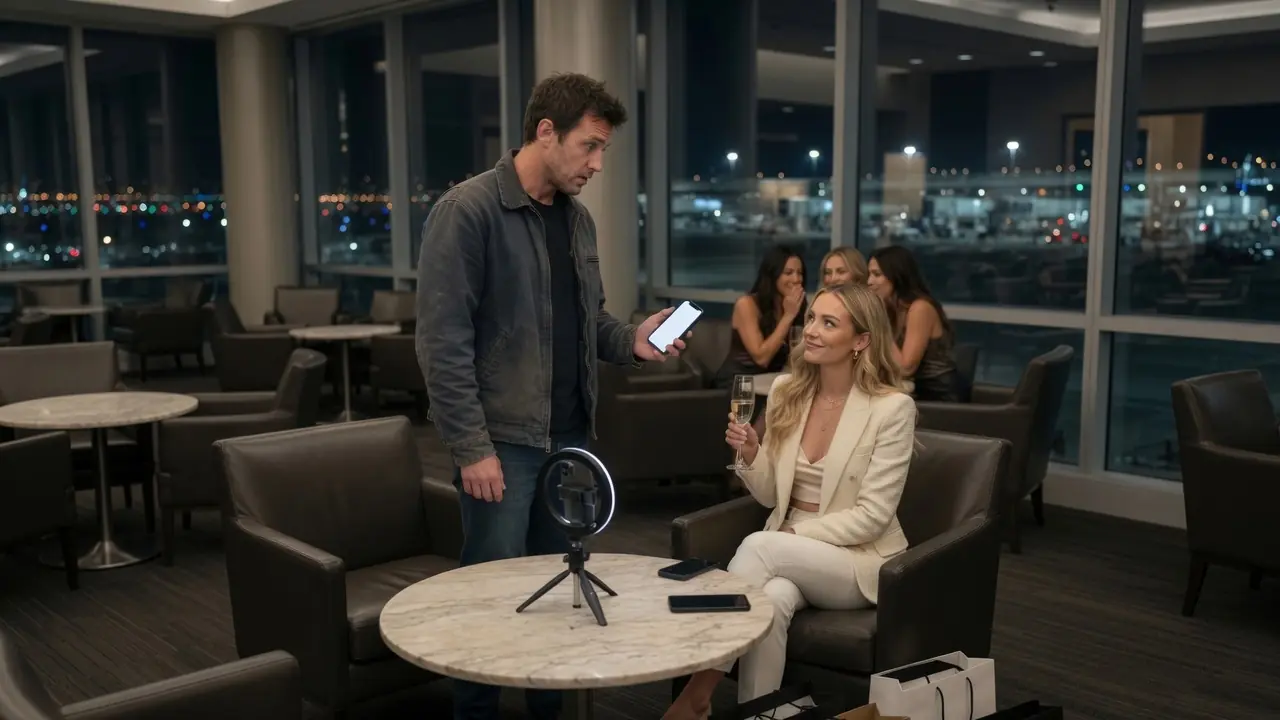
Four days after that, Chloe posted from the LAX business-class lounge. I saw the story during another lunch break, this time while eating a protein bar because I had been too busy to buy actual food. She was holding a mimosa, laughing beside three other influencer friends, all of them surrounded by luxury luggage and designer bags. The caption read, “Sometimes you just need to say yes to adventure.”
The geotag said Tom Bradley International Terminal. The next story said, “Cabo, here we come.” Before I could even process that, my phone buzzed with a credit card alert. Four Seasons Resort Los Cabos, almost three thousand dollars, followed by another alert for airline tickets.
For a moment, I just sat there in the editing bay, the glow of three monitors on my face, feeling something inside me go very still. She had maxed out my card on Rodeo Drive, promised she would pay me back, and then used the same card to fund a luxury trip. I called her, and this time she answered breathless, irritated, and surrounded by background laughter. “Ryan, I’m literally about to board. Can this wait?”
“No,” I said. “It cannot wait.” I told her I had seen the charges and the Instagram stories. She made a small annoyed sound, like I had interrupted a meeting. “The girls invited me last minute,” she said. “I needed this trip for my mental health and for content. You know how stressful negotiations have been.”
“With my money?” I asked. There was a pause, and then her voice changed. It became colder, flatter, and meaner than I had ever heard it. “Your credit limit is forty thousand, Ryan. You can handle it. Real providers do not act like this.”
The word provider hit me harder than the charges. Not partner, not boyfriend, not the man who split rent and carried her packages and stayed up fixing her videos. Provider, like I was a service, a card, a number printed in raised silver letters. I said her name once, warning her without meaning to, but she kept going.
“God, you are so embarrassing,” Chloe said, lowering her voice while somehow making sure her friends could still hear. “I’m standing here with women who understand ambition, and you are calling me to lecture me about money like some insecure broke guy.” I heard giggling in the background. Then she said the sentence that ended us before either of us knew it.
“If you were really a provider, Ryan, you would shut up and pay.” She said it with a scoff, like my exhaustion was unattractive, like my concern was weakness, like every hour I had worked was something she was entitled to spend. I remember staring at the studio wall, my jaw tight, my phone warm against my ear. Something that had been bending for months finally snapped into place.
“You spent my money without permission,” I said. Chloe laughed once, sharp and dismissive. “Real men in LA do not nickel-and-dime their girlfriends over a little luxury.” A little luxury, she called it, while I was eating vending-machine lunches and calculating rent in my head. Then she told me I was ruining her trip before it started and hung up.
I did not yell. I did not call back. I sat there for maybe a full minute, listening to the air conditioner hum above the editing bay, and for the first time in months, everything felt clear. Chloe did not see me as a man she loved. She saw me as a credit limit that had started talking back.
I called Chase first. The customer service representative asked how he could help, and I said I needed to report unauthorized charges and freeze my card immediately. My voice was steady enough that it almost scared me. I explained that someone had used my card without permission for personal purchases and travel, and within twenty minutes, the card was frozen.
The representative told me all new charges would be declined. He started the dispute process for the travel charges and flagged the Rodeo Drive purchases for investigation. When he said a replacement card would arrive in seven to ten business days, I thanked him like he had just handed me oxygen. Then I sat back in my chair and looked at Chloe’s Instagram story again, frozen on her laughing face.
The next call was to my landlord. I asked if I could change the locks, and he said I could as long as he got an emergency key. I told him I wanted to make sure my apartment was secure. He asked if everything was all right, and I said yes because I was not ready to explain that my own home had become a storage unit for someone else’s fantasy.
After that, I called my friend Jake. He had gone through a brutal breakup the year before, and when I told him what had happened, he went quiet in the way men do when they realize another man has finally hit the wall. “You need a lawyer,” he said. “Not tomorrow emotionally. Tomorrow legally.” He gave me the number for Rebecca Ortiz, an attorney in Century City who, according to him, smiled only when someone deserved consequences.
I left work early and went home. The apartment was empty except for Chloe’s presence, which somehow filled every corner even when she was not there. Ring lights stood in the living room, designer boxes sat beside the couch, clothing racks blocked the hallway, and throw pillows I had never liked were arranged like props in a life I had been financing but not living. I walked into the bedroom and opened the closet.
The Rodeo Drive shopping bags were shoved in the back, hidden but not carefully. Most of the tags were still attached because Chloe had probably planned to film unboxings later. Chanel, Dior, Gucci, Saint Laurent, all sitting in my closet like trophies from my own humiliation. I pulled everything out, laid it on the bed, photographed every tag, receipt, box, dust bag, and serial number.
Then I started listing the items online. The descriptions were simple: brand new, tags attached, purchased during my ex-girlfriend’s shopping spree, her loss, your gain. Messages started coming within an hour. By midnight, I had sold three bags and had serious offers on several more.
The next morning, I met Rebecca Ortiz. She was in her early fifties, sharp-eyed, perfectly dressed, and direct in a way that made me feel both nervous and protected. I laid out the charges, the call, the text messages, the Instagram stories, the promise to pay me back, and the Cabo trip. She listened without interrupting, then leaned back in her chair.
“This is not complicated,” she said. “A relationship does not give someone unlimited access to your credit.” She explained the civil claims, the possibility of fraud allegations, the breach of her promise to repay, and the strength of documentation. She also told me not to communicate with Chloe except in writing. That part was easy, because I no longer wanted to hear her voice.
By the time Chloe landed in Cabo, her free ride had already ended. That evening, my phone lit up with messages from numbers I did not recognize. One of her friends told me Chloe’s card had been declined at dinner and demanded to know what I had done. Another called me immature for embarrassing her in Mexico.
Then Chloe started texting. At first, she was angry, telling me I had humiliated her, ruined her trip, and made her look poor in front of her friends. Then the tone shifted. She said she was stuck, she was scared, she would pay me back, she had promised, and I needed to stop overreacting.
I replied once. “My card was used without permission and has been reported stolen. Please contact my attorney about repayment.” Then I muted the thread. My hands shook after I sent it, not because I regretted it, but because standing up for yourself can feel like cruelty when you have spent years being trained to tolerate disrespect.
Three days later, Chloe came home. I was not there because I had been staying at Jake’s place while the locks were changed. But I had spent the night before packing her things into boxes and bags, carefully, not angrily. Clothes, makeup, tripods, ring lights, shoes, PR packages, skincare, throw pillows, and every part of the curated life she had built inside my apartment.
I placed everything neatly near the front door outside the building, where the landlord allowed move-out items to sit for pickup. Taped to the door was a copy of the civil complaint Rebecca had filed. Ryan Parker v. Chloe Bennett, Superior Court of California, County of Los Angeles. Credit card fraud, breach of oral contract, intentional misrepresentation.
I was parked half a block away when her Uber pulled up. Chloe stepped out in sweatpants and a hoodie, hair in a messy bun, no makeup, no filter, no lighting, no caption ready to turn the moment into empowerment. She saw the boxes first. Then she saw the papers on the door.
Even from my car, I could see the exact second she understood. She tried the old key, and when it did not work, she tried it again harder, as if force could undo consequences. Then she started banging on the door, yelling my name. A neighbor opened his door and told her to stop before someone called building security.
No friends came to help her. Not Madison, not the girls from Cabo, not the women who had laughed when she mocked me for worrying about money. Chloe stood there alone, surrounded by bags and boxes, trying to load her luxury lifestyle into the back of an impatient Uber. The ring light kept tipping over, and she grabbed it with both hands, furious and humiliated.
I watched longer than I should have, not because I enjoyed it, but because I needed to see the illusion finally fail in real time. For two years, Chloe had made everything look effortless because someone else was absorbing the cost. Now the performance had no crew, no sponsor, no unpaid boyfriend standing behind the camera. It was just her, the sidewalk, and the things she thought made her valuable.
When she finally left, I waited another hour before going upstairs. The apartment felt bigger without her things, quieter, almost unfamiliar. I ordered pizza, opened a beer, and sat on the couch where Chloe used to film morning routines about abundance. For the first time in months, nothing in the room asked me to become smaller so someone else could look expensive.
The online sales recovered most of the money from the designer purchases. The bank reversed the travel charges after the investigation started moving. Rebecca handled the legal side, and Chloe did not fight as hard as I expected. There was too much evidence and too little truth on her side.
Eight weeks later, she agreed to a settlement. She would repay the remaining balance plus my legal fees in monthly installments. The amount was not dramatic compared with the damage she had tried to cause, but by then, the money mattered less than the acknowledgment. She had used me, lied to me, and finally had to sign a document admitting that promises made to manipulate someone still counted when the bill came due.
Her influencer life did not collapse overnight, but it cracked fast. Her friends talked about the Cabo disaster because people who build friendships on image rarely protect one another when the image gets ugly. Brands that had been half-interested backed away. Her follower count dipped, then dipped again, and the comments under her posts became quiet except for bots and men with fire emojis.
I heard later that the huge wellness deal had never existed. Rebecca’s team subpoenaed enough communication to prove there had been no six-figure contract waiting, no serious negotiation, no manager ready to take her global. There were only vague emails, hopeful pitches, and Chloe’s ability to make fantasy sound like strategy. She had been living on credit and calling it ambition.
As for me, I stayed in Los Angeles. I kept working in post-production, kept grinding through long days, and eventually got promoted from associate editor to lead editor. The raise was not life-changing, but it was real, earned, and mine. I started saving money again, building an emergency fund, and contributing more to my retirement account, all the boring responsible things Chloe used to mock.
I also got a new roommate, another guy from the studio named Miles. He paid rent on time, labeled his groceries, and thought a good night was Lakers basketball and takeout from Koreatown. There were no ring lights in the living room, no surprise charges, no lectures about how real men proved love through financial silence. The peace felt so simple that I almost did not trust it at first.
Sometimes Chloe still appeared on my feed. She posted less often, and when she did, the content felt thinner, like a set after the lights had been turned off. She talked a lot about authenticity, healing, feminine energy, and starting over. The luxury was mostly gone, and without it, the brand she had built looked like what it had always been: a performance with someone else paying production costs.
I do not hate her anymore. Hate would require a kind of attachment I no longer have. For a while, I was angry, then embarrassed, then numb, and finally free. The opposite of love is not always hatred; sometimes it is the calm realization that you would not cross the street to ask why someone hurt you.
The lesson cost me twenty thousand dollars, a relationship, and a version of myself that kept confusing sacrifice with loyalty. But it also saved me from a future where I might have married someone who measured my worth by what I could fund. Chloe once said that if I were really a provider, I would shut up and pay. She was wrong.
A real partner does not demand silence as proof of love. A real partner does not turn your exhaustion into an inconvenience or your credit limit into her career plan. A real partner does not humiliate you in public, then call it ambition when she spends what you worked for. I learned that the hard way, but at least I learned it before there was a ring, a wedding, or a mortgage with her name attached to my life.
Now I still work long days. I still eat sad desk lunches sometimes, and I still live in an overpriced city full of people chasing versions of themselves they hope someone else will believe. But when I go home, my home is mine. My money is mine, my peace is mine, and the next person who wants to call love a luxury lifestyle will have to find someone else to finance the lie.