The night I realized my relationship was over, I was standing in my own kitchen holding a wooden spoon. A pot of pasta sauce was simmering on the stove, the apartment smelled like garlic and tomatoes, and I had been trying to make the evening feel special without making a big production out of it. Marissa stood across from me near the counter in her beige sweater, phone in hand, her face already annoyed before I finished speaking. I had not accused her of anything yet, but she was looking at me like I had ruined her night by having feelings.
My name is Ethan Parker, and I was twenty-six years old when I finally learned that love cannot survive permanently in sixth place. I had been dating Marissa Cole for two years, and for most of that time, I convinced myself that being patient meant being mature. She had a close group of friends, and at first, I thought that was a good thing. Khloe, Adrien, Tasha, and Finn were always around, always messaging, always planning something, and Marissa treated them like a second nervous system she could not function without.
At the beginning, I admired it. I had friends too, but not the kind who texted all day, coordinated outfits for parties, planned every weekend together, and referred to themselves as “the squad” without irony. Marissa said they had gotten each other through college breakups, family drama, bad jobs, and bad dates. I respected that history. I just did not realize that in Marissa’s mind, history meant hierarchy.
Six months before that kitchen argument, Marissa and I moved in together. We found a clean apartment in Austin with white cabinets, good light, and enough space for both of our lives, or so I thought. We split rent, divided chores, bought a sofa together, and joked about becoming boring adults. I believed moving in meant we were building something.
But once we shared an address, I started noticing how often she left that address to be with them. Wednesday game nights. Friday drinks. Saturday brunch that somehow became afternoon shopping and then dinner. Sunday recovery hangouts where everyone lay around someone’s living room talking about the previous night like they had survived a historic event.
I was invited sometimes, but never as a partner who belonged. I was added like an accessory, the boyfriend who drove, paid his share, smiled at inside jokes, and went quiet when the conversation turned into memories from before I existed. If I did not come, Marissa said I was being antisocial. If I did come and looked tired, she said I was ruining the vibe.
The first big warning came at my master’s graduation. I had worked for three years while holding a full-time job, and the ceremony mattered to me more than I admitted. Marissa promised she would be there. Then Adrien planned a housewarming party on the same afternoon, and suddenly my graduation became “something your parents can cover.”
She apologized later, but not really. She said she felt terrible, then spent ten minutes explaining why Adrien had needed emotional support because moving into his first apartment was a huge milestone. I remember sitting on the edge of the bed in my graduation clothes, listening to her describe someone else’s milestone while my own hung untouched in the closet. That should have been the moment I started packing.
It was not.
The next warning came at my brother’s wedding. Marissa had agreed to be my plus one months in advance, then canceled the morning of because she was exhausted from a three-day music festival with the group. She sent a text full of sad-face emojis and said she hoped I understood. I stood in family photos alone while my aunt asked where the girl I had been talking about was.
Even when my mother had surgery, Marissa made it about scheduling. She said she wanted to visit, of course she did, but it conflicted with their weekly game night, and cancelling last minute would be unfair to the group. I drove to the hospital alone. That night, while my mother slept, I watched Marissa’s Instagram story and saw her laughing over a board game with Tasha leaning on her shoulder.
Every time I tried to talk about it, Marissa turned the conversation sideways. She said I was insecure. She said I wanted her to abandon people who had been there before me. She said healthy relationships allowed independence, and I needed to stop acting like love meant constant access. The words sounded reasonable enough that I began questioning myself.
Maybe I was too needy. Maybe I expected too much. Maybe one anniversary dinner, one hospital visit, one family wedding, one important night at a time did not add up to neglect. Maybe I was being dramatic because the neglect never arrived as one huge insult, only as a thousand small reschedulings.
Then our two-year anniversary came.
I had planned it quietly. Nothing extravagant, nothing designed to trap her in some grand romantic performance. I booked the small Italian restaurant where we had our first real date, the place with the patio lights and the waiter who remembered her favorite dessert. I also bought tickets to a band she had been obsessing over for months.
That Saturday afternoon, I started cooking early because I wanted to surprise her before telling her the plan. I was standing at the stove, stirring sauce, when she walked into the kitchen with her phone in her hand and the distracted smile she wore whenever the group chat was active. I told her I had something special planned for our anniversary that evening. Her smile fell like I had given her bad news.
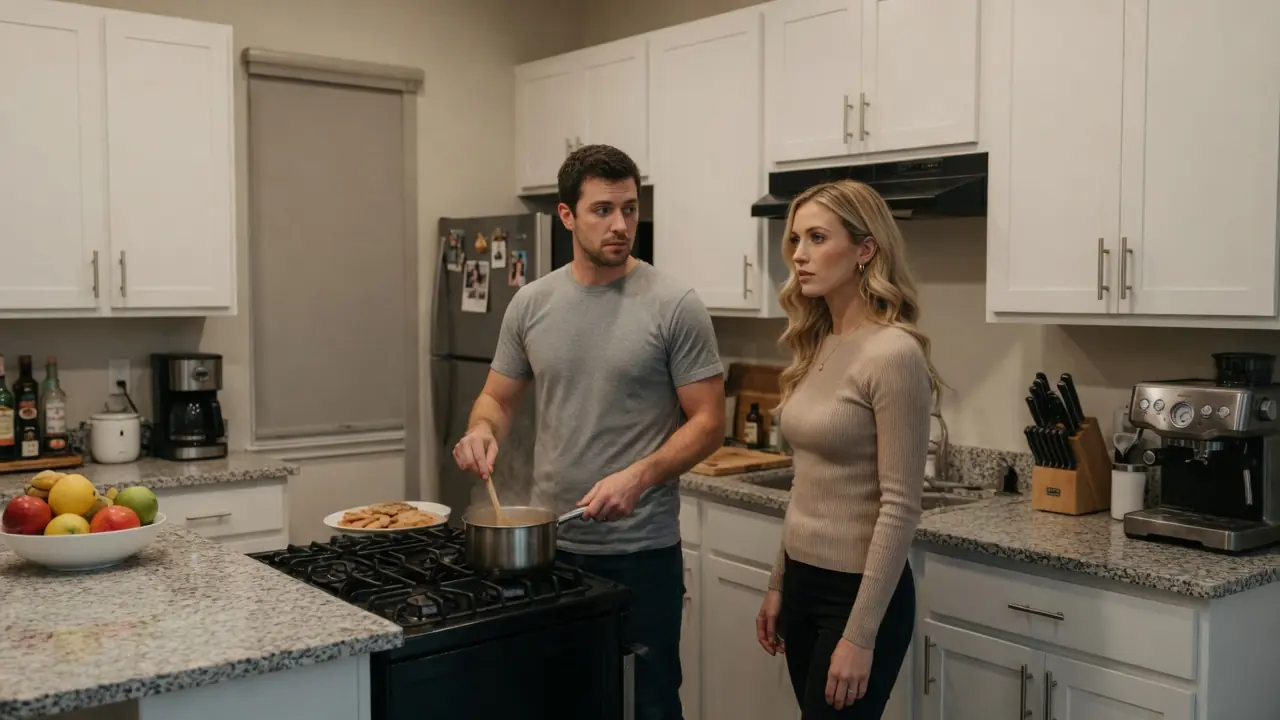
“Oh,” she said. “That’s tonight?”
I looked at her. “Our anniversary is tonight.”
She shifted her weight and glanced at her phone again. “Ethan, that’s Tasha’s birthday pregame.”
I thought I had misheard her. “The pregame? Not even the actual birthday?”
“Don’t say it like that,” she snapped. “It matters to her.”
“So does this.”
Marissa crossed her arms, phone still in one hand. “You don’t understand. Adrien has that big conference tomorrow, Khloe’s been stressed at work, Finn’s still weird after his breakup, and Tasha specifically planned tonight because it’s the only night everyone can come. The group needs this.”
The group needs this. Those words had become a kind of emergency pass in our relationship. Whenever the group needed something, I was expected to step aside without taking it personally. I turned down the heat on the stove because the sauce had started bubbling too hard.
“I planned dinner,” I said. “And tickets.”
Her face did not soften. If anything, she looked more irritated, like my effort was now an additional problem. “Why didn’t you check with me first?”
“It’s our anniversary, Marissa.”
“And I already had plans.”
I stared at her, holding the wooden spoon. “You made plans over our anniversary?”
She let out a sharp laugh. “You’re making it sound like I cheated on you. It’s one night with my friends.”
“It’s one important night with me.”
That was when her expression changed completely. She looked at me with cold, annoyed superiority, the kind of look you give someone embarrassing you in public. But we were not in public. We were in our kitchen, where I was cooking dinner for a relationship I still believed could be saved.
“Love can wait, Ethan,” she said. “Friendship can’t.”
I felt the spoon grow heavy in my hand.
Then she added the sentence that ended us, even if the breakup came later. “They were here before you, and they’ll be here after you.”
After you.
She said it casually, like our ending was not a tragedy but a scheduling assumption. Not if something ever happens between us, not God forbid we do not work out, but after you, as if I had always been temporary. I looked at her and suddenly saw every canceled plan, every lonely ceremony, every hospital hallway, every night I had waited for her to come home while she gave her best energy to people who never had to beg for it.
“So I’m temporary,” I said.
She rolled her eyes. “Don’t twist my words.”
“I’m repeating them.”
“You’re acting needy again.”
The word landed with a strange quietness. Needy. I had been called supportive when I picked her up from bars at two in the morning. Patient when I waited for her to finish group calls before talking to me. Understanding when she forgot things that mattered to me.
But when I asked for one night, I became needy.
I turned off the stove.
Marissa noticed that. For a second, something like concern crossed her face, but it disappeared under irritation. “Seriously? Now you’re doing the silent thing?”
“I’m done arguing.”
“Good. Then we agree I’m going tonight.”
I set the wooden spoon down carefully beside the stove. “No, Marissa. We do not agree.”
She stared at me. “What does that mean?”
“It means I finally understand what place I have in your life.”
She huffed, grabbed her purse from the counter, and said, “I’m not doing this guilt trip right now.” Then she walked out, leaving the kitchen smelling like dinner for two and feeling like a room after a storm. I stood there for a long time, listening to the door close behind her.
That night, I did not eat the pasta. I packed it into containers and put it in the fridge because throwing it away felt too dramatic and eating it felt too pathetic. Then I opened my laptop and looked at apartments. There was a one-bedroom twenty minutes away, smaller than our place but bright, affordable, and available within two weeks.
The application sat open on the screen for almost an hour. I kept thinking she would come home early, apologize, tell me she had been defensive, admit the sentence had been cruel. Instead, near midnight, she posted a video of herself laughing with Tasha, Khloe, Adrien, and Finn, her arm around Finn’s shoulders, captioned: “Real ones always show up.”
I submitted the application.
I was approved two days later.
For the next week, I moved quietly. Marissa was out enough that it was almost easy. I took books first, then winter clothes, then my gaming setup, then the kitchen things I had bought before we moved in together. I left shared furniture because I no longer wanted to argue over who deserved a lamp.
By Thursday night, most of my life had already left the apartment.
Marissa noticed when she came home around midnight and found the corner of the living room empty. “Ethan?” she called. Her voice had a sharp edge to it, rising as she moved from room to room. “Where’s your computer?”
I was in the bedroom, packing the last of my clothes. She appeared in the doorway, still dressed from whatever rooftop bar they had gone to that night. Her eyes moved over the open suitcase, the empty dresser drawers, the bare side of the closet.
“Are you moving out?”
“Yes.”
The word was calm, and that seemed to frighten her more than shouting would have. I handed her a letter because I knew a conversation would become a circle. In it, I wrote that I loved her, but I could not keep coming after her friends, after group plans, after emergencies that were not emergencies, after everyone else’s needs. I wrote that I needed a partner, not someone who treated me like a backup plan.
She read it once quickly, then again more slowly.
When she looked up, her face was red with anger. “You’re leaving because I have friends?”
“No,” I said. “I’m leaving because you use your friends as proof that I should accept being neglected.”
“That is such a manipulative way to describe it.”
“Is it inaccurate?”
She shook the letter at me. “This whole thing sounds like you want me to choose between you and everyone I care about.”
“I wanted you to choose me sometimes.”
“Of course I choose you.”
“When?”
She opened her mouth, then closed it. I watched her search for examples and find memories where I had been present near the group, not moments where she had chosen me over them. That distinction seemed to confuse her. It broke my heart that she did not even know what was missing.
“I asked for one anniversary night,” I said. “One.”
“And I explained why that night mattered to Tasha.”
“Our anniversary mattered to me.”
Marissa looked at me like I was speaking another language. “You’re throwing away two years because you can’t handle my social life.”
“No,” I said. “I’m ending two years because I cannot keep begging my girlfriend to want to be my girlfriend.”
That hit her. Her eyes filled suddenly, but the tears came with anger, not understanding. She followed me around the apartment as I packed, listing memories that were supposed to prove we had something worth saving. But every memory included the group.
Remember the concert where we ran into Khloe and Adrien? Remember when we cooked dinner for everyone? Remember that cabin weekend with Tasha and Finn? It was like she could not remember us without them standing in the background.
Finally, I zipped the suitcase.
“I’ll come back for the last boxes Saturday,” I said. “You’ll be at Tasha’s pool party.”
Her face twisted. “You’re really using my plans against me.”
“No. I’m using them accurately.”
I placed my key on the kitchen counter and left.
The first night in my new apartment felt unreal. I had no couch yet, so I sat on the floor eating takeout from the container. The place smelled like fresh paint and cardboard. It was lonely, but not in the way our shared apartment had been lonely.
This loneliness belonged to me.
By Saturday morning, my phone started exploding. Marissa called eleven times before noon. Then the squad began. Khloe sent a long message saying Marissa was devastated and I was breaking up a family dynamic. Finn called me immature. Adrien offered to mediate, as if our relationship had a committee. Tasha sent a paragraph explaining that I had no right to leave without “group closure.”
Group closure.
That phrase almost made me laugh.
By Sunday evening, the messages had become worse. I was selfish. I was controlling. I was punishing Marissa for having friends. I was emotionally abandoning her, apparently not only as a boyfriend but as a member of their “chosen family.”
I did not respond.
Monday evening, they showed up outside my new building.
All five of them.
Marissa stood in front, with Khloe, Adrien, Tasha, and Finn arranged behind her like a dramatic intervention scene from a show nobody should have produced. I came home from work carrying groceries and stopped on the sidewalk, exhausted before anyone spoke. Marissa started immediately.
“We need to settle this right now,” she said loudly enough that a neighbor looked over. “You don’t get to disappear and ignore everyone.”
I looked at her friends. “Why are they here?”
“Because they care about me.”
“This is between us.”
Finn stepped forward. “Dude, you hurt all of us.”
I stared at him. “I barely know you.”
He looked offended, which told me everything. In their world, dating Marissa had apparently made me a supporting character in their collective life. Leaving her was not a private decision. It was a betrayal of the group.
“I’m going inside,” I said.
Marissa’s voice cracked. “So that’s it? Two years, and you won’t even fight for us?”
“I fought for us while I was still in it.”
“You left.”
“Yes.”
Khloe started crying. Tasha pulled out her phone like she was documenting a public injustice. Adrien kept saying, “Let’s just talk like adults,” while ignoring that adults do not show up in groups to pressure someone outside his home. I told them they had thirty seconds to leave before I called building security.
They did not leave.
So I called.
Security came out and asked them to go. Marissa looked humiliated, then furious. Before walking away, she shouted, “This isn’t over.”
But it was, at least for me.
The next few weeks were quieter. Not peaceful at first, but quieter. I blocked numbers, changed passwords, updated my address, and slowly rebuilt a life that did not revolve around someone else’s social calendar. I reconnected with friends I had neglected during the Marissa years, and the strangest thing happened: they did not demand constant performance from me.
We got dinner. We watched games. We talked. Nobody made me feel like missing one hangout meant I had failed a sacred test of loyalty.
Months passed. I heard things through mutual friends because stories travel even when you do not ask for them. Adrien got engaged to a woman named Emma and started pulling back from the group. Khloe accepted a promotion that moved her to Portland. Tasha and Finn finally admitted whatever complicated thing they had been doing for years and began dating seriously.
The squad began changing because adults change. People grow careers, relationships, priorities, and private lives. The thing Marissa had treated as permanent turned out to be no more immune to time than anything else.
Then Marissa texted me.
I stared at her name on my phone for a full minute before opening it. She wrote that she had been thinking, that things ended badly, that maybe we could get coffee. The next message came a day later. She said she understood now that balance mattered, that she had made mistakes, that she had been young and did not know how to prioritize.
I did not answer.
Not because I hated her. I did not. I even believed, in a way, that she might have learned something. But learning after losing someone does not obligate that person to return and test the lesson.
By then, I had met Sarah.
Sarah had friends. Good ones. Close ones. She also understood that a relationship needed private space to breathe. On our third date, she turned her phone face down without announcing it like a sacrifice, and we spent two hours talking without interruption. It felt so easy that I almost did not trust it.
The final time I saw Marissa was at a downtown Italian restaurant. Sarah and I were leaving when I spotted Marissa at a corner table with Finn and Tasha. Khloe and Adrien were not there. Marissa looked older somehow, or maybe just less certain.
She approached us near the exit. Sarah squeezed my hand and said she would wait by the car, graceful in a way that made me feel grateful and sad at the same time. Marissa stood in front of me, twisting her fingers together.
“I know you haven’t answered my messages,” she said. “I understand why.”
I nodded.
“I just wanted to say you were right. About balance. About priorities. About me making you feel like an option.” Her voice shook a little. “I see Adrien with Emma now, and I realize I never made space for you like that.”
“Thank you for saying it,” I said.
“I’m sorry,” she whispered. “Really. No excuses.”
That was the first apology she had ever given me that did not arrive carrying a defense. It did not change anything, but it mattered. Not enough to reopen the door, but enough to close it without bitterness.
“I hope you’re okay,” I said.
She looked toward Sarah by the car and smiled sadly. “She seems nice.”
“She is.”
“I hope she appreciates what she has.”
I did not say that I had once wanted Marissa to do exactly that. There was no point. She already knew.
I walked away feeling lighter than I expected. Sarah asked if I was okay, and I realized I was. Not triumphant, not cruelly satisfied, just okay.
Sometimes healing is not a dramatic moment. Sometimes it is standing in a parking lot with someone who once broke your heart and realizing they no longer have access to the place they damaged. Sometimes it is hearing the apology you wanted months too late and understanding that late apologies can be sincere without being useful.
Marissa’s group eventually faded, according to what I heard. Adrien built his life with Emma. Khloe thrived in Portland. Tasha and Finn needed distance from the dynamic that had kept them stuck for years. Marissa tried to hold everyone together, planning events and sending nostalgic messages, but people cannot be forced to stay in a shape they have outgrown.
I think that was the lesson she learned too late.
As for me, I do not regret leaving. I regret how long I explained basic care to someone who had already decided my needs were an inconvenience. I regret calling myself patient when I was actually afraid to admit I was unhappy. I regret cooking dinner that night for someone who had already made other plans.
But I do not regret turning off the stove.
I do not regret packing quietly.
I do not regret walking away before I became someone who begged for scraps of affection and called it love.
A relationship should not feel like waiting outside a room where everyone else has a permanent seat. It should not require you to compete with a group chat, a weekend plan, or someone else’s need for attention. Love can include friendship, independence, and community, but it cannot survive when the person beside you keeps reminding you that you are temporary.
Marissa said love could wait, but friendship could not.
So I let love stop waiting.
And when I finally walked away, I discovered something I should have known all along: being alone is easier than being treated like an option by someone who claims to love you.