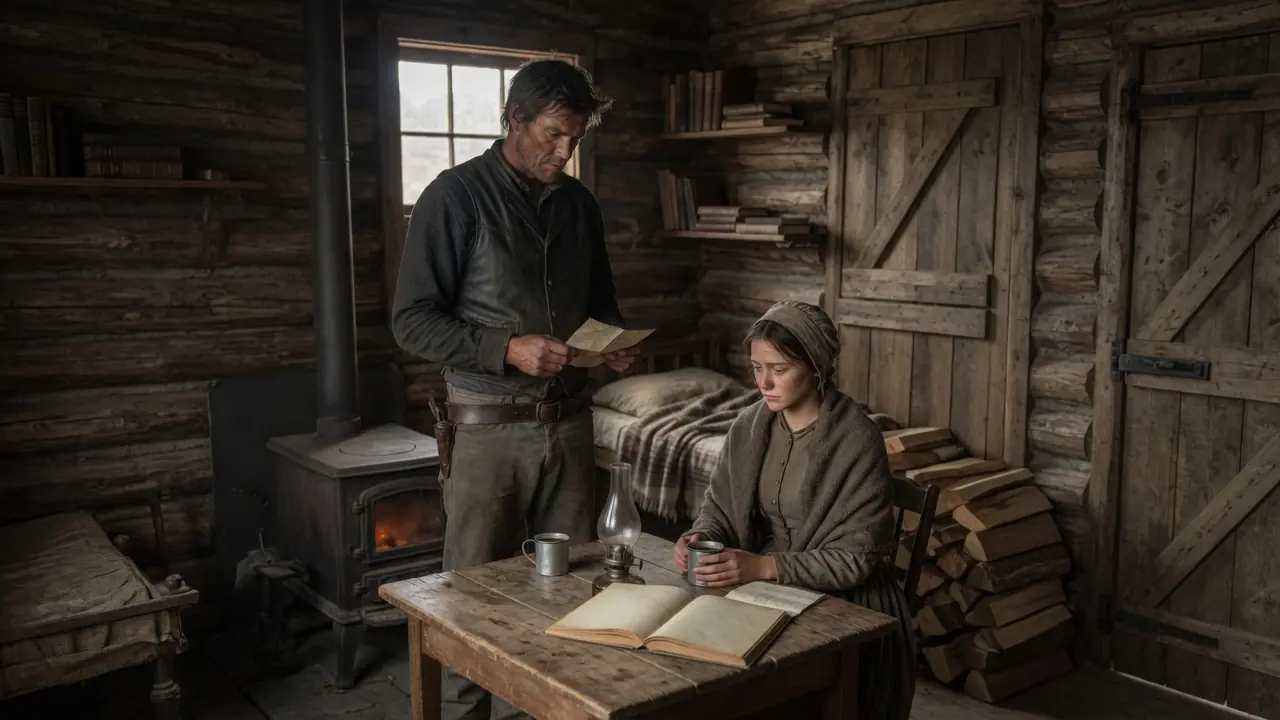
Callum Hargrove had lived alone long enough that silence no longer felt like silence to him. It felt like furniture, like the cast-iron stove against the wall, like the rough table he had built from river pine, like the cot tucked near the back of the cabin with one folded wool blanket at the foot. Outside, the late October wind moved across the red canyon country east of Boise City, Idaho Territory, rattling the shutters and stripping the last gold leaves from the aspens along the ridge. Inside, Callum stood near the stove with a folded letter in his hand and a young woman sitting across from him who looked as if pride was the only thing keeping her upright.
Her name was Clara Dutton. She was twenty-four, though grief and hunger had made her seem older when she first appeared on his porch an hour earlier with no horse, no wagon, and no companion. She wore a plain travel dress, worn boots, and a wool shawl clutched so tightly around her shoulders that her knuckles had gone pale. Her brown hair was pinned simply beneath a tired bonnet, and her eyes were red-rimmed from crying, though there were no tears in them now.
She had walked from Boise City with a folded letter pressed against her chest. That was the first thing Callum had noticed when he opened the door and saw her standing there in the gray afternoon. Not her beauty, though there was a quiet beauty in the steadiness of her face. Not her fear, though it was plain enough. The letter had caught his attention because she held it like a person holds the last solid thing in the world.
“My father said you needed a wife,” she had murmured.
Callum had stared at her, the wind pushing cold air past her skirts and into the cabin. Edmund Dutton’s daughter stood on his threshold, and the dead man’s memory stood there with her. Callum had not been prepared for either. Edmund had been buried three weeks ago, fever taking him in four days, and Callum had stood at the funeral in silence because words had never been easy for him, not even when they mattered.
Maybe especially then.
Clara had clearly expected refusal. She had expected him to look away, to pity her, to tell her that her father had asked too much, that a woman with debts and worn boots had no place in a stranger’s cabin. Callum knew the shape of refusal because he had handed it to many people in his life without needing to say much. But when Clara spoke those words, something in him answered before caution could stop it.
“Maybe,” he had said. “You.”
Now she sat at his table with a tin cup of coffee between her hands, staring at the steam as if it might give her instructions. Callum stood near the stove reading Edmund’s letter again, though he already knew every word. The handwriting was cramped and deliberate, the way Edmund had written all things, as if careless letters invited careless thoughts. Callum, my Clara is too proud to ask for help and too good to need it, but circumstances have made liars of better people than her. I have told her to go to you. I know what I am asking. I know what you are. Look after her. That is all. E. Dutton.
Callum folded the paper carefully. He did not know what to do with tenderness when it came at him dressed as obligation. He had spent eight years in the territory building a life that asked nothing from anyone and offered little beyond fair dealing, hard work, and a reputation sharp enough to keep trouble at a distance. In Boise City, people did not call him lonely. They called him dangerous.
They called him the man who shot three outlaws at Dry Creek Crossing and never once smiled about it.
That story had followed him farther than he liked. It had made strangers step aside, made men speak carefully, made women glance at him and look away. The truth was less grand than the telling. Three men had tried to rob a freight wagon, one of them had shot the driver, and Callum had done what had to be done before anyone else could die. He did not smile about it because there had been nothing worth smiling over.
But people preferred stories to truth.
Clara looked up finally. “You don’t understand,” she said.
Callum set the letter on the table. “Then explain.”
“I have nothing.”
He waited.
“My father’s debts took the house. Mrs. Opal Greer says she will put my trunk in the street by Friday if I don’t pay the boarding room. I have no family left in the territory. No money. No proper prospects.” Her mouth tightened. “And I did not come here asking for charity.”
“I know.”
Her eyes sharpened. “Do you?”
“Yes.”
“You said maybe me as if it were simple.”
“It is simple,” Callum said. “Not easy. There is a difference.”
Clara stared at him for a long moment. The cabin was bare around them, but not neglected. A single shelf of books sat above the writing box. Two oil lamps rested near the table. A kettle steamed faintly on the stove, and stacked firewood waited by the door. It was a place built for survival, not comfort.
“What exactly are you offering?” she asked.
Callum came to the table and sat opposite her. He placed both hands flat on the rough wood because he had found over the years that being plain helped people understand him. “A legal arrangement. Civil ceremony, nothing more than that unless we both decide otherwise down the road. You would have your own space, your own standing, and the legal right to remain here.”
“And in return?”
“You help run the household and the accounts. I cannot keep this land, the horses, the garden, the winter stores, and the books all straight by myself.”
“That sounds like a business proposal.”
“Partly.”
“Only partly?”
Callum looked at the letter. “Your father saved my life.”
Clara’s face softened, and grief crossed it like a cloud moving over open country. “He never told me.”
“He would not have.”
“No,” she whispered. “He would not.”
Seven years earlier, Edmund Dutton had carried Callum eight miles through dangerous territory with a Paiute arrow buried in his shoulder. Callum had been fevered, bleeding, and too weak to ride, and Edmund had walked through rain and dark with Callum’s arm across his shoulders, stopping only when stopping was required to keep both of them alive. Afterward, he sat two nights beside Callum’s bed while fever tried to take him. When Callum woke with enough sense to thank him, Edmund only said, “Pass it on when the time comes.”
Now the time had come wearing Edmund’s daughter’s face.
“Why would my father send me to you?” Clara asked. “He knew other men. Easier men.”
Callum almost smiled. “He knew easier men would want easier things.”
She looked down at the cup in her hands.
The wind pressed against the shutters again. Callum watched her fingers tremble around the tin. She was trying very hard not to show weakness, and the effort made him respect her more, not less. A person who has nothing left and still insists on dignity is a person worth helping carefully.
He stood and moved around the table.
Clara stiffened. “Mr. Hargrove?”
He stopped beside her chair and lowered himself to one knee so he was not towering over her. That seemed to surprise her more than if he had raised his voice. Slowly, with care enough to give her time to refuse, he took her hands away from the coffee cup. Her fingers were cold.
“I am not buying you,” he said quietly. “And I am not taking you in like a stray.”
Her breath caught.
He wrapped both of his rough hands around hers, warming them. “I am honoring Edmund Dutton. And I am offering you a roof, a name, and a place where no boarding house woman can put your trunk in the street.”
Clara looked down at their joined hands. Her lashes trembled. “You speak as if a name can save a woman.”
“In this territory, sometimes it can.”
“And what saves a man like you?”
Callum did not answer quickly. He lifted the edge of her wool shawl and drew it higher around her shoulders. His knuckles brushed the side of her cheek, only for a moment, only by accident perhaps, but the cabin seemed to still around the touch. Clara looked up at him through sudden tears, startled by gentleness from a man everyone else feared.
“Maybe,” he said, voice low, “not being alone through winter.”
She held his gaze, and something fragile passed between them. Not love. Not yet. But the first small warmth of possibility. Callum drew his hand back, though part of him did not want to.
“And if I stay?” she asked softly.
“Then this cabin stops being lonely.”
Thursday came cold. Ice skimmed the water trough, and the aspens had lost most of their leaves during the night. Callum woke before dawn, shaved with care, and found a dark wool shirt in the trunk at the foot of his cot. It had belonged to the man he might have become if life had been gentler, a shirt his mother had once told him made him look almost civilized.
When he stepped outside, Clara was waiting by the fence.
She wore a dress the color of winter sage, gray-green and modest at the collar, with small pearl buttons down the front. Her hair was pinned differently, softer at the sides, and though her boots were still worn, she stood straight in the morning cold like a woman determined not to arrive at her new life looking defeated. Callum stopped when he saw her. For the first time in years, words failed him for a reason other than grief.
“You look well,” he said.
Clara glanced down. “It was my mother’s. The only good thing I brought.”
“It is enough.”
They rode into Boise City in his wagon. The town was already awake, freight men unloading crates, the blacksmith hammering, two boys chasing each other along the boardwalk while a dog barked at nothing. The circuit judge, Aldous Crane, received them in the back room of the land office with the calm boredom of a man who had married people in worse circumstances and better clothes. A trapper waiting on a deed signed as witness for two bits and a cup of coffee.
The ceremony lasted nine minutes.
When it was done, Judge Crane said, “You may consider the matter settled.”
Clara looked at Callum. Callum looked at Clara. Neither moved. Then Callum offered his arm.
She took it.
They walked out into the cold Boise morning as husband and wife, and Callum felt the strangeness of that settle on him with unexpected weight. He had done difficult things in his life. He had survived ambushes, gunfire, hunger, fever, and years of hard weather. But walking beside Clara Dutton as her husband felt both quieter and more dangerous than any of them.
The first weeks were careful. Clara took the narrow cot behind the hanging blanket that divided the back of the cabin, and Callum slept near the stove with his bedroll, refusing to let her argue. She organized the cabin with a precision that bordered on military. By the third day, she had made a ledger system so clear that Callum wondered how he had managed not to bankrupt himself from confusion alone.
She repaired the chicken wire on the coop. She negotiated a better price for winter wheat at the mercantile. She found jars he had forgotten he owned and filled them with dried beans, salt pork, and preserved apples from a neighbor willing to trade. She made meals from nearly nothing, and more than once Callum looked up from his plate trying to hide astonishment.
Clara noticed anyway.
“Is something wrong with the stew?” she asked one night.
“No.”
“You look troubled.”
“I am not troubled.”
“Then why are you staring?”
Callum looked back at his bowl. “I am trying to understand how potatoes and three onions became something worth remembering.”
A smile tugged at her mouth, gone almost as soon as it appeared. “That is almost praise.”
“It was meant as praise.”
“You may want to practice.”
“I expect I will need to.”
She laughed then, quietly, like the sound surprised her. It changed the cabin. The lamp flame seemed steadier, the stove warmer, the space between them less formal.
Little by little, conversation stretched beyond weather and accounts. Clara told him about following her father across Oregon Territory, across small towns, mining camps, church posts, and lonely settlements where Edmund worked any honest job that kept them fed. She spoke of him with pain but not weakness. Callum told her about Missouri, about arriving in Idaho Territory with forty dollars and a horse that died two days later, about building a life because stubbornness was cheaper than hope.
“You don’t ask for much,” Clara said one evening.
“Asking invites disappointment.”
“My father used to say men who expect nothing from the world are usually the ones who deserve the most from it.”
Callum lifted his coffee. “Your father was frequently right.”
Clara looked at him across the lamplight. “Frequently?”
“Enough to make a man cautious.”
The trouble came in December wearing dark wool and silver jewelry. Dorothea Hatch arrived in a black lacquered buggy that looked absurd on the canyon road. She was a wealthy widow who owned the largest cattle operation north of the Boise River and had spent two years trying to buy Callum’s land because it controlled reliable creek access. Callum had refused every offer.
Clara opened the door.
Dorothea looked her over slowly, from plain dress to worn boots. “You must be the new arrangement.”
Clara did not answer. She simply opened the door wider.
Callum came in from the yard and stopped when he saw Dorothea. His face gave nothing away, which meant he was annoyed. “Mrs. Hatch.”
“Mr. Hargrove,” she said. “I heard you had taken a wife under rather peculiar circumstances.”
“Circumstances were straightforward.”
“I am sure they were. A destitute girl and a lonely man. Very practical.”
Clara’s chin lifted, but she stayed quiet.
Dorothea went on, explaining in a sweet voice that the Boise River Cattle Association might have cause to challenge the water route that fed Callum’s land. It was a lie, and Callum knew it. Worse, Dorothea knew he knew it. But lies cost money to disprove, and she had plenty.
“Or,” Dorothea said, “you could sell to me. Fair market price. You and your bride could start somewhere without complications.”
Clara stepped forward. “Thank you for the visit, Mrs. Hatch. The road back to town is easier before dark.”
Dorothea looked at her with new interest. Then she smiled. “That girl has a spine,” she said to Callum, as if Clara were not standing there. “Pity it won’t be enough.”
She drove away.
Three weeks later, the hay barn burned.
Callum smelled smoke before he heard the crackle. Not stove smoke. Not chimney smoke. The hard chemical bite of something wrong. He was outside in seconds, and the east wall of the barn was already burning, flames climbing toward the roof with terrible patience.
“Clara!” he shouted once.
She came out behind him with a bucket and blanket before he could shout again. They worked in freezing dark, Callum at the pump, Clara hauling water, both coughing as smoke thickened the air. They saved what they could. The horses had been in the pasture, which was mercy. The hay was mostly gone.
When it was over, Clara stood in the snow with ash on her face and hands red from cold water. Callum found her coat and draped it around her shoulders. She did not thank him at first. She stared at the burned wall, her expression colder than the night.
“She did this,” Clara said.
Callum looked at the base of the exterior wall where the snow smelled of kerosene. “Then we find proof.”
“I ride with you at first light.”
He looked at her, and there was no fear in her face now. Only partnership. Callum nodded.
Sheriff Thomas Ridley listened the next morning while Callum described the kerosene, the tracks, and the canteen with the embossed H found near the barn. By noon, Roy Burl, a man who ran errands for the Hatch operation, had been found at the Continental Saloon and pressed into giving a statement. Dorothea Hatch had paid him forty dollars to burn the hay barn and frighten Callum off the land.
The news moved through Boise City in two days.
Dorothea’s influence did not survive it. The cattle association quietly withdrew from her water claim. Clara went to the land office and requested every recorded deed and water right connected to the property. That evening, she spread the papers across the table and found three discrepancies in Dorothea’s boundary claim.
Callum read the letter Clara drafted to the territorial land commissioner twice.
“Where did you learn to write like this?”
“My father made me copy legal documents when I was twelve,” she said. “He said a woman who could read a contract was harder to cheat than one who couldn’t.”
Callum looked at her for a long moment. “He was right about everything.”
Clara’s face softened. “Almost.”
“Almost?”
“He said you needed a wife.” She paused. “I think he was only half right about what you needed.”
“What did I need?”
She folded the papers carefully. “Someone who would not be frightened away from standing beside you.”
Spring came late, but it came. The river ran fast and cold, the red rock warmed in the afternoon sun, and Clara’s garden pushed green shoots through the Idaho soil. Dorothea sold her ranch in March and left without farewell. Callum rebuilt the barn wall with timber from the ridge, and Clara painted it red ochre because she said a scar could still be made handsome.
What changed between them happened gradually. A cup of coffee brought to the fence line. A shared silence that felt less empty than speech. A book read aloud by lamplight. A conversation that lasted until the stove clicked cool and neither noticed the hour.
One cold March afternoon, they were mending a fence post together in the mud when Callum stopped tying wire and looked at her.
“I love you,” he said.
Clara set down the hammer.
She looked at him for a long moment, her face very still. Then she said, “I know.”
Callum waited.
She blinked, as if realizing that was not enough. “I love you too, Callum. I think I have for a while now.”
“I was not certain you would want to hear it,” he said.
Her smile came slowly, full and bright enough to reach her eyes. “Then hear it now.”
“I want to hear it every day.”
“Then you will.”
He reached for her muddy hand, and she let him take it. The fence stood unfinished beside them, the wind moved across the canyon, and Callum bent his head to kiss her fingers with a tenderness that made her eyes close. Then Clara stepped closer and rested her forehead against his chest, just beneath his chin, and Callum wrapped one arm around her carefully, as if holding something both precious and strong.
For a long while, neither of them moved.
The territory could talk if it wanted. The wind could carry names and gossip all the way to Boise City. The barn could still smell faintly of smoke, and winter could still leave cold in the ground. But Clara was warm against him, real and living, and Callum held her with the stunned gratitude of a man who had never expected to be chosen.
That summer, people in Boise City began speaking of the Hargroves differently. Not as a scandal, not as an arrangement, but as a household that worked. Clara’s garden fed half the neighbors through a dry August. Callum became a man people were glad to see instead of merely careful around. On the first Saturday of each month, Clara organized barn dances, and Callum stood near the door pretending he did not enjoy them until she pulled him onto the floor.
He was not graceful.
She told him so.
He said, “I never claimed to be.”
She laughed and stayed in his arms anyway.
Callum Hargrove had come to Idaho Territory with nothing but stubbornness and a broken horse. He had not expected softness, partnership, or the peace of loving someone who chose to stay. Clara Dutton had arrived with debts, grief, worn boots, and a letter from a dead father who understood more than either of them did.
Edmund Dutton had said Callum needed a wife.
He had been right.
But he had also sent Callum something greater than a wife.
He had sent him a home.