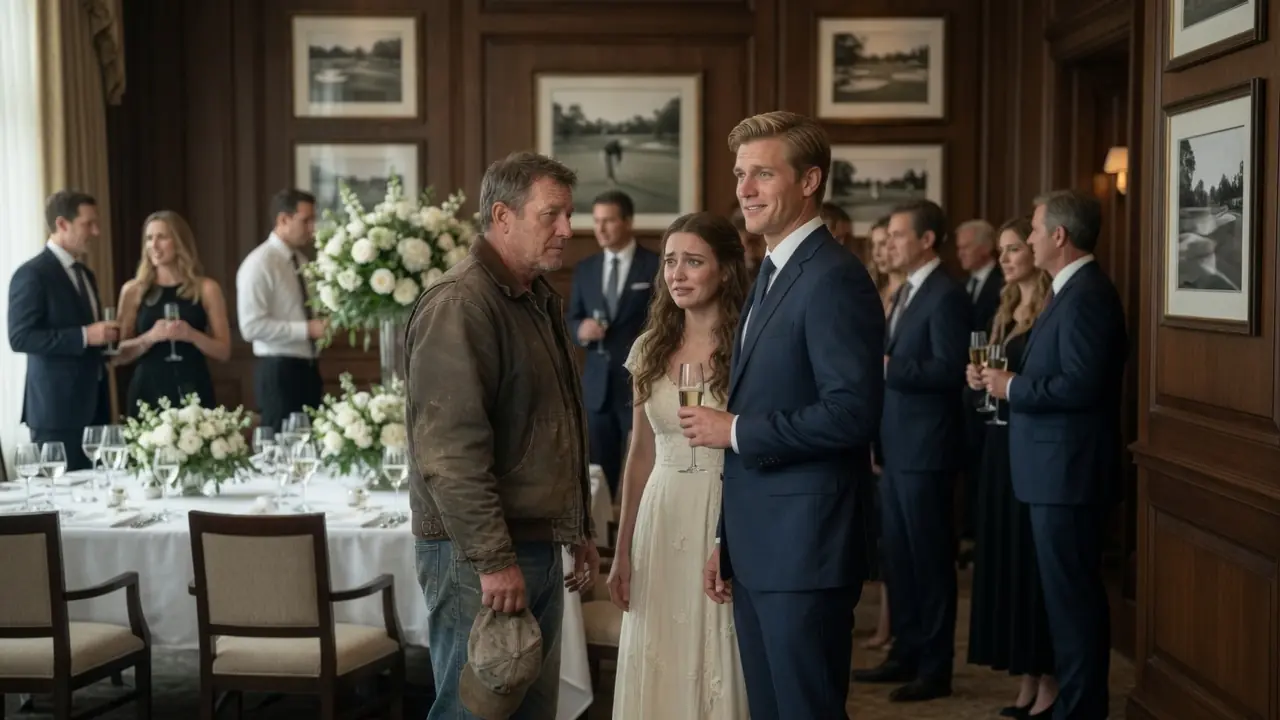
Thomas Wilson arrived at Oak Valley Country Club wearing dusty work boots, faded jeans, and a worn Carhartt jacket that still carried the smell of sawdust and concrete dust from the job site. He paused just outside the private dining room where his daughter Emma’s rehearsal dinner was already in full swing. Through the open doorway, he saw white tablecloths, crystal glasses, expensive floral centerpieces, polished silverware, and guests dressed like they had stepped out of a magazine spread about inherited money. He held his old work cap in one hand and smiled softly, because none of that mattered to him as much as seeing his daughter happy the night before her wedding.
Emma stood near the long table in an ivory rehearsal dinner dress, her chestnut hair styled carefully over one shoulder, her face bright but nervous in the way brides often look when joy and pressure are tangled together. Thomas saw her laugh politely at something one of Bradley’s relatives said, and for a second, he felt the old ache of pride. Twenty-four years earlier, he had carried her home from the hospital alone after her mother died in childbirth. Now she was standing inside a country club, about to begin a new life.
Then Bradley Morrison saw him.
Bradley’s face changed so quickly that Thomas might have missed it if he had not spent decades reading people on construction sites, in boardrooms, and across negotiation tables. The young man went pale for half a second, then covered it with a polished smile that looked more like a mask than a welcome. He whispered something to Emma, touched her elbow, and stepped toward the doorway before Thomas could enter the room. Thomas watched him come, calm already settling in his chest.
“Thomas,” Bradley said, not quite meeting his eyes. “We only want important people at our celebration. I’m sure you understand.”
Emma froze.
The words were quiet, but not quiet enough. Two nearby guests stopped talking. A waiter holding a tray of water glasses looked down and tried to disappear into the wall. Thomas stood in the doorway with his cap in his hand, his boots leaving faint dust on the polished floor, and looked at the man his daughter planned to marry the next day.
“Important people?” Thomas asked.
Bradley’s smile tightened. “You know what I mean.”
“I do not think I do.”
Bradley glanced down at Thomas’s boots, then back toward the wealthy guests behind him. “Emma has a real future now. She cannot be dragged backward by your construction-site life.”
Emma turned toward him. “Bradley, that is my father.”
Bradley lowered his voice again, but his eyes stayed cold. “I am trying to protect you.”
That sentence told Thomas everything. It was not only contempt. It was control dressed up as concern. Bradley was not embarrassed by one jacket or one pair of boots; he was embarrassed by the idea that Emma had come from a life he considered beneath him.
Thomas looked at Emma, and the hurt in her eyes almost made him speak differently. He wanted to comfort her, to tell her she had done nothing wrong, to promise that this did not have to ruin the night. But Thomas had spent twenty-five years teaching his daughter that character mattered more than presentation. If he walked away quietly now, he would teach her the opposite.
So he looked back at Bradley and smiled.
“Interesting,” Thomas said.
Bradley blinked. “Excuse me?”
Thomas only nodded once, turned, and walked away from the doorway. Behind him, Emma called, “Dad,” but he did not stop. Not because he was punishing her, and not because he did not love her. He kept walking because he had just seen the truth of the man standing beside her, and truth, once revealed, needed room to work.
Twenty-five years earlier, Thomas Wilson had made a decision that shaped the rest of his life. He was twenty-seven, newly widowed, holding a newborn daughter in one arm and a modest inheritance from his grandfather in the bank. He could have chased a clean office job, bought suits, and tried to become the kind of man other people respected on sight. Instead, he bought work boots, a pickup truck, and used the money to start Wilson Construction.
At first, it was one truck and one man. Thomas repaired porches, framed additions, rebuilt fences, patched roofs, and accepted every job that allowed him to keep Emma fed and safe. He worked long days, came home exhausted, warmed bottles, changed diapers, and fell asleep in chairs with invoices spread across his lap. People saw a young construction worker barely getting by, and Thomas let them.
The first year, he made sixty-two thousand dollars. The second year, more. By the fifth year, he had three crews, steady contracts, and a reputation for finishing projects on time without cutting corners. By the time Emma was sixteen, Wilson Construction had become Wilson Development, then Wilson Holdings, with companies, properties, crews, partnerships, and investments spread across three states.
But Emma never knew the full truth.
She knew her father wore work boots. She knew he drove an old truck. She knew he lived in the same modest two-bedroom house for most of her childhood. She knew he paid for private school and college by saying he had saved carefully and sacrificed everything for her, which was true in spirit even if the details were incomplete.
Thomas had hidden the scale of his success because he wanted Emma to grow up normal. He had seen too many children raised around wealth become careless with other people’s dignity. He wanted his daughter to know the value of a dollar, the dignity of honest work, and the danger of judging people by clothes, cars, or titles. He wanted her to understand that respect was earned in the way a person treated others when nobody important seemed to be watching.
For years, he believed the lesson had worked.
Then Emma brought home Bradley Morrison.
Bradley was twenty-eight, polished, ambitious, and already convinced that assistant marketing director sounded more impressive than it was. He drove a leased BMW, wore suits with the sleeves cut too slim, and name-dropped Patterson and Associates before anyone asked. At their first dinner in Thomas’s modest house, Bradley looked around the living room with the expression of a man studying a museum exhibit about limited ambition.
“So, Mr. Wilson,” Bradley said while cutting his steak with careful precision, “Emma tells me you work in construction.”
“I do,” Thomas said.
“That must be challenging physically.”
“It can be.”
Bradley smiled as if he were being kind to someone simple. “I am sure it builds character.”
Thomas held up one calloused hand. “It does.”
Bradley’s smile widened with the faintest edge of condescension. “I’m sure.”
After that, Thomas watched closely. Bradley suggested Emma should not mention Thomas’s job around certain colleagues. He joked that he would help “upgrade” her social circle. He offered to pay for small things with the air of a man rescuing her from embarrassment, though Thomas knew the money behind the wedding was quietly coming from him. Every time Emma defended her father, Bradley softened his voice and made his contempt sound like strategy.
The wedding planning revealed more. Oak Valley Country Club cost forty-five thousand dollars for the venue alone. The dress was eight thousand five hundred. Flowers, twelve thousand. Photography, another twelve thousand. Catering, music, transportation, cake, rehearsal dinner, and smaller expenses pushed the total close to one hundred thousand dollars.
Emma worried about the cost constantly.
Thomas transferred money quietly into her account and let her believe it represented everything he had saved. When she cried and said she was sorry he had to sacrifice so much, he only hugged her and said, “Your happiness is worth everything I’ve got.” In a way, that was the truth. But Thomas had not spent twenty-five years building an empire just to watch his daughter marry a man who would teach her to be ashamed of him.
Three days before the wedding, Bradley’s mask slipped during a venue walkthrough. Thomas had arrived in work clothes, standing quietly near the back while Bradley’s parents discussed optics, guest quality, and career connections as if a wedding were a corporate merger. Bradley’s mother said the celebration needed to reflect “the right future.” Bradley nodded and said important people would be there.
Then his father noticed Thomas.
“Who is that?” the older man asked.
Bradley’s voice dropped, but not enough. “That is Emma’s father. He works construction. With his hands.”
The disgust in his tone was so casual that Thomas knew it was familiar.
That night, Emma came to Thomas with tears in her eyes. Bradley thought maybe Thomas should skip the ceremony and come only to the reception. He was worried about colleagues, impressions, and what people might think. Emma could barely say the words, and Thomas did not make her finish.
“What do you think I should do?” he asked.
“I do not know,” Emma whispered. “I love you, Dad. But I love him too.”
Thomas hugged her tightly and made his decision.
“Do not worry,” he said. “Everything is going to work out exactly the way it should.”
At 2:15 the next morning, Bradley called him drunk.
Thomas almost let the call go unanswered. Then he remembered something his grandfather had once told him: never interrupt arrogant people when they are revealing themselves. So he answered, started recording, and listened.
Bradley spoke for seven minutes.
He talked about Patterson and Associates handling clients worth hundreds of millions. He mentioned the Vanderbilt account as if it were a crown jewel only people like him could touch. He said Emma had potential, but a father who showed up in work boots would hold her back. He said people who summered in the Hamptons did not want to make small talk with someone who smelled like sawdust.
Thomas asked quiet questions and let Bradley keep going.
Bradley said Emma needed to distance herself from where she came from. He said Thomas could maybe be given a nice clean supervisory job somewhere, something where he could wear a button-down shirt and look more acceptable. He said this was not personal. It was business.
At the end, Thomas asked, “Do you know what I do for work, specifically?”
Bradley laughed. “You build stuff, right? Houses and things.”
“Houses and things,” Thomas repeated.
“Look, I respect the work,” Bradley said. “Someone has to do the manual labor. But let’s not pretend it is the same as what I do.”
Thomas smiled in the dark of his bedroom. “Bradley, I want you to remember this conversation tomorrow. Every word of it.”
“What is that supposed to mean?”
“It means your education is about to begin.”
Then Thomas hung up.
By three in the morning, he was awake at his laptop, making calls. Sarah Thompson, his business manager, was first. She had been with him for eight years and knew every company, property, contract, and political connection tied to Wilson Holdings. His banker came next, then his lawyer, then his assistant who could pull vendor contracts before sunrise.
By six o’clock, Thomas had the full map in front of him. Patterson and Associates had done business with Wilson companies for eighteen months. Bradley had worked on several liaison projects without ever realizing his paycheck was indirectly tied to the man he mocked. The Morrison Plaza renovation, the Patterson family estate expansion, and several downtown office projects had all run through Wilson entities.
Bradley did not just insult a construction worker.
He insulted a client.
At eight o’clock, Sarah entered Thomas’s office carrying three thick folders and wearing the kind of smile that meant someone else’s day was about to collapse. She laid out contracts, vendor agreements, Patterson’s ethics policy, and a transcript of Bradley’s recorded call. Thomas read it all without visible emotion. Then he picked up the phone.
The florist was first.
“Patricia, it’s Tom Wilson,” he said. “There has been a change of plans. Cancel the Morrison wedding flowers.”
“The wedding is tomorrow,” Patricia said.
“I know. Bill me in full for labor and materials.”
“What happened?”
“The groom has concerns about important guests.”
There was a pause. Patricia had met Bradley during planning. “I was never comfortable with that boy anyway,” she said. “I’ll send the invoice. The flowers will go to the children’s hospital.”
The caterer came next. Then the photographer. Then the cake designer, musicians, transportation, and every other vendor tied to the wedding. Thomas paid cancellation fees without arguing. By ten o’clock, he had spent more than sixty thousand dollars to make sure the celebration would not happen as planned.
Then he called William Patterson.
“Bill,” Thomas said, “we need to discuss Bradley Morrison.”
By eleven, Emma called crying.
“Dad, the vendors are canceling everything,” she said. “They keep saying Mr. Wilson requested it. Please tell me you did not.”
“I need you to come to my office,” Thomas said.
“Your office?”
“1,247 Industrial Boulevard. Top floor. Bring Bradley.”
One hour later, Emma and Bradley walked into Wilson Holdings headquarters. The lobby was glass, steel, stone, and quiet efficiency, with Thomas Wilson’s name in brushed metal behind the reception desk. Emma looked confused at first, then frightened, as if the world had suddenly shifted under her feet. Bradley looked irritated until the receptionist said, “Miss Wilson, your father is expecting you. Executive elevator, top floor.”
When the elevator opened directly into Thomas’s corner office, Emma stopped in the doorway.
“Dad,” she whispered. “What is this place?”
“This is where I work,” Thomas said.
Bradley stared at the framed building permits, architectural awards, charity photos, business licenses, and a picture of Thomas shaking hands with the governor at a ribbon cutting. His face changed with every new detail. Thomas let him look.
Then he opened the first folder.
“Twenty-five years ago, I started Wilson Construction with forty-three thousand dollars and a truck,” he said. “Today, Wilson Holdings owns eleven construction companies, forty-seven commercial properties, and brings in over fifteen million dollars in annual revenue.”
Emma sat down slowly. Her hands trembled as she turned the pages: bank statements, property deeds, business registrations, tax records, payroll reports, and scholarship donations. Thomas showed her the college tuition payments she thought had come from sacrifice alone. He showed her the insurance, the car expenses, the account records, and the charity contributions.
“This cannot be real,” Emma whispered.
“It is real.”
Bradley found his voice. “You drive an old truck.”
“Yes.”
“You live in that tiny house.”
“Yes.”
“You dress like a construction worker.”
Thomas looked at him. “Because I am a construction worker. I just happen to own the construction companies.”
Bradley went pale.
Then Thomas slid another folder across the desk. “This is for you. Patterson and Associates has paid my companies over two point three million dollars this year. You have been handling liaison work connected to my businesses for eighteen months.”
Bradley’s mouth opened, but nothing came out.
Thomas continued. “You told me people like you manage accounts worth more money than I would see in my lifetime. Turns out you were managing mine.”
Emma looked at Bradley like she was seeing him without light for the first time. “You said my father was an embarrassment?”
Bradley swallowed. “Emma, I was drunk.”
Thomas shook his head. “You were honest.”
Sarah entered with the transcript. She read Patterson’s professional conduct clause aloud, then placed the printed phone conversation on the desk. Bradley tried to object, then stopped when Thomas mentioned William Patterson had already heard enough to clear his Saturday schedule. The arrogance that had carried Bradley into the room began draining out of him.
Still, he tried.
“This changes nothing,” Bradley said. “He still is not the kind of person my colleagues expect. He still does not have class.”
Emma stood.
“Shut up,” she said.
Bradley stared at her. “Emma, be reasonable.”
“My father raised me alone. He built all of this and still chose humility. You saw work boots and decided he was beneath you.” Her voice shook, but it did not weaken. “You were ashamed of where I came from.”
“I wanted a better future for you.”
“No,” Emma said. “You wanted a prettier story.”
She removed her engagement ring and placed it on Thomas’s desk.
“The man I thought I loved would not have asked me to erase my father from my wedding,” she said.
By six that evening, Bradley tried to rewrite the story online. He posted about family drama, financial manipulation, and people who could not handle their children moving up in the world. For about an hour, sympathetic comments came in from coworkers and friends who did not know the truth. Then Patricia Wells responded. Then James Rodriguez. Then Dr. Margaret Foster from General Hospital.
At 9:31 p.m., Eleanor Vanderbilt ended the war.
She wrote that Thomas Wilson had served with her on charity boards for years, contributed millions to local causes, and funded projects Bradley had been bragging about attending. She added that some bridges should not be burned, especially by people standing on them. The comments turned immediately.
By 10:23, someone posted the recording.
Bradley’s voice spread through social media, slurred and arrogant, calling Thomas an embarrassing blue-collar nobody who smelled like sawdust. The backlash was brutal. By midnight, Patterson and Associates had terminated him. By morning, Bradley Morrison was no longer the ambitious fiancé with important connections; he was a cautionary tale about arrogance meeting receipts.
The next afternoon, Thomas drove his old pickup truck to Oak Valley Country Club. He wore a tailored suit this time, Italian silk tie included, not because he needed to impress anyone, but because he wanted the room to understand choice. A valet who had once ignored him stood straighter when Thomas stepped out. Inside, two hundred guests milled around a nearly empty ballroom with no flowers, no food, no photographer, and no bride.
Bradley stood near the front in a tuxedo, sweating through his shirt and speaking frantically into his phone.
Thomas walked to the microphone.
“Ladies and gentlemen,” he said, “my name is Thomas Wilson. I am Emma’s father.”
The room quieted.
He explained the cancellation. He explained the rehearsal dinner insult. He played part of the recording, not all of it, just enough for the truth to stand on its own. Gasps moved through the room as Bradley’s own voice filled the speakers, mocking the man whose companies supported half the professional world he had tried so hard to impress.
Then Thomas held up his business card.
“Bradley assumed that because I work with my hands, I was unimportant,” he said. “He assumed dusty boots meant small value. He assumed a man in a worn jacket had no power, no place, no dignity worth respecting.”
He looked directly at Bradley.
“He was wrong.”
William Patterson stood and confirmed that Wilson companies had been major clients. Eleanor Vanderbilt stood and confirmed Thomas’s charity work. A few guests looked embarrassed. Others looked angry. Bradley stood alone in the center of the room, finally stripped of the image he had tried to project.
“This wedding was canceled,” Thomas said, “because no daughter of mine will marry a man ashamed of where she came from.”
Someone asked where Emma was.
“She is at home,” Thomas answered, “deciding whether she wants a life built on appearance or one built on respect.”
Then he walked out.
Six months later, Emma sat across from Thomas in his office at Wilson Holdings. She had taken a job with the Wilson Foundation, learning the other half of her father’s life, the part that donated quietly, built shelters, funded scholarships, and supported families who needed second chances. She looked different now. Stronger. Less dazzled by polished people with polished lies.
“Any word from Bradley?” Thomas asked.
“He moved to Phoenix,” Emma said. “New girlfriend already.”
“Are you okay?”
Emma smiled faintly. “I am relieved.”
Through the office window, they could see one of Wilson’s crews working on an affordable housing project several blocks away. Men in hard hats moved between equipment and half-built walls, doing the kind of work Bradley had once mocked without understanding. Emma watched them for a long time.
“Dad,” she said, “are you angry that I almost chose him?”
Thomas shook his head. “No.”
“I should have seen it sooner.”
“Sometimes people show us what we want to see until pressure reveals what is underneath.”
She looked at him. “Are you angry that I did not know who you really were?”
Thomas smiled softly. “You knew who I really was. You just did not know what I owned.”
Emma’s eyes filled with tears.
Later, she told him there was someone new at the foundation. A social worker who drove an old Honda, made very little money, and treated everyone with the same quiet respect. He had no idea what Thomas was worth. Emma grinned when she said she could not wait for him to meet her father in work boots.
Thomas laughed.
Some lessons cost exactly one hundred thousand dollars.
This one saved his daughter’s future.