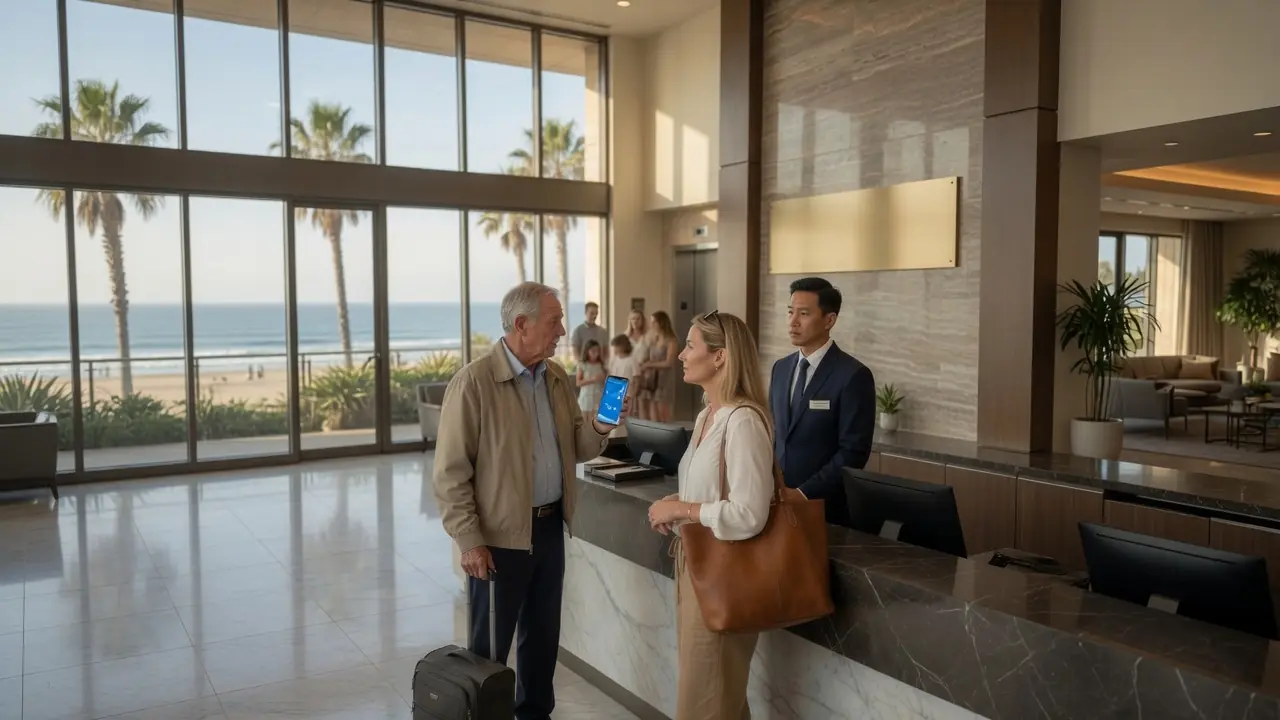
The Ocean View Resort looked like the kind of place where families came to heal. Sunlight poured through the tall glass windows, flashing across the marble floors, while the Pacific Ocean stretched blue and endless beyond the lobby. Truman Moreno stood near the reception desk with one hand on the handle of his small wheeled suitcase and the other holding his phone, where the payment receipt glowed on the screen. Eight thousand five hundred dollars had left his account for this trip, and for the first time in years, he had believed the money might buy something more than bills, school tuition, and short phone calls from his daughter.
At sixty-three, Truman was not a helpless man. He had spent thirty-five years designing homes, civic buildings, and coastal hotels as an architect, and he knew how to read a space the moment he entered it. The Ocean View Resort was designed to make people feel welcomed, with low lounge chairs, tropical plants, polished stone, and warm staff smiles that seemed trained but still kind. Yet standing before the reception desk, Truman felt more out of place than he had ever felt in any building he had helped create.
The young receptionist had searched the reservation twice. Then she searched by his full name, by Jennifer Hayes’s name, by the confirmation number, and finally by the card used for payment. Her professional smile began to strain as the truth refused to change. There were two rooms under the reservation: an ocean-view family suite for Jennifer, her husband Dylan, and a separate room for the children. There was no room for Truman.
“I’m very sorry, Mr. Moreno,” she said carefully. “The payment did come through from your card, but the reservation does not list a room under your name.”
Truman stared at her. “I paid for the entire vacation.”
“I understand, sir.”
“No,” he said softly. “I don’t think I do.”
He stepped away from the counter before his voice could crack in front of a stranger. Around him, the hotel lobby continued its bright, expensive rhythm. A family of four laughed as they received their keycards, a bellhop rolled gold luggage toward the elevators, and a woman in a white sundress leaned against her husband while pointing toward the ocean outside. Everyone in that lobby seemed to know where they belonged.
Truman sat in a leather armchair near the window and placed his suitcase beside him like a loyal dog. He called Jennifer. It rang four times and went to voicemail. He tried again, then sent a text message: I’m at the hotel. There is no room reserved for me. Please call me.
No reply came.
He looked down at the receipt on his phone. Resort deposit, family suite, children’s room, parking package, activity fee, service charges. Jennifer had told him she would handle the online booking because websites confused him, though in truth they never had. Truman had designed commercial buildings with software more complicated than any travel website, but when his daughter said, “Dad, let me handle it,” he had handed over his credit card information without suspicion.
Why would he suspect his own daughter?
Jennifer had sounded excited when she suggested the trip. “We all need time together, Dad,” she had said. “The kids miss you. You’ve been alone too much since Mom passed.” Truman remembered how those words had warmed him, how quickly he had agreed to pay when she said the resort was expensive but perfect for making memories. He had imagined breakfasts by the water, walks with his grandchildren, conversations with Jennifer after the children slept.
Now his phone sat silent in his palm.
Thirty minutes passed. Then forty. The receptionist glanced toward him twice, her face showing the helpless sympathy of someone too junior to fix the problem. Truman tried to sit upright, to look patient and dignified, but every time the elevator doors opened and laughing guests stepped inside, the humiliation deepened. He was not simply waiting for his family. He was waiting to find out whether they had remembered him at all.
A man in a crisp navy suit approached from the side of the reception desk. His name tag read Robert Chen, Hotel Manager. He was in his mid-forties, neat, professional, with calm eyes that noticed more than most people wanted noticed. Truman recognized that look. Architects noticed structure; hotel managers noticed human problems before they became public scenes.
“Mr. Moreno?” Robert said. “I’m Robert Chen. May I speak with you for a moment?”
Truman stood slowly. “Of course.”
“I understand there may be an issue with your reservation.”
Truman looked toward the reception desk, then back at him. “My daughter made the booking. I paid for the trip. She booked rooms for herself, her husband, and the children, but apparently not for me.”
Robert’s face changed only slightly, but it was enough. His jaw tightened, and his eyes moved once to the lonely suitcase beside Truman’s shoes. “Did she tell you she had booked a room for you?”
“She told me everything was handled.”
Robert nodded. “I see.”
That was all he said at first, but the silence carried judgment. Not toward Truman, but toward the person who had left him standing in a lobby with proof of payment and no bed. Truman expected a polite explanation about hotel policy, a suggestion to call the booking party, maybe an apology that nothing could be done. Instead, Robert straightened.
“Mr. Moreno,” he said quietly, “please come with me.”
Truman frowned. “I don’t want to cause trouble.”
“You are not causing trouble.”
“I can sit here until Jennifer calls back.”
Robert’s expression softened. “With respect, sir, I don’t think you should have to.”
He walked Truman to the elevator, carrying the suitcase himself despite Truman’s attempt to stop him. They rode up in silence to the fourth floor. Robert led him down a quiet hallway, stopped before room 417, and opened the door with a master key. When the door swung inward, Truman saw a king bed, crisp white linens, a cream-colored sofa, a balcony, and beyond it, the ocean filling the windows like a painting.
“This is one of our ocean-view rooms,” Robert said. “It is available tonight. I’ve placed it under your name.”
Truman turned to him. “I can pay for it.”
“No,” Robert said. “This room is on the house.”
“I can’t accept that.”
“Yes, you can.” Robert placed the keycard in his hand. “Family should treat you better than strangers do.”
The words struck harder than Truman expected. He looked away toward the ocean because if he looked at Robert too long, he might lose the composure he had been holding together since the desk clerk said there was no room. For seven years since his wife Margaret died, Truman had told himself Jennifer was busy, stressed, overwhelmed, raising children in an expensive state. He had paid, helped, answered every emergency, and excused every cold silence.
But in that room, offered by a stranger’s decency, he saw the shape of the truth.
Robert left him with privacy. Truman rolled his suitcase beside the bed and stood before the window, watching the water move in slow silver lines below. The room was beautiful, but beauty felt strange when it arrived as pity. He looked at his phone again. Still no message from Jennifer.
At six that evening, Truman went back downstairs. He had not planned to confront them immediately, but he heard Jennifer’s laugh from the lobby before he reached the bottom floor. She stood near the reception desk wearing a white resort blouse and tan linen pants, sunglasses pushed onto her head, an expensive beach tote hanging from her shoulder. Dylan stood beside her scrolling through his phone, while Emma and Caleb, Truman’s grandchildren, held dripping ice cream cones and stared at their tablets.
Jennifer saw him and smiled as if nothing had happened.
“Dad,” she said brightly. “You made it. I was wondering when you’d get here.”
Truman looked at her for a moment, waiting for concern to appear. It did not. She hugged him lightly with one arm while keeping the tote balanced on her shoulder.
“Jennifer,” he said, “why wasn’t there a room reserved for me?”
Her smile flickered. “Oh, Dad. Don’t start.”
“I’m asking a simple question.”
“You’re a grown man,” she said, lowering her voice as if he were embarrassing her. “I figured you could handle your own room.”
Truman felt something inside him go still. “You used my card for your suite and the children’s room, but left me standing at the desk with no reservation.”
“The suite was expensive,” she said, as though that explained everything. “And the kids needed their own room. You always figure things out anyway.”
Dylan finally looked up from his phone. “Didn’t you get a room?”
Truman turned toward him. “The manager helped me.”
“Great,” Dylan said. “Problem solved.”
The casual cruelty of that phrase nearly took Truman’s breath away. Problem solved. Not sorry. Not how could this happen. Not thank you for paying for everything. Just problem solved, as if Truman had been an inconvenience that had removed itself.
Jennifer reached out and touched Truman’s arm, the way she always did when preparing to ask for more. “Listen, since you’re settled now, can you add another two thousand to the card? The spa package is amazing, and Dylan and I really need a break.”
Truman stared at her. “You want more money?”
“Well, it’s vacation,” she said with a little laugh. “Don’t make it awkward.”
A man could spend years building walls around his pain and still have one sentence knock them flat. Truman thought of every payment he had made since Margaret’s funeral. The wedding venue, the car, the private school tuition, the emergency card, the rent help, the vacations, the birthdays, the quiet transfers that appeared whenever Jennifer cried into the phone. Each one had felt like love when he sent it.
Now he understood she had been treating love like a credit line.
Robert Chen stood several feet away, pretending to check a clipboard while watching the scene with the careful attention of a manager ready to intervene. Jennifer did not notice him. Dylan did, and his face tightened slightly. Men like Dylan disliked witnesses, especially ones in suits.
“We’re going to dinner,” Jennifer said, turning toward the restaurant entrance. “You’re coming, right?”
Truman should have said no. He knew that later. But fathers do not stop being fathers in one clean instant. He followed them into the hotel restaurant, not because he wanted to pay, but because a part of him still hoped someone at the table would remember he was more than the bill.
They were seated near the windows. The sunset spread orange and pink across the water, but no one looked at it. Dylan studied the menu, making sure Truman saw the prices. Jennifer talked about the beach, the pool, the cabanas, the excursions she wanted to book, and the massage she claimed she deserved. Emma and Caleb barely looked up from their devices.
“I thought tomorrow we might walk through the village,” Truman said. “There are art galleries nearby. I read about one with local painters.”
Jennifer waved a hand. “We already have plans.”
“Oh.”
“You can do that yourself, Dad. You like that kind of thing anyway.”
That kind of thing. Art, architecture, light, texture, the things Truman had built his life around. His daughter said it like he had a strange habit she tolerated only because it cost her nothing.
The server arrived. Dylan ordered prime rib. Jennifer ordered sea bass and wine. The children ordered burgers with truffle fries and sodas. Truman ordered chicken because it was the least expensive thing on the menu and because his appetite had left him in the lobby.
During dinner, Jennifer and Dylan spoke around him. They discussed the next day’s activities, who would reserve cabanas, whether they should book a boat tour, and whether the spa had availability. Every plan included Truman’s money and excluded Truman’s presence. When the check came, Jennifer slid it toward him without looking.
Three hundred twenty dollars.
Truman placed his card in the leather folder. The server thanked him with genuine warmth when she returned it, and that small kindness hurt. He added a generous tip because the young woman had treated him like a person. Then he watched Jennifer stand.
“Thanks, Dad,” she said over her shoulder. “See you tomorrow.”
Dylan said nothing.
The children wandered after their parents, still absorbed in their screens. Truman remained at the table until the server came to clear the plates. She asked if he wanted anything else. He almost said no, then changed his mind.
“Coffee,” he said. “Black, please.”
He drank it slowly while the restaurant emptied around him. Through the window, the ocean had gone dark. Reflections of the dining room lights floated on the glass, and in them he saw his own face looking older than it had that morning. Not physically older, but clearer, as if some soft illusion had been washed away.
That night, Truman did not sleep.
He sat in the ocean-view room Robert had given him and opened his banking app. One by one, he looked through years of charges. Private school tuition. Jennifer’s “emergency” credit card. Dylan’s car. Rent assistance. Furniture. Medical bills that were never explained. Vacation deposits. The numbers began to stack in his mind like bricks in a wall.
By dawn, the wall was high enough to see over.
The next morning, he walked down to the lobby just after eight. Jennifer and Dylan were already near the concierge desk, dressed for a tour, with the children in swimsuits and cover-ups. Jennifer’s smile brightened the moment she saw him, not with affection, but with relief. A customer had arrived.
“Perfect timing, Dad,” she said. “We found this coastal cave tour. It’s four hundred fifty per person, so with all of us it’s twenty-two fifty. Can you put it on the card?”
“No.”
The word came out calm.
Jennifer blinked. “What?”
“No,” Truman repeated. “I’m not paying for that.”
Dylan lowered his phone. “Excuse me?”
“You heard me.”
Jennifer laughed once, forced and brittle. “Dad, don’t be dramatic. We’re on vacation.”
“You are on vacation,” Truman said. “I am here because I paid for one.”
Her face tightened. “Are you really doing this in the lobby?”
“Yes,” he said. “This seems to be where you decided my place was.”
The concierge looked down at her desk. The receptionist from the day before froze beside her computer. Robert Chen appeared near the far end of the lobby, watching again, but this time Truman did not feel embarrassed. He felt awake.
Jennifer stepped closer, voice low and sharp. “The kids were excited.”
“Then you and Dylan can pay for the tour.”
“We budgeted based on you helping.”
“You budgeted based on using me.”
Dylan gave a cold laugh. “Wow. So now you’re going to punish your grandchildren because of one room mix-up?”
Truman turned to him. “Do not use those children as a shield for your entitlement.”
Dylan’s eyes hardened. “Careful, Truman.”
Robert began walking toward them.
Truman raised one hand slightly, not to stop Robert, but to show he was fine. Then he looked back at Jennifer. “I paid eight thousand five hundred dollars for this vacation. You booked everyone a room except me. Then you asked for spa money before you apologized.”
Jennifer’s cheeks flushed. “I was stressed.”
“No,” he said. “You were comfortable.”
That silenced her.
Truman reached into his jacket and took out the emergency credit card she had used for three years. He had already opened the banking app that morning while the sun rose over the ocean. With one press, he had frozen it. Now he placed it on the concierge desk between them.
“This card is closed.”
Jennifer stared at it. “You can’t do that.”
“It is my account.”
“But we use that for emergencies.”
“Nordstrom is not an emergency. Spa treatments are not an emergency. Resort meals are not emergencies.”
Dylan stepped forward. “You’re acting like a bitter old man.”
“And you’re acting like a man who mistook generosity for weakness.”
For the first time, Jennifer looked afraid. Not heartbroken, not sorry, but afraid of losing access. Truman recognized the difference, and it hurt more than he expected. The daughter he remembered, the little girl who used to fall asleep with storybooks on her chest, was still somewhere inside that woman. But the woman in front of him had learned to see him as a resource before seeing him as a father.
“Dad,” she said, softening suddenly. “Let’s talk upstairs.”
“No.”
“Please.”
“We will talk when I’m ready,” Truman said. “Not before.”
He turned away from them and walked toward the elevators. Jennifer called after him, but he did not stop. Dylan muttered something under his breath, and Emma asked why Grandpa was mad. Caleb simply stared.
The elevator doors closed.
In his room, Truman packed his suitcase. He checked out by ten, thanked Robert Chen personally, and tried once more to pay for the room. Robert refused again. “Then let me at least write a note to your general manager,” Truman said.
Robert smiled faintly. “That, I will accept.”
“Thank you,” Truman said. “Not for the room. For seeing me.”
Robert’s expression softened. “Sometimes that is what people need most.”
Truman drove home to La Jolla with the windows slightly open, letting the ocean air cut through the heaviness in his chest. The house he returned to was quiet, Spanish-style, with tiled floors, arched doorways, and framed sketches from his architectural career lining the hallway. Margaret had loved that house. Jennifer had grown up in it.
He went straight to his office.
For the rest of the day, Truman built a spreadsheet. Architects measure before they build, and now he needed to measure the shape of his own exploitation. Date, amount, reason, recipient, repaid. He pulled bank statements, credit card bills, wire records, emails, and texts. One number at a time, the truth became visible.
Wedding: forty-five thousand dollars.
Rental deposit: fifteen thousand.
Dylan’s car: twenty-eight thousand.
Private school tuition: twenty-four thousand per year for four years.
Emergency credit card charges: ninety thousand over three years.
Vacations, furniture, repairs, medical bills, birthday parties, sudden crises, and urgent requests that never stopped arriving.
By midnight, the total stood at three hundred eighty-seven thousand dollars.
Truman sat back in his chair and stared at the screen. He recalculated the formula twice. The number did not change. In seven years, his daughter had taken nearly four hundred thousand dollars from him while giving him less warmth than a hotel manager had offered in five minutes.
His phone had been ringing all evening. Jennifer left messages that began angry, turned wounded, then became threatening. Dylan left one too.
“Truman, this is ridiculous,” Dylan said. “You embarrassed your daughter in public. Fix the card situation, and we can all move on like adults.”
Truman deleted it.
The next morning, he called Patricia Gomez, an estate planning attorney in San Diego. Her assistant asked what had prompted the appointment. Truman looked at the spreadsheet on his desk.
“Clarity,” he said.
Three days later, he sat in Patricia’s office overlooking the bay. He handed her the spreadsheet, bank records, copies of messages, and his current will. Patricia read in silence. She was in her early fifties, sharp-eyed, with a calm professional voice that made no room for emotional fog.
“Mr. Moreno,” she said finally, “your daughter is an adult. She has no legal right to your assets during your life or after your death unless you choose to give them to her.”
Truman exhaled slowly. “She says family takes care of family.”
“Care is not the same as extraction.”
The sentence landed like a key turning in a lock.
Patricia recommended a new will, a revocable living trust, a healthcare directive, and a power of attorney that did not name Jennifer. Truman decided seventy percent of his estate would create the Margaret Moreno Architectural Scholarship Foundation, twenty percent would go into an education trust for Emma and Caleb that Jennifer and Dylan could not access, and the remaining ten percent would cover personal gifts and smaller charitable donations. Jennifer would receive nothing directly.
“Do you want to disinherit her completely?” Patricia asked.
“I want to stop rewarding behavior that would have broken her mother’s heart.”
The documents were drafted within a week. Truman signed them with witnesses, a notary, and a medical competency letter to prevent future claims that he had been influenced or confused. Each signature felt like a beam placed correctly in a damaged structure. Not revenge. Support.
The confrontation came before he expected it.
Jennifer and Dylan arrived at his house two days after someone saw his car near Patricia’s office. They brought the children, because manipulation often wears innocent faces when adults run out of honest arguments. Emma and Caleb carried handmade cards covered in glitter, and Truman knelt to accept them, kissed both children on the forehead, and sent them to the kitchen for cookies. Then he closed the door halfway, leaving Jennifer and Dylan on the porch.
“We need to talk,” Jennifer said.
“Yes,” Truman replied. “We do. But not in front of the children.”
Dylan crossed his arms. “You’re really enjoying this power trip.”
Truman looked at him calmly. “Power is not the same as boundaries.”
Jennifer’s eyes filled with practiced tears. “Dad, I don’t know what happened to you. You were always generous. Mom would be devastated seeing you treat us like strangers.”
For the first time in years, Truman’s voice rose. “Do not use your mother’s memory to defend your greed.”
Jennifer recoiled.
“Your mother taught you kindness,” he continued. “She taught you dignity. She taught you that love is not a transaction. If she saw what happened at that hotel, she would not ask why I stopped paying. She would ask why you forgot your father had a heart.”
Jennifer’s tears became real then, but Truman was no longer sure whether they came from shame or fear. “We made mistakes.”
“You left me without a room on a vacation I paid for.”
“I thought you’d handle it.”
“No,” he said. “You thought I would tolerate it.”
Dylan stepped forward. “You’re going to regret pushing us away when you’re old and need help.”
Truman smiled sadly. “You just confirmed why I changed the documents.”
Jennifer went pale. “What documents?”
He opened the door wider and invited them inside. The children stayed in the kitchen with cookies and juice while Truman led Jennifer and Dylan to the living room. On the coffee table sat copies of the new will, the trust documents, and a letter of intent explaining his decision.
Jennifer picked up the first page. Dylan leaned over her shoulder.
The silence that followed was long and cold.
“You can’t do this,” Jennifer whispered.
“I already did.”
Dylan snatched the papers. “We’ll contest it. You’re clearly being influenced by someone.”
“I completed a cognitive assessment,” Truman said. “My attorney anticipated that accusation.”
Jennifer looked up sharply. “So you planned this against us?”
“No,” Truman said. “I planned for myself.”
Her voice cracked. “I’m your daughter.”
“Yes.”
“That should mean something.”
“It did,” he said. “It meant three hundred eighty-seven thousand dollars over seven years. It meant wedding costs, school tuition, credit cards, car payments, rent help, vacations, and endless emergencies. It meant I kept saying yes because I loved you, while you forgot love was supposed to go both ways.”
Dylan scoffed. “So this is about money.”
“No,” Truman said. “That is the part you still do not understand. If it were only money, I might have kept making excuses. This is about the hotel lobby. This is about realizing my daughter could spend my money on ocean-view rooms and leave me sitting beside a suitcase with nowhere to sleep.”
Jennifer’s face twisted. “You’re punishing the kids.”
“The children’s education trust is protected. You cannot touch it. Dylan cannot touch it. When they are old enough, it will help them.”
“So you trust them but not me?”
“I trust what they may become more than what you have chosen to be.”
Dylan threw the papers onto the table. “Come on, Jen. We’re done here.”
Jennifer stood slowly, but at the doorway she turned back. “Dad, please. Don’t do this. We can fix it.”
Truman looked at her, and for one moment he saw the little girl in her face. He wanted to save that girl. But the woman standing in his house needed consequences more than rescue.
“If you want a relationship with me,” he said, “it will not be built on money again.”
She waited for more.
“That is the only offer.”
Jennifer said nothing. Dylan pulled her out the door, angry and red-faced. Truman watched them gather the children and leave. Emma waved from the driveway, confused and sad. Truman waved back with a smile that cost him more than the money ever had.
When the car disappeared, the house became quiet.
Truman sat in the living room for a long time. The documents remained on the coffee table, untouched now except for the crease Dylan had made. Through the tall windows, the Pacific shimmered in the distance. Margaret’s photo sat on the mantel, her smile soft, steady, and kind.
“I hope you understand,” Truman whispered.
The room did not answer, but the silence felt gentle.
Weeks passed. Jennifer did not apologize, not truly. She sent short texts with photos of the children, and Truman replied warmly but briefly. No money was requested. None was offered. Their relationship, damaged but not dead, settled into a new shape with clear edges.
Robert Chen sent a handwritten note from the resort thanking Truman for his kind letter to management. He wrote that the staff still remembered him and hoped he was doing well. Truman framed the note and placed it in his office, not because of the free room, but because it reminded him that dignity sometimes arrives from unexpected places. A stranger had seen what his family refused to see.
Truman also began visiting local galleries again, something he had stopped doing after Margaret’s death. He reconnected with architecture, with light, with the quiet pleasure of noticing how space could hold emotion. One afternoon, he stood in a small coastal gallery and realized he had spent years funding someone else’s life while abandoning his own. That realization did not make him bitter.
It made him busy.
He began consulting part-time on small design projects, helping young artists shape studio spaces and advising a nonprofit on affordable housing layouts. The Margaret Moreno Architectural Scholarship Foundation awarded its first grant to a student whose essay reminded him of his wife’s practical compassion. Truman attended the ceremony in a navy suit and spoke for five minutes about beauty, usefulness, and integrity. Nobody there asked him for his credit card.
Months later, Jennifer called. Not texted. Called.
Truman let it ring twice before answering.
“Hi, Dad,” she said quietly.
“Hello, Jennifer.”
There was a long pause. “I got a job.”
He closed his eyes. “That’s good.”
“Full-time. Real estate office. Entry level, but it’s something.”
“That is a start.”
“I wanted you to know.”
“I’m glad you told me.”
Another pause. “The kids ask about you.”
“I ask about them too.”
Her breath shook. “Dad, I don’t know how to fix what I did.”
Truman looked out at the ocean beyond his window. “Start by not asking me to fix it for you.”
She was silent for a moment, then said, “Okay.”
It was not an apology. Not yet. But it was the first sentence that did not contain a demand. Truman accepted it for what it was, a small plank across a wide broken place.
After they hung up, he made coffee and walked onto his terrace. The sun was setting over the Pacific, turning the water copper and gold. He thought about the hotel lobby, the suitcase beside his feet, Jennifer’s careless smile, Dylan’s cold voice, and Robert Chen saying, “You deserve better than this.”
He had believed that better would come from his daughter finally valuing him.
Instead, better had come from Truman finally valuing himself.
He had lost the illusion of being needed. He had lost the comfort of denial. He had lost the role of endless provider, emergency fund, silent payer, and forgotten guest.
But he gained something stronger.
A room with his own name on it.
A future with locks he controlled.
And a life where love would never again be confused with a receipt.