The moment my daughter pulled my newborn granddaughter away from my arms, something inside me went very quiet. Not angry at first, not even shocked in the loud way people imagine shock should feel. It was quieter than that, deeper than that, like a door closing somewhere far inside my chest. I stood in the private hospital room holding a pink knitted blanket I had spent three months making by hand, and for the first time in my life, I felt like a stranger in my own daughter’s family.
My name is Juliana Freeman, and I was sixty-three years old when my granddaughter Amelia was born. I had spent most of my adult life building a life for one person, my daughter Vanessa. Her father died when she was nine, and from that day forward, every choice I made was shaped by one promise. Vanessa would never feel abandoned, unsafe, or afraid of the future if I could help it.
I worked harder than I knew a human body could work. I took interior design jobs that barely paid enough for groceries, accepted late-night client calls, drove through snowstorms for consultations, and learned how to smile even when I wanted to collapse. While other women my age were going to dinner with friends or taking weekend trips, I was sitting at my kitchen table under a weak lamp, sketching furniture layouts while Vanessa slept on the couch nearby. She hated sleeping alone after her father died, so I let her stay near me, even if it meant I worked until two in the morning.
Back then, Vanessa adored me in the way only a frightened child can adore the one person who remains. She used to sit on the floor beside my fabric samples, asking which colors looked expensive and which chairs rich people liked best. Sometimes she would fall asleep with her cheek pressed against a catalog, and I would carry her to bed even when my back hurt from working all day. She once told me, “When I grow up, Mom, I’m going to take care of you the way you take care of me.”
I believed her.
Years passed, and slowly, the struggle became success. Freeman Interiors grew from a one-woman business into a respected design firm with hotel contracts, luxury residential clients, and enough steady income that I could finally breathe. I paid Vanessa’s tuition at Northwestern University without letting her take out loans. I bought her first condo after graduation because I did not want her starting adulthood with rent anxiety hanging over her head. When she got her first real job, I surprised her with the white Mercedes she had once admired in a showroom window.
At first, Vanessa received my help with tears and gratitude. She hugged me tightly, called me the best mother in the world, and promised she would never forget what I had done for her. I did not help her because I wanted repayment. I helped because giving to her felt like finishing the work her father and I had started together. Every check, every gift, every sacrifice felt like love made visible.
Then she met Ethan Carter.
Ethan was handsome, polished, and impressive in the way expensive things are impressive before you learn what they cost. He worked in private investments, wore tailored suits, and spoke in a calm voice that made every sentence sound more intelligent than it was. When I first met him, he brought flowers and called me Mrs. Freeman. He told me Vanessa was extraordinary and that I had raised a remarkable woman.
I wanted to like him, so I did.
The changes in Vanessa came slowly enough that I could pretend not to see them. First, it was my clothes. She suggested I update my wardrobe because “people in certain circles notice presentation.” Then it was my handbag, my shoes, the way I talked about money, the way I admitted when something was expensive. Little by little, my practical nature, the same nature that had kept us alive after her father died, became something she seemed embarrassed by.
One afternoon, we went shopping on Michigan Avenue, and I made the mistake of quietly saying that a winter coat cost more than my first month’s rent after marriage. Vanessa’s smile vanished instantly. She leaned close and whispered, “Mom, please don’t talk like that here.” I stared at her, confused, but she looked away like I had done something vulgar. That night, I sat alone in my kitchen and realized my daughter had begun measuring me by standards I had never taught her.
Ethan encouraged it without ever appearing cruel. He talked constantly about image, networking, private clubs, and the importance of being seen in the right places. Vanessa absorbed every word as if he were teaching her how to survive in a better world. Their life grew more expensive each year, and somehow, pieces of the cost kept finding their way back to me. A larger house, a country club membership, luxury furniture, household help, private wellness services during pregnancy, and small emergencies that were never small.
I paid because I told myself I was supporting my daughter.
I did not realize then that support without boundaries can become permission.
When Vanessa became pregnant, I truly believed motherhood would bring her back to me. I thought the baby would soften the distance between us and remind her that love was not about status, presentation, or social circles. I spent months knitting a pink blanket for the baby, choosing the softest yarn I could find. I cleaned Vanessa’s old storybooks from the attic and imagined reading them to my granddaughter while Vanessa smiled beside me.
The morning Amelia was born, I woke before sunrise, too excited to sleep. Snow drifted gently outside my windows, and the whole city seemed softened by winter light. I dressed carefully, choosing a cream wool coat, pearl earrings, and a modest blouse Vanessa had once complimented years before. I packed the knitted blanket, tiny socks, a silver bracelet engraved with Amelia’s initials, and an old photograph of Vanessa as a newborn sleeping against my chest.
I drove to Northwestern Memorial Hospital with my hands trembling on the steering wheel. I felt nervous, but it was the sweet kind of nervous, the kind that comes before something precious. I imagined Vanessa tired but happy, maybe emotional, maybe ready to forgive whatever distance had grown between us. I imagined holding Amelia and feeling our family become whole again.
The maternity floor smelled like flowers, clean sheets, and warm blankets. Nurses moved softly through the hallway, and families whispered congratulations outside half-open doors. When I reached Vanessa’s room, I paused for one second before entering because I wanted to remember the moment. Then I stepped inside with the gift basket in my hands and a smile already breaking across my face.
Vanessa was sitting in bed, pale and exhausted but beautiful, holding Amelia against her chest. Ethan stood near the window looking down at his phone, and his mother, Margaret, sat in the corner arranging flowers as if she owned the room. For one brief second, I saw Vanessa as my little girl again. Not the polished wife of Ethan Carter, not the woman who corrected my clothes, just my daughter, tired and fragile after becoming a mother.
“Oh, sweetheart,” I whispered. “She’s perfect.”
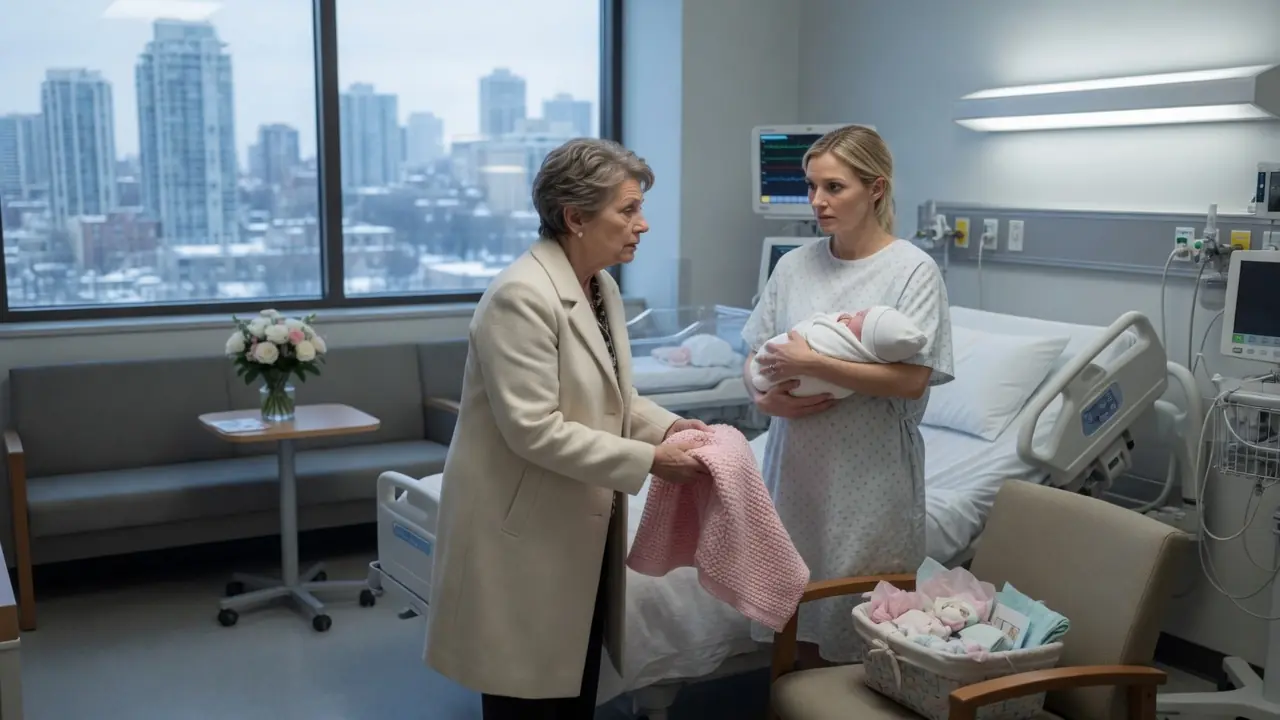
Vanessa smiled faintly, but it did not reach her eyes. I moved closer slowly, careful not to crowd her, careful not to appear too emotional because emotion had become something she criticized lately. I placed the gift basket on a chair and unfolded the pink blanket just enough for her to see it. Then, with tears already forming in my eyes, I held out my arms.
“May I hold my granddaughter?”
Vanessa looked down at Amelia. Then she looked toward Ethan. Then, finally, she looked at Margaret. The air changed so quickly that I felt it before she spoke. Her arms tightened around the baby, and she shifted Amelia slightly away from me.
“I think it’s better if you don’t hold her right now,” Vanessa said.
At first, I thought I had misunderstood. I stood there with my arms still half-raised, waiting for her to smile and explain that the baby had just fallen asleep or that the nurse had given instructions. I even tried to help her by saying, “Of course, I can sanitize again if you want.” My voice sounded gentle, but inside me something had already begun to crack.
“That’s not necessary,” Margaret said smoothly from the chair.
I looked at Vanessa, not Margaret. “Vanessa?”
My daughter would not meet my eyes at first. She adjusted the edge of Amelia’s blanket and took a slow breath, as if she were preparing to say something reasonable. “We’re trying to keep a certain environment around the baby,” she said. “At least for now.”
A certain environment.
Those words moved through me slowly, cruelly, and completely. I had built safe environments for Vanessa since the day her father died. I had worked through exhaustion, fear, loneliness, and grief so she would never feel unwanted. Now she was speaking as if I were something that might damage the perfect world she wanted around her child.
I looked toward Ethan, hoping he would soften the moment or at least look ashamed. He did not. He kept his eyes lowered toward his phone, his face carefully neutral. Margaret, however, wore the faintest smile, the kind of smile people wear when they believe a social boundary has been successfully enforced. That smile hurt almost as much as Vanessa’s words.
“I see,” I said quietly.
Vanessa finally looked at me then, and for one second, guilt flickered across her face. It vanished quickly, replaced by the polished coldness I had come to recognize as Ethan’s influence. “Please don’t make this difficult,” she said softly. “I just had a baby.”
I wanted to say that I had once had a baby too. I wanted to remind her that she had been placed in my arms after twenty hours of fear and pain, and that I had held her like she was the whole world because she was. I wanted to ask when I had become so embarrassing that my touch was no longer welcome. Instead, I lowered my hands.
The pink blanket felt suddenly heavy in my arms. I folded it carefully because I did not know what else to do with my hands. I placed it beside the gift basket on the chair and smoothed the edge with trembling fingers. Then I looked at Amelia, my granddaughter, the tiny child I had imagined holding for months, and I realized I might not be allowed to know her unless Vanessa decided I was useful again.
“I should let you rest,” I whispered.
Vanessa nodded too quickly. “Okay.”
That one word ended something between us. Not completely, not forever, but enough that I felt the break. She did not say, “Mom, wait.” She did not say, “I’m sorry.” She did not even soften her voice. She simply accepted my leaving like it was easier than my staying.
I somehow made it to the elevator before the tears came. The doors closed, and I pressed one hand over my mouth, trying not to make a sound while strangers politely looked anywhere but at me. I had been denied the chance to hold my granddaughter, but the deeper pain was clearer now. My daughter was ashamed of me.
In the parking garage, I sat behind the wheel for a long time without starting the car. Snowflakes melted against the windshield, and the world outside looked blurred and distant. My phone buzzed in my lap, and when I looked down, I saw Ethan had already posted a birth announcement. Vanessa smiled in the photo, Margaret held the baby proudly beside her, and hundreds of people were already commenting on the perfect new family.
I was not in a single picture.
Not one.
That was when sadness began turning into clarity. I had spent years funding a lifestyle that slowly edited me out of my own daughter’s life. The house, the car, the membership, the staff, the vacations, the polished image, the perfect nursery, all of it had my money behind it. Yet in the hospital room, I was treated like someone too ordinary to touch the baby whose life I had helped make comfortable before she was even born.
I wiped my face slowly.
Then I made the first phone call.
My financial adviser, Rachel Monroe, answered on the second ring. She had worked with me for years and knew enough about my accounts to understand when my voice sounded wrong. I told her I needed to freeze every discretionary payment connected to Vanessa and Ethan’s lifestyle until further review. Rachel was silent for a moment, then said gently, “Juliana, are you sure?”
“No,” I said honestly. “But I’m doing it.”
The next morning, I sat at my dining table surrounded by financial statements. Rachel had warned me months earlier that spending connected to Vanessa’s household had become unusually aggressive. I had ignored the warning because mothers are experts at refusing to see what would hurt too much to understand. Now every line item looked different. The country club fees, the luxury car lease, the staff payments, the furniture invoices, the travel deposits, and the emergency transfers were no longer gifts of love.
They were evidence.
I called the bank. I called the lease company. I called the payroll service handling the housekeeper and night nurse. I called the trust attorney to suspend automatic approvals tied to the estate property. Each call felt like removing a thread from a life I had helped weave, and with every thread, I wondered whether Vanessa would love me at all without the things I provided.
By evening, I was exhausted.
Not proud, not powerful, exhausted. People imagine boundaries as dramatic moments of strength, but sometimes they feel like grief. Sometimes setting a boundary means admitting that the love you were trying to protect has already become unhealthy. That night, I sat alone in my living room with the untouched baby blanket on my lap and cried until there was nothing left.
Vanessa called three days later.
Her voice was sharp the second I answered. “What is going on with the accounts?”
I closed my eyes. “The accounts I pay for?”
“My card was declined,” she said. “The payroll service called about the nurse. Ethan says the club membership is suspended. Why would you do this right after I had a baby?”
The old me almost apologized. The old me almost said it was temporary, that I would fix it, that I was sorry for upsetting her. Then I remembered her pulling Amelia away from me while Margaret smiled from the chair. I remembered the phrase “certain environment,” and something inside me held steady.
“You made it clear I’m not part of the environment you want around your child,” I said. “So I’m stepping out of the lifestyle attached to it.”
Vanessa went silent. “Mom, you’re overreacting.”
That sentence landed harder than shouting would have. Overreacting meant my pain was inconvenient. Overreacting meant she still believed the issue was my sensitivity, not her cruelty. I held the phone tightly and said, “No, Vanessa. I’m reacting exactly enough.”
Ethan joined the call a few minutes later, his voice smooth and controlled. He said emotions were high, everyone was tired, and the financial disruption was creating unnecessary instability. He never asked how I felt after leaving the hospital. He never apologized for staying silent. He only talked about stability, payments, and the baby needing consistency.
“Consistency?” I asked quietly. “I have been consistent for Vanessa since she was nine years old.”
He paused. “Juliana, no one is questioning what you’ve done.”
“You are only questioning my right to stop doing it.”
Neither of them answered.
Over the next week, the truth became uglier. Rachel found irregular transfers connected to Ethan’s investment accounts. My attorney, Daniel Brooks, discovered documents that carried something close to my signature but not close enough to fool me. The house trust had been used more aggressively than I understood. Money had moved through channels I never approved, and Ethan’s name appeared too often to ignore.
For the first time, I realized Vanessa might not simply be spoiled. She might also be trapped. Trapped by status, trapped by debt, trapped by a husband who had trained her to fear ordinary life. The thought did not erase what she had done to me, but it changed the shape of my anger. Beneath the polished robe, cold words, and superior expression, my daughter might have been drowning inside the life she pretended to love.
Two weeks after Amelia’s birth, Vanessa invited me to dinner. She said it would be just family, and because hope is stubborn, I went. The house looked beautiful from outside, glowing against the snow like something from a magazine. Inside, the dining room was arranged too perfectly, with candles, expensive wine, and Margaret seated at the table wearing an expression that told me this was not a reconciliation.
It was an intervention.
Margaret began first, speaking softly about forgiveness, misunderstandings, and how cruel it was to punish new parents financially. Ethan spoke next, using phrases like practical solutions and household stability. Vanessa sat quietly beside him, pale and tired, barely touching her food. Nobody asked how it felt to be refused my granddaughter.
I listened until Ethan made the mistake that revealed everything.
“Without your support,” he said, carefully but not carefully enough, “Vanessa has nothing protecting her current quality of life.”
The room went silent.
There it was, spoken plainly at last. Not love, not family, not healing, not Amelia. Quality of life. The image. The house. The car. The club. The life that made Vanessa feel superior enough to reject the mother who funded it.
I looked at my daughter and saw something shift in her face. For the first time, she looked embarrassed by him instead of by me. Not fully awake, not ready to admit everything, but shaken. The truth had slipped out, and even Vanessa could not pretend she had not heard it.
“I spent years believing my generosity was love,” I said quietly. “Now I see it may have taught you to confuse support with entitlement.”
Vanessa’s eyes filled with tears.
Ethan touched her arm, and just like that, her face closed again. That small gesture told me more than any argument could have. She was still caught in his approval, still measuring herself through his reactions, still afraid of disappointing the man who had helped turn her away from me. So I stood, picked up my purse, and left before they could pull me back into guilt.
At the door, Vanessa whispered, “Mom, please.”
I looked at her for a long moment. “When you are ready to talk about what happened, not what I stopped paying for, you know where to find me.”
Then I walked out.
The collapse came faster after that. Legal letters went out, accounts were frozen properly, and the trust protections activated. Ethan stopped sounding polished and started sounding desperate. Vanessa called one morning with a trembling voice and asked, “Mom, what forged signatures?”
That was the first moment I knew she did not understand everything Ethan had done.
When she came to Daniel’s office, she looked nothing like the polished woman from social media. Her hair was tied back carelessly, her face was tired, and her eyes carried the fear of someone whose perfect life had begun cracking in every direction. Daniel showed her the documents slowly. Vanessa stared at the pages, confused at first, then horrified.
“I never saw these,” she whispered.
I believed her.
That belief hurt in a different way. It meant my daughter had been cruel to me, yes, but it also meant she had been manipulated into protecting a life she did not fully control. Ethan had used her hunger for approval, her fear of seeming ordinary, and her desire to belong in his world. He had turned my generosity into a resource and my daughter’s insecurity into a weapon.
Still, accountability mattered.
Vanessa cried in Daniel’s office, but I did not rush to comfort her the way I once would have. I stayed beside her, but I did not rescue her from the truth. She needed to feel the weight of what had happened, not because I wanted her punished, but because she could not heal from a life she kept pretending was harmless. For the first time, I loved her without removing the consequence.
A few nights later, she called me close to midnight. Amelia was crying in the background, and Vanessa sounded broken with exhaustion. “Mom,” she sobbed, “I don’t know what to do.”
I drove to her house without hesitation.
The nursery was enormous, beautiful, and cold. Imported furniture, designer wallpaper, a crystal ceiling fixture, and in the middle of it all, my daughter sat on the floor holding a crying baby like she had no idea how to survive the night. The image broke my heart. Luxury had given her everything except peace.
“Give her to me for a minute,” I said softly.
Vanessa froze.
We both remembered the hospital.
For one painful second, shame filled her face. Then, slowly, with trembling hands, she placed Amelia into my arms. The moment my granddaughter settled against my chest, I felt tears rise so quickly I could barely breathe. She was warm, tiny, and real, and I had waited weeks for a moment that should have been given freely.
I rocked Amelia gently and hummed the same lullaby I used to sing to Vanessa after nightmares. Within minutes, the crying softened. Then it stopped. Vanessa watched me with tears running down her face, and when I said, “I used to do this with you,” she covered her mouth and began to sob.
“I’m sorry,” she whispered. “I’m so sorry.”
I wanted forgiveness to be simple. I wanted one apology to erase the hospital room, the shame, the months of cold comments, the years of being treated like a wallet in a cardigan. But real healing is not that quick. So I only nodded, held Amelia close, and let my daughter cry beside me.
Over the following months, Vanessa’s life changed completely. Ethan’s financial problems became impossible to hide, and the marriage began collapsing under the weight of its own performance. The Range Rover disappeared first. Then the country club membership. Then the large house became a place of legal discussions instead of social gatherings.
Eventually, Vanessa moved into a modest two-bedroom apartment on the north side of Chicago, above a quiet bakery. The floors creaked, the windows rattled in the wind, and Amelia’s crib barely fit in the corner of the living room. The first time I visited, Vanessa looked embarrassed and said, “I know it’s small.” I looked around and realized it felt warmer than the mansion ever had.
“It feels safe,” I said.
She cried when I said that.
Slowly, my daughter began returning to herself. Not the old Vanessa exactly, because none of us return unchanged after truth breaks open our lives. She became humbler, quieter, more honest about fear. She learned to budget, to ask for help without demanding rescue, and to sit with discomfort instead of covering it with expensive things.
I helped her, but differently now.
When she needed groceries, I helped her make a budget. When she panicked about daycare, I helped her research options instead of paying for the most expensive one. When she cried from exhaustion, I listened, but I did not take over her life. For the first time, I respected her enough to let her grow stronger.
One afternoon, while Amelia napped, Vanessa looked at me from across her small kitchen table and said, “You’re treating me differently.”
“Yes,” I said.
“Because you don’t trust me?”
“No,” I answered gently. “Because I finally understand that rescuing you from every hard thing was not the same as loving you well.”
That sentence stayed between us for a long time.
Months later, on a quiet October Sunday, Vanessa came to my house with Amelia on her hip. There was no designer coat, no luxury handbag, no careful performance. Just my daughter, tired but peaceful, standing on my porch while autumn leaves moved across the yard. Amelia reached for me the moment the door opened.
I held my granddaughter for most of the afternoon. She slept against my shoulder while sunlight came through the living room windows, and Vanessa sat beside me with tears in her eyes. Finally, she whispered, “I will regret that hospital room for the rest of my life.”
I looked down at Amelia’s tiny fingers curled against my sweater. Then I reached for Vanessa’s hand.
“I forgave you before I knew how to say it,” I whispered. “But forgiveness does not mean we go back to the way things were.”
Vanessa nodded through tears. “I don’t want to go back. I want to become better.”
That was the beginning of something new.
Not perfect. Not painless. Not the fairy-tale healing people like to imagine. But honest. Boundaried. Real.
I learned that love should never require abandoning your dignity, not even for your own child. Vanessa learned that luxury can impress strangers, but it cannot replace emotional safety. And Amelia, sweet little Amelia, became the reason both of us chose to rebuild something healthier than the life we lost.
Now, on quiet mornings, Vanessa brings Amelia to my house, and we drink coffee while the baby plays with wooden blocks on the rug. Sometimes my daughter looks around at my simple living room and says it feels peaceful. I smile when she says that because peace was always what I wanted for her. She simply had to lose the performance before she could recognize it.
I never got back the first moment I should have held my granddaughter.
Some wounds remain part of the story.
But when Amelia reaches for me now, laughing with her whole tiny body, I no longer feel erased. I feel present. I feel loved. And most importantly, I feel like the woman I once forgot to protect has finally come home to herself.