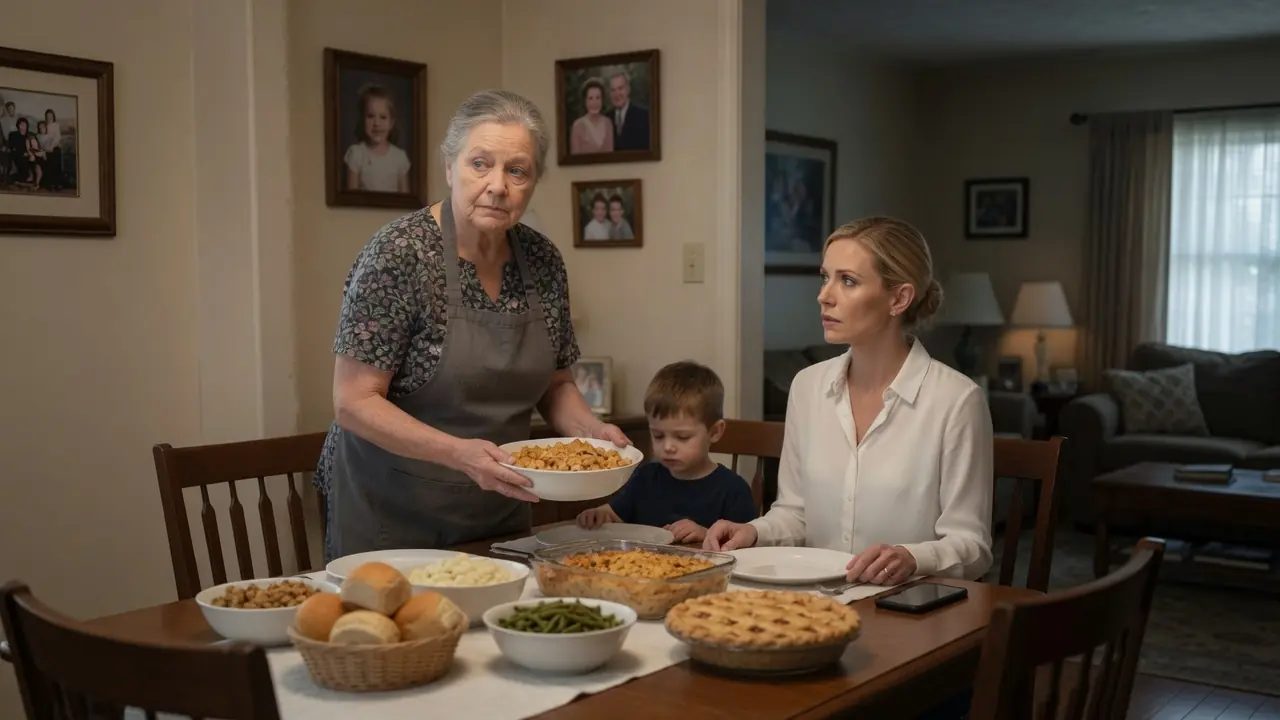
Evelyn Carter was standing beside the dining table with a white serving bowl in both hands when her daughter Madison looked up and made the whole room go quiet. The bowl held chicken casserole, the same one Evelyn had baked for nearly thirty years, the same one her late husband Robert used to ask for when the weather turned cold. Madison sat at the table in her crisp white blouse, one hand resting near her empty plate, her blonde hair pulled neatly back, her phone lying beside her silverware like she was waiting for a better place to be. Beside Madison, her ten-year-old son Caleb stared down at his lap, already old enough to know when adults were about to say something they could not take back.
The dining room looked exactly the way Evelyn had always loved it. A wooden table sat beneath a framed family photo from Robert’s old restaurant, where he and Evelyn were smiling in front of a plate of rolls and a chalkboard menu. Bowls of green beans, mashed potatoes, roasted carrots, dinner rolls, and homemade pie filled the table, each dish placed carefully because Sunday dinner had always meant care in Evelyn’s house. The room smelled like butter, chicken broth, fresh bread, and something warm that should have made people feel safe.
But Madison did not look safe. She looked annoyed. Her eyes moved from the casserole to Evelyn’s apron, then to the old cabinets, then back to the bowl as if every part of the room offended her equally. “You made that casserole again?” she said, her voice sharp enough to cut through the clatter of dishes. “Mom, I told you I cannot stand this heavy old food.”
Evelyn’s fingers tightened around the bowl. She had known Madison might complain, because lately Madison complained about everything: the food, the house, the curtains, the old wallpaper, the dining chairs, the way Evelyn still kept Robert’s picture on the wall. But knowing an insult might come did not make it hurt less when it arrived. Evelyn looked at the table, then at Caleb, then back at her daughter, trying to smile before the hurt reached her face.
“It was your father’s favorite,” Evelyn said softly. “And you used to ask for it every birthday when you were little.” Madison gave a short laugh and pushed her plate away with two fingers. “That was before I knew better,” she said. “Now it just smells like this house is trapped in 1986.”
Nobody moved. Evelyn’s son Mark, who had come early to help set the table, slowly lowered his fork. Her youngest daughter Hannah pressed her lips together, the way she did when she wanted to cry but refused to do it in front of anyone. Caleb glanced up at his grandmother, and that small frightened look hurt Evelyn more than Madison’s words.
Madison did not seem to notice the silence she had created. Or maybe she noticed and enjoyed it. She leaned back in her chair, folded her arms, and looked at the food like it had personally embarrassed her. “I mean, come on, Mom,” she continued. “People don’t eat like this anymore unless they’ve just given up.”
That was the part that finally made Mark speak. “Madison,” he said, his voice low. “Enough.” Madison rolled her eyes immediately. “Oh, relax. I’m just being honest.” Mark set his fork down harder than necessary, and the sound echoed against the plates.
Madison had not always been this way. As a child, she had stood on a stool beside Evelyn in the kitchen, wearing Robert’s old gray apron that dragged across the floor. She used to stir batter with both hands, leaving flour on her cheeks and sugar on her sleeves, proud when Robert called her his little chef. At nine years old, Madison once told Evelyn that her casserole could fix a bad day faster than any medicine.
Evelyn remembered that girl so clearly it sometimes felt like grief. That little girl had loved Sunday dinners, had stolen dinner rolls before the blessing, had fallen asleep against Robert’s shoulder after dessert while the adults talked around the table. But somewhere between college, a corporate job, and marrying a man who measured worth by polish and money, Madison had started treating her past like a stain. Now she lived in a sleek high-rise apartment in Chicago and came home just often enough to remind everyone she had outgrown them.
At first, the comments had been small. “Do you still cook with real butter?” “This is a lot of carbs.” “Mom, nobody under sixty eats casseroles anymore.” Evelyn had laughed because everyone else seemed unsure what to do, and laughing made the moment pass faster. That was how humiliation trained people: softly at first, until they learned to smile through it.
Then Madison married Grant Whitmore, a finance executive with expensive watches, perfect teeth, and the ability to insult people politely. He once called Evelyn’s pot roast “beautifully rustic,” in a tone that made the word rustic sound like an illness. He complimented her house by saying it had “historical charm,” though the word historical seemed to mean old, outdated, and beneath him. Madison began speaking the same way, as if Grant had taught her a new language and the first rule was to look down on where she came from.
Robert would never have allowed it. Evelyn knew that, and maybe that was why Madison had grown bolder after he died. Robert had been gentle, but he had possessed a quiet authority that stopped cruelty before it spread. He believed teasing belonged only where love was still clear, and once a joke made someone smaller, it was no longer a joke.
Evelyn carried the bowl to the table and set it down carefully. Her hands trembled, so she placed them against her apron before anyone could see. “If you don’t want any, you don’t have to eat it,” she said. Madison laughed again, but this time there was irritation under it. “That’s not the point, Mom. The point is that every time we come here, it’s the same tired food, the same tired house, the same tired routine.”
Hannah’s chair scraped slightly as she shifted forward. “Then why do you come?” she asked. Madison looked at her sister as if the question offended her. “Because she expects us to,” Madison said, nodding toward Evelyn. “Because if I miss one dinner, suddenly I’m the daughter who abandoned her mother.”
Evelyn felt the words land in places Madison could not see. She had never wanted the dinners to feel like a trap. She kept cooking because after Robert died, the house became so quiet that she feared silence would swallow the family whole. Sunday dinner was the last thread connecting them to the home they had built together, and Evelyn had held that thread with both hands because losing it felt like losing Robert again.
Mark stood up then. “You don’t get to blame Mom because you feel guilty.” Madison’s face hardened. “I don’t feel guilty.” “Then stop acting like everyone here is embarrassing you,” Mark replied. Caleb looked from his mother to his uncle, his small shoulders shrinking inside his sweater.
Grant was not there that night. He had stayed in Chicago for a “client event,” which Madison mentioned three times before dinner as if his absence made him more important. Evelyn was secretly relieved, because Grant’s presence always made Madison sharper. Without him, Evelyn had hoped her daughter might soften, might remember the house before it became something to criticize.
Instead, Madison looked at the casserole and said the sentence that broke something in Evelyn. “Honestly, maybe this is why Dad always had health problems,” she said. “You fed him like every meal was trying to win a county fair.” The silence that followed was complete. Robert had not died from health problems; he had died when a delivery truck ran a red light on his way home from the hardware store.
Hannah covered her mouth. Mark’s face went pale with anger. Caleb whispered, “Mom,” in a tiny voice, as if even he understood she had crossed a line. Evelyn looked at Madison and saw no immediate regret, only surprise that everyone had reacted so strongly.
“Madison,” Mark said, his voice shaking. “What is wrong with you?” Madison blinked defensively. “I didn’t mean it literally.” Hannah stood so quickly her napkin fell to the floor. “You brought Dad into this over casserole.” Madison crossed her arms tighter. “Oh my God, everyone is so sensitive.”
Evelyn untied her apron slowly. Nobody spoke while she slipped the loop over her neck and folded the apron once, then twice, with hands that had suddenly become very steady. She placed it on the sideboard beneath Robert’s picture. Then she turned back to the table and looked directly at her oldest daughter.
“I think you should go home,” Evelyn said. Madison stared at her. “Excuse me?” “You don’t like the food, the house, or the memories here,” Evelyn replied. “So tonight, I won’t force you to sit with any of them.”
For the first time all evening, Madison looked uncertain. She glanced toward Mark, then Hannah, as if waiting for someone to correct their mother. No one did. Caleb looked close to tears, and Evelyn’s heart twisted for him, but she also understood that children learned what love looked like by watching adults either protect it or let it be insulted.
Madison grabbed her purse from the chair. “Fine,” she said coldly. “If you want to punish me because I’m honest, go ahead.” Evelyn did not answer. Madison took Caleb’s hand, but the boy hesitated long enough to look back at his grandmother. Evelyn forced herself to smile at him. “I love you, sweetheart,” she said.
After Madison left, no one touched the casserole for several minutes. The front door closed, and the house seemed to exhale. Hannah began crying quietly, not loudly, just enough for Evelyn to hear the pain beneath it. Mark walked to the window, stared out into the dark street, and said, “I’m sorry, Mom.”
Evelyn sat down at the table for the first time all evening. “I kept thinking if I loved her patiently enough, she would come back to herself,” she said. Hannah wiped her eyes. “Mom, she’s been hurting you for years.” Evelyn looked at Robert’s empty chair, the one she still could not bring herself to remove. “I know.”
That night, after Mark and Hannah went home, Evelyn stood alone in the kitchen wrapping leftovers. The casserole was barely touched. She lifted the lid, and the smell rose into the quiet kitchen, rich and familiar, carrying a memory of Robert coming through the back door, kissing her cheek, and asking, “What’s cooking, Evie?” She pressed one hand to the counter and cried so hard her shoulders shook.
The next morning, Madison texted. You embarrassed me in front of my son. Evelyn read the message twice, waiting for pain to rush in. It came, but beneath it was something new, something like a floor beneath her feet. She replied with one sentence: I will not invite you to Sunday dinner again until you can come with respect.
Madison did not answer for six hours. When she did, the message was long, defensive, and cold. She accused Evelyn of guilt-tripping her, of clinging to outdated traditions, of turning food into emotional control. She said Grant had always warned her that the family dinners were less about love and more about making everyone feel obligated. Evelyn read every word and then set the phone face down.
The following Sunday, Evelyn woke out of habit before sunrise. For years, Sunday mornings had carried a weight in her chest because she knew Madison would arrive by late afternoon with criticism folded into every smile. That morning, the anxiety came first, then the memory that Madison was not coming. Evelyn stood in the kitchen holding a stick of butter and laughed softly, not because anything was funny, but because she realized she had been afraid of her own ingredients.
She cooked exactly the way she wanted. Roast chicken, mashed potatoes with cream, green beans with almonds, cornbread in Robert’s old cast-iron skillet, and peach cobbler because Caleb loved it, though Caleb would not be there that evening. She did not adjust the salt, did not replace butter with something Madison approved of, and did not check her recipes like she was preparing evidence for a trial. For the first time in years, cooking felt like comfort instead of performance.
Mark arrived at three with his wife and two daughters. Hannah arrived twenty minutes later carrying flowers and a grocery bag full of ice cream. The house filled with noise, laughter, coats on chairs, and children asking if they could taste the cobbler before dinner. Evelyn kept waiting for the sharp voice that never came.
Dinner felt lighter, and that lightness made everyone aware of how heavy things had become before. No one said Madison’s name for the first hour. They ate, laughed, argued about baseball, remembered Robert’s terrible singing voice, and passed food around the table until the serving spoons clinked against empty bowls. At one point, Mark looked at Evelyn and said, “This tastes like home.”
Those four words nearly broke her. Evelyn swallowed hard and looked down at her plate. She had spent years letting Madison convince her that home was something inferior, something outdated and embarrassing. But here were the people who still understood that home was not measured by modern taste or expensive plates. Home was the place where food was offered with love and no one made you feel small for accepting it.
Hannah took a picture after dessert. Evelyn stood in the center holding the cobbler dish, laughing because Mark’s youngest daughter had frosting on her nose. The photo went online with a simple caption: Sunday dinner at Grandma’s. Forty-three minutes later, Madison called.
“You had dinner without me?” Madison said as soon as Evelyn answered. Evelyn looked around the quiet kitchen. “Yes.” Madison let out a bitter laugh. “Wow. So this is what we’re doing now?” Evelyn leaned against the counter, still wearing the apron she had almost stopped using because of her daughter.
“We had dinner, Madison,” Evelyn said. “That’s all.” “No, you excluded me.” “You made it clear you hated being here.” Madison went silent for a moment, then said, “I didn’t hate being there. I hated watching you refuse to evolve.”
Evelyn closed her eyes. There it was again, that word Grant loved and Madison had adopted. Evolve, as if kindness was primitive and warmth was something educated people outgrew. “You don’t want me to evolve,” Evelyn said quietly. “You want me to apologize for being the mother who raised you.”
Madison did not respond immediately. When she did, her voice was sharper. “That is not fair.” Evelyn looked toward Robert’s picture. “Neither was using your father’s memory to insult my cooking.” The silence after that felt different, heavier, because even Madison could not pretend she had not said it.
“I was upset,” Madison muttered. Evelyn nodded though her daughter could not see her. “So was I. But I didn’t use your childhood as a weapon.” Madison inhaled sharply. “You’re acting like I’m cruel.” Evelyn answered before fear could stop her. “You have been cruel to me for a long time.”
Madison hung up without saying goodbye. Evelyn stood in the kitchen holding the phone, expecting guilt to flood her. It did not. There was sadness, yes, and worry for Caleb, and the old mother’s instinct to call back and make things easier. But there was also relief, small and steady, like a candle surviving in a room that had been dark too long.
Two weeks passed. Madison did not call, but Hannah heard from Caleb through a birthday message and learned he missed Grandma’s dinners. That knowledge hurt Evelyn deeply, because boundaries often protected one person while still causing pain in another place. She sent Caleb a card with no mention of the conflict, only a picture of a bluebird and a note saying she loved him more than peach cobbler. Madison did not respond, but Evelyn hoped Caleb saw it.
Then something unexpected happened. Evelyn ran into an old friend named Margaret Dawson at the grocery store. Margaret had worked with Evelyn decades earlier at Robert’s small restaurant before it closed, back when Evelyn cooked professionally and people lined up for her soups every winter. Margaret hugged her in the canned tomato aisle and said, “Tell me you still cook that chicken casserole.”
Evelyn laughed awkwardly. “Some people think it belongs in the past.” Margaret narrowed her eyes. “Some people have no taste.” Evelyn tried to wave it off, but Margaret studied her face carefully. “Who made you ashamed of your own hands?”
That question stayed with Evelyn all night. She sat at the kitchen table under Robert’s picture, remembering the years before motherhood swallowed the rest of her identity. She had not only cooked because her family needed dinner. She had loved creating food, loved feeding people, loved hearing a room grow quiet because the first bite had reached something deeper than hunger. Somewhere along the way, Madison’s judgment had made Evelyn forget that.
A month later, Margaret entered Evelyn in the Dayton Winter Food Festival. Evelyn almost backed out three times. On the morning of the event, she stood in front of her mirror with shaking hands, telling herself she was too old, too out of practice, too ordinary. Then she heard Robert’s voice in memory, warm and amused: “Let the food speak, Evie.”
The festival changed everything. Evelyn served chicken casserole, beef stew, cornbread, and peach cobbler from a modest booth with her name printed on a paper sign. At first, she was nervous, but then people began recognizing her from the old restaurant. One man said her stew had gotten him through the winter after his wife died. A woman cried after tasting the casserole and said it reminded her of the meals her grandmother used to make when life felt safe.
By midafternoon, Evelyn’s booth had one of the longest lines at the festival. Local reporters arrived, and a young journalist from Dayton Living asked what made her cooking special. Evelyn almost gave a modest answer, the kind women of her generation were trained to give. Instead, she looked at the steaming pans in front of her and said, “I cook like I want people to feel welcome.”
The article went online that evening under the headline: The Woman Who Fed a Town With Love. Mark sent the link to everyone. Hannah posted it proudly. Margaret called Evelyn famous and unbearable in the same sentence, which made Evelyn laugh for the first time in days.
Madison commented under the article an hour later. Interesting that people still celebrate food like this. For once, Evelyn did not collapse under the words. She looked at the long line of comments from strangers praising the meals, sharing memories, and defending the value of food made with care. Madison’s voice, once the loudest in Evelyn’s mind, suddenly seemed much smaller.
But Madison was not finished. The next day, she wrote a long post about “nostalgia being confused with quality” and “families using tradition to avoid change.” She did not name Evelyn directly, but everyone knew. Mark called furious, Hannah cried, and Margaret announced she was ready to drive to Chicago and personally remove Madison’s internet connection. Evelyn told them all to stop.
That night, Madison called. Her voice was not sharp this time. It sounded tired. “Everyone is acting like I’m a monster,” she said. Evelyn sat at the kitchen table, one hand resting near the folded apron. “Are they acting that way because of what I said, or because of what you said?” Madison went quiet.
“I just don’t understand why everyone chooses you,” Madison whispered. The sentence hit Evelyn harder than the insults. Beneath the polished cruelty, there was fear, the fear of a woman who thought love was a competition she was losing. Evelyn softened, but she did not surrender the truth.
“This isn’t about choosing me over you,” Evelyn said. “It’s about how you made people feel.” Madison’s breath trembled. “I never meant to become someone everyone hated.” Evelyn closed her eyes. “Then stop fighting to defend the part of you that hurt people.”
There was a long silence. Then Madison said something Evelyn had never heard from her before. “I was embarrassed.” Evelyn did not speak. Madison continued in a smaller voice, “In Chicago, everyone is polished. Grant’s friends talk about where they summered, what schools they went to, what restaurants they know. I felt like if they saw where I came from, they’d decide I didn’t belong.”
Evelyn’s heart ached, but this time she understood without excusing. Madison had not been confident all those years. She had been afraid. She had used superiority like armor, and every time she felt small, she made her mother smaller instead. Fear explained the cruelty, but it did not erase it.
“You were never embarrassing to me,” Evelyn said. Madison gave a broken laugh. “I made you embarrassing to myself.” Evelyn swallowed. “Yes, you did.” The honesty hurt both of them, but it was the first honest bridge between them in years.
Madison apologized that night, not perfectly, not dramatically, but for real. She apologized for the comments, for the Thanksgiving joke about Robert, for letting Grant’s contempt become her own, and for making Caleb watch her treat his grandmother with disrespect. Evelyn did not say everything was fine, because it was not. She only said, “I hear you.”
Madison did not return to Sunday dinner the next week. Evelyn did not invite her yet. Some doors needed to open slowly, not because love was gone, but because respect had to arrive before routine could return. For the first time, Evelyn understood that forgiveness without change was only another way to keep bleeding.
Three weeks later, Madison came to the house alone. No Grant, no expensive coat, no sharp performance. She stood on the porch with a small grocery bag in her hand and looked younger than thirty-eight, almost like the little girl who once waited for frosting spoons. “I brought apples,” she said quietly. “I thought maybe you could show me how to make Dad’s cobbler.”
Evelyn stood in the doorway for a long moment. Then she stepped aside. “Come in.” Madison entered the kitchen slowly, looking at the cabinets, the table, the picture of Robert, and the casserole dish drying beside the sink. This time, she did not insult any of it.
They made cobbler in near silence at first. Evelyn showed Madison how to peel the apples without wasting too much fruit, how to add cinnamon by smell, how to keep the crust cold before rolling it. Madison listened carefully, and when she made a mistake, she did not turn it into a joke at anyone’s expense. She simply tried again.
At one point, she touched the edge of Robert’s old apron hanging near the pantry. “I used to wear this,” she said. Evelyn nodded. “You used to drag it all over the floor.” Madison’s eyes filled. “I remember thinking this kitchen was the safest place in the world.”
Evelyn looked at her daughter then. “It was.” Madison wiped one tear quickly, embarrassed by it but no longer hiding behind cruelty. “I’m sorry I forgot.” Evelyn reached for the rolling pin, giving them both a moment to breathe. “Then remember slowly.”
That Sunday, Madison did not stay for dinner. That mattered to Evelyn. She was not trying to rush back into the old pattern, where pain was covered with food and everyone pretended full plates meant healed hearts. Madison took half the cobbler home for Caleb and promised to call during the week. Evelyn believed her, cautiously.
Months passed before Madison returned to a full family dinner. When she did, she came with Caleb and without Grant, from whom she had quietly separated after realizing how much contempt she had mistaken for sophistication. She sat at the table, looked at the casserole, and said, “This smells like home.” No one teased her for it. No one forgave everything instantly either.
Healing came in small portions. Madison helped clear plates. She thanked Evelyn for dinner. She listened when Mark told stories about Robert instead of correcting the past to make herself comfortable. Caleb asked for seconds of casserole, and Madison smiled through tears when Evelyn served him.
After everyone left that night, Evelyn stood alone in the kitchen the way she had so many Sundays before. But the silence felt different now. It was not grief echoing through empty rooms. It was space, quiet and honest, where something broken had finally stopped pretending it was whole.
Evelyn touched the edge of the dining table and looked up at Robert’s picture. “We’re still here,” she whispered. The table was scratched, the cabinets were old, and the casserole recipe still belonged to another generation. But the room had dignity again.
Evelyn had once believed family meant always setting a plate, no matter how someone treated the table. Now she knew better. Love could be patient, but it also needed boundaries, or it turned into quiet self-destruction. And when Madison finally returned, it was not because Evelyn kept begging her to come back, but because Evelyn stopped allowing love to be served with disrespect.
The casserole had never been the problem. The old house had never been the problem. The problem was shame, and the cruelty people use when they cannot bear their own roots. Evelyn did not fix everything by refusing to set one plate, but she did something just as important.
She remembered that a mother can love her child deeply and still refuse to be insulted in her own home.