The gift box was not expensive. I knew that the moment I carried it through the front door of my son’s house, because Natalie had taught me exactly how she measured value. Expensive things came in glossy bags, wrapped by store employees who wore black gloves and spoke in soft voices. My gift came in blue wrapping paper I had folded myself at my kitchen table, with a silver ribbon I had tied twice because my old fingers did not work as smoothly as they used to.
My name is Arthur Bennett, and I was sixty-seven years old when my daughter-in-law threw my gift onto the floor in front of thirty people. It was my son Michael’s thirty-eighth birthday, and the party was being held in his bright suburban dining room outside Cleveland, Ohio. Natalie had turned it into something far bigger than Michael wanted: catered food, champagne, hired servers, floral centerpieces, and a guest list full of people who laughed too loudly and looked at price tags before they looked at faces. I came wearing my best navy blazer, a clean white shirt, and the same brown dress shoes I had polished every Sunday since my wife Ellen was alive.
Michael was not there when I arrived. He had been delayed at his office because one of his company’s major accounts had an emergency, and Natalie made sure everyone knew it. “That’s what happens when you marry a man with real ambition,” she told her friends, raising her glass. “He gets called away because important people need him.”
I stood in the hallway holding the wrapped box with both hands, waiting for a moment to set it somewhere safe. Natalie saw me before anyone else did. Her smile tightened the way it always did when she had to acknowledge I existed in a room where she was trying to appear flawless. She wore a cream designer dress, diamond earrings, and the expression of a woman who believed the house, the party, and my son’s future all belonged to her.
“Oh,” she said, loud enough for the nearest guests to hear. “Arthur. You made it.”
“I wouldn’t miss Michael’s birthday,” I said.
Her eyes dropped to the box in my hands. “And you brought something.”
There was a slight pause after that word, something, like the gift might be dirty or embarrassing before she even knew what it was. Her mother, Diane Collins, appeared beside her with a glass of white wine and the same sharp smile. Preston Collins, Natalie’s father, stood near the fireplace, already watching me like I was a service worker who had wandered into the wrong room.
“It’s for Michael,” I said. “I wanted to give it to him myself.”
Natalie stepped closer and held out her hand. “I’ll put it with the others.”
“I’d rather wait until he gets here.”
That was my first mistake, according to Natalie. She did not like being told no, especially not in front of people whose opinion she valued more than decency. Her smile vanished for half a second, and then came back colder than before.
“Arthur,” she said, tilting her head, “this is a nice party. We’re not doing some emotional little garage moment in the middle of it.”
A few guests turned. I felt their attention slide toward us, curious and hungry. People like to pretend they dislike conflict, but most of them will stop chewing to watch someone be humiliated.
“It’s only a birthday gift,” I said quietly.
Diane laughed under her breath. “That’s usually what people say before handing over something handmade.”
Natalie’s eyes brightened, because her mother had given her permission to be cruel. “Is that what this is? Another little craft project?”
I looked down at the wrapped box. “It’s something personal.”
“Personal,” Natalie repeated, and several people chuckled. “Michael is thirty-eight years old, Arthur. He runs a successful company. He doesn’t need little personal trinkets like he’s still ten.”
The words landed, but I stayed still. I had spent forty years working as a tool-and-die machinist, which meant I understood pressure. Metal only bends when heat and force are applied in the right way. Natalie had been applying both to me for years.
She had started small after the wedding. A comment about my old truck. A joke about how I still used coupons at the grocery store. A suggestion that I sit farther from the head table during Thanksgiving because her parents were “used to a more formal arrangement.” Michael never saw the worst of it because Natalie was careful, and because I never wanted my son’s marriage to become a battlefield with me in the center.
But that day, she wanted witnesses.
“Let me see it,” Preston said, walking over.
“It’s for Michael,” I said again.
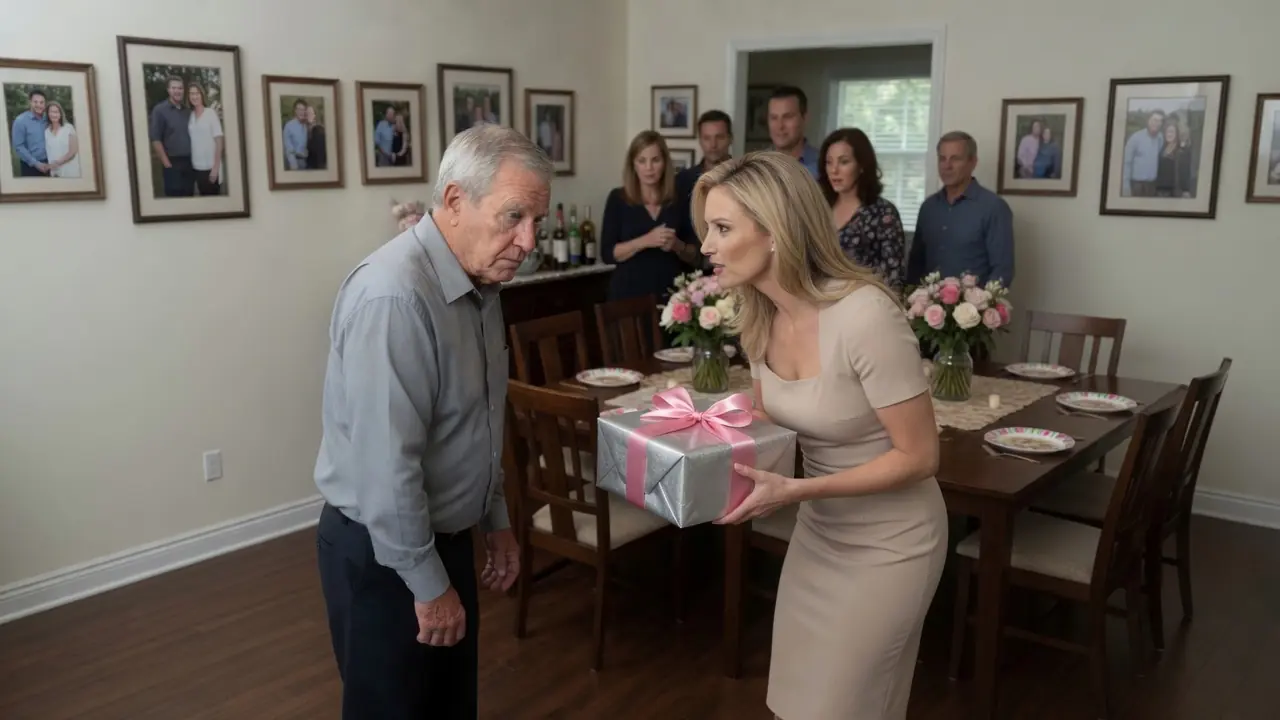
Natalie took the box from my hands before I could step back. She did it quickly, smiling as if she were saving me from myself. Her fingers tightened around the ribbon, but she did not open it. She turned it over, inspecting the wrapping paper, the folded corners, the small handwritten tag.
“For Michael,” she read aloud. “Love, Dad.”
The room had gone quiet now. Even the hired servers slowed near the dining room doorway. I could hear the soft clink of ice in someone’s glass.
Natalie held the gift up between two fingers. “This is sweet,” she said, but the word sweet came out like cheap. “Very sweet. Very… simple.”
“It’s not for you,” I said.
Her face sharpened. “Excuse me?”
“It’s for my son.”
That was the line she decided to punish.
Natalie turned toward the guests and gave a soft laugh, the kind of laugh that pretends to be embarrassed for someone else. “You see what I deal with? I spend all week planning a beautiful party, and Arthur shows up with a little mystery box wrapped like it came from a church basement raffle.”
Diane covered her mouth and laughed. Preston shook his head, enjoying himself. Several of Natalie’s friends smiled in that careful way people do when cruelty feels socially approved.
I reached for the gift. “Natalie, give it back.”
She pulled it away. “No. I think everyone should understand something tonight.”
“Natalie,” I said, warning in my voice now.
She looked directly at me. “You don’t get to walk into my home and make this party about your feelings.”
My home. That was the phrase that made me look up fully. The house Michael lived in had been purchased three years earlier, after I sold the commercial lot behind my old workshop and gave him the down payment. Natalie had picked the curtains, the dining table, the imported tile, and the lighting fixtures, so in her mind, ownership had become decoration. I paid quietly, and she posed loudly.
“This is Michael’s birthday,” I said.
“And he deserves better than whatever sad little object is in this box,” Natalie snapped.
Before I could move, she dropped it.
No, dropped is too gentle a word. She threw it down hard, arm extended, wrist snapping, the blue-wrapped box striking the hardwood floor with a sharp crack that made everyone flinch. One corner tore open, but the actual gift remained hidden inside the wrapping. The ribbon loosened and slid across the floor like a broken promise.
A sound came out of me, not a word, just breath.
Natalie looked down at the box, then back at me. “Oops.”
Preston laughed first. Diane followed. Then two of Natalie’s friends laughed because rich people often mistake cruelty for confidence when it comes from someone well-dressed. I stood there staring at the gift I had spent weeks preparing, not because it cost a fortune, but because it carried something no one in that room had enough patience to understand.
“What is wrong with you?” I asked softly.
Natalie’s eyes flashed. “What’s wrong with me? What’s wrong with you, Arthur? You keep forcing yourself into places where you don’t fit.”
The room went still again.
She stepped closer, pointing one manicured finger at my chest. “You come here with your old-man stories, your cheap clothes, your bargain gifts, and that wounded face like everyone is supposed to stop and applaud your struggle. Michael has moved beyond that life. He has moved beyond you.”
My hands shook, but I lowered them to my sides.
Diane stepped in, her voice smooth and poisonous. “Natalie, dear, don’t be too harsh. Arthur comes from a different world. People like him think effort matters more than presentation.”
Preston lifted his glass toward me. “No offense, Arthur, but a man needs to know when to stop dragging his son backward.”
Natalie smiled, encouraged by them. “Exactly. Michael is building something respectable. We have clients here tonight, investors, people who matter. And then you walk in looking like you’re about to ask where to park the delivery van.”
Someone gasped quietly. Nobody defended me.
I looked down at the gift box on the floor. The wrapping was bent, the ribbon twisted beneath it. Still, no one knew what was inside. Maybe that was the only mercy left.
“Pick it up,” I said.
Natalie laughed. “What?”
“Pick up my son’s gift.”
Her mouth opened in disbelief. “Do not order me around in my own house.”
“It is not your house,” I said.
That wiped the smile off her face.
Preston took a step forward. “Careful, old man.”
I looked at him. “I am careful. That is why I still have what careless people lose.”
Natalie recovered fast. She bent down, but not to pick up the gift with respect. She hooked the edge of the torn wrapping with the tip of her heel and pushed the box across the floor toward me. It scraped lightly over the hardwood and stopped near my shoes.
“There,” she said. “Take your little box and go sit somewhere quiet before you embarrass Michael more than you already have.”
I bent down slowly. My knees complained, but I did not let my face show it. I picked up the gift with both hands and checked the torn corner. The inner case had cracked, but the papers inside were still protected.
Natalie saw me looking at it and rolled her eyes. “Oh, don’t start crying. If it was so precious, you should have brought something worthy of this room.”
I stood up. “You do not know what is worthy of a room.”
“And you do?” she snapped. “You spent your life in a machine shop, Arthur. Let’s not pretend you’re some wise patriarch. You are a retired widower with a rusty truck and too much free time.”
That one found a tender place. Not because of the truck, or the retirement, or the insult to my work. Because she used the word widower like it was another sign of failure, as if Ellen’s absence made me smaller.
“My wife would have been ashamed of you,” I said.
Natalie’s expression turned vicious. “Good thing she isn’t here to make this party sadder.”
The words rang through the dining room.
Even Preston stopped smiling.
For the first time that night, I almost lost my composure. Not because she hurt me, but because she reached into the grave of a woman who had only ever shown her kindness. Ellen had welcomed Natalie with open arms, sent her birthday cards, bought her a pearl bracelet the first Christmas she joined our family, and told me to be patient with her because insecurity often wore expensive perfume.
I took one step back. “Enough.”
Natalie raised her chin. “No, Arthur. Enough is you thinking love gives you access. Enough is you thinking being Michael’s father means you can drag your little sentimental poverty routine into every important moment of his life.”
The front door opened.
No one noticed at first because Natalie was still speaking. Michael stepped into the foyer in a dark suit, holding his phone and briefcase, rain shining faintly on his shoulders. He looked tired from work, but the moment he saw the room, his entire expression changed.
He saw me standing near the dining table with the damaged gift in my hands. He saw Natalie facing me like a prosecutor. He saw the torn wrapping, the silence, the smirking faces, and the way his father was breathing carefully through humiliation.
“What happened?” Michael asked.
Natalie spun around. Her face changed instantly. The cruelty vanished, replaced by concern so false it made my stomach turn.
“Michael, sweetheart,” she said, rushing toward him. “Your father is upset. He brought this strange little gift and got emotional when I said we should open it later.”
Michael did not look at her. His eyes stayed on me.
“Dad?”
I did not answer right away.
Preston stepped forward with a practiced laugh. “Michael, don’t make a big thing out of it. Your father had a little moment. He brought some homemade nonsense, Natalie tried to manage the situation, and he got sensitive.”
Michael looked at the gift box in my hands. “Did someone throw that?”
No one spoke.
Natalie’s smile trembled. “It slipped.”
Michael turned to her. “From your hand to the floor?”
“It was an accident.”
I looked at my son and said quietly, “It was not.”
Michael’s face went still.
Natalie’s eyes flashed toward me with hatred. “Arthur, don’t you dare.”
Michael took one step closer. “Don’t he dare what?”
She crossed her arms. “Your father is trying to make me look bad at my own party.”
Michael looked around the room. “Did she throw it?”
Nobody answered. That silence was louder than confession.
Michael turned to one of his old friends standing near the sideboard. “Eric.”
Eric swallowed. “Yes.”
“Did my wife throw my father’s gift onto the floor?”
Eric looked miserable. “Yes.”
The color drained from Natalie’s face.
Michael nodded slowly. “Did she insult him?”
Eric looked at me, then at Michael. “Yes.”
Natalie exploded. “Are you serious right now? You’re going to interrogate guests at your birthday party because your father can’t take a joke?”
Michael finally looked at her fully. “What did you say to him?”
“I told him the truth,” she snapped. “That he embarrasses you. That he walks into rooms like this and drags your whole image down. Someone had to say it.”
A few people inhaled sharply. Michael’s jaw tightened.
Natalie kept going, because pride often mistakes momentum for strength. “You are not that little shop boy anymore, Michael. You are a grown man with a company, investors, responsibilities, and a wife who actually understands how the world works. You cannot keep letting your father’s sad little gestures pull you backward.”
Michael’s voice was quiet. “My father built the first machines that made my company possible.”
Natalie waved a hand. “Oh, please. He fixed tools in a garage.”
“He designed the prototype line,” Michael said. “He funded my first shop lease. He mortgaged his own house so I could hire my first employees.”
Natalie froze.
Michael looked at Preston and Diane. “And since we’re telling truths, he also covered the emergency bridge loan that kept Collins Interiors alive last winter.”
Diane’s glass lowered slowly.
Preston’s face tightened. “That was a private business matter.”
“No,” Michael said. “It became family business the second you stood here laughing while your daughter humiliated the man who saved your company payroll.”
Natalie turned to her father. “What is he talking about?”
Preston did not answer.
Michael stepped toward the damaged gift. “Dad, may I?”
I handed it to him.
He took the box carefully, like it still deserved tenderness after being dragged across the floor. He removed the torn wrapping, opened the cracked inner case, and pulled out a folded set of documents inside a protective sleeve. Natalie stared, suddenly interested now that the gift looked official instead of sentimental.
Michael unfolded the first page. His eyes moved across it, and something in his expression softened.
“What is it?” Natalie demanded.
Michael looked at me.
I cleared my throat. “It was the final transfer paperwork for the old Bennett workshop property. I was giving it to you outright. No loan. No strings. The land is zoned commercial now, and the city just approved the expansion corridor. I thought you could use it for your second production facility.”
The room went silent.
Michael lowered the paper. “Dad, this land is worth millions.”
“Yes,” I said.
Natalie’s mouth opened.
I looked at her. “That was the cheap little box.”
Nobody laughed now.
Michael placed the documents on the dining table, smoothed the bent edges, and turned toward his wife. “You threw away the gift that was going to double my company’s capacity.”
Natalie swallowed. “Michael, I didn’t know what was inside.”
“That is the point.”
She blinked. “What?”
“You did not know,” he said. “And still you decided it had no value because it came from him.”
Natalie looked around, desperate to regain control. “Okay, fine. I was harsh. But he provoked me. He stood there acting wounded and making me look cruel.”
Michael’s voice hardened. “You did not look cruel because of him. You looked cruel because you were cruel.”
Preston stepped forward. “Now hold on.”
Michael turned to him. “No. You hold on. You laughed while my father was insulted in my house.”
Diane’s voice shook. “Michael, this is getting out of hand.”
“It got out of hand when my wife dragged my mother’s memory into her mouth.”
Natalie’s face went pale. “I didn’t mean it like that.”
Michael’s eyes became cold. “What exactly did you mean when you said it was good my mother wasn’t here to make the party sadder?”
That sentence destroyed the last of her defense. The guests looked away, uncomfortable and disgusted. Even Natalie’s friends seemed to shrink from her.
Michael removed his wedding ring and set it on the dining table.
Natalie stared at it. “What are you doing?”
“Ending the performance.”
Her voice cracked. “Michael, don’t be dramatic.”
He gave a humorless laugh. “You threw my father’s gift on the floor, mocked his clothes, insulted his work, used my dead mother as a punchline, and then lied to my face when I walked in. I am not being dramatic. I am finally paying attention.”
Natalie stepped closer, panic rising. “You’re not leaving me over one argument.”
“No,” Michael said. “I’m leaving because this is the first time you were careless enough to show me who you are in front of witnesses.”
Preston slammed his glass onto the sideboard. “You ungrateful little—”
Michael turned on him. “Finish that sentence and I cancel your company’s loan guarantee before midnight.”
Preston stopped.
Michael looked at him with a calm I recognized. It was the calm I had taught him: never shout when you have leverage. “Bennett Industrial holds your emergency note. You missed two payments last month. My father covered them because I asked him to help family. But after what I saw tonight, I no longer consider you family.”
Diane grabbed Preston’s arm. “Preston.”
Michael pulled out his phone. “I’m calling the bank Monday morning. You have until then to refinance without Bennett backing you.”
Natalie’s voice became thin. “You wouldn’t.”
Michael looked at her. “You threw his gift on the floor because you thought he had nothing to give. Now you get to learn what he already gave.”
She reached for him. “Michael, please.”
He stepped back before she could touch him. “Do not.”
That single command landed harder than any shout.
The guests began leaving quietly. No one wanted cake anymore. No one wanted champagne. People collected coats, whispered apologies to me, and slipped out through the foyer like they had just watched a house catch fire and did not want smoke on their clothes.
Within fifteen minutes, the dining room that Natalie had designed to impress important people looked empty and foolish. The flowers leaned in their crystal vases. Half-filled glasses sat abandoned on the table. The gift wrapping remained on the floor where Natalie had thrown it, bright blue against the wood like evidence.
Natalie stood in the center of the room, crying now. “Michael, I’m sorry. I was embarrassed. I didn’t think.”
“No,” he said. “You thought very clearly. You just thought I would choose your image over my father.”
She turned to me. “Arthur, tell him. Tell him I didn’t mean it.”
I looked at her for a long time. The apology was not for me. It was for the life she felt slipping away.
“I believe you meant every word,” I said.
She began sobbing harder.
Michael walked to the staircase and pointed upward. “Pack a bag. Go stay with your parents.”
Natalie looked at him as if he had spoken another language. “You’re kicking me out?”
“I am asking you to leave before I say something I cannot take back.”
Preston tried to protest, but Diane pulled him toward the door. They understood numbers, and Michael had just shown them a ledger they could not afford to ignore. Natalie stood frozen for another moment, then ran upstairs, her heels striking each step in frantic little cracks of sound.
Michael and I were alone in the dining room.
He looked at the damaged case and the bent papers. “Dad, I’m sorry.”
I shook my head. “You did not throw it.”
“I let her treat you badly for too long.”
That was the truth, and because I loved him, I did not lie to soften it. “Yes,” I said. “You did.”
His eyes filled, but he held himself together. “I thought keeping peace meant being patient.”
“Peace without respect is just surrender wearing better clothes.”
He nodded slowly.
I picked up the torn wrapping paper and folded it, not because it could be saved, but because my hands needed something to do. “Your mother used to say that people show you who they are when they think kindness has no consequences.”
Michael smiled sadly. “She would have hated tonight.”
“She would have hated Natalie’s cruelty,” I said. “But she would have been proud that you finally saw it.”
He looked at the land transfer documents again. “I can’t accept this tonight.”
“Yes, you can.”
“After what happened?”
“Especially after what happened.”
He looked at me, confused.
“That land is not a reward,” I said. “It is legacy. Your wife’s behavior does not get to decide whether I pass something to my son.”
Michael pressed his lips together, fighting tears. “I don’t deserve you.”
I placed my hand on his shoulder. “You are my son. Deserving has nothing to do with it.”
Natalie came downstairs twenty minutes later with two designer suitcases and a face streaked with makeup. She did not look at me. She looked at Michael, waiting for him to weaken. When he did not move, she dragged the suitcases to the door herself.
“This is humiliating,” she whispered.
Michael answered without raising his voice. “No, Natalie. Humiliating is what you did to my father. This is consequence.”
She left with her parents.
The door closed behind them, and the house became quiet in a way it had probably not been since before Natalie moved in. Michael stood still, listening to the absence of her voice. Then he walked to the floor, picked up the last loose strand of silver ribbon, and placed it gently beside the gift box on the table.
“I’ll fix the case,” he said.
I smiled. “I know a guy who works well with his hands.”
He laughed then, barely, but it was real.
A month later, Michael filed for legal separation. Two months after that, Collins Interiors lost its loan guarantee and had to sell half its assets to stay alive. Preston never apologized, but men like him often confuse silence with dignity when it is really just fear. Diane sent one letter, written in careful handwriting, saying she regretted the way things happened, which was not the same as regretting what they did.
Natalie called Michael every day for three weeks. First she cried. Then she blamed stress. Then she said her parents had influenced her, as if cruelty were a coat someone else had placed on her shoulders. Finally, when none of it worked, she accused Michael of choosing his father over his wife.
Michael’s answer was simple.
“I chose the person who never made me choose.”
He moved forward slowly after that. Some evenings he came to my house after work, loosened his tie, and sat at my kitchen table while I made coffee. We talked about his company, the new facility, the land transfer, and occasionally, when he was strong enough, about Natalie. He never pretended the marriage had not mattered, and I never rushed him through his grief.
People think betrayal only hurts when love remains. That is not true. Betrayal hurts because it forces you to question the years you spent believing someone was better than they were.
One Saturday morning, Michael brought the damaged gift case back to my workshop. The crack had been sanded smooth, reinforced from inside, and stained darker than before. It looked different now, but not ruined. Together, we placed the land documents inside it again, along with an old photograph of Ellen standing beside my first workbench, smiling at Michael when he was six years old and covered in sawdust.
Michael held the box for a long time.
“I keep thinking about how she called your gift cheap,” he said.
I looked around my little workshop. “Cheap is when something has a price but no meaning.”
He nodded. “And valuable?”
“Valuable is when someone can throw it on the floor and it still matters.”
He closed the box carefully and held it against his chest.
That evening, we went to the old Bennett workshop property together. The building was worn, the windows dusty, the fence leaning in two places, but the land stretched wide behind it, waiting for a future. Michael stood near the gate, looking at the place where my life’s work had started and where his next chapter would begin.
“She thought you were dragging me backward,” he said.
I smiled. “Roots always look like backward motion to people who only care about height.”
He looked at me then, and for the first time in a long time, I saw peace on my son’s face. Not happiness yet. Happiness takes time after a wound like that. But peace had returned to him, and peace is a foundation strong enough to build on.
Natalie had thrown my gift on the floor because she thought she was humiliating an old man with nothing important to offer. She thought wrapping paper, plain shoes, and quiet dignity meant poverty. She thought status lived in champagne glasses, designer dresses, and rooms full of people eager to laugh at someone weaker.
She was wrong about all of it.
The gift was never just a box.
It was a test.
And when she threw it away, she finally showed my son exactly what he needed to see.