Margaret Collins had always believed that family kindness should be given freely, but she had learned too late that some people treated kindness like an open wallet. At sixty-four, she was not a rich woman in the way people imagined when they saw her neat cardigan, polished shoes, and well-kept home. She was comfortable because she had lived carefully, saved wisely, and stretched every dollar after her husband passed away. Her life was quiet, orderly, and peaceful, and that peace had become the most valuable thing she owned.
Her son Kevin was thirty-five, kind at heart, but soft in the places where a man needed a backbone. He had always hated conflict, even as a boy, preferring to nod along until the loudest person in the room stopped pushing. Margaret loved him deeply, but she had also watched him become the kind of husband who apologized for problems he did not create. Since marrying Ashley, he had learned to survive by staying silent.
Ashley Collins was beautiful in the shiny, polished way of women who knew exactly how to use appearances. She was thirty-one, blonde, sharp-eyed, and always dressed like she was stepping into a lifestyle advertisement. She called Margaret “Mom” in public with a bright smile and honeyed sweetness, but there was always something measuring in her eyes. Margaret had felt it from the beginning, though she had tried hard to ignore it for Kevin’s sake.
At first, Ashley’s demands came disguised as closeness. She invited Margaret to brunch, then forgot her wallet. She suggested a spa day to help them bond, then acted surprised when the bill arrived at Margaret’s side of the counter. She asked Margaret to pick up “a few things” for Sunday dinner, and somehow those few things became imported cheeses, organic cuts of meat, specialty desserts, and flowers Ashley claimed made the table feel more welcoming.
Margaret paid because she wanted peace. She paid because Kevin looked relieved when she did. She paid because she told herself new marriages were delicate, and perhaps Ashley only needed time to feel secure. But every time Margaret signed another receipt, she felt a little less like a mother-in-law and a little more like an account Ashley expected to access.
The pregnancy announcement changed everything. Ashley invited Margaret and Kevin to dinner, waited until dessert, then placed a tiny pair of baby socks in the center of the table. Kevin cried immediately, and Margaret reached across the table to hold his hand. She was going to be a grandmother, and for a moment, all the frustration vanished under a wave of joy so deep she could barely speak.
Ashley cried too, though even then she watched Margaret’s reaction closely. Within two weeks, she began sending links to expensive baby items. At first, Margaret found it sweet. Then the links became lists, the lists became highlighted spreadsheets, and the spreadsheets became conversations where Ashley used phrases like “investment in the baby” and “grandmother contribution” as if love had a price tag.
Margaret bought a handmade quilt, a few classic children’s books, and a small silver rattle engraved with the baby’s initials once Ashley chose the name. She thought those gifts were thoughtful and generous. Ashley thanked her, but the smile never reached her eyes. “That’s so sweet,” she said once, turning the rattle in her hand. “Very traditional.”
Traditional, Margaret had learned, was Ashley’s favorite word when she meant cheap.
The Saturday at Westbridge Mall began with a text from Ashley. Lunch today? Just us girls. I want to include you in something special for the baby. Margaret stared at the message for a long moment before answering yes, partly because she truly wanted to be involved and partly because she still hoped there was a kinder version of Ashley waiting to appear.
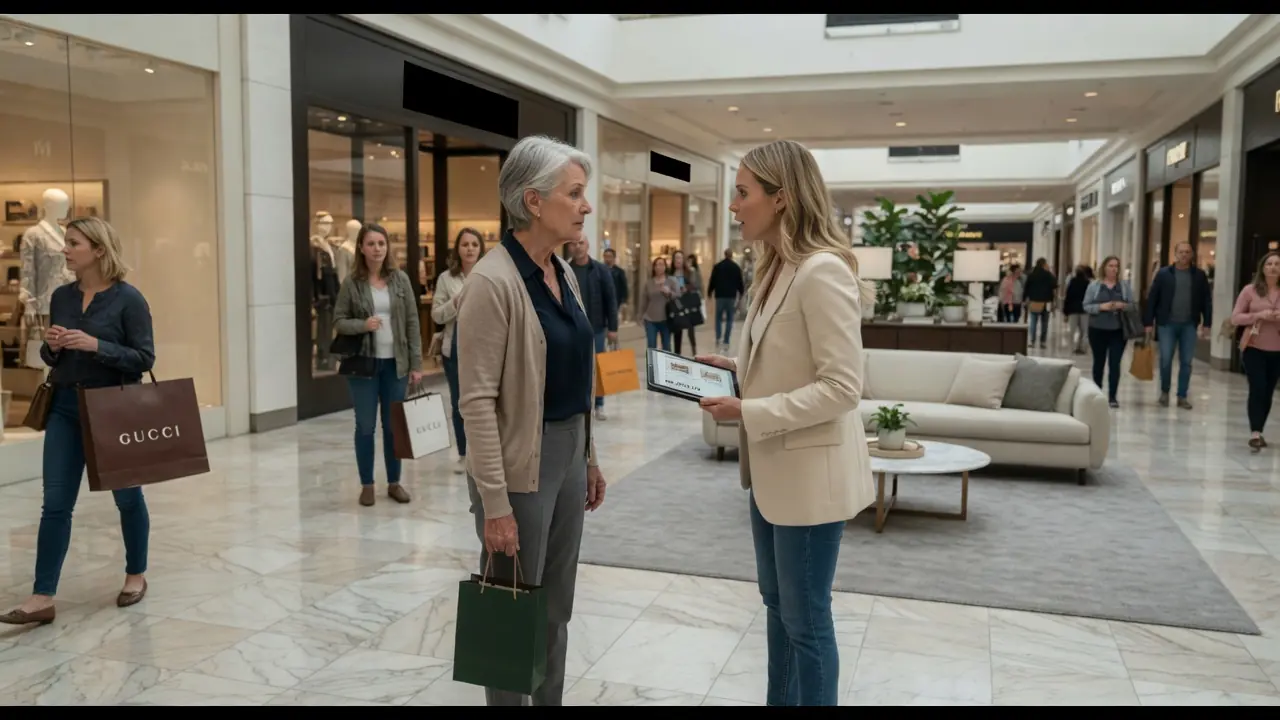
Westbridge Mall was crowded when Margaret arrived. The central atrium gleamed under high glass ceilings, with polished marble floors, shining storefronts, and shoppers carrying branded bags from stores where a scarf cost more than Margaret’s weekly groceries. A fountain bubbled near the escalators, and the scent of perfume drifted through the open walkway. Margaret wore a beige cardigan over a navy blouse, tailored pants, low leather shoes, and carried a small paper bag from the bookstore where she had stopped to buy a picture book.
Ashley was waiting near the designer furniture pop-up display, wearing a cream blazer, fitted jeans, and heels that clicked sharply on the marble. She was holding a tablet against her chest and waving with exaggerated brightness. Margaret noticed there was no lunch bag, no restaurant reservation, no warm greeting beyond the performance. She also noticed the sales associate standing nearby, alert and ready, as if Ashley had already prepared the stage.
“Mom,” Ashley said, leaning in for an air kiss. “I’m so glad you came. This is going to mean so much.”
Margaret smiled politely. “You said this was about the baby.”
“It is,” Ashley said, turning the tablet around. “The nursery.”
On the screen was a complete designer nursery set. A white oak crib with curved rails. A matching dresser. A velvet rocking chair. A handmade changing station. A gold-accented lamp shaped like a moon. Custom wallpaper printed with pale clouds. The total at the bottom of the screen was $8,417.62.
Margaret looked at the number, then back at Ashley. “This is quite a list.”
Ashley’s smile sharpened. “It’s not a list. It’s the nursery. I already picked everything out.”
“Did Kevin agree to this?”
Ashley waved one hand, annoyed by the question. “Kevin wants what makes me happy. And what makes the baby happy. Besides, this is not really his part.”
Margaret stayed still. “Then whose part is it?”
Ashley’s eyes flicked toward the sales associate, then toward the shoppers passing near the display. Her voice grew just a little louder. “Yours, Mom. I mean, obviously. A real grandmother wants to give the baby something meaningful.”
There it was. Not a request. Not a conversation. A public expectation dressed in family language. Margaret felt the old pressure rise in her chest, the familiar instinct to smooth things over before anyone stared. She almost reached for her purse, not because she wanted to pay, but because paying had become easier than being made into the villain.
But this time, something stopped her.
Maybe it was the way Ashley had positioned them in the busiest part of the mall. Maybe it was the sales associate watching with professional discomfort. Maybe it was the word real, as if Margaret’s grandmotherhood could be measured by whether she agreed to an $8,400 order chosen without her. Whatever it was, the soft part of her finally stepped aside and let the strong part speak.
“You invited me to lunch,” Margaret said quietly. “Not to buy your furniture.”
Ashley’s expression changed. Not much, but enough. The smile tightened at the corners, and her green eyes cooled. “It is not furniture. It is for your grandchild.”
“I understand that.”
“Then I don’t understand why you are making this difficult.”
Margaret glanced at the tablet again. “Because I was not asked. I was cornered.”
Ashley gave a small laugh, the kind meant for an audience. “Cornered? Mom, honestly, don’t be dramatic. This is a normal thing grandmothers do.”
A woman passing with two shopping bags slowed down. A man by the fountain looked over. The sales associate pretended to adjust a fabric sample. Margaret saw the trap fully now. Ashley had counted on embarrassment doing the work that politeness had done before.
Ashley lifted the tablet higher. “If you want to be involved, this is where you prove it.”
Margaret’s bookstore bag hung from her wrist, light and ordinary. Inside was a picture book about a rabbit looking for the moon. She thought of the small silver rattle, the quilt, the savings account she had already planned to open quietly for the baby’s future. She thought of all the real ways love could show up without being dragged through a luxury mall.
“No,” Margaret said.
Ashley blinked. “Excuse me?”
“No,” Margaret repeated. “I will not pay for this.”
The word seemed to strike Ashley harder than shouting would have. Her lips parted, then pressed together. For a second, she looked less like a confident future mother and more like a spoiled child denied a toy in front of strangers. Then she raised her voice.
“You are seriously refusing to support your own grandchild?”
Several shoppers stopped pretending not to listen.
Margaret did not move. “I am refusing to be manipulated.”
Ashley’s cheeks flushed. “That is disgusting. I cannot believe you would call me manipulative while I am trying to prepare a beautiful nursery for your grandson.”
“You chose an $8,400 nursery set without asking me,” Margaret said. “Then you brought me here in public because you thought I would be too embarrassed to say no.”
Ashley gripped the tablet tightly. “You are twisting this.”
“No,” Margaret said. “I am finally naming it.”
The sales associate cleared her throat softly. “Would you like me to hold the order while you decide?”
Ashley spun toward her. “This is a family matter.”
Margaret looked at the associate with sympathy. “There is nothing to hold.”
Ashley turned back so quickly her hair shifted over one shoulder. “Do you know how humiliating this is for me?”
Margaret almost laughed. Not because it was funny, but because the audacity was so complete. Ashley had brought her to the center of a luxury mall, demanded thousands of dollars, raised her voice, and now claimed humiliation because the answer was no. It was almost impressive, the way entitlement could trip over itself and still call itself wounded.
Then Ashley pulled out her phone. “Fine. I’m calling Kevin.”
“Of course you are,” Margaret said.
Ashley’s fingers moved quickly over the screen. “He needs to know how you are treating me.”
“He should.”
“He is going to be furious.”
Margaret folded her hands in front of her. “Then he can be furious here.”
The next fifteen minutes stretched painfully. Ashley sent message after message, pacing near the display, occasionally wiping at her eyes when she noticed someone watching. Margaret stood calmly, letting her breathe, letting her perform, letting her discover that her audience did not change the truth. The tablet stayed on the table, glowing with the unpaid order.
Kevin arrived from the escalator, slightly out of breath. He wore a gray polo and jeans, and his face carried the exhausted panic of a man summoned into a storm. His eyes moved from Ashley to Margaret, then to the furniture display. Margaret loved him, but in that moment, she needed him to choose truth without being carried to it.
“What happened?” Kevin asked.
Ashley rushed toward him. “Your mother embarrassed me in front of everyone. She refused to help with the nursery after telling us she wanted to be involved.”
Margaret noticed that Ashley’s voice trembled in all the right places.
Kevin looked at Margaret. “Mom?”
Margaret reached into her purse and took out her phone. “Before you decide what happened, I want you to read something.”
Ashley froze. “What is that?”
Margaret opened the screenshots she had saved the night before. She had not planned to use them in public, but Ashley had made the confrontation public first. The messages had come from Brenda, one of Ashley’s friends who also attended Margaret’s book club. Brenda had sent them with a short apology, saying she thought Margaret deserved to know what was being said.
Margaret handed Kevin the phone.
His face changed as he read.
Ashley had written to her friends, I’m taking Kevin’s mom to Westbridge this weekend. She’s so polite she’ll never say no in public. I’m making grandma cover the expensive nursery stuff because Kevin keeps whining about the budget. Another message said, Old people love feeling needed. You just have to make it sound emotional.
Kevin read in silence.
Ashley’s face drained of color. “That was private.”
Margaret looked at her. “So it is true.”
“It was a joke.”
Kevin looked up slowly. “You planned this?”
Ashley stepped toward him. “Kevin, don’t let her twist it. I was venting.”
“You said you were going to make Mom pay.”
“I said that because I was frustrated.”
“You said she was too polite to say no.”
Ashley’s eyes flashed. “Because she always says no when I ask normally.”
Margaret gave a small nod. “And there is the truth.”
Kevin closed his eyes briefly. When he opened them, he looked ashamed. Not only of Ashley, Margaret realized, but of himself. He had seen pieces of this pattern and chosen not to name them because naming them would require action. Today, his silence had finally run out of space.
Ashley grabbed his arm. “Say something. Tell her she cannot treat your wife like this.”
Kevin gently removed her hand. “I think Mom has been treated badly enough.”
Ashley stared at him as if he had slapped her. “You are taking her side?”
“I am taking the side of what I just read.”
Shoppers were watching openly now. A woman near the fountain whispered to her friend. The sales associate looked deeply uncomfortable, but there was also something like relief in her face. Margaret wished this had happened somewhere private, but she was done carrying shame that did not belong to her.
Ashley turned on Margaret. “You are doing this to ruin my pregnancy.”
“No,” Margaret said. “You are using your pregnancy to excuse your behavior.”
“That baby is your family.”
“Yes,” Margaret said. “And I will love that baby. I will read to him, hold him, celebrate him, and show up for him. But I will not let you turn him into an invoice.”
Kevin stared at the floor.
Ashley’s voice cracked. “So what now? You just walk away?”
Margaret picked up her bookstore bag. “Yes.”
“You cannot just leave.”
“I can,” Margaret said. “That is what adults do when a conversation becomes disrespectful.”
Ashley looked around, realizing the crowd had not become the weapon she hoped for. Nobody was glaring at Margaret. Nobody was stepping forward to shame the grandmother who refused to pay. If anything, the mood around them had shifted into quiet judgment, but it was not aimed at Margaret.
Margaret turned to Kevin. “You are welcome to visit me alone this Thursday if you would like to talk calmly.”
“Mom,” Kevin said softly. “I’m sorry.”
“I know,” she replied. “But sorry needs to become different behavior.”
Then she walked away.
The mall seemed louder once she left the atrium. Music played from stores, children laughed near the fountain, and escalators hummed steadily as if nothing important had happened. Margaret passed the bookstore where she had bought the picture book and stopped for a moment outside the window. Her reflection looked older than she felt, but also steadier.
She drove home without crying.
At home, she made tea, placed the rabbit book on the kitchen table, and sat in the quiet. Her phone buzzed three times. First Kevin. Then Ashley. Then Kevin again. Margaret did not answer immediately. She watched a pair of cardinals land near the bird feeder and let the silence remind her that she was safe.
Later that evening, she listened to Ashley’s voicemail. It was angry, tearful, and full of accusations. Ashley said Margaret had humiliated her, damaged her marriage, and caused stress that was bad for the baby. She said any decent grandmother would apologize and make it right.
Margaret deleted it.
Kevin’s message was different. He said he was sorry again. He said he had not realized how far Ashley had taken things. He said he wanted to come over Thursday if Margaret still meant it. Margaret listened twice, then sent back one sentence.
Thursday at six is fine. Come alone.
That night, Margaret opened her bank statements.
She did not do it with anger. She did it with a black pen, a notebook, and the calm focus she had once used to manage household budgets after her husband died. She went back through twelve months of expenses and wrote down every time she had paid for something Ashley had engineered. Brunches, spa treatments, groceries, baby items, household goods, clothes Ashley claimed were necessary for maternity comfort.
The total made Margaret sit back in her chair.
It was not only the money. It was the pattern. Each payment had been wrapped in family language, softened by guilt, or justified by Kevin’s helpless expression. Margaret had not been helping; she had been training them to expect her sacrifice.
The next morning, she called her bank. She removed Kevin from the emergency credit card she had kept open since his college years. She canceled the automatic payment she had quietly made for his phone line. Then she called her attorney and scheduled an appointment to review her will, medical directives, and house documents.
She was not cutting Kevin out.
She was removing confusion.
On Thursday, Kevin arrived alone with a deli bag and flowers from the grocery store. He looked nervous standing on the porch, like a boy who had broken a window. Margaret opened the door and let him in. They ate at the kitchen table, where Ashley had once sat flipping through paint samples for a room Margaret had never offered.
For a while, they talked about his job. Then the silence came.
Kevin set his sandwich down. “I should have stopped it sooner.”
“Yes,” Margaret said.
He looked up, surprised she did not soften it.
She folded her hands. “You are my son, and I love you. But loving you does not mean pretending you are helpless. You have watched Ashley pressure me for money many times, and you let me carry it because it made your life easier.”
His eyes filled with shame. “I know.”
“Do you?”
“Yes,” he said. “I didn’t want to fight with her.”
“So I was easier to disappoint.”
Kevin flinched.
Margaret did not enjoy hurting him, but she knew this conversation had to be honest or it would be useless. “I am no longer available for that role.”
He nodded slowly. “I understand.”
“I hope you do,” she said. “Because when the baby comes, I want to be a grandmother, not a wallet and not a hostage.”
Kevin wiped his face with both hands. “Ashley is furious.”
“I assumed.”
“She says you are trying to control us.”
“No,” Margaret said. “I am controlling myself. That is what she dislikes.”
Kevin almost smiled, but it faded quickly. “She wants me to ask if you’ll at least pay for half the nursery.”
Margaret looked at him for a long moment.
His face reddened. “I told her I wouldn’t ask.”
“But you just did.”
“I know,” he whispered.
Margaret stood, walked to the counter, and picked up the rabbit book. She placed it in front of him. “This is my nursery contribution for now. A book. A loving note inside. Something chosen with care.”
Kevin touched the cover gently. “It’s nice.”
“It is enough because it was freely given.”
He nodded.
After Kevin left, Margaret changed the locks.
She had not planned to do it that quickly, but the conversation confirmed what she already knew. Kevin was sorry, but he was still weak when Ashley pushed hard enough. Margaret could love him and still protect herself from the consequences of his weakness. The locksmith arrived before dusk and replaced every exterior deadbolt.
When he handed her the new keys, he asked if she needed a spare for family.
“No,” Margaret said. “Just these.”
The true test came two weeks later.
Margaret was pruning roses in the backyard when her porch camera sent a notification to her tablet. Ashley stood at the front door holding a large plastic storage bin. Her hair was pulled back, her mouth tight, and she looked around as if she expected the neighbors to witness another performance. She tried her old key.
It did not work.
She tried again, harder.
Margaret watched for a few seconds before walking to the door. She opened it with the security chain still in place. “Hello, Ashley.”
Ashley lifted the bin. “My key doesn’t work.”
“I changed the locks.”
“You changed the locks on family?”
“I changed the locks on my house.”
Ashley’s face hardened. “I brought some baby things to store in your guest room. Our townhouse is packed.”
“My guest room is not available for storage.”
“It is for your grandchild.”
Margaret looked at the bin. “No, Ashley. It is for you.”
Ashley’s eyes narrowed. “You are being unbelievably cruel.”
“I am being clear.”
“You are going to regret this when the baby comes and I decide who gets visits.”
There it was. The threat Margaret had expected. The grandchild as leverage. The baby as a key to every locked door.
Margaret felt sadness move through her, but not fear.
“That will be your choice,” she said. “And how I respond will be mine.”
Ashley stared at her, stunned that the threat had not landed. “Kevin said you wanted to be involved.”
“I do,” Margaret said. “But involvement without respect is just access. And access can be denied.”
She closed the door.
For a minute, Ashley remained on the porch. Then she turned and carried the bin back to her car. Margaret watched through the camera until the driveway was empty again. Her hands shook only after Ashley left, but even that passed quickly.
Three months went by.
Ashley did not visit. She sent occasional messages through Kevin, usually complaints dressed as updates. Kevin came by every other Thursday, always alone, and slowly, awkwardly, began learning how to speak without asking his mother to absorb the tension in his marriage. Margaret did not push him. She simply refused to be pulled back into the old pattern.
The baby was born in early spring.
A boy.
Kevin called from the hospital, crying so hard Margaret could barely understand him. His name was Oliver James Collins, seven pounds, nine ounces, healthy and loud. Margaret sat down at the kitchen table with one hand over her heart. For all the pain Ashley had caused, the baby was innocent, and Margaret loved him instantly.
Ashley did not invite Margaret to the hospital.
Margaret expected that. She mailed flowers anyway, not expensive ones, just a cheerful arrangement with a small card welcoming Oliver to the world. Then she waited. Three days later, Kevin called and asked if she would come by the house to meet him.
“Will Ashley be comfortable with that?” Margaret asked.
There was a long pause. “She said you can come for thirty minutes.”
Margaret almost laughed at the formality of it. Thirty minutes to meet her first grandchild. Thirty minutes granted like a favor. But she agreed, because Oliver was not responsible for his mother’s pride.
When she arrived, Ashley sat on the sofa holding the baby, pale and tired but still watchful. For the first time, Margaret saw a crack in her polished surface that was not performance. Motherhood had humbled her, at least physically. Her hair was unwashed, her robe was loose, and burp cloths were scattered across the coffee table.
Kevin took Oliver gently and placed him in Margaret’s arms.
Everything else faded.
Oliver was warm, tiny, and perfect, with a wrinkled face and a fierce little fist pressed against his cheek. Margaret looked down at him and felt her eyes fill. “Hello, sweetheart,” she whispered. “I’m your Grandma Margaret.”
Ashley watched from the sofa. “The nursery still isn’t finished.”
Kevin closed his eyes.
Margaret did not look away from Oliver. “He does not seem to mind.”
Ashley said nothing.
That was the first visit. It was tense, short, and beautiful because of Oliver. Margaret left after exactly thirty minutes, kissed the baby’s forehead, thanked Ashley for letting her come, and drove home with tears on her cheeks. She cried for joy, but also for the family that could have been easier if respect had come naturally.
Over time, something shifted.
Not quickly. Not dramatically. Ashley did not become warm overnight, and Margaret did not pretend the past had vanished. But motherhood exhausted Ashley in ways entitlement never had. She began to realize that babies did not care about designer wallpaper. Oliver spit up on expensive blankets and slept best in plain cotton ones. He preferred Margaret’s soft humming to the white-noise machine Ashley had insisted was essential.
One afternoon, when Oliver was four months old, Ashley called Margaret directly.
Margaret almost did not answer.
“Hello, Ashley.”
There was a pause. Then Ashley said, “I need help.”
Margaret waited.
“I’m tired,” Ashley admitted. “Kevin is working late, and Oliver has been crying all day. I don’t need money. I just need someone who knows what they’re doing.”
It was the first honest request Ashley had ever made.
Margaret went.
She did not bring gifts. She did not bring a check. She brought soup, clean hands, and patience. She rocked Oliver while Ashley showered. She folded a basket of baby clothes without comment. When Ashley came back downstairs looking smaller and more human than usual, Margaret handed her a bowl of soup.
Ashley sat at the table and began to cry.
“I was awful to you,” Ashley said.
Margaret continued rocking Oliver. “Yes.”
Ashley gave a broken laugh through her tears. “You don’t soften anything, do you?”
“I did for a long time,” Margaret said. “It did not help either of us.”
Ashley wiped her face. “I thought if everything looked perfect, people would think I was a good mother.”
“People who matter will know by how loved your child is.”
Ashley looked at Oliver. “I don’t know how to do this.”
“No one does at first.”
“I’m sorry,” Ashley said, and this time the words did not sound strategic. “About the mall. About the money. About using the baby.”
Margaret looked at her carefully. “An apology matters if behavior changes.”
Ashley nodded. “I know.”
It was not a fairy-tale repair. Those rarely happen in real families. Trust returned slowly, in small pieces. Ashley stopped asking for money. Kevin moved his finances fully into his own household. Margaret babysat once a week, not because she was pressured, but because she chose it.
The nursery was eventually finished, though not with the $8,400 set. Kevin painted the walls himself. Ashley found a secondhand dresser and refinished it. Margaret gave Oliver a small bookshelf and filled it with stories, including the rabbit book she had bought on the day everything changed.
One evening, nearly a year after the mall confrontation, Margaret sat in her living room with Oliver asleep against her shoulder. Kevin and Ashley were in the kitchen cleaning up after dinner. She could hear them talking quietly, not perfectly, not without tension, but like two adults learning to carry their own life.
Ashley came into the living room and paused. “He loves sleeping on you.”
Margaret smiled. “Babies know where it is peaceful.”
Ashley nodded, accepting the lesson without argument.
That was enough.
Margaret looked around her home, the home she had protected, the peace she had refused to surrender, and the family that had survived because she finally stopped paying the price of everyone else’s comfort. She had not won by humiliating Ashley. She had won by holding a boundary until the people around her learned that love could not be demanded like a purchase.
The mall had taught Ashley that Margaret’s kindness had limits.
But Oliver taught them all something better.
Limits did not destroy family.
Sometimes they were the only thing strong enough to save it.