The morning Brittany slid the printed schedule across the kitchen table, I knew something inside me had finally broken. It was not the first list she had ever given me, and it was not the first time she treated my time like something she owned. But this one was different because it had every hour of my week written down in neat little blocks, as if I were not a grandmother, not a widow, not a retired woman with a life of my own, but household staff waiting for instructions. School pickups, soccer practice, dinner prep, laundry, vacuuming, kitchen cleaning, overnight babysitting, and even “Saturday meal organization” were printed in bold.
My name is Paula Stevens, and I was sixty-eight years old when I finally understood that love can be used against you if you never learn to say no. I had been married to Richard for forty-two years before I lost him, and after he was gone, loneliness became the quietest and heaviest thing in my house. My son Ethan lived twenty-five minutes away with his wife Brittany and their two children, Lily and Noah. In the beginning, helping them felt like a blessing because it gave my days shape and gave my heart somewhere to put all the love grief had left behind.
At first, Brittany thanked me for everything. She called me a lifesaver when I picked Lily up from school, hugged me when I brought soup over, and told her friends I was the kind of grandmother every family needed. Ethan used to kiss my cheek and say, “Mom, I don’t know what we would do without you.” Back then, I heard appreciation in those words. Later, I learned they also meant dependence.
The change did not happen all at once. It happened the way paint fades on a sunny wall, slowly enough that you do not notice until the original color is gone. A favor became a routine, a routine became an expectation, and an expectation became an obligation. By the time I realized what was happening, Brittany no longer asked if I was free; she simply told me when to arrive.
That Saturday morning, I sat at their polished kitchen table with a cup of tea cooling between my hands. White cabinets shone under the clean morning light, Lily and Noah’s backpacks leaned near the door, and a wall calendar covered with color-coded activities hung beside the refrigerator. Brittany stood over me in her beige blouse and black trousers, her blonde hair tucked neatly behind one ear, her nails tapping the paper as if she were training an employee. Ethan sat beside her with his coffee and phone, nodding along like this was all normal.
“This should make things easier for everyone,” Brittany said. Then she pointed to the first line. “Monday pickup, Tuesday soccer, Wednesday dinner, Friday overnight, Saturday laundry and meal help.” She tapped each item harder than necessary. “I wrote everything down so there’s no confusion.”
I looked from the schedule to my son. “You planned my whole week before asking if I had one of my own?” My voice came out softer than I expected, but the hurt was there. Ethan avoided my eyes and stirred his coffee though there was nothing left to stir. Brittany gave a small laugh, the kind people use when they want your pain to sound unreasonable.
“Paula, you’re retired,” she said. “It’s not like we’re taking you away from a demanding career.” Then she pushed a laundry basket closer to my feet with one heel. “Honestly, you should be grateful you still feel useful at your age.” The words were spoken lightly, but they landed like stones.
Ethan should have stopped her. He should have looked at his wife and said that no one spoke to his mother that way. Instead, he cleared his throat and said, “Mom, Brittany didn’t mean it harshly. We just figured you’d want to help. You’re happier when you have something to do.” That was the moment that hurt more than the schedule.
I had spent years convincing myself that Brittany was simply overwhelmed and Ethan was simply tired. Parents of young children were busy, I told myself. Careers were demanding, daycare was expensive, schedules were complicated. But sitting there while my son used my loneliness as a reason to assign me work, I saw the truth clearly for the first time.
They did not think they were asking too much because they no longer thought of it as asking. My time had become part of their household system. My gas, my energy, my aching knees, my canceled lunches, my missed church meetings, my unopened books, my quiet evenings, all of it had been absorbed into their lives without acknowledgment. I was not a guest in their family anymore; I was the emergency plan, the driver, the cook, the cleaner, and the person everyone assumed would say yes.
Brittany picked up the second page and slid it toward me. “I also wrote some meal notes because Noah is being picky lately, and Lily needs more protein before dance. There’s a chicken thawing, but you’ll need to prep vegetables. And please don’t forget to clean the counter after the kids do homework; markers got everywhere last time.” She said all this while checking her watch, as if I was already behind.
I stared at the pages. They were printed cleanly, organized perfectly, and completely humiliating. There were little notes beside each task, like “wipe baseboards if time,” “fold Ethan’s shirts separately,” and “make sure Paula remembers cleats.” My name appeared twice, not as family, but as an instruction.
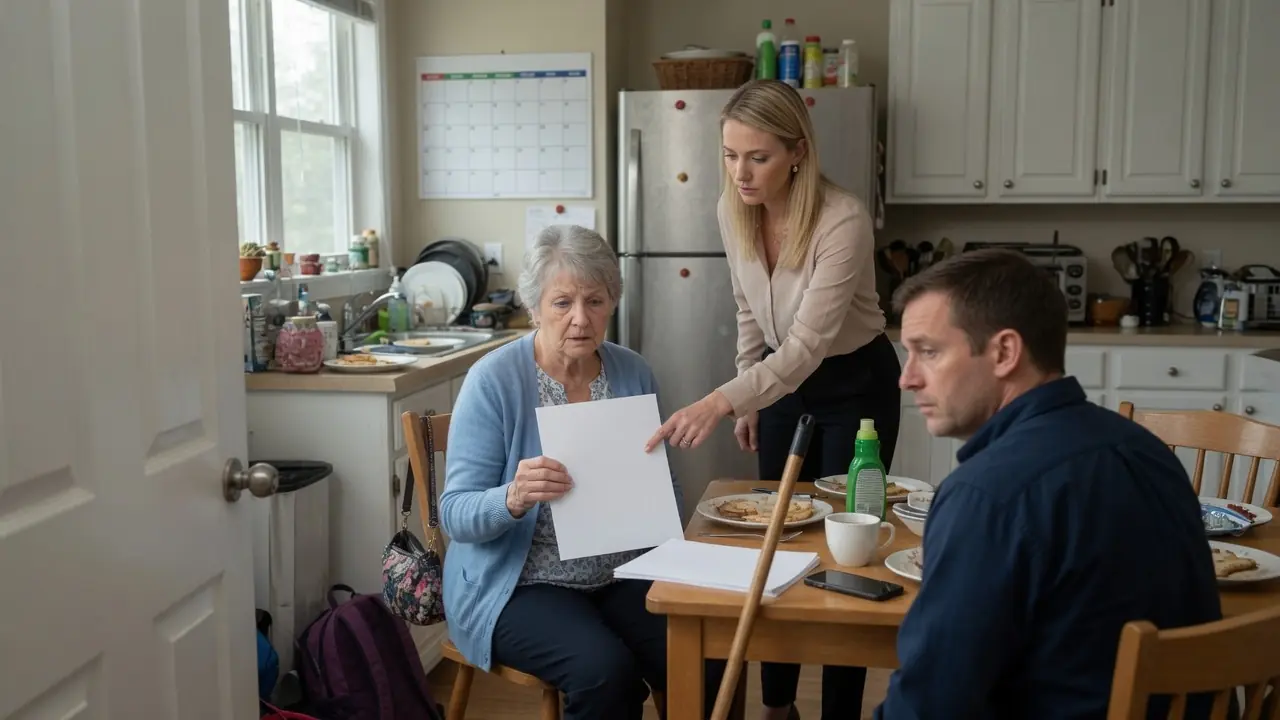
“Brittany,” I said carefully, “I came here to spend time with my grandchildren, not to become your housekeeper.” Her mouth tightened immediately. “Nobody is calling you a housekeeper,” she said, though the laundry basket was still touching my shoe. “But if you’re already here, it makes sense for you to help. We all need to contribute.”
I almost laughed. I had contributed for years. I had picked up Lily from school more times than I could count, taken Noah to soccer, paid for tutoring, covered summer activities, bought groceries, stayed overnight when one of them was sick, and cooked Saturday dinners because Brittany said weekends exhausted her. I had contributed so much that my own life had become the one thing nobody bothered to schedule.
Ethan stood then, slipping his phone into his pocket. “Mom, we’ve got to go,” he said. “Can we not make this a thing?” That sentence stayed with me. Not “Are you okay?” Not “Maybe this is too much.” Just don’t make this a thing.
They left the kitchen in a rush of keys, perfume, coffee, and excuses. Brittany called over her shoulder that the laundry should be separated by color and that the kids’ bedding needed changing. Ethan said, “Love you, Mom,” the way people say goodbye to a machine they expect to still be running when they return. The door closed, and I sat alone with the printed schedule in front of me.
I did the work that day. I am not proud of that, but it is the truth. I folded laundry, loaded dishes, wiped counters, packed snacks, drove to soccer, cooked dinner, cleaned the kitchen again, and smiled when Lily and Noah hugged me because none of this was their fault. Children should not have to carry the consequences of adult entitlement.
By the time I drove home, my back hurt and my hands smelled like dish soap. I sat in my driveway for several minutes, unable to move. The house Richard and I had shared was dark except for the small porch light I always left on for myself. For the first time, it did not look lonely to me; it looked like shelter.
Inside, I took off my shoes and stood in the living room. Richard’s photograph sat on the bookshelf, his smile frozen in a summer from years ago when we still believed we had all the time in the world. I picked up the frame and whispered, “What have I let happen?” The silence did not answer, but my own heart did.
A few days later, I heard the conversation that made pretending impossible. It was a rainy Wednesday afternoon, and I had picked Lily up from school after Brittany texted that she was stuck in a meeting. I let myself into the house through the garage, just like always, and sent Lily upstairs to change. As I placed her backpack on the kitchen chair, I heard Brittany’s voice from the family room.
“I don’t know how people survive without family nearby,” Brittany said. Another woman laughed and said, “You mean without Paula nearby?” I froze. I recognized the other voice as Brittany’s friend Melissa, a woman who always wore expensive perfume and spoke to me as if I were part of the furniture.
Brittany laughed too. “Seriously, daycare would cost us a fortune.” Melissa asked, “At least you pay her something, right?” The room exploded with laughter. I stood beside the kitchen counter, one hand still on Lily’s backpack, feeling heat crawl up my neck.
“Pay her?” Brittany said. “Why would I pay her? She’s retired.” Melissa said quietly, “Still, she watches the kids constantly.” Brittany lowered her voice, but not enough. “Paula loves feeling needed. All I have to do is ask.”
Then came the sentence that changed everything. “Why pay for daycare when Ethan’s mom does everything for free?” They laughed again, and the sound seemed to go through the walls and settle in my bones. Every pickup, every dinner, every canceled plan, every tired drive home had just been reduced to a clever way to save money.
Melissa asked, “Doesn’t she have her own life?” Brittany snorted. “What life?” Those two words nearly knocked the breath out of me. What life? As if mine had ended when Richard died, as if retirement had erased my personhood, as if being a grandmother meant I no longer deserved time, rest, joy, or privacy.
Then Brittany added, “Besides, Ethan says she doesn’t really have much going on.” That was the part that broke me. Brittany’s cruelty hurt, but Ethan’s agreement shattered something deeper. My own son, the boy I had raised, the man who knew my grief better than anyone, apparently believed I had nothing better to do than orbit his family until they needed me.
I slipped back into the garage without making a sound and sat in my car while rain tapped against the windshield. I did not cry right away. The pain was too large for tears at first. I just sat there, gripping the steering wheel, replaying every word until the truth became impossible to soften.
That night, after I returned home, I opened Richard’s wooden memory box. Inside were photographs, old letters, anniversary cards, ticket stubs, and small pieces of a life that had once felt full and steady. I found an envelope with my name written in his handwriting. I had forgotten about it, though I remembered him telling me once that he had written letters for “when I needed him and he wasn’t there.”
The letter was mostly love, memories, and Richard’s gentle humor. But near the end, one paragraph stopped me cold. He had written, “Promise me something, Paula. If I go first, do not spend the rest of your life disappearing inside other people’s needs. You have spent decades taking care of everyone. Leave room to take care of yourself too.”
I read those words until they blurred. Richard had known me. He had known how easily I gave pieces of myself away and called it love. He had known that if he left first, I might try to survive by becoming useful to others until there was nothing left of me.
That night, I asked myself a question I had avoided for years. What did I want? Not what Ethan needed, not what Brittany demanded, not what Lily and Noah expected, but what I wanted. The answer came quietly, then grew stronger.
I wanted freedom. I wanted peace. I wanted to wake up without waiting for my phone to ring. I wanted one stretch of time that belonged entirely to me.
Savannah appeared on my laptop screen almost by accident. Richard and I had once planned to go there together, to walk beneath the oak trees draped with Spanish moss and sit by the river eating seafood. We had said “one day” for years. Then illness came, and one day never arrived.
My finger hovered over the confirmation button for a long time. I felt ridiculous, guilty, excited, terrified, and alive all at once. Then I clicked. Five days in Savannah, Georgia, leaving in less than two weeks.
The next morning, I woke up with guilt already waiting for me. It whispered that I was selfish, that Brittany would be angry, that Ethan would be disappointed, that Lily and Noah would miss me. Then I remembered Brittany laughing in the family room. Why pay for daycare when Ethan’s mom does everything for free?
That memory stiffened my spine. I did not cancel the flight. I bought a new suitcase, packed walking shoes, a sun hat, a light sweater, and Richard’s letter. For once, I did not arrange backup childcare, did not send a list of alternatives, did not solve the problem before they even knew they had one.
A week before my departure, Brittany sent a group text with next month’s schedule attached. She had filled in my days without asking again. The dates overlapped with Savannah, and when I noticed that, I laughed out loud. It was not a happy laugh, exactly, but it was the laugh of a woman who had finally seen the absurdity clearly.
The morning I left, I made coffee before sunrise and sat at my kitchen table in silence. No one needed me yet. No one had texted yet. No one had turned my day into an errand sheet. I touched Richard’s letter in my purse and whispered, “I’m going.”
Savannah welcomed me with soft air, old brick, river light, and the strange beauty of not being responsible for anyone else’s schedule. I checked into a small hotel overlooking the water, unpacked slowly, and walked along River Street without watching the clock. That first evening, I sat outside a restaurant as the sun set over the river and felt something loosen inside me. I had forgotten that peace could feel almost like grief when you had lived without it for too long.
Then Ethan called. I stared at the screen, knowing the conversation would come sooner or later. When I answered, he did not ask how I was. He said, “Mom, where are you?” I looked out at the river and said, “Savannah.”
Silence. Then, “Georgia?” “Yes.” Another silence, sharper this time. “Why didn’t you tell us?” I took a sip of water. “Because I wanted a vacation.”
“You just left?” he said, as if I had abandoned a post. “Yes.” His voice tightened. “What about the kids?” There it was. Not are you safe, not are you happy, not I hope you enjoy yourself. What about the kids?
“That is something you and Brittany will have to figure out,” I said. The words felt strange in my mouth, but good. Strong. Mine.
Brittany called next, then texted. Where are you? What are we supposed to do? You can’t just disappear. This is incredibly selfish. I read the messages while the river moved calmly in front of me. After years of free childcare, one vacation made me selfish.
That told me everything. I put my phone away and ordered dessert. For the first time in years, I did not let someone else’s emergency become my assignment.
The next few days were not easy, but they were necessary. I woke up to missed calls, guilt-laced messages, and accusations that I had put them in an impossible position. I walked through Forsyth Park anyway. I sat under oak trees, wrote in a notebook, drank coffee while street musicians played, and met a widow named Carol who understood almost everything before I finished explaining it.
Carol was from North Carolina, silver-haired, sharp-eyed, and kind in the way only women who have rebuilt themselves can be. When I told her I had come to Savannah because I needed to remember who I was, she nodded like that was the most natural reason in the world. “Family?” she asked. I laughed softly and said, “How did you know?”
“Because women like us are always told our love should have no edges,” she said. “Then one day we wake up and realize we have disappeared.” Her words stayed with me. I had not come to Savannah to punish anyone. I had come because I was tired of vanishing.
On my fourth day, Brittany made the mistake of taking the conflict public. She posted a picture of Lily and Noah on Facebook with a long message about grandparents who only show up when convenient. She wrote that family should come first and that her children had been abandoned by someone they trusted. She expected sympathy.
For a moment, she got it. A few of her friends commented with outrage and hearts. Then people who actually knew me started responding. A neighbor wrote that I had picked up those children more times than she could count. A soccer parent wrote that I had been at every practice and game. A woman from church wrote, “Grandparents are helpers, not employees.”
The comments multiplied. Women shared stories of being treated like unpaid childcare. Others asked why the parents could not arrange daycare like everyone else. Someone wrote, “Older women deserve lives too,” and I stared at that sentence until my eyes filled with tears. Yes, we did.
Ethan called that evening sounding exhausted. “Mom, have you seen the post?” he asked. “Yes.” He sighed. “People are saying things about us.” I answered quietly, “No, Ethan. They are saying things about how you have treated me.”
For once, he did not argue. That was the first crack in the wall between us. The second came when Brittany tried to use my saved banking information to pay for emergency childcare. My bank declined the charge and sent me an alert while I was sitting in a cafe near the river.
At first, I thought it had to be a mistake. Then the representative confirmed that the attempt had come through an old payment profile connected to Ethan’s household. It was not fraud in the dramatic sense. It was worse in a quieter way: the same old assumption that my money, like my time, was available if they needed it.
I removed every authorization immediately. Then I began reviewing years of transactions. Tutoring, summer camps, home repairs, school supplies, small emergencies, utility help, car repairs, and countless “temporary” supports that had never been acknowledged again. None of the amounts were huge alone, but together they formed a painful map of how invisible my help had become.
When Ethan flew to Savannah three days later, he arrived looking older than I remembered. We met at a cafe near the river, and for a moment all I saw was my little boy, tired and confused. Then I remembered the schedule, the silence, the way he had let Brittany turn my love into labor. Love did not erase accountability.
I opened my notebook and showed him the payments. At first, he looked confused. Then concerned. Then stunned. “Mom,” he whispered, turning page after page, “I didn’t know.”
I believed him, and that made the pain more complicated. He had not known about all the money, but he had known about the babysitting. He had watched me cancel plans, spend long days at his house, accept chore lists, and drive home exhausted. Ignorance was not innocence.
“I stopped feeling like your mother,” I told him. His eyes filled instantly. “I stopped feeling like family.” The cafe noise continued around us, but our table went still. “When was the last time you called just to ask how I was?”
He looked down. He had no answer. I asked when he last invited me somewhere without needing childcare, when he last asked what I wanted, when he last noticed I was tired. Each question landed, and for the first time, shame crossed his face instead of defensiveness.
“I failed you,” he said quietly. I wanted to comfort him out of habit, but I did not. His discomfort was not mine to fix. That was one of the first new lessons Savannah gave me.
Brittany arrived two days later, furious and worried about her reputation more than anything else. She accused me of making people hate her, said the Facebook post had gotten out of control, and insisted everyone misunderstood her. Ethan asked if she had known about the financial help. Panic flashed across her face before she could hide it.
The truth came out in pieces. She had accepted the money, sometimes requested it, sometimes shifted it to places Ethan did not know about. She had exaggerated emergencies, used my sympathy, and treated my support like a private cushion. When I said she wanted free labor instead of a grandmother, she exploded.
“You act like you’re some kind of victim,” she snapped in the restaurant. “You abandoned your family.” I stayed calm. Then she made her biggest mistake. “If you had just sold your house and moved closer, none of this would have happened.”
Ethan looked up sharply. “What do you mean, sell her house?” Brittany froze. Too late. The words had revealed what I had only suspected: all those comments about downsizing, moving closer, and making life easier had not been concern. They had been control disguised as family planning.
I placed another folder on the table. Before leaving Ohio, I had updated my estate plan. My house, savings, and investments were now protected in a trust for Lily and Noah when they reached adulthood. Ethan would not control it. Brittany would not touch it.
Brittany’s face went pale. “You changed everything?” “Yes,” I said. Her panic told me all I needed to know. If her concern had truly been the children, she would have been relieved. The only thing she had lost was control.
Ethan apologized again, this time without excuses. “I should have protected you,” he said. That sentence finally broke something open in me, and tears slipped down my face. It did not fix everything, but it was the first honest beginning we had had in years.
When I returned home, I did not return to my old life. I returned with boundaries. No more printed schedules. No more automatic yes. No more financial help without transparency. No more being treated like an obligation instead of a person.
Brittany tested me the first week. She called cheerfully and asked if I could take the kids for the entire weekend. I said, “I already have plans.” The silence on the other end was long and confused, but the world did not end. She said okay, and I survived saying no.
My relationship with Lily and Noah became better, not worse. When I saw them, I was not exhausted from being overused. I took them for ice cream, baked cookies, walked in the park, and listened to their stories without resentment sitting in my chest. I became their grandmother again instead of their unpaid employee.
Three months later, I sold my house. Not because Brittany wanted me to, not because Ethan needed me closer, but because I chose it. The house had been a beautiful chapter with Richard, but it was not my whole story. I bought a smaller condo near a lake, with walking trails, a community center, and a balcony where morning light reached my coffee.
Ethan and I are still healing. Slowly. Some wounds do not close just because someone says sorry. But he calls now without asking for anything, and sometimes that alone feels like a small miracle.
As for Brittany, our relationship is polite and cautious. I do not hate her, but I no longer trust her with my time, my money, or my guilt. She knows where the boundaries are now, and so do I. That clarity is a kind of peace.
The day Brittany handed me that babysitting-and-chore schedule, she thought she was organizing my usefulness. She did not realize she was showing me exactly how invisible I had become. She thought retirement meant I had nothing better to do. She thought being needed would be enough to keep me obedient.
But I booked a flight to Savannah, packed Richard’s letter, and disappeared from the life they had built on my silence. I did not leave because I stopped loving my family. I left because I finally understood that loving them did not require abandoning myself.
At sixty-eight years old, I learned that boundaries are not cruelty. They are the doors we build so love does not become a prison. And the day I disappeared was not the day I walked away from my family.
It was the day I came back to myself.