Irene Whitaker knew the phone had not fallen by accident the moment Lauren held it out to her. The iPhone 17 dangled between her daughter-in-law’s fingers like a piece of broken trash, its screen shattered into a glittering web of cracks, the metal edge bent at one corner where it had clearly struck something hard. Lauren’s mouth wore the flattest little smile, the kind people use when they want cruelty to look casual. Behind her, Ryan stood near the kitchen doorway with his eyes lowered, pretending the floor tiles had suddenly become the most important thing in the house.
“Sorry, Irene,” Lauren said, her voice light and empty. “Looks like your iPhone is completely smashed.” The kitchen was clean, bright, and still, with a mug of tea cooling on the table and desert sunlight pressing against the Phoenix windows. Just ten minutes earlier, Irene had calmly refused to lend Lauren ten thousand dollars for yet another business idea. Now the broken phone sat in Lauren’s hand like punishment for daring to say no.
Irene was sixty years old, a widow of five years, and the house around them had been bought with decades of work she and her late husband, Martin, had put into every payment. She had shared it because Ryan was her son, because grief had made the rooms too quiet, and because she had believed helping family meant giving them a safe place to stand. But Lauren had slowly turned safety into entitlement, acting less like a grateful guest and more like a woman waiting for Irene to disappear from her own life. The smashed phone did not start the war; it only showed Irene that the war had already been happening.
Ryan finally lifted his head enough to mutter, “Lauren, you shouldn’t have done that.” It was weak, barely more than a sound, and Irene almost pitied him for how small he looked beside his wife’s arrogance. Lauren rolled her eyes and shrugged as if the whole thing were silly. “It slipped,” she said, though no one had asked.
Irene held out her hand. Lauren placed the ruined phone into it with theatrical care, as if handing over a napkin. Irene felt the jagged glass under her fingers and understood that her peace had cracked the same way, all at once but from pressure that had been building for years. She did not yell, did not cry, and did not ask for the truth. She simply looked at Lauren, then Ryan, then turned and walked down the hall to her bedroom.
Lauren mistook the silence for surrender. Irene could hear her in the kitchen moments later, opening cabinets, making coffee, and laughing under her breath as if she had won some private contest. Ryan said something too quiet to catch, and Lauren answered sharply enough to make him fall silent again. Irene closed her bedroom door and sat at her old laptop, the one Lauren had once mocked for being slow.
The house felt different that night, as if every room were waiting for Irene to remember who owned it. She placed the ruined phone beside the keyboard and logged into her cell carrier account. Three phone lines appeared under her name: hers, Ryan’s, and Lauren’s. For thirty-eight months, she had paid their bills without complaint, a favor that had quietly become an expectation.
Next came the streaming services, the shopping accounts, the shared passwords, the cloud storage, the delivery memberships, and every little subscription Lauren had used without once asking who paid for it. Irene changed passwords to long strings of numbers and symbols, logged every device out, and removed saved payment methods. From the living room, she heard Lauren laugh at something on the television. Irene imagined the screen freezing before the next episode and felt no guilt at all.
Then she opened the bank portal. Years earlier, she had given Ryan limited access to help in emergencies, and for a long time she believed that was reasonable. But emergencies had become excuses, and excuses had become access. Irene revoked every permission, printed the confirmation, and slid it into the same folder.
By midnight, the folder had grown thick. Cell service, account passwords, bank access, insurance details, car registration, pantry receipts, utility bills, and proof that Ryan and Lauren had lived under her roof for three years without meaningfully contributing. Irene had always been organized, but she had never organized her own boundaries so clearly before. Each page felt less like paperwork and more like a brick being placed back into the wall of her life.
She slept better that night than she expected. In the morning, Lauren came into the kitchen in a robe, hair messy, face already irritated. She grabbed her phone and frowned. Then she held it higher, walked toward the window, turned it off, turned it on, and shook it like the signal might fall out.
“My internet isn’t working,” Lauren snapped. Ryan came in a minute later looking pale. “Mom, did you mess with the router? I can’t log into anything.” Irene sat at the table, sipping tea from her favorite mug. The quiet inside her felt almost luxurious.
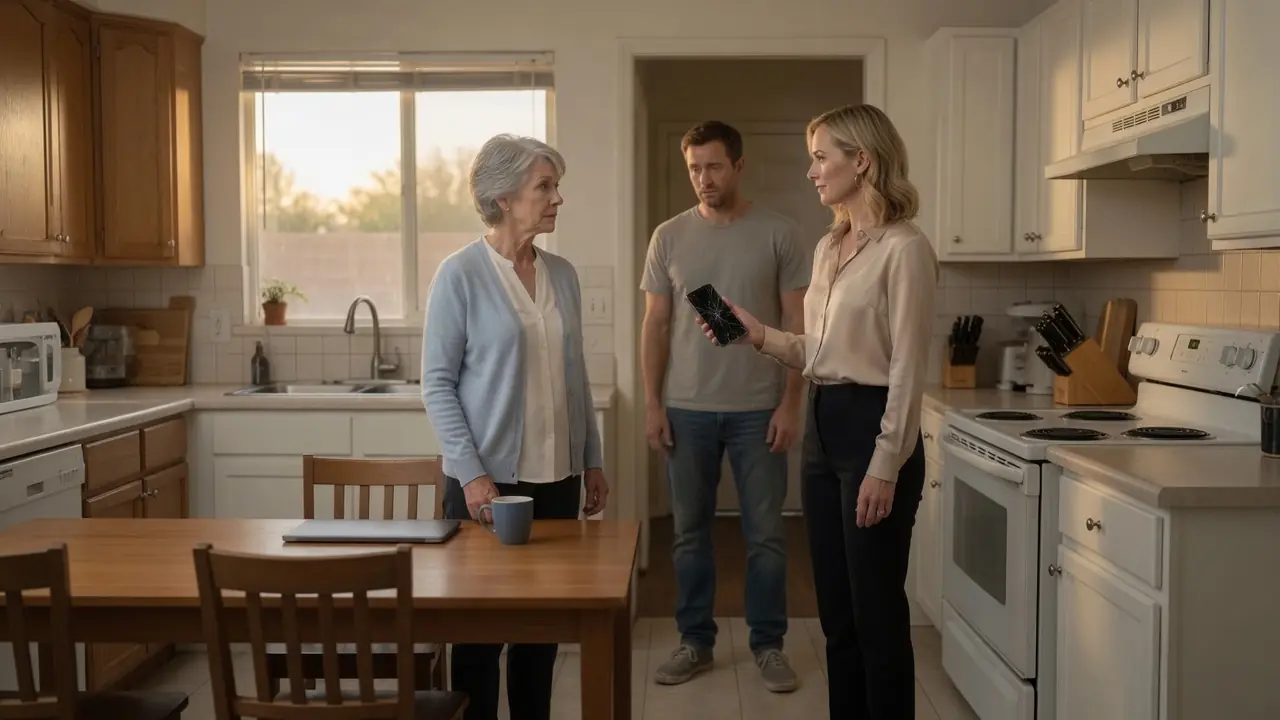
“I cleaned up the accounts,” Irene said. “After my phone was destroyed, I had to rethink my contracts.” Lauren stared at her, blinking as if the words were in another language. Ryan’s mouth opened slightly. Irene set down her mug and looked directly at both of them. “I can’t keep covering your phone bills, streaming accounts, shopping memberships, and subscriptions anymore.”
The silence that followed was sharp enough to hear. Lauren’s face flushed red. “You can’t be serious. I have important calls today.” Irene folded her hands neatly in front of her. “Then you should get your own plan today.”
Ryan looked wounded, as though Irene had betrayed him by refusing to be used. “Mom, we’re family.” Irene nodded. “Exactly. Family should treat each other with respect.” She looked at the broken phone on the counter, now sealed in a clear plastic bag. “Smashing someone’s property after being refused money is not family behavior.”
Lauren’s eyes narrowed. “It was an accident.” Irene stood and carried her cup to the sink. “Then this is a financial adjustment.” Lauren tried to laugh, but the sound came out wrong. For the first time in years, she had run into a wall that did not apologize for standing.
The rest of that morning, Irene moved through the house with quiet purpose. She went into the garage and took the spare car key Ryan had been using as if the vehicle belonged to him. She placed it in her small bedroom safe with her passport, deeds, and insurance papers. The car was in her name, the insurance was in her name, and the repairs always came from her account.
Around eleven, Ryan appeared with his jacket on. “Mom, I need to run to the hardware store real quick.” Irene was sorting mail at the kitchen table. “I need the car today,” she said without looking up. “And from now on, nobody drives it unless I approve it first.”
Ryan looked stunned. “I’ve been using it for years.” Irene finally looked at him. “You have been allowed to use it for years. That is not the same thing.” He glanced toward the stairs, already dreading Lauren’s reaction more than his mother’s disappointment. Irene saw that too and said nothing.
By early afternoon, Lauren came downstairs dressed for battle. Her hair was smooth, her makeup perfect, and her anger sharpened into a performance. “We need to talk,” she said. “This isn’t okay. You can’t just cut us off like that. We live here too.”
Irene walked to the refrigerator and taped up a printed sheet. It listed the monthly cost of utilities, internet, groceries, phone bills, insurance, and household supplies. Beside each category, she had written a fair contribution amount for two adults living under her roof. Lauren read it once, then again, her face tightening with each line.
“Starting next month,” Irene said, “I expect rent and utility contributions.” Lauren laughed in disbelief. “Rent? From us?” Irene nodded. “Yes. Or I can rent the guest room to someone who pays.” She glanced toward the hallway. “The room you turned into your office used to be my sewing room. I will be taking it back.”
Ryan whispered, “Mom, that’s too much.” Irene turned to him with a calm that made him look away. “Too much was paying for two healthy adults for three years while being treated like a wallet with a pulse.” Lauren’s mouth fell open. For once, she had no immediate comeback.
That evening, they changed tactics. Anger had failed, so they tried concern. Ryan sat beside Irene in the living room, leaning forward with his elbows on his knees. Lauren stayed in the kitchen pretending to wipe an already clean counter while listening to every word.
“Mom,” Ryan began, “Lauren is really upset. The phone thing was dumb, but she’s been under a lot of stress.” Irene looked at her son and saw the boy she had raised beneath the man he had become. That was the hardest part. She still loved him, even while refusing to rescue him from the consequences of letting his wife turn cruel.
“Stress does not smash a phone,” Irene said. “A person does.” Ryan rubbed his face. “You’re blowing this out of proportion.” Irene leaned back, the lamp soft beside her chair. “No. I am finally putting the proportions back where they belong.”
Lauren entered with red eyes and a small trembling apology. “Irene, I’m sorry. I was desperate. I just need the internet for applications and calls.” Her voice was soft, almost convincing. Irene had caved to that voice before because it seemed easier than conflict.
“You can use the public library,” Irene said. “They have free Wi-Fi.” Lauren’s expression flickered for half a second, and the rage underneath showed itself like a snake beneath a rock. Then the regretful mask returned, but it was too late. Irene had seen enough.
The next morning, Irene woke before sunrise and began clearing the upstairs office. Lauren had filled the room with a large white desk, folders for business ideas that never survived a month, vision boards, packaging samples, and boxes of unused supplies bought with other people’s money. Irene did not throw anything away. She packed it neatly into labeled boxes and carried them to the hallway.
When Lauren discovered her, she nearly screamed. “What are you doing? Those are my documents. This is my office.” Irene kept taping a box. “This is my room.” Ryan ran upstairs at the noise, hair damp from the shower. “Mom, come on. You can’t just take her workspace.”
“I can,” Irene said. “And I am.” She lifted the box and walked past them. “If you need a workspace, find one you pay for.” Lauren’s face went pale with fury. “You’re so selfish. All because of one stupid phone.”
Irene stopped at the top of the stairs. “No, Lauren. The phone was the receipt.” She turned enough to meet her daughter-in-law’s eyes. “The purchase was three years of disrespect.” Then she carried the box downstairs.
By lunchtime, the office was empty. Irene vacuumed the carpet, opened the blinds, and brought in her old sewing machine from the closet where Lauren had shoved it years earlier. She set it by the window and touched the machine with both hands, remembering evenings when she used to sew curtains, pillow covers, and baby blankets before grief and houseguests swallowed her hobbies. The room felt like sunlight returning to a place that had forgotten it.
Lauren and Ryan retreated to their bedroom for most of the afternoon. Irene heard low arguments, drawers opening, a suitcase zipper, then silence. She made herself soup for dinner and ate at the kitchen table with a book propped beside her bowl. For the first time in years, the house felt tense but honest.
The next conflict came over food. Ryan tried to use the joint credit card at the grocery store and came home empty-handed. Irene was trimming roses in the backyard when he found her. “The card got declined,” he said, more accusing than worried.
“I canceled it,” Irene replied. “It was tied to my account.” Ryan stared. “We don’t have bread, meat, anything.” Irene wiped her pruning shears with a cloth. “Then you need to buy groceries with your own money.” He looked genuinely shocked. That hurt Irene, but it also strengthened her.
“You’re going to let us starve?” he asked. Irene’s face hardened. “Do not insult me with that kind of nonsense. You are two healthy adults in a city full of grocery stores and jobs.” She gestured toward the house. “I have locked my pantry because I am done feeding people who treat me like a servant.”
Ryan’s eyes filled with shame, but shame still did not become responsibility. “Lauren doesn’t have money.” Irene nodded. “Then Lauren needs income, not my phone, not my passwords, not my car, and not my savings.” The words seemed to land in him slowly, like rocks dropped into deep water.
A week passed, and every day made Irene stronger. Ryan took a small delivery job to cover basic expenses. Lauren stayed in their bedroom, coming out only to complain, glare, or demand that Ryan fix things. But Ryan was learning, unwillingly and painfully, that his mother’s support had been holding up more of his marriage than love had.
On Thursday, Irene changed the locks. She did not lock Ryan and Lauren out; she handed each of them a new key when they returned from a walk. Lauren stared at the key in her palm as if it were an eviction notice. Irene stood in the doorway and explained the condition clearly.
“By the end of the month, you either start paying fair rent or you move out.” Lauren gave a hysterical laugh. “You would bring strangers into our house?” Irene’s eyes did not soften. “It is my house. And strangers would at least pay rent and not break my things.”
Something shifted in Lauren then. For the first time, she realized Irene was not bluffing, not sulking, and not waiting to be guilted back into the old pattern. Lauren turned sharply and stormed upstairs. Within minutes, Irene heard drawers opening and clothes being thrown into suitcases.
Ryan followed her, pleading, but Lauren’s voice cut through the ceiling. She called Irene crazy, controlling, bitter, lonely, and cruel. Irene listened from the hallway without moving. Those words would have wounded her once, but now they sounded like noise from a person losing free shelter.
The moving truck came on a rainy Saturday. Lauren had called a friend with a pickup and rented the smallest truck she could find. Ryan looked pale and miserable, carrying boxes like a man helping load his own lesson into the back of a vehicle. Irene sat on the porch with a cup of tea and watched without interfering.
Lauren made one last trip inside and stopped in front of Irene. Her eyes were hard and wet with anger. “You’re going to regret this when you’re old and have nobody.” Irene gave a small smile. “I had nobody while you were here. I just had noise.”
Ryan paused by the steps, holding a duffel bag. “I’ll call you, Mom.” Irene nodded. “You are always welcome as my son and as a guest who respects this house.” His face tightened. He understood the difference now, even if he did not yet know what to do with it.
When the truck drove away, the neighborhood seemed to exhale. Irene stood on the porch until the taillights disappeared, then went back inside and opened every window. The rooms Lauren and Ryan had occupied looked bare, but not sad. Empty space, Irene realized, could feel like freedom if the right people had left it.
She cleaned slowly that afternoon. She washed bedding, wiped shelves, gathered forgotten receipts, and found two more subscription charges Lauren had hidden inside shared accounts. Irene canceled those too. By evening, the house smelled of lemon polish, clean air, and quiet.
That night, she cooked a small dinner for one. Grilled chicken, rice, sliced tomatoes, and tea. She ate at her kitchen table with no one complaining, no one asking for money, no one sighing because she had said something inconvenient. The silence was not loneliness. It was ownership.
A month later, Irene’s iPhone was repaired. She paid for it herself, using money saved from the canceled phone lines and subscriptions. The repaired screen shone clean and bright in her hand, but she kept one photograph of the shattered version in her folder. Not because she wanted to remember the damage, but because she wanted to remember the decision it awakened.
Ryan called once or twice a week. At first, his voice carried exhaustion and frustration. He and Lauren fought about money, bills, groceries, gas, and everything else Irene had quietly handled for years. Irene listened, but she did not send money, did not offer the car, and did not invite them back.
One afternoon, Ryan showed up alone. He stood at the front door holding a small box of chocolates. His clothes were neat, his face tired, and something in his posture had changed. He did not step inside until Irene invited him.
“I bought these with my first real paycheck,” he said. “I know it’s not much.” Irene accepted the box with both hands. “It is enough.” They sat in the kitchen and talked about simple things: his job, the weather, the repaired phone, and the new curtains Irene was sewing for the bright upstairs room.
Ryan did not ask for money that day. That mattered. He apologized quietly before leaving, not with dramatic tears, but with the low voice of someone beginning to understand. “I let her treat you badly,” he said. Irene looked at him for a long moment. “Yes, you did.”
He swallowed hard. “I’m sorry.” Irene did not rush to forgive him fully, because forgiveness offered too quickly can become another way of avoiding truth. “Keep becoming someone who would not do that again,” she said. Ryan nodded, and this time he looked her in the eyes.
After he left, Irene locked the door and went upstairs to the sewing room. The afternoon light filled the space where Lauren’s desk had once stood. Irene sat at her machine and guided soft blue fabric beneath the needle, the color of the sky after a storm. The sound of the machine was steady, familiar, and hers.
She thought of Martin then, of the years they had worked for the house, of the widowhood that had made her too generous because she feared being alone. She was alone now, technically, but not in the way Lauren had threatened. She had neighbors who waved, classes at the community center, tea with women who enjoyed her company, and a son who might finally be growing into a man.
Most importantly, Irene had herself. The woman who had once swallowed disrespect to keep peace had learned that peace without dignity was just a softer form of captivity. Lauren had believed smashing a phone would frighten her into compliance. Instead, it woke the owner of the house.
Sometimes silence means giving in. But sometimes silence is the sound of a woman counting every account, changing every password, reclaiming every room, and quietly taking the wheel of her own life. Irene Whitaker had not screamed when Lauren smashed her phone. She had done something far more powerful. She had stopped paying for the hand that broke it.