There was something about vintage pearls that always made me think of my grandmother. They were not loud, not desperate for attention, and not designed to impress people from across a room. They had a quiet kind of beauty, the kind that waited for someone patient enough to notice. That was why, when Madison Parker invited me to Morrison and Sons for a “girls’ day out,” I found myself standing in front of the pearl display longer than I intended.
Madison had been dating my son Christopher for only eight weeks. She was twenty-nine, beautiful, polished, and ambitious in a way that made every smile feel carefully measured. From the beginning, she had spoken to me as if I were not Christopher’s mother but a gate she had to open. She complimented my home, my charity work, and my taste, but somehow every kind word carried the shape of a question: how useful are you to me?
My name is Abigail Cooper. At sixty-five, I had learned not to mistake manners for goodness. Fifteen years earlier, after my divorce from Edward, I had rebuilt my life around my children, my volunteer work, and the kind of dignity that does not need permission. I chaired the auction committee for the Children’s Symphony Fund, helped organize hospital benefits, and lived quietly in the same house where Christopher had recently returned after his startup collapsed.
Christopher was thirty-two, brilliant, kind, and still searching for solid ground. He had moved back into the guest suite while considering his next career move, and I had tried not to make him feel like a failure. He was not weak, but he was vulnerable, and Madison had noticed. She had entered his life with perfect timing, endless praise, and the kind of attention a man in transition can easily confuse with love.
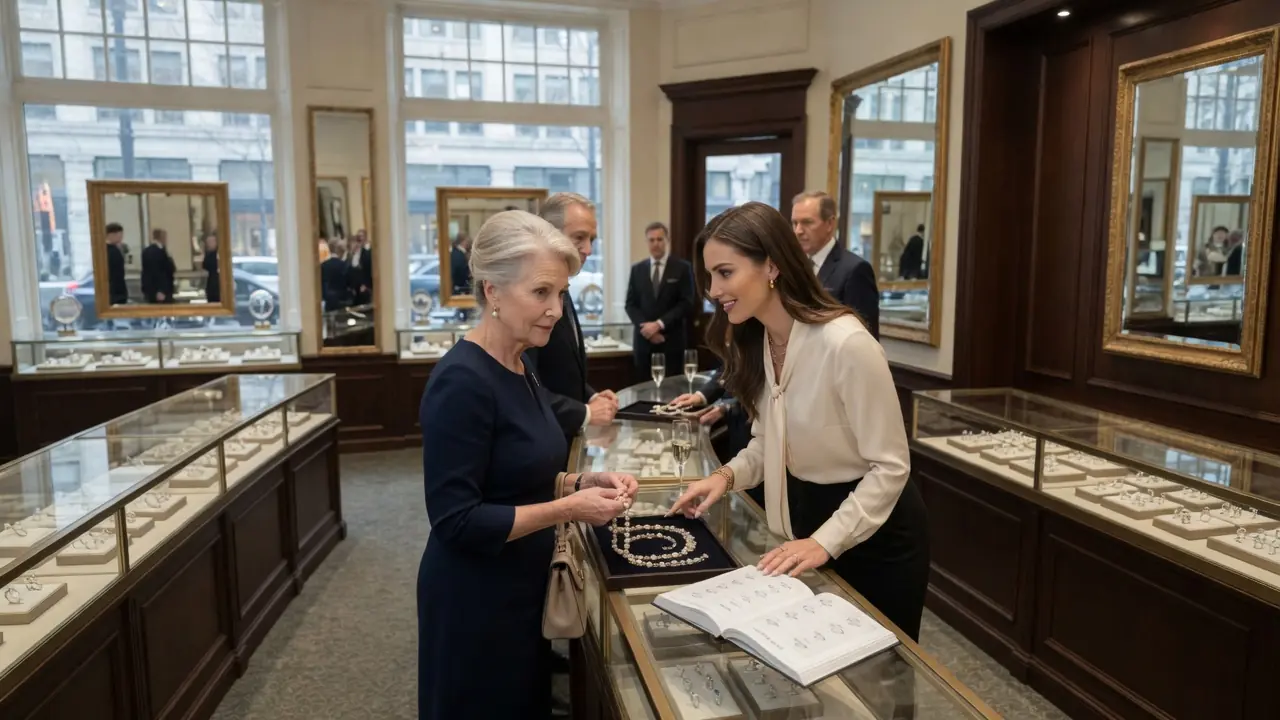
That morning at Morrison and Sons, Madison wore a cream designer blouse, a fitted black skirt, nude heels, and a smile sharp enough to cut glass. She walked through the jewelry store like she already owned something inside it. Her eyes moved over display cases filled with sapphire earrings, diamond rings, antique brooches, and pearl bracelets, but she kept glancing at me to check whether I was reacting properly. It felt less like shopping and more like being guided through a scene she had rehearsed.
“Vintage pearls are so special, don’t you think, Abigail?” she asked, standing close enough that her perfume surrounded me. I looked down at a delicate pearl bracelet resting on midnight blue velvet. “They’re timeless,” I said. “Though I’m surprised you’re interested in vintage pieces.” Madison laughed lightly, a musical little sound that belonged more to a dinner party than a jewelry store. “I appreciate beauty in all forms.”
Then she mentioned Christopher. She said he had told her I had quite an eye for jewelry, which was not exactly true. Christopher knew I loved antique craftsmanship, but he also knew I did not meddle in other people’s romantic choices. The mention of his name felt placed there, like a pin holding her plan together. I began to understand that this outing was not really about me.
Before I could ask what she meant, Madison waved toward the main counter. “Mr. Morrison,” she called, lifting her hand with a confident little flick of her wrist. The silver-haired proprietor approached with professional courtesy, though his gaze took in the situation faster than most people would have noticed. Madison tapped her manicured nail against the glass case. “We’d love to see your engagement collection when you have a moment.”
There it was. The real reason I had been invited. Not to bond, not to share tea, not to browse pearls, but to become an unwilling witness to Madison’s campaign for a proposal. She wanted me in that room so she could later tell Christopher his mother had helped her choose a ring.
I kept my expression calm. Christopher had told me just a week earlier that he was nowhere near ready to marry anyone, especially someone he had known less than two months. He liked Madison, yes, but he had also admitted she moved quickly and sometimes made him feel as if the relationship had already passed milestones he had not agreed to. I had listened without judgment, because adult children do not need lectures as much as they need safe places to tell the truth.
Madison turned to me with a sweet smile. “Christopher is very traditional,” she said. “I know he would want his mother’s approval.” Her tone suggested approval was not something I could freely give or withhold, but something I was expected to perform. Then she leaned closer and lowered her voice. “Let’s stop pretending we came here for pearls, Abigail. Christopher needs a little push, and you’re going to help me give it to him.”
I looked directly at her. “My son is not a ring you can point at and claim because it looks expensive.” Madison’s smile tightened. For a moment, the polished girlfriend disappeared, and I saw the impatience underneath. “Careful,” she whispered. “If you make this difficult, I’ll make sure Christopher thinks his lonely mother is the problem.”
Mr. Morrison reached us before I could answer. Madison extended her hand first, introducing herself with the confidence of someone accustomed to being accommodated. “Madison Parker,” she said. “And this is Christopher’s mother, Abigail.” The way she said it made me sound like an accessory she had brought along. Mr. Morrison turned toward me, and something changed in his expression.
“Mrs. Cooper?” he asked warmly. “Abigail Cooper?” I nodded, surprised by the recognition. He clasped my hand with genuine pleasure and said his wife served on a hospital board with Maryanne Hollister, who had spoken often about my work with the Children’s Symphony Fund. Madison’s smile faltered, and for the first time since we entered the store, she was not controlling the moment.
Mr. Morrison invited us into the Sapphire Room, a private viewing space usually reserved for the store’s most distinguished clients. Madison’s eyes widened with surprise, then narrowed with irritation. She had expected to guide me through the intimidating world of high-end jewelry. Instead, she was watching the staff treat me like the honored guest.
The Sapphire Room was intimate and beautiful, with midnight blue velvet walls, soft cream seating, polished display counters, and a discreet champagne bar in the corner. A sales associate named Rebecca brought refreshments and placed them before us with careful attention. Mr. Morrison had me seated in the central position on the settee, then arranged several velvet trays in front of me. Madison sat beside me, stiff with a smile that no longer reached her eyes.
“We have a remarkable collection from a European auction,” Mr. Morrison said. “Given your appreciation for historical craftsmanship, Mrs. Cooper, I thought you might enjoy these.” He opened the first tray, revealing pearl and sapphire bracelets, antique earrings, and delicate pieces that looked as if they carried stories from another century. I forgot Madison for a moment and leaned closer. The craftsmanship was extraordinary.
Madison did not like being forgotten. “Actually,” she said brightly, “we came to look at engagement rings.” Her hand landed on the edge of the tray, blocking my view of the bracelet I had been admiring. “Christopher mentioned he might be ready to take that step soon, and I thought his mother could help select something appropriate for the family.” The lie floated in the room like perfume that had turned sour.
Mr. Morrison handled the moment diplomatically. He said Rebecca could bring the engagement collection shortly, but first he thought I might enjoy the vintage pieces. Then he mentioned the gala auction I had curated the previous year, where several donated pieces had broken fundraising records. I felt a modest flush of pleasure. Madison looked at me as if I had committed a personal offense by having a reputation she could not control.
“How interesting,” she said, her voice brittle. “Christopher never mentioned his mother was a jewelry expert.” I smiled gently. “It is only a hobby.” I reached for a pearl and sapphire bracelet, and Mr. Morrison helped fasten it around my wrist. The piece was delicate, elegant, and beautifully made.
Madison stared at the bracelet like it had insulted her. She had brought me there to use me, not to see me admired. Every time Mr. Morrison addressed me with respect, her posture hardened. Every time Rebecca looked to me for preference, Madison’s jaw tightened.
“Perhaps we could see the engagement rings now,” Madison said, no longer bothering to hide her annoyance. “Since that is what we actually came for.” Mr. Morrison smiled professionally and said of course. But before Rebecca could move toward the door, he suggested I try the matching earrings. That was when Madison’s patience snapped.
“Enough,” she said sharply. Her voice cut through the elegant room like glass breaking. “This is ridiculous. We’ve been here half an hour, and you’re fawning over her like she’s royalty.” She stood, her face flushed, all sweetness gone. “She is nobody. Just a divorced housewife living off old alimony.”
The room froze. Rebecca stopped near the door. Mr. Morrison’s expression went still. I felt the words land, not because they were true, but because they were meant to humiliate me in front of people she thought mattered. Madison saw that she had shocked us, but instead of retreating, she grew crueler.
She grabbed my wrist. Her fingers closed hard around the bracelet, and she yanked it loose with enough force that I gasped. “You are making a fool of yourself,” she hissed. “Pretending to be some kind of jewelry expert. What a pathetic joke.” Then she held the bracelet between two fingers as if it were trash.
“Madison,” I said quietly, trying to pull my hand back. She stepped closer, her face full of contempt. “You are nothing but a clown,” she said. “A sad, desperate clown trying to seem important because your son is finally building a life without you.” The bracelet slipped from her fingers and dropped onto the plush carpet.
The door to the Sapphire Room opened. A tall man stepped inside, broad-shouldered, silver-haired, and dressed in a bespoke suit that carried wealth without needing to shout. His presence changed the temperature of the room. He did not hurry, did not raise his voice, and did not look confused. His steel gray eyes fixed on Madison.
“Touch my wife again,” he said calmly, “and see what happens.” No one moved. Madison’s face drained of color as recognition struck her. I recognized him too, though we had never met. Joseph Walker, founder and CEO of Walker Grand Hotels, a billionaire whose face appeared in business magazines and charity pages with the easy regularity of old money and new power.
“I’m sorry,” Madison stammered. “There has been a misunderstanding. I did not realize she was—” “My wife,” Joseph finished smoothly. He stepped fully into the room and glanced at me with concern so perfectly performed that I understood instantly. He was giving me a way out, a shield strong enough to stop Madison’s attack in its tracks.
Survival instinct took over. “Darling,” I said, placing just enough relief into my voice. “I wasn’t expecting you for another hour.” Joseph came to my side and helped me stand with a gentleness that contrasted sharply with the warning in his eyes. His hand rested lightly at my back, steadying me. “My meeting ended early,” he said. “Lucky timing, it seems.”
Madison looked as if the floor had opened beneath her. “Mr. Walker, I had no idea,” she whispered. “Mrs. Cooper never mentioned—” “That someone would object to you grabbing her?” Joseph cut in, his tone soft enough to be terrifying. “Or that someone would hear you call her a clown?” Madison swallowed. Her arrogance was evaporating by the second.
Mr. Morrison bent to pick up the bracelet, but Joseph reached it first. He lifted it carefully, examined the clasp, then placed it in my palm and closed my fingers around it. The gesture was protective, deliberate, and devastating to Madison. She understood exactly what the room now saw: not a powerful young woman putting an older woman in her place, but a cruel social climber caught exposing herself.
Madison tried to recover. “Christopher and I are practically engaged,” she said. “We’re practically family.” Joseph looked at her for one long moment. “Practically,” he repeated, turning the word into a verdict. “In my experience, Ms. Parker, people reveal their true character not when things go their way, but precisely when they do not.”
Mr. Morrison finally spoke, offering Madison a graceful exit through the main showroom if she wished to view engagement rings elsewhere. She accepted too quickly, nodding with frantic politeness. “Abigail, I’m truly sorry,” she said, though her apology was aimed more at Joseph than me. Neither of us answered. Rebecca escorted her out, and the door closed behind them with a quiet final click.
The room fell silent. Joseph stepped back a respectful distance, the role of husband fading into something more formal. “I apologize for the presumption, Mrs. Cooper,” he said. “It seemed the fastest way to stop the situation.” I looked at him, then at the bracelet in my hand, and despite the lingering shock, a laugh escaped me. “No apology necessary. It was quite the gallant rescue.”
“Joseph, please,” he said, smiling. “And I must admit, I have never acquired a wife quite so suddenly before.” “Nor have I found myself married without my knowledge,” I replied. His smile deepened, and something about the warmth in it steadied me. For the first time that day, I felt like myself again.
We sat for a few minutes in the Sapphire Room after Mr. Morrison discreetly excused himself. Joseph explained that he had been waiting in an adjacent private room for an appointment when he heard Madison’s raised voice. He had heard enough to know I needed help. “Though,” he added, “you were handling yourself with far more grace than most people would have managed.”
I thanked him again, and he asked gently whether Madison was actually family. I told him she was my son’s girlfriend of eight weeks, though according to her, they were practically engaged. Joseph laughed, not mockingly, but with warm disbelief. “Something tells me your son may have a different view of that timeline.”
“He certainly does,” I said. “And I should probably warn him before Madison creates her own version of today.” “Over dinner, perhaps?” Joseph suggested, then immediately lifted one hand. “Forgive me. That was presumptuous after an already presumptuous introduction.” But I found myself considering the invitation seriously.
There was something refreshingly clear about him. No manipulation, no hidden agenda, no careful little traps hidden beneath compliments. He had stepped in because he saw cruelty and chose not to ignore it. After Madison’s performance, that kind of directness felt like a gift.
“Dinner would be lovely,” I said. “As a proper thank you, and perhaps to discuss how I should tell my son that I apparently married a hotel magnate without his knowledge.” Joseph’s eyes lit with pleasure. “I know just the place,” he said. “Assuming you’re comfortable being seen with your new husband.”
We had dinner that evening in a quiet restaurant tucked behind an unmarked oak door. Joseph chose it because it valued conversation more than status, and I understood why as soon as we sat down. The tables were spaced far apart, the lighting was gentle, and the staff treated him with respect but not spectacle. For the first time in weeks, I felt like a woman at dinner, not a mother being positioned inside someone else’s scheme.
We talked for hours. He told me about building Walker Grand Hotels after his sister’s illness opened his eyes to the miserable accommodations available to families traveling for medical care. I told him about my divorce, my volunteer work, and my children. He listened carefully, not as if waiting for his turn to speak, but as if the details mattered.
When Joseph drove me home, I saw Christopher’s car parked out front. The lights were on, and I knew before entering that Madison had beaten me there. Sure enough, she sat at my kitchen island with red eyes and a trembling mouth, while Christopher paced nearby, angry and confused. The ambush had already been staged.
“Mom,” Christopher said tightly, “what happened at the jewelry store?” Madison sniffled and reached for his hand. She claimed she had only wanted to bond with me, that I had been cold, jealous, and cruel. She said I humiliated her because I could not accept my son moving on with his life. The lies were so polished that I almost admired their construction.
I asked Christopher whether he wanted to hear what actually happened. Madison’s eyes narrowed, then widened again into wounded innocence. I explained the engagement rings, her claim that Christopher was ready for marriage, the wrist-grabbing, the bracelet, and the word clown. Christopher’s face shifted with every sentence, anger moving away from me and toward the woman beside him.
Madison tried to deny it. Then I calmly mentioned security footage at Morrison and Sons. That was when her mask cracked. She admitted she had exaggerated about engagement because she needed to create momentum. “You are thirty-two,” she snapped at Christopher. “You cannot live in your mother’s guest suite forever.”
Christopher stared at her as if seeing her for the first time. “We have been dating eight weeks,” he said. Madison said time did not matter when people knew what they wanted. I thought of her hand on my wrist, her voice calling me a sad clown, and the way she had tried to turn herself into the victim before I even got home. Christopher told her to leave.
Her exit was dramatic, tearful, and completely unconvincing. She kissed his cheek, looked back once from the doorway, and disappeared into the night. When the door closed, Christopher turned to me. “I have been an idiot, haven’t I?” he asked softly.
“No,” I said. “You have been lonely and flattered. That is not the same thing.” We made tea and sat in the living room while I told him the rest. Joseph’s intervention became less absurd with every detail, though Christopher still stared when I admitted I had gone to dinner with him. “You had dinner with Joseph Walker?” he asked. “The billionaire?”
“Millionaire, I believe,” I corrected. Christopher laughed for the first time all evening. Then he grew serious and said something I had not expected. “Mom, you looked lighter when you came in tonight, even before the drama started.” I asked what he meant. “I mean you looked like something good happened to you.”
Something good had happened. Madison had tried to make me feel small in a jewelry store, but her cruelty had opened a door I had not known existed. Joseph and I exchanged messages that night, and he asked whether I might like lunch the next day. I said yes.
Over the next few weeks, Madison’s schemes unraveled completely. Christopher discovered she had been researching his routines long before their supposed chance meeting. She had known about his trust fund, his favorite coffee shop, his professional weaknesses, and his need to feel admired after the startup failure. Their relationship had not been romance so much as a long con with lipstick.
Madison tried once more to regain control. She appeared at Symphony Hall during intermission, claiming Christopher had been in an accident and needed me at the hospital. Terror struck before suspicion could stop it, but I called Christopher immediately. He answered from dinner with colleagues, perfectly safe, and Madison’s lie collapsed in public.
What she did not realize was that the call remained connected. When she lost control and admitted she had been positioning herself in Christopher’s life for years, he heard every word. She said his trust fund vested in three months. She said she had planned too long to let me ruin everything. The lobby fell silent around us, and finally, even Madison understood she had exposed herself beyond repair.
Security escorted her out. Joseph stood beside me through all of it, calm and steady, never taking control away from me but always making sure I did not stand alone. That was what impressed me most about him. He protected without possessing. He supported without making me feel weak.
Christopher sent a cease-and-desist letter through his attorney and removed Madison from his life completely. He also began moving forward in ways I had prayed for quietly but never pushed. He accepted a position with a technology company, started apartment hunting, and stopped letting disappointment define him. In losing Madison, he seemed to recover himself.
Joseph and I continued seeing each other. Lunch became dinner, dinner became concerts, and concerts became quiet evenings in his restored brownstone kitchen while he cooked and I poured wine. My daughters teased me endlessly, calling him the jewelry store husband. Christopher approved of him with the protective caution of a son who had finally realized his mother had a life beyond motherhood.
Three months after the jewelry store incident, Joseph invited me to the restored Walker Grand downtown before its official opening. We had toured the building during construction, and I had admired the way he preserved history while making space for something new. That evening, the hotel glowed like a promise. He had arranged dinner for two in the Elizabeth Suite, named after his beloved sister.
On the terrace, overlooking the city, Joseph raised a glass. “To unexpected beginnings,” he said. “And second chances.” I smiled. “To jewelry store rescues and sudden marriages,” I added. He laughed, and the sound carried into the night air like music.
Later, beside the terrace doors, he told me he loved me. He said he had not expected to feel that way again at sixty-eight, but there we were. I looked at this man who had entered my life by calling me his wife in front of a woman trying to humiliate me, and I felt the truth settle gently into place. “I love you too,” I said.
Madison had wanted to make me look pathetic. She had wanted to expose me as lonely, irrelevant, and desperate for importance. Instead, she exposed herself. She revealed my son’s danger, revealed her own greed, and accidentally introduced me to someone who saw me more clearly than any stranger had a right to.
That is the strange thing about humiliation. Sometimes people try to use it as a weapon, but it strikes the wrong target. Madison thought she was dragging me down in that jewelry store, but she only cleared the stage for the truth to enter. She thought she was showing the world that I was nothing. Instead, a billionaire walked through the door, called me his wife, and reminded everyone in the room that dignity does not disappear just because a cruel person tries to name it something else.
And as for me, I kept the bracelet. Not because it was expensive, though it was. Not because Joseph later insisted on buying it for me, though he did. I kept it because every pearl reminded me of something quiet, lasting, and strong. Beauty does not have to shout to be real, and neither does a woman who knows her own worth.