The night my daughter-in-law stood up at my retirement dinner and told sixty-three people I had always made my son’s life harder, I did not cry. I did not shout. I did not throw my napkin on the table or beg my son to defend me. I simply folded my hands near my plate, looked at the woman who had spent two years turning my own child away from me, and nodded as if she had just confirmed something I already knew.
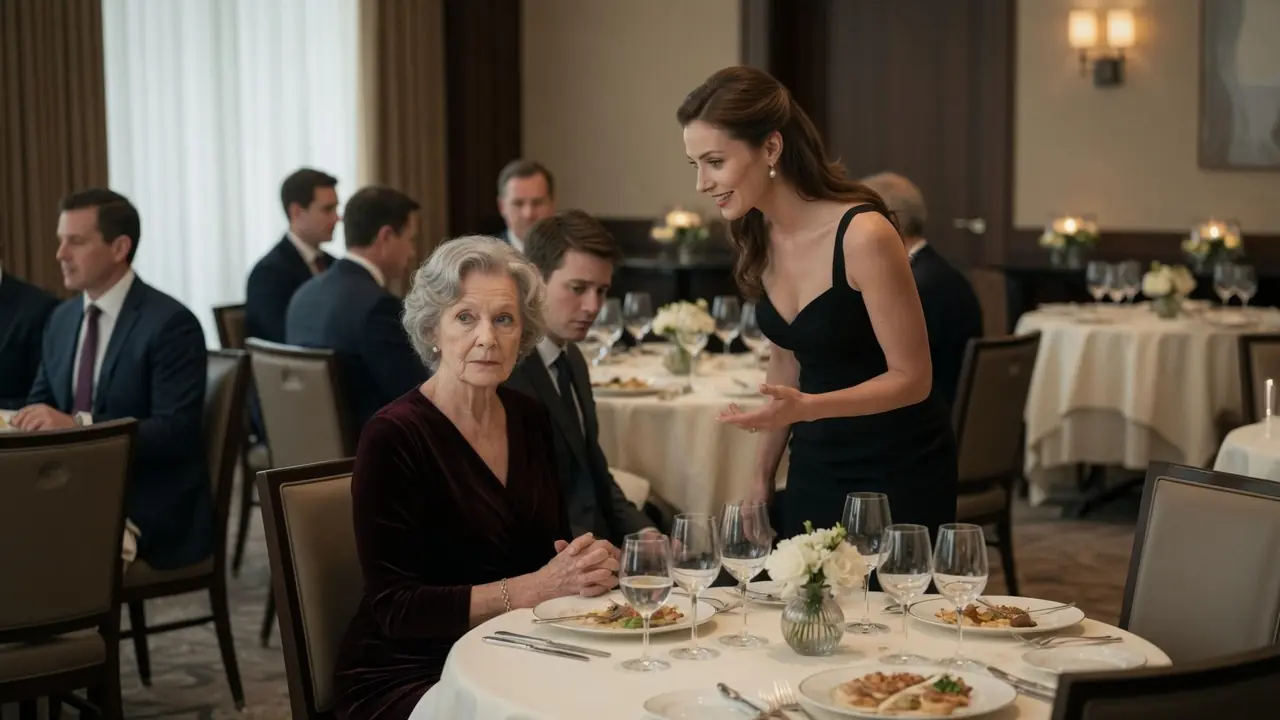
Her name was Daphne Fairweather. She was thirty-one years old, polished in a way that made people confuse beauty with character, and she knew how to speak cruelly while smiling. That evening, she wore a fitted black dress, pearl earrings, and a face arranged for sympathy before she had even begun her performance. She stood beside the head table as if she had earned the right to speak for my family, while my son Elliott sat between us with his eyes lowered.
The private dining room was clean, elegant, and beautifully arranged. Ivory linen covered the round tables, white flowers sat in little glass vases, and every wine glass caught the restaurant light like something precious. It was supposed to be a celebration of my twenty-six years at the county assessor’s office. Instead, Daphne decided it would be the night she put me in my place.
I was sixty-seven years old then, newly retired, three years widowed, and tired in a way that sleep did not fix. My husband Raymond had died suddenly on a February morning, leaving me with a quiet house, a carefully paid mortgage, and a son I thought would still be part of my life. For the first year after Raymond’s death, Elliott called me every Sunday. He would talk about work, the weather, the small repairs he was doing around the house, and I would listen because those calls stitched my week together.
Then he met Daphne.
At first, I tried to like her. That is what mothers do when their sons bring home someone new. We make tea, we compliment the dress, we ignore the way the young woman looks around our living room as if appraising what can be replaced. The first time Daphne visited my home, she sat in Raymond’s chair by the window, not knowing it had been his, and called the room cozy in a tone that made the word sound small.
I told myself she was nervous. I told myself she was young. I told myself Elliott was happy, and that should be enough. But the Sunday calls became shorter, then less frequent, then replaced by texts that sounded like he was reporting to someone standing over his shoulder.
Sorry, Mom, this week is hectic.
Sorry, Daphne has a work thing.
Sorry, maybe next month.
I began writing the dates down in a note on my phone. Not because I planned anything yet, but because I am a woman who has always believed memory should have witnesses. Raymond used to tease me that I could document a sunrise if it happened on a Tuesday. He was not wrong.
The first time I realized Daphne truly disliked me was at Thanksgiving. I had set my table that morning with my mother’s china, cream-colored plates with a thin gold rim, the kind I only used twice a year. Daphne offered to help, and I said yes. Then she rearranged everything I had already placed, moved the centerpiece six inches to the left, switched the napkins, and nodded to herself as if she had repaired a failure.
Elliott stood in the doorway holding a bottle of wine, watching me carefully.
I smiled at him.
He looked relieved.
That was the first small surrender I noticed too late.
From then on, Daphne corrected me in ways that sounded helpful when spoken aloud. She suggested I “modernize” the house because older spaces can feel emotionally heavy. She told Elliott I needed hobbies, then told me I was too attached when I mentioned Raymond. She called my grief “dependency” and my love for my son “pressure.”
It was all done cleanly. No screaming. No obvious cruelty. Just small sentences slipped under the skin until Elliott began repeating them in his own voice.
One afternoon, after I had knee surgery, he sent flowers instead of coming over. The card said, Thinking of you, Mom. Daphne had probably chosen the white roses. They were beautiful, and that made it worse because people think beauty softens absence. It does not.
My neighbor Faye was the first person brave enough to say what I had been avoiding. She came over with lemon cake and sat with me on the back porch while my hydrangeas were just beginning to open. She cut the cake, handed me a slice, and said, “Eloise, how long are you going to pretend this is fine?”
That is my name. Eloise Fairweather. Sixty-seven years of explaining that my mother liked old names and wanted something graceful. I did not feel graceful that day. I felt old, foolish, and afraid that admitting the truth would make it more real.
“He is busy,” I said.
Faye looked at me over her coffee cup. “He missed your birthday, your knee recovery, and Easter dinner. Busy is not the word for that.”
I stared at the cake.
“I am not trying to hurt you,” she said. “I am trying to help you see.”
I did see. I had seen for months. But mothers are talented at rearranging pain into excuses when it involves their children.
The retirement dinner was Elliott’s idea. My supervisor Beth had wanted a small gathering at the office, maybe cake and coffee, but Elliott called with excitement I had not heard from him in a long time. He said Daphne knew a restaurant with a private dining room. He said they wanted to do it properly. He said I deserved to be honored.
I wanted to believe him.
That is the part I still struggle with. I was not naïve. I was not blind. I simply wanted my son back badly enough to mistake planning for love.
Two weeks before the dinner, I went to Elliott’s house with a casserole. Daphne was traveling, and he had mentioned he had been eating takeout all week. I still had a key from the summer he asked me to water the plants, so I let myself in, placed the casserole in the refrigerator, and was on my way out when I saw his laptop open on the kitchen island.
I was not searching. I was walking past it. But my name was on the screen in a full paragraph, and the words beside it made me stop.
We cannot keep accommodating her forever.
I should have left.
I did not.
At sixty-seven, a woman has earned the right to know when her life is being discussed like a problem.
The email was from Daphne to her sister. Fourteen paragraphs. She called me a burden Elliott could not bring himself to cut loose. She said I had inserted myself into their marriage by existing too close to it. She said the retirement dinner would be the last thing she did for “that woman.”
Then came the part that turned my hands cold.
My house.
Daphne had spoken to a real estate attorney. She wrote that property values in my neighborhood had risen, that if Elliott inherited the house, they could sell it immediately and start fresh somewhere she “actually wanted to live.” She mentioned Raymond’s coin collection, my savings, and the fact that I had never changed my will after Raymond died.
I scrolled farther.
There were older emails. Months of them. Daphne had been documenting my phone calls, my visits, my words at family dinners. When I cried after they canceled Christmas, she called it manipulation. When I asked Elliott if he was eating well, she called it emotional enmeshment. When I mentioned missing Raymond, she wrote that grief had become my “main method of control.”
Then I saw one line that made my stomach tighten.
I started recording her when she visits, just in case.
I stood in my son’s kitchen for a long time. Then I took photographs of the emails on my phone, closed nothing, touched nothing else, and went home.
The casserole stayed in his refrigerator.
The next morning, I called my attorney.
Walter Goss had been Raymond’s attorney first. He was seventy-two, slow-spoken, and calm in a way that made panic feel unnecessary. I sat across from him in his office and told him everything. He listened without interrupting, then said, “All right, Eloise. Let us talk about what can be done.”
What could be done was more than Daphne ever imagined.
The will was first. Raymond and I had updated it years before his death, and Elliott had been the primary beneficiary. Walter drew up a new one. The house, the savings, Raymond’s coin collection, and the investment accounts were redirected according to my wishes. Some went to my sister Marta, some to a literacy foundation where I had volunteered for fifteen years, and the rest to a scholarship fund for young women entering public service.
I signed the new will on a Wednesday afternoon.
I walked out of Walter’s office feeling lighter than I had in years.
Then we discussed the dinner.
Walter did not suggest what I eventually did. That part was mine. He only asked whether I was sure and then made certain everything was handled properly. If Daphne wanted to turn my retirement dinner into a public performance, I decided I would let the room hear both performances.
Over the next six weeks, I prepared quietly. I did not record illegally. I did not stalk, threaten, or manipulate. I simply preserved what I was legally allowed to preserve and gathered what Daphne had already put in writing. Screenshots, printed emails, notes, and a few recordings made within the limits Walter explained.
I had Daphne in her own voice telling Elliott that my money was “just sitting there.” I had her saying I would not be around forever and that they needed to plan. I had her telling him that he had to stop letting guilt make him weak. And then, softly, painfully, I had Elliott saying, “I know.”
That part hurt more than Daphne’s insults.
A stranger can cut you. A child can hollow you out.
Faye came by three weeks before the dinner and found me at the kitchen table with folders arranged in front of me. She read the top page upside down, then looked at me. “How close are you?”
“Close enough,” I said.
“What do you need me to do?”
“Sit where I can see you,” I told her. “And do not look surprised.”
She nodded. “Done.”
My sister Marta came two days before the dinner. She drove up from Savannah and brought a garment bag, a bottle of wine, and the kind of sisterly determination that does not ask permission. She helped me choose Raymond’s favorite burgundy dress, the one he had given me for our anniversary four years before he died. It needed to be taken in slightly because grief had changed my body in quiet ways.
On the evening of the dinner, Marta fastened my thin gold bracelet because my fingers were stiff.
“You look beautiful,” she said.
“I feel ready,” I replied.
She studied me in the mirror. “Raymond would have laughed himself breathless.”
For the first time in weeks, I laughed too.
The restaurant was lovely. I will give Daphne that. The private dining room was clean, tasteful, and warm with soft restaurant light. Round tables were draped in ivory linen, little vases of white flowers sat at the center of each table, and the head table was arranged perfectly.
Sixty-three people came. Colleagues from the assessor’s office, old friends from church, neighbors, my sister, Faye, and people who had known Raymond. They hugged me, told stories, and asked how I felt about retirement. More importantly, they waited for the answer.
For the first hour, the night was almost beautiful.
My old supervisor Beth told a story about the year I caught an error in a property record that saved the county from a lawsuit. Sandra from my office cried before she even started speaking. Howard, a former department manager who must have been eighty by then, stood up unprompted and said I was the most precise person he had ever worked with and the only one who could make government paperwork sound like a moral duty.
The room laughed warmly.
I felt honored.
And then Daphne stood.
She tapped her glass with her fork, bright smile in place, and the sound traveled through the room.
“I just want to say a few words,” she said. “As the woman who married into this family, I have had a unique view of Eloise.”
I folded my hands in my lap.
Daphne smiled at the room, then looked at me. “She is not always easy.”
A few people gave uncertain laughs.
Daphne continued. “Strong women rarely are, of course. But I think everyone here should understand that strength can sometimes become pressure. Eloise has always known what she wanted, and she has always been very comfortable asking for it, even when that meant asking too much of the people who loved her.”
My face stayed still.
Her voice sharpened.
“You have always made Elliott’s life harder, Eloise,” she said, louder now, her fake warmth beginning to fall away. “And tonight, maybe everyone should finally hear that.”
The room shifted. A chair scraped. Someone whispered my name.
I looked at Elliott.
He lowered his eyes.
Daphne took that silence as permission.
“You demanded attention when we needed space. You made him feel guilty for choosing his own marriage. You turned every boundary into some kind of tragedy. Do you know what it is like to build a life with a man who feels responsible for a mother who refuses to let him breathe?”
My colleagues stared at her. Faye did not move. Marta’s hand tightened around her water glass.
I said quietly, “This is my retirement dinner, Daphne.”
She smirked. “Exactly. One more evening where everyone is expected to clap for you while Elliott carries the weight.”
That was the moment.
Not because of what she said. I had already read worse. Not because the room heard it. I had prepared for that too. It was Elliott’s silence that told me the time for hoping had ended.
I turned to the event coordinator near the back wall and gave one small nod.
He nodded back.
I stood slowly.
“Before dessert,” I said, my voice steady, “I would like to share something I prepared. A short retrospective. Twenty-six years is a long time to work, and a family is an even longer kind of work. Tonight seems like a good time to be honest about both.”
The projector screen at the far end of the room lit up.
It began with photographs. My first day at the assessor’s office in 1997, standing with brown hair and a stack of files too large for one person. Office birthday parties. Retirement certificates. My coworkers laughing over broken coffee machines, holiday decorations, and the annual records audit we survived by sheer stubbornness.
People smiled at first.
Then the slide changed.
A screenshot of Daphne’s email appeared on the screen.
Burden he cannot bring himself to cut loose.
The room went silent.
Another slide.
The retirement dinner is the last thing I am doing for that woman.
A sound came from somewhere near the back, half gasp, half disbelief.
Daphne’s face went pale.
Then came the audio. Her voice filled the private dining room, clear and unmistakable.
“She is not going to be around forever, Elliott. We have to plan.”
A pause.
Then Elliott’s voice.
“I know.”
I looked at my son. He had turned the color of old paper. Daphne sat rigid, one hand gripping the stem of her glass. All the elegance in the room could not soften what the truth sounded like when it finally spoke aloud.
The next slide was a summary from Walter regarding Daphne’s contact with a real estate attorney about my property. Below that, in plain text, was the part I had written myself.
As of September 14, the will of Eloise Fairweather has been revised. Elliott Fairweather is no longer named as primary beneficiary. All assets have been redistributed according to Mrs. Fairweather’s wishes.
Walter stepped forward from near the side wall. He wore a dark suit and the calm expression of a man who had prepared for exactly this moment.
“Good evening,” he said. “I am Walter Goss, Mrs. Fairweather’s attorney. I am present tonight as a witness and, if necessary, to answer legal questions. I hope that will not be necessary.”
Nobody moved.
I stood at the front of the room, not triumphant, not shaking, simply finished.
“I have worked for twenty-six years serving this county honestly,” I said. “I built a life with my husband. We raised a son. I buried my husband, and I kept going. I am sixty-seven years old, and I am not finished.”
I looked at Daphne.
“No one gets to decide when I am finished.”
The silence held.
Then I smiled faintly.
“Enjoy dessert,” I said. “The chocolate torte is excellent. Daphne chose it.”
I sat down.
Daphne and Elliott left before the cake was served. Elliott paused beside me as he passed and placed one hand briefly on my shoulder, but he did not speak. Daphne looked straight ahead, walking toward the exit like someone trying to outrun a fire without admitting there were flames.
After they left, the room exhaled.
Sandra began clapping first. Faye joined immediately. Marta followed with tears in her eyes. The applause spread, uncertain at first, then stronger, then real. I did not need it, but I accepted it because sometimes witnesses are not just for truth.
Sometimes they are for the person who survived it.
The days after were quieter than people imagine. There were no shouting matches, no dramatic visits, no public statements from me. Marta stayed for a week, and we painted the back porch a blue-gray color called Morning Fog. Faye came over with coffee and pretended not to check on me every day.
The locksmith came Thursday.
Walter confirmed the will revision, secured the documents, and checked on me once a week for the first month. I joined a watercolor class at the community center because I had always wanted to learn and had spent too many years saving the time for later. Later, I had learned, is not a guarantee.
Elliott wrote me a letter in November.
Six pages. Handwritten. He said he had not known how bad it had become, then admitted that was not true. He said he should have known. He said he had let Daphne’s version of me become easier to live with than the real one. He said he was sorry and understood if sorry was not enough.
I read it three times.
Then I made tea and sat with it on the kitchen table.
There is a kind of apology that does not repair, but it clears a small space where repair might someday begin. I wrote back one page. I told him I loved him because I do. I told him love and trust are different things and rebuild on different timelines. I told him I had no interest in punishing him, but I would never again return to a relationship that required my invisibility.
I mailed the letter and slept well that night.
Daphne never wrote.
I did not expect her to.
People like Daphne do not apologize when a plan fails. They rebrand themselves as victims and wait for a more sympathetic audience. I heard through others that she said I humiliated her. Perhaps I did. But I did not invent her words. I only returned them to the room where she had chosen to perform.
I am still in my house.
Raymond’s chair is still by the window. My mother’s china is back in the cabinet. The hydrangeas sleep through winter and return in May, faithful in a way people are not always faithful. On Thursdays, I paint crooked bowls of fruit in watercolor and enjoy myself immensely despite having no natural talent.
Some people have asked whether I regret what I did.
I do not have a neat answer. I regret that it became necessary. I regret that my son sat quietly while his wife called me a burden. I regret that Daphne thought my age made me easy to move, easy to rewrite, easy to wait out.
But I do not regret protecting myself.
There is a difference between cruelty and consequence. Cruelty is what Daphne planned in private and performed in public. Consequence is what happened when I refused to let her version of me be the only one in the room. At sixty-seven, I learned that a quiet woman can still carry something sharp.
I am capable of grace.
But I am also capable of documentation.
And if someone decides to erase you in front of a room full of people, you are allowed to pick up the pen and write yourself back in.