The morning everything changed, the lake was still enough to reflect the porch windows like glass. Long Pond lay beyond the screen door, blue and quiet, with a heron standing near the reeds as if it had been painted there. I had made blueberry pancakes, bacon from Reggie’s smokehouse, and fresh orange juice with extra pulp because my granddaughter Hattie liked it that way. At sixty-eight years old, I still believed a good breakfast could keep a family together for at least one more morning.
My name is Theodore Whitman, though most people call me Theo. The lake house on Long Pond was not just property to me. My late wife Helen and I built it in the summer of 1987 with borrowed money, sore hands, and more stubborn hope than common sense. Every board in that house carried some part of our marriage.
Helen had been gone four years by then, but I still felt her on that porch. Her favorite chair sat near the west window, angled toward the water because she liked watching the sun climb over the pine trees. Her coffee mug still rested in the cabinet, though I had not used it since the week after the service. Some people say houses are just wood and nails, but those people have never held a dying wife’s hand in a bedroom they built together.
That Sunday after Labor Day, my son Marcus sat across from me with his phone beside his plate. He was thirty-four, my only child, a lawyer by training, though not as steady as I had once hoped he would become. His wife Bryn sat beside him in a cream sweater, her blonde hair perfect, her jewelry delicate, and her eyes moving over the porch like an appraiser deciding what could be sold. Hattie, their nine-year-old daughter, sat between them with powdered sugar on her chin.
Hattie was the only innocent person at that table. She was telling me about a social studies project on the Wabanaki, her words tumbling out between bites of pancake. I listened because I had learned that children stop talking when adults stop listening. Marcus gave her a distracted nod now and then, but Bryn did not even pretend to care.
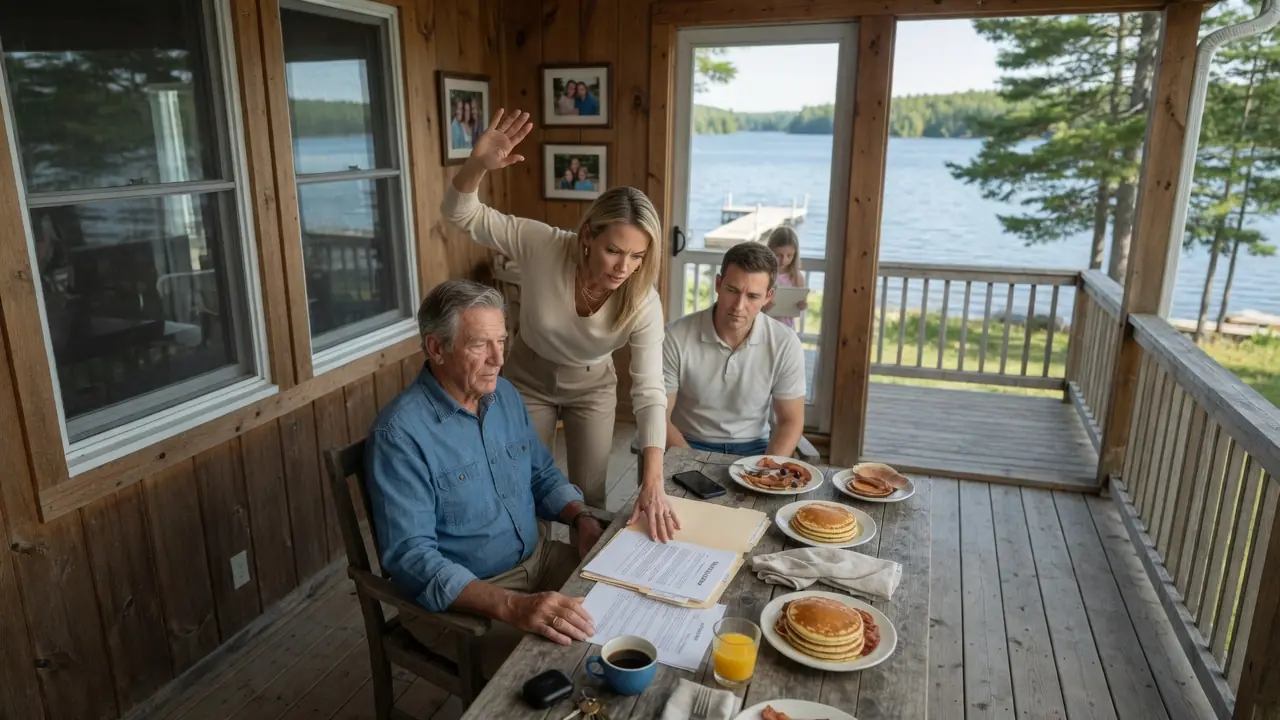
I should have noticed the manila folder earlier. It sat beside Bryn’s plate, neatly tabbed, too formal for a family breakfast. It looked like something a person brought to a deposition, not to a porch where a child was eating pancakes. When Bryn placed one manicured hand on top of it, I felt a small warning move through me.
“Theo,” she said, using my name with the false softness people use before asking for something ugly, “we need to talk about the property.” I looked from the folder to Hattie. A child does not need to hear adults circle each other like wolves. So I poured her more orange juice and told her to take her sketchbook down to the dock to draw the heron.
Hattie went without arguing. She was a good kid that way, trusting and bright, still young enough to believe adults sent her outside only because the heron mattered. The screen door closed behind her, and the porch changed. The air felt heavier, though the lake was still shining beyond the rail.
Bryn opened the folder. Inside were papers, already printed, already arranged, already marked with little colored tabs. She slid the top document across the table with two fingers. “It’s a quitclaim deed,” she said. “Just a clean way to make things structurally fair.”
I remember those words because people like Bryn always hide greed behind polished language. Structurally fair. It sounded like something from a seminar, not a demand made across the breakfast table of a widower. I looked down at the deed, then at my son. Marcus had suddenly become very interested in his phone.
“Whose name goes on it?” I asked. Bryn did not hesitate. “Mine and Marcus’s, joint with right of survivorship.” She said it as if she had practiced the line. Marcus still did not look up.
I set my fork down carefully. “And if your marriage does not last?” Bryn gave a little laugh, sharp and dismissive. “Theo, don’t be morbid.” That was when I understood she was not asking. She had arrived expecting me to obey.
For thirty-four years, I had given Marcus almost everything he needed. Cleats, tuition, law school, a used car, a down payment on the Falmouth house, help with taxes, help with repairs, help with every emergency that seemed to become my emergency by sunset. I did not regret loving my son, but love had slowly become a habit of rescue. Somewhere along the way, I had taught him that my checkbook was easier to reach than his own spine.
Bryn had understood that faster than I did. From the first dinner, she had looked at my life like a catalog. She asked about the lake house, the back lot, the boat, Helen’s china, my investments, and whether I had “modernized” my estate plan. I told myself she was just practical. Helen would have called it what it was.
Helen had not trusted Bryn. She said it once in 2017, after Bryn made a joke about old people sitting on valuable real estate. “That woman sees rooms before she sees people,” Helen told me. I laughed it off because I wanted peace. I have spent years regretting that laugh.
After Helen’s service in 2021, while her sister was still putting food on the table and the house was full of flowers, Bryn cornered me near the kitchen and asked whether I had thought about estate planning. My wife had been gone barely long enough for the lilies to wilt. I told Bryn, “Not today.” What I should have said was, “Not with you. Not ever.”
So there we sat, four years later, with pancakes cooling and a deed between us. Bryn tapped the signature line with one fingernail hard enough to make the page jump. “Theo, you are not getting younger,” she said. “You cannot keep pretending this place is some sacred shrine forever.”
“It is my home,” I said. “It is also an asset,” she replied. “A valuable one. And frankly, it is irresponsible for you to hoard it when the family could use it properly.” The word hoard landed colder than the lake in November.
Marcus finally lifted his eyes, but only halfway. “Dad, maybe just hear her out,” he said. It was not support. It was surrender disguised as neutrality. I looked at him and saw the boy I had taught to bait a hook, the boy who once fell asleep on my shoulder during a thunderstorm, now sitting across from me like a witness hoping not to be called.
“I have heard enough,” I said. Bryn’s face tightened. “You are being selfish.” I kept my voice low because I did not want Hattie to hear anger from the dock. “This is the house where I held your mother-in-law’s hand when she was leaving this world. This is the house where Hattie learned to swim. This is not an asset for you to grab.”
Bryn pushed back her chair so hard it scraped the porch floor. She stood and walked around the table, the folder still in one hand. I remained seated. A part of me still believed she would stop at words because decent people stop before they make something permanent.
She leaned over me with a furious smile. “You old men always think memories give you ownership over everyone else’s future,” she said. “You’re sitting on money while we carry the real family forward.” Her hand rose into the air, palm open. For one long second, the whole porch held still.
That second told me everything. Bryn’s face was not out of control. It was clear, deliberate, almost satisfied. Marcus saw her hand raised, saw me sitting there, and did not move. The sound that followed was not the worst part.
Her hand came across my face, and the shock of it turned the lake silent in my mind. My hearing aid slipped loose and clattered against the floorboards. My cheek burned, but pain was not what hollowed me out. What hollowed me out was Marcus looking up and saying, “Dad, why do you have to make everything so difficult?”
That sentence entered me deeper than Bryn’s hand ever could. I stared at my son and waited for some other version of him to appear. The version I had raised. The version who would stand, step between us, and tell his wife she had crossed a line no one could uncross.
He did not appear. There was only Marcus, pale and weak, staring at me as if I had caused the scene by refusing to be robbed politely. Bryn stood over me, breathing hard, her hand still half raised as if she had not decided whether the first strike had done enough. I bent down, picked up my hearing aid, wiped it on my shirt, and put it back in my ear.
Then I stood. Slowly, because I wanted them to see I was not shaking. “Bryn, Marcus,” I said, “go inside and pack a bag. You are leaving.” Bryn blinked, as if the words did not fit the role she had assigned me. Marcus said, “Dad,” but I held up one hand.
“Go,” I said. Bryn’s expression shifted to false regret. “Theo, don’t be dramatic. I was emotional. I didn’t mean to.” I looked at her until she looked away. “You meant to. You absolutely meant to. Go pack.”
They went upstairs, not because they were sorry, but because they thought I would calm down. People who have been given too much often mistake silence for weakness. They believed the old man would soften by dinner, apologize for upsetting everyone, and maybe even sign the paper to keep access to his granddaughter. They did not know that something in me had finally become still and sharp.
I walked out to the dock. Hattie lay on her stomach with her sketchbook open, drawing the heron in careful gray pencil. She looked up when she heard me. Her small face changed immediately because children notice things adults pretend to hide.
“Pop-Pop, are you okay?” she asked. I sat beside her, keeping my sore cheek turned slightly toward the water. “I am going to be,” I said. She looked at me for a few seconds longer than children usually do. Then she nodded, accepting the answer without believing all of it.
I told her I needed to make a few phone calls and asked her to stay on the dock where I could see her. She agreed. I walked to the end of the dock, where the boards were gray from years of sun, and called Margaret Sutherland. Margaret had been my attorney since 1994, and she answered on a Sunday because Margaret had never been the kind of woman to let my name ring unanswered.
I told her the facts. The deed. The demand. The raised hand. Marcus’s sentence. Margaret was quiet for four seconds, and then she said, “Theo, do not let them leave with anything that is not theirs. I am getting in the car.”
My second call was to Carter Mendelson, my financial advisor in Portland. He had handled my accounts for seventeen years, long enough to know when my voice meant business. I told him to freeze every account Marcus had access to by Monday morning. The brokerage account, the operating line connected to old contract work, and every courtesy arrangement I had left in place out of fatherly habit.
Then I told him about the trust. After Helen died, we had arranged a structure that protected Hattie if something happened to me, with Marcus as primary and Hattie as contingent. “Change it,” I said. “Marcus comes out. Hattie moves up. Corporate trustee, with Roberta as family advisor.” Carter did not argue.
The third instruction was the Falmouth house. Helen and I had helped Marcus and Bryn buy it, but we kept twenty percent on the deed because Helen insisted. “I want my twenty percent back,” I told Carter. He understood immediately what that meant. A partition action would force a buyout or a sale.
“Theo, you know what that does,” he said. “Yes,” I replied. “It teaches them the difference between help and entitlement.” Carter was silent for a moment, then said, “Understood.” I ended the call and stood there looking at the lake until my breathing steadied.
When I returned to the house, Marcus and Bryn were in the kitchen. Bryn had arranged her face to look tearful, and Marcus held a glass of water like it gave him purpose. She stepped toward me. “Theo, I have been thinking, and I want to apologize.”
“Stop,” I said. She tried again, explaining stress, work, Hattie’s school, the mortgage, the pressure of everything. I let her speak for maybe fifteen seconds, then I said, “I said stop.” My voice was quiet enough that Marcus’s head lifted. Sometimes volume weakens a thing. Stillness strengthens it.
“Margaret will be here in thirty-five minutes,” I said. “You are welcome to wait until she arrives, or you are welcome to leave now. I would prefer you leave now.” Marcus swallowed. “What paperwork is Margaret bringing?” he asked. I looked at my son, and for the first time in years, I did not soften myself for him.
“For thirty-four years, I have given you things you asked for and things you did not know to ask for,” I said. “I paid tuition. I co-signed. I wired money. I carried emergencies that were not mine.” Marcus stared at the floor. Bryn folded her arms, but she did not interrupt.
“The one thing I needed from you today was not money,” I continued. “It was not gratitude. It was for you to stand up and tell your wife she does not get to put her hand on your father in his own house. Instead, you asked me why I was difficult.”
Marcus tried to speak. I did not let him. “You will leave this house today. You will not come back until you understand what happened on that porch. And the paperwork Margaret is bringing will make sure you learn what it is like to live on the life you built, not the life I have been quietly subsidizing since you were eighteen.”
Bryn’s face hardened. “You are out of your mind,” she said. “No,” I replied. “I have never been more clear.” She played her last card then, the one people like her always save for the end. “And what about Hattie? Are you punishing her too?”
“Hattie is the only person in this house I am protecting,” I said. That landed. It landed because even Bryn knew there was no clean answer to it. She turned away, grabbed her sunglasses from the counter, and put them on inside the house like she was leaving a bad restaurant instead of a family she had nearly destroyed.
They packed quickly. Marcus carried two duffel bags to the SUV while Bryn refused to look at me. I walked down to the dock and told Hattie that her parents had to go back early, but we would FaceTime that night about the heron. She hugged me around the waist and said, “Your face is red.”
“I am okay, sweetheart,” I told her. “Are you sad?” she asked. “A little,” I said. “But I am going to be all right.” She held on a second longer than usual. Children know when adults are lying kindly.
Margaret arrived thirty-eight minutes after my call, carrying a banker’s box and wearing her reading glasses. She took one look at my face and said, “Theodore, we are going to handle this.” We sat at the porch table where the deed still lay, its signature line empty. The pancakes were cold, the bacon untouched, and the orange juice sweating in its glass.
We worked until nearly ten that night. First came the formal demand letter regarding the Falmouth property and my intention to pursue partition if they refused a buyout. Second came the trust amendment, removing Marcus and protecting Hattie through a corporate trustee and Roberta’s oversight. Third came the document I hated most: a new estate plan disinheriting my son personally and routing what would have been his share into Hattie’s protected trust.
Margaret asked if I was sure. I looked at Helen’s chair by the window. “He watched his wife raise her hand at me and asked why I was difficult,” I said. “I am sure.” Margaret nodded and signed as witness.
Over the next six weeks, the consequences arrived quietly but firmly. Monday afternoon, Marcus discovered the brokerage account had been frozen. He called me five times. I let every call go to voicemail.
Tuesday morning, the operating line at the old firm closed. He had been drawing small amounts from it for years, claiming it was tied to legacy contract work. I had allowed it because I assumed the money helped with Hattie. That kindness ended with the sound of his silence on my porch.
Wednesday, the partition action was filed in Cumberland County. Bryn called me that afternoon. I answered because I wanted to hear the moment she realized I was not bluffing. “Theo, this is insane,” she said. “You are going to make us sell our house.”
“I am going to make you buy out my twenty percent at fair market value or sell,” I said. “Yes.” She said they could not afford that. I said, “I know.” She brought up Hattie’s school, as if the child she had used as leverage could still make me afraid.
“Hattie will be fine,” I said. “The question is whether you will be fine, and I am no longer invested in that answer.” Bryn called me a cruel old man. I almost laughed. “I am a man whose home you tried to take after breakfast,” I said. “Goodbye, Bryn.” I have not spoken to her since.
Thursday, I changed the locks at the lake house, both doors and the boathouse. I gave a key to Margaret and one to Doris, my neighbor, who had watched the place every winter since 1998. No one else. The keys felt heavier in my hand that day, but they also felt honest.
Friday, the trust amendment was signed. Hattie became my primary heir in trust, with no funds permitted to pass through Bryn. Bryn’s name appeared only in a single sentence stating she could never serve as trustee, co-trustee, advisor, or manager of the trust. I imagined her reading that sentence and understanding at last that she had raised her hand toward the wrong man.
Eight days after the breakfast, Marcus drove up alone. He sat in the driveway for twenty minutes before coming to the door. I watched from the kitchen window and saw a man who had slept badly. I let him in, poured coffee, and took him back to the porch where everything had happened.
He said, “Dad, please.” I said, “Tell me what you are sorry for, specifically.” He started with Bryn. Her stress. The mortgage. Her anxiety. Hattie’s tutoring. I let him talk for about a minute before stopping him.
“Marcus, you are telling me about your wife,” I said. “I am asking about you.” His face crumpled then. Not theatrically, not defensively, but like a man who had finally run out of borrowed excuses. “I am sorry I did not stand up,” he said. “I am sorry I let it happen.”
“Why didn’t you?” I asked. He stared at the table for a long time. “Because I was afraid of her,” he said. There it was, the truth I had both suspected and dreaded.
I wanted to forgive him immediately. I wanted to reach across the table and rescue him again, because that had been my pattern since the day he was born. But I did not. One honest sentence does not repair years of cowardice, and it does not restore a father’s trust by magic.
“The disinheritance stands,” I told him. “The partition action stands. Those were not things you earned. They were things I gave, and I am taking them back.” He nodded, crying quietly, and for once did not argue. That was progress, but it was not redemption.
“But the door to this house is not closed to you,” I said. “It is closed to Bryn.” He looked up. I continued, “If you want a relationship with me, and if you want Hattie to have a relationship with me, that can exist. But it will not happen on Bryn’s terms.”
He asked what would happen if he could not leave her. I said, “Then you have made your choice, and I have made mine.” He sat on the porch for another hour. He did not promise me anything, which I respected in a strange way. The old Marcus would have promised everything and changed nothing.
Months passed. The Falmouth house sold in April after they failed to buy out my share. Marcus and Bryn moved into a smaller rental in Westbrook. I heard she blamed me, of course. People like Bryn always mistake consequences for cruelty.
Hattie now comes to the lake one weekend a month. Marcus drops her off alone and picks her up alone. Bryn does not enter my property, does not ride in the car, and does not speak to me through my granddaughter. Hattie knows only that Grandma Bryn and Pop-Pop had a fight. At nine years old, that is enough.
When she is older, I will tell her the truth carefully. I do not believe in poisoning children against their parents, but I also do not believe in lying to them forever. Hattie deserves to know that love has boundaries. She deserves to know that family does not mean surrendering your dignity.
Marcus and I have dinner once a month at a diner halfway between us. We talk about Hattie, sometimes the firm, sometimes nothing much at all. We do not talk about Bryn. He has not left her, and I did not expect him to, but the man across the booth is not the same man who sat on my porch and failed me.
He picks up the check sometimes now. That may sound small, but Marcus had never picked up a check in his life without looking at me first. I notice things like that. Growth often arrives in ordinary clothing.
This is not a happy ending tied in a ribbon. My son is still married to the woman who raised her hand at me on my own porch. My granddaughter still lives under that woman’s roof. There will be school plays, birthdays, graduations, and holidays where the arrangements are harder than they should be.
But the lake house is mine. The accounts are mine. The trust is locked, and Hattie is safe inside it. My son has learned, for the first time in his adult life, that not standing up has a cost.
On Sunday mornings when Hattie is here, she comes down the hallway in pajamas asking for blueberry pancakes. She sits at the table where Helen once sat and tells me about school, birds, books, and whatever creature she has named that week. The heron is now Mr. Fenwick, and apparently he has a complicated personality. I make the pancakes, pour the orange juice with pulp, and listen.
Sometimes I look at Helen’s chair and think about what I should have done sooner. I should have spoken when Bryn asked about estate planning after the funeral. I should have spoken when she photographed the china. I should have spoken when peace began costing me pieces of myself.
But I am speaking now. The locks are changed, the papers are signed, and the keys remain where they belong. They will go to Hattie one day, not because she demanded them, but because she has loved the lake house without trying to own me through it. That is the difference Bryn never understood.
Love is not a checkbook. Family is not a signature line. And a home built with a wife’s memory, a man’s labor, and a child’s laughter is not something you slide across a breakfast table and take with a manicured finger.
If Marcus ever decides, truly decides, to become the man who should have stood up that morning, he knows where to find me. The porch is still there. The coffee is still on. The door has changed, but the welcome has not disappeared.
It has simply become earned.