The security alarm shattered the stillness at exactly five in the morning. One sharp tone cut through the mountain air, followed by the buzzing of my phone on the nightstand. I did not jump. I did not panic. I simply opened my eyes and stared at the wooden beams above me, watching the faint glow of dawn filter through the window.
The phone buzzed again. I reached for it slowly, my fingers wrapping around the cool glass as I brought it to my ear. “Mrs. Harlan?” The voice was shaky and young. It was Mike, the security guard I had hired three weeks earlier.
“I am so sorry to wake you,” he said, “but your daughter-in-law just pulled up to the gate. She has a moving truck with her, three men, and she is saying she owns the property now.” I let the words settle for a moment, feeling the weight of them without giving them power. My tea sat cold on the bedside table, untouched since midnight, when I had finally turned off the lamp and laid my head down. “Let her in,” I said, my voice steady and quiet.
“But ma’am, she has paperwork,” Mike said. “She is waving documents around and telling me you do not live here anymore. Should I call the police?” “No,” I replied. “Let her in, Mike. Make sure she signs the visitor log. Full name, time of arrival, everything.”
There was a pause on the other end. I could hear his confusion, the hesitation in his breathing. “Are you sure?” he asked. “I am sure,” I said. I ended the call and set the phone back down, listening as the silence returned.
Outside, I could hear the low rumble of a truck engine echoing up the driveway. Tires moved over gravel, doors slammed, and then her voice rose through the morning air, sharp and confident. Melissa. I sat up slowly, pulled my robe around my shoulders, and tied it at the waist. My hands did not shake. My heart did not race.
I had been preparing for this moment for weeks. I stood and walked to the window, pulling the curtain back just enough to see the driveway below. The moving truck was parked at an angle, blocking the path to the garden shed. Three men in work jackets stood near the back, looking uncomfortable.
And there she was, Melissa, wrapped in a long wool coat, her hair pulled back in a sleek ponytail, her face lit by the glow of her phone screen as she tapped furiously. She looked victorious, radiant even, like she had already won. I watched her gesture toward the front door, pointing and giving instructions to the movers as if she were directing a stage production. One of the men nodded, grabbed a dolly from the truck, and started toward the porch.
She thought this was her house now. She thought I would be gone, confused, powerless. She thought she had outmaneuvered me. I let the curtain fall back into place and turned toward the mirror above my dresser. My reflection stared back at me, calm and unbothered.
Gray hair still pinned neatly from the night before, eyes clear, no tears, no fear, only patience. I picked up my tablet from the desk and unlocked it, pulling up the security camera feed. Six different angles appeared: living room, kitchen, front porch, driveway, hallway, and side entrance. Every corner of this property was being recorded, timestamped, saved, and she had no idea.
I watched her step onto the porch, her heels clicking against the wood. She knocked twice, hard and demanding. I did not answer. She knocked again, louder this time, and I heard her voice muffled through the door. “I know you are in there. Open up. This is my property now.”
I smiled faintly, set the tablet down, and picked up my cold tea. I took a slow sip, savoring the bitterness and the quiet power of knowing exactly what was about to happen. Melissa had no idea what I had done yesterday. But she was about to find out.
Four months before that knock at my door, life looked entirely different. I had just retired from teaching biology at a high school in Denver after thirty years of educating teenagers about cellular respiration, photosynthesis, and the delicate balance of ecosystems. For thirty years, I had watched young minds bloom, stumble, and eventually find their way. When I finally turned in my keys and packed up my classroom, I did not feel lost. I felt free.
I filled my days with quiet routines. Mornings began with tea on the back porch while mist rose off the trees. Afternoons were spent in the garden, coaxing tomatoes and basil to grow despite the altitude. Evenings, I read by the fire or worked on quilts I donated to a shelter in town. I was alone, but I was not lonely.
Solitude, I had learned, was a gift. It gave me space to think clearly, to move through my home without negotiating, and to make decisions without compromise. After decades of managing classrooms full of energy and noise, the stillness felt earned. But I would be lying if I said there were not nights when the silence pressed a little too close.
That was when I would call Daniel, my son, my only child. Daniel had always been sweet-natured, the kind of boy who brought home injured birds and insisted we nurse them back to health. As a man, he carried that same gentleness. He worked in tech consulting, spent weekends hiking, and called me every Sunday without fail.
We were close, not in the way some mothers smother their sons, but in the way two people respect and genuinely enjoy each other’s company. He would drive up to the cabin once a month, help me fix whatever had broken, and sit by the fire talking about everything and nothing. He was proud of his independence and proud of the life he had built. I was proud of him, too.
But Daniel had one flaw, one I had noticed since he was young. He trusted too easily. He saw the best in people, sometimes to the point of ignoring warning signs others might catch. As his mother, I had always worried that someone would take advantage of that kindness. I just never expected it to happen the way it did.
It was late April when he called. The snow had finally melted, and I was outside planting seeds in the small raised beds near the shed. My phone rang, and I wiped the dirt from my hands before answering. “Mom,” he said, and I could hear the smile in his voice. “I have something to tell you.”
“You are quitting your job and becoming a park ranger,” I teased. “Finally.” He laughed. “Not quite. But I did meet someone.” I straightened, holding the phone closer. “Someone?”
“Her name is Melissa,” he said. “We have been seeing each other for a few months now. I wanted to wait to tell you until I was sure, you know? But Mom, I am sure. She is incredible.” There was a warmth in his voice I had not heard in years, the kind of excitement that made my chest tighten with both joy and caution.
“Tell me about her,” I said gently. He told me she was smart, ambitious, and worked in finance managing portfolios for private clients. She had grown up on the East Coast, moved to Denver for work, and loved hiking as much as he did. They had met at a networking event, started talking about trail recommendations, and things had grown from there. “She wants to meet you,” Daniel said. “I told her all about the cabin and about you. She is really excited.”
I smiled, though something in my chest tightened slightly. Maybe it was a mother’s instinct, or maybe just the fear that comes with knowing your child’s heart is now in someone else’s hands. “I would love to meet her,” I said. “Bring her up whenever you like. I will make dinner.” Daniel sounded relieved and happy. “Next weekend?” he asked. “Next weekend is perfect,” I said.
When we hung up, I stood there in the garden, phone still in hand, staring at the mountains in the distance. I told myself I was being overprotective, that every mother worries when her child falls in love, and that I should be happy for him. But somewhere deep inside, in a place I could not quite name, I felt the first stirring of unease. Daniel had always seen the best in people. I had always been the one who saw what lay beneath.
The following Saturday arrived with clear skies and weather warm enough to eat outside. I spent the morning preparing, not out of nerves, but out of respect for the occasion. Meeting the woman my son loved deserved effort. I made a roast with rosemary and garlic, the kind Daniel had loved since childhood. I set the table with linen napkins I had ironed that morning and filled a vase with wildflowers picked along the trail behind the house.
By the time their car pulled into the driveway, everything was ready. I stepped onto the porch, wiping my hands on my apron, and watched Daniel climb out of the driver’s seat. He looked happy, lighter than I had seen him in months. He waved, grinning, and moved to open the passenger door. That was when I saw her.
Melissa stepped out with the kind of grace that seemed rehearsed. She was striking, tall, with dark hair falling in perfect waves over her shoulders. She wore a cream-colored sweater and expensive-looking jeans that fit just right without trying too hard. Her smile was wide, bright, and practiced. She walked toward me with her hand extended, and I noticed her nails, polished and immaculate, the hands of someone who did not garden, scrub floors, or do much that left marks.
“Mrs. Harlan,” she said warmly, taking my hand in both of hers. “It is such an honor to finally meet you. Daniel talks about you constantly.” Her grip was firm and confident, but there was something about the way she held on just a fraction too long that made me aware she was measuring me. “Please, call me Helen,” I said, returning the smile. “It is wonderful to meet you, too.”
Daniel came up beside her, slipping an arm around her waist. “Mom, isn’t this place amazing? I was just telling Melissa about the view from the back porch.” “It is stunning,” Melissa agreed, her eyes already drifting past me toward the open door. “Daniel was not exaggerating. This house is absolutely beautiful. You must feel so lucky to have a place like this.”
There it was, that word. Lucky. Not proud, not grateful, lucky. As if I had stumbled into ownership rather than worked three decades to earn it. I let it pass. “Come in,” I said, stepping aside. “Dinner is almost ready.”
Inside, Melissa’s gaze swept across the living room. She took in the stone fireplace, the bookshelves lined with novels and field guides, the wooden furniture I had refinished myself, and the framed photos of Daniel as a child climbing trees and holding fish he had caught on summer trips. “This is just charming,” she said. “It feels cozy, like something out of a magazine.” She walked to the mantel and ran her fingers along the edge, pausing at a photo of Daniel and me at the peak of a mountain trail.
“You two look so happy here,” she said softly. “We were,” I replied, watching her closely. She turned and smiled at me again, that same practiced warmth. “Daniel told me this property has been in your family for a while. It must be worth quite a bit now, with how the market has been.”
I felt Daniel stiffen slightly beside her, but he said nothing. “It is worth whatever peace of mind is worth,” I said evenly. “I do not think about it in those terms.” Melissa nodded, though her eyes betrayed a flicker of something I could not quite name. Curiosity, maybe. Or calculation.
Dinner was pleasant on the surface. Melissa complimented everything: the roast, the bread, the wine. She asked thoughtful questions about my years teaching, laughed at the right moments, and touched Daniel’s arm whenever he spoke. But I noticed things. Her gaze drifted to corners of the room when she thought no one was watching, and her questions felt just a degree too personal, wrapped neatly in politeness.
“Do you ever think about moving closer to the city?” she asked over dessert. “It must be hard being up here alone, especially in winter.” “I manage just fine,” I said. “I have always preferred solitude to crowds.” She tilted her head. “But do you not worry about emergencies? Medical things? Daniel mentioned you are getting to the age where those things matter.”
The age. There it was again, another subtle jab dressed up as concern. Daniel shifted uncomfortably. “Mom is tougher than anyone I know,” he said. “She does not need to worry about that stuff yet.” Melissa placed her hand over his and smiled. “Of course. I am just thinking ahead. It is what I do for work.”
She turned that smile back to me. “I would love to help you organize things, Helen, just to make sure everything is in order, for Daniel’s sake if nothing else.” I set my fork down slowly and met her eyes. “That is kind of you, Melissa, but I have always handled my own affairs. I am very particular about how things are done.” She did not flinch. She simply nodded, still smiling, and took a sip of wine. But I saw the way her jaw tightened.
After dinner, Daniel stepped away to take a call, leaving Melissa and me alone on the porch. She leaned against the railing, gazing out at the view. For a moment, she said nothing. Then her voice lowered. “Daniel is lucky to have a mother who cares so much about him.” “I am the lucky one,” I said.
She glanced at me, and for just a second, the warmth in her expression flickered. Something cooler slipped through. “He deserves someone who can take care of him,” she said. “Someone who can make sure he is not burdened by things he does not need to carry.” I met her gaze steadily. “He has never been burdened by me.”
Three weeks after that dinner, Daniel called to tell me they were engaged. His voice was breathless with excitement, the words tumbling out faster than I could process them. I congratulated him and told him I was happy. I meant it, mostly. But when we hung up, I sat in the quiet kitchen, staring at the phone, feeling the first real tug of worry settle into my chest.
The wedding happened quickly, too quickly in my opinion, but I kept that thought to myself. It was a small ceremony in Denver, tasteful and elegant, with only close family and a few friends. Melissa looked radiant in a simple white dress, and Daniel looked at her like she had hung the moon. I smiled through the vows, toasted their future, danced with my son, and told him I loved him.
Within a month, Daniel’s calls became less frequent. Where he once phoned every Sunday, now it was every other week, then once a month. His texts grew shorter and less detailed, as if someone were editing them before he hit send. When we did speak, his words did not sound like his own anymore. “Mom, Melissa thinks you should consider getting a medical alert system,” he said one evening. “Just in case something happens while you are alone up there.”
“Something like what?” I asked. “You know, a fall or a health issue. She is just worried about you.” I kept my tone calm. “I am sixty-two, Daniel, not ninety, and I am in excellent health.” He sighed. “I know, but still, it would not hurt to have a safety net.”
A week later, he called again. “Melissa was wondering if you have thought about updating your will. She says it is important to have everything organized, especially at your age.” There it was again, my age, as if I were one strong breeze away from collapse. “My will is fine,” I said. “I updated it two years ago with my lawyer.”
“Right, but Melissa says those documents need to be reviewed regularly,” Daniel continued. “She works with estates all the time. She could help.” “I do not need help, sweetheart, but I appreciate the thought.” There was a pause. I could almost hear him struggling, caught between loyalty to me and whatever Melissa had coached him to say. “Okay,” he finally said. “Let me know if you change your mind.”
Then Melissa started visiting. The first time, she showed up unannounced on a Thursday afternoon, holding a bakery box tied with string. “Helen, I hope you do not mind. I was in the area and thought I would stop by.” In the area? My cabin was forty minutes off the main highway, down a road that led nowhere else. Still, I stepped aside and said, “Come in.”
She set the pastries on the kitchen counter and moved toward the cupboard as if she already knew where everything belonged. “I thought we could have tea,” she said. I watched her open drawers, look for spoons, and touch things with a familiarity that did not belong to her. “You have such a lovely setup here,” she said, glancing around. “But do you not find it overwhelming, maintaining a place this size on your own?”
“I have managed for over a decade,” I replied. She smiled softly. “Of course, but you are not getting any younger. Daniel worries about you constantly.” She said it so smoothly that someone else might have believed her. But I had spent thirty years reading teenagers. I knew when someone was performing.
The visits continued. Every week or two, she arrived with some excuse, dropping off groceries I had not requested or checking on repairs I had not mentioned needing. Each time, she moved through my home like she was taking inventory, touching picture frames, opening cabinets, and commenting on how much space I had. Then came the paperwork. It was late June when she arrived with a leather folder tucked under her arm.
“Helen, I have been working on something that I think will make your life so much easier,” she said. She opened the folder and pulled out printed documents with highlighted sections and sticky tabs marking where signatures were needed. “This is just a simple financial consolidation form,” she explained. “It lets Daniel help manage your bills and property taxes so you do not have to worry about it. Everything stays in your name, of course. It just makes things smoother.”
I scanned the first page. Legal jargon, authorization clauses, and lines for signatures filled the paper. “I do not need help managing my finances,” I said quietly. Her smile tightened. “I understand, but would it not be nice to have one less thing to think about? Daniel wants to make sure you are taken care of. This is just a precaution.”
“A precaution for what?” I asked. “In case of an emergency or if your memory starts to slip. It happens to everyone eventually.” I looked up at her and saw it clearly: the calculation behind the concern, the agenda wrapped in kindness. She was not helping. She was positioning.
“I will need time to review this with my lawyer,” I said, closing the folder and sliding it back toward her. Her jaw tightened for just a second, then the smile returned. “Of course. Take all the time you need. I will leave it here for you.” After she left, I sat at the table for a long time, staring at the folder she had left behind. I already knew what was inside. This was not about making my life easier. This was about control.
In July, I first noticed the change in town. My neighbor Margaret drove by one morning and did not wave, though she looked right at me. Two days later, the cashier at the grocery store was polite but distant, barely making eye contact. Then, at the post office, I overheard two women talking near the bulletin board. “I heard she is getting forgetful,” one said. “Her daughter-in-law mentioned it. Said the poor woman forgets to lock her doors and leaves the stove on.”
I froze with a package still in my hands. They were talking about me. Forgetful. Leaving the stove on. Forgetting to lock doors. None of it was true. Not a single word.
That evening, I called Daniel. I tried to keep my voice steady as I explained what I had heard. “Sweetheart, I think Melissa has been saying things about me to people in town, things that are not true.” He paused. “What kind of things?” “That I am forgetful, that I leave the stove on, that I should not be living alone.”
He sighed, and I could hear exhaustion in it. “Mom, I am sure it is just a misunderstanding. Melissa cares about you. She is probably just expressing concern, and people are interpreting it wrong.” “Daniel, she is telling people I am losing my memory. I am not.” His tone became careful, the tone used to placate someone believed to be overreacting. “Maybe you are reading too much into this.”
He told me Melissa had said I seemed confused the last time she visited. She claimed I could not remember where I had put some documents and had asked her the same question twice. None of that had happened. I had refused to sign her papers and put them away deliberately. I had not asked her anything twice. She was lying to my son about me.
After that call, I began double-checking everything. I checked the locks. I checked the stove. I wrote down conversations, dates, and details so I could prove to myself I was not losing track. Then I found the inconsistencies. My cabin’s security system logged every time a door opened or closed, and the logs showed every door had been locked. My electric stove had an automatic shutoff, making her claim impossible.
The lies were small enough to sound believable, but specific enough that I could prove they were false. She was not making mistakes. She was building a narrative. She was laying groundwork, painting me as incompetent, forgetful, and unable to care for myself so no one would question her stepping in. Then a letter arrived in my mailbox addressed to Harlan Family LLC.
The address listed was my cabin, but I had never heard of Harlan Family LLC. I had never registered any company or signed anything creating one. Inside was a letter from a property management firm in Denver, thanking Harlan Family LLC for its inquiry about estate consolidation services. Someone had created a company using my family name and my address. I had a sinking feeling I knew exactly who.
The next morning, I called Ruth Bennett, my lawyer of fifteen years. She was in her late fifties, sharp as a blade, with silver hair cut short and a no-nonsense approach to everything. She had earned my trust by being direct, even when the truth was uncomfortable. “Helen,” she answered. “It has been a while. What can I do for you?” “I need to see you as soon as possible,” I said.
I drove to Denver with the envelope on the passenger seat beside me. Ruth met me at her office door, took one look at my face, and gestured toward her desk. “Sit. Tell me everything.” So I did. I told her about Melissa’s first visit, the financial consolidation paperwork, the rumors in town, Daniel’s changing words, and the envelope addressed to Harlan Family LLC.
Ruth read the letter carefully. Her expression did not change, but I saw her jaw tighten. “Helen, what you are describing is a pattern, and I have seen it before,” she said. “Family financial exploitation. It starts with trust, then control. They spread doubt about the person’s competency, isolate them from others, and begin moving assets through legal structures that look legitimate on the surface.”
My stomach tightened. “Like creating a company in my name?” Ruth nodded. “Exactly. If she gets your signature on the right documents, she can transfer ownership of your property into that company. Once it is under the LLC, she can claim she is managing it on your behalf. And if you are deemed incompetent, which is why she is spreading those rumors, a judge might let her continue managing it without your consent.”
“Can we stop her?” I asked. Ruth’s expression shifted into something almost like a smile. “We will not stop her. We will let her think she succeeded.” I blinked. “What do you mean?” She leaned forward and pulled a legal pad toward her. “If we confront her now, she will retreat and change tactics. If we let her think she is winning, she will get overconfident and make mistakes.”
Ruth created the plan. First, we would transfer my property into a revocable living trust. I would be the grantor and trustee, retaining complete control while removing the cabin from my individual name. Any documents Melissa tried to file claiming ownership would be meaningless. Ruth would also request a quiet title action, sealing the records so public searches would make the property appear to be in legal transition.
To anyone searching public databases, my cabin would look like it was in limbo. That was exactly what we wanted Melissa to believe. We would document everything: every conversation, every visit, every document, every forged signature, every illegal move. If she tried to force me out, Ruth said, we would have trespassing, attempted theft, and elder exploitation. “You need to appear compliant,” she warned. “Stall. Let her think she is in control.”
Two days after that meeting, Ruth filed the trust paperwork and sealed title request. Within forty-eight hours, it was approved. The property was protected. Any ownership transfer Melissa attempted would be rejected or void. Ruth called me that Friday to confirm it. “Now we wait,” she said. “And we record.”
I bought six small wireless cameras from an electronics shop in town. By evening, I had cameras installed in the living room, kitchen, hallway, front porch, driveway, and side entrance. One faced the mantel where Melissa always lingered. Another captured the kitchen table where she laid out papers. The porch camera covered the front door and driveway. The quality was clear enough to catch faces, voices, and expressions.
Over the next week, I prepared in small, methodical ways. I copied every document Melissa had brought me and photographed forged signatures. I compared them to my real signature, noting the wrong slant and uneven pressure. I started a log, not a diary, but a record of dates, times, conversations, visits, and rumors. Patterns emerged when written down. Details became evidence.
By mid-August, everything was in place. The trust was filed and sealed, the cameras were recording, and my documentation was thorough. Then Melissa called. “Helen, I am coming by tomorrow,” she said brightly. “There are some new forms we need to finalize. Daniel is really hoping you will cooperate this time. He is worried about you.” I kept my tone light. “Tomorrow? I suppose that is fine.”
She arrived exactly at ten, wearing a cream blazer and dark pants, her sleek ponytail making her look like she was attending a board meeting rather than visiting family. I opened the door before she could knock. “Good morning,” I said warmly. “Come in. I just put the kettle on.” She hesitated, surprised by my cheerfulness, then smiled. “Thank you, Helen. You are always so welcoming.”
We settled at the kitchen table. I poured tea, offered cookies, and let her lead the conversation. She opened her briefcase and pulled out a stack of papers clipped together, each one marked with colored tabs. “I know we have talked about this before,” she began, patient and gentle, “but I really think this is best for you. It simplifies everything. You will not have to worry about bills, property taxes, or administrative headaches.”
I picked up the first page and scanned it slowly. Transfer of asset management, irrevocable authorization, power of attorney for financial decisions. “What exactly does this do?” I asked, keeping my voice uncertain. “It just gives Daniel and me the ability to help you,” she said smoothly. “Everything stays in your name, of course. We are just managing the day-to-day details.”
“I do not know, Melissa,” I said. “This feels like a lot.” She reached across the table and placed her hand over mine, a gesture meant to comfort but feeling like pressure. “You trust Daniel, do you not?” “Of course I do.” “Then trust that he is looking out for you. We both are.”
I sighed as if surrendering. “Can I think about it for a day or two?” Her jaw tightened, but she kept smiling. “Of course, but time is a factor. At your age, an accident or health crisis can happen suddenly.” I asked if I could keep the documents to read them carefully. She hesitated, calculating the risk, then agreed.
The moment her car disappeared down the driveway, I locked the door and checked the tablet. The cameras had captured everything: her voice, her words, the documents she had left behind. I photographed every page and sent the files to Ruth. Twenty minutes later, Ruth replied, “These are bad, Helen. Really bad. Do not sign anything.” That evening, she called and explained that the documents were designed to strip me of all financial autonomy.
Buried in the fine print was language transferring ownership to the LLC Melissa had created. Once under that entity, Melissa would control it, not me, not Daniel. Three days later, another letter arrived from the property management firm. It thanked me for enrolling in estate services and confirmed that ownership documents had been received and filed. I had never signed anything.
I scanned the form and sent it to Ruth. At the bottom was my signature, except it was not mine. The loops were wrong, the spacing was off, and the pressure was uneven. Ruth called back within the hour. “She forged it,” she said. “And the notary seal is fake. That registration number does not exist.”
That night, I stood on my porch in the darkness, looking out at the mountains barely visible against the sky. This was not just manipulation anymore. It was criminal fraud. I had one camera left, still in its box. I climbed a step ladder and mounted it above the porch light, where it had a clear view of anyone approaching the door.
The following Tuesday, I called Daniel casually and told him I was thinking of spending a few days with Barbara, an old teaching friend with a ranch outside Boulder. I said I might leave the next morning for three or four days. I could hear him relay the information to someone in the background. Within an hour, Melissa would know I was supposedly gone. She would see it as an opportunity.
I did not actually go to Barbara’s ranch. Instead, I parked my car at a friend’s house in town and walked back through the woods to my cabin. I entered through the back door, locked it behind me, pulled curtains and shades, and settled in the back bedroom with my tablet. From the outside, the house looked empty. From inside, I could watch every camera feed.
The first day passed without incident. The second day was the same. On the third day, at precisely two in the afternoon, the motion sensor triggered. Melissa’s car came up the driveway. She was alone. She knocked, waited, tried the doorknob, then walked around the house checking windows, doors, and the garage.
Then she opened a small metal lockbox and removed a key. My spare key. The one I kept hidden under a false rock near the garden shed. She had found it, or more likely, taken it during one of her visits. I watched as she unlocked the front door and stepped inside.
The living room camera captured her perfectly. She stood in the doorway, looked around, and muttered, “Empty. Good. Finally.” She walked to the mantel, picked up the photo of Daniel and me, studied it, and set it face down. “You have had long enough,” she said quietly. “This is mine now.”
She opened drawers, checked cabinets, took photos of rooms, and made notes on her phone. She paused at the kitchen table, picked up a stack of mail, and smiled. “Still paying bills like you own the place,” she said. “Not for much longer.” At one point, she stood in the middle of the living room and said, “This is going to sell for a fortune, and she will never see a cent of it.”
I sent the footage to Ruth immediately. “She just broke in,” I wrote. “Recorded everything.” Ruth’s response came quickly. “Do not move. Do not confront her. Stay where you are. I am contacting the sheriff’s office now.” I stayed hidden the rest of the day and night, watching the cameras and replaying the footage to make sure every angle was clear.
At four in the morning, my phone buzzed with a motion alert. Headlights appeared at the end of the driveway. Not one car. Two. Behind them was a moving truck. I did not panic. The security alarm sounded, and then Mike called.
“Mrs. Harlan, your daughter-in-law just arrived at the gate with a moving truck and three men,” he said. “She says she owns the property now and that you are supposed to be gone.” I asked exactly what she had said, then told him to let her in. “Make sure she signs the visitor log,” I said. “Full name, time of arrival, and reason for visit.”
I opened the camera feed and watched the gate open. The moving truck rumbled through first, followed by Melissa’s sleek sedan and another vehicle. She stepped onto my porch dressed like she meant business, in dark slacks, a tailored jacket, and heels that clicked against the wooden steps. She looked confident, almost radiant. She believed she had won.
One mover asked for documentation before loading anything. Melissa waved dismissively. “I have everything. The deed was transferred yesterday. The property is mine. The previous owner is already gone.” Another mover asked if she had keys. She pulled the stolen key from her purse like a trophy. “Right here. Now let’s get started. I want everything out by noon.”
Inside, she flipped on lights and moved through the space as if it already belonged to her. “Start with the bedroom,” she ordered. “The bed, the dresser, all of it. Then the living room. I want the couch, the chairs, everything.” One mover asked about personal items like photos and books. “Box it all up,” Melissa said. “I will sort through it later. Most of it is probably worthless anyway.”
Another mover looked uncomfortable. “Ma’am, I am not sure about this. If the previous owner did not authorize this move, we could be liable.” Melissa turned sharply. “The previous owner signed over the property. I have the deed right here.” She showed him documents with official-looking seals and my forged signature. “Everything is legal. Now get to work.”
At 5:14, red and blue lights appeared at the end of the driveway. A patrol car rolled up behind the moving truck. An officer stepped out, a woman in her forties with sharp eyes and a calm demeanor. “Morning,” she called. “Can I ask what is going on here?”
Melissa emerged from the house with practiced charm. “Good morning, officer. Just moving some furniture. Nothing to worry about.” The officer asked if she had authorization to be there. “I own the property,” Melissa said confidently. “The deed was transferred to me yesterday.” She handed over the folder, her smile never wavering.
The officer scanned the documents slowly. Then she looked up. “Ma’am, according to county records, this property is held in trust under a sealed court order filed two weeks ago. Any transfer of ownership would require approval from the trustee. Do you have that approval?” Melissa’s face went pale. “That is impossible. I have the deed. She signed it over to me.”
The officer examined the documents again. “These documents show a filing date from three days ago, and the notary seal on this signature page does not match any registered notary in the state. I need you to step outside and explain how you obtained these.” Melissa’s voice rose. “There must be a mistake. She is confused. She does not understand what she signed. I was helping her.”
“Helping her by forging her signature?” the officer asked. “I did not forge anything,” Melissa snapped. “She is an old woman. She does not know what she is doing anymore. Ask anyone in town. She has been forgetting things and leaving doors unlocked. I was just trying to protect her assets.” The officer’s expression hardened. “Ma’am, you are on private property without permission, in possession of forged documents, and directing the removal of items that do not belong to you.”
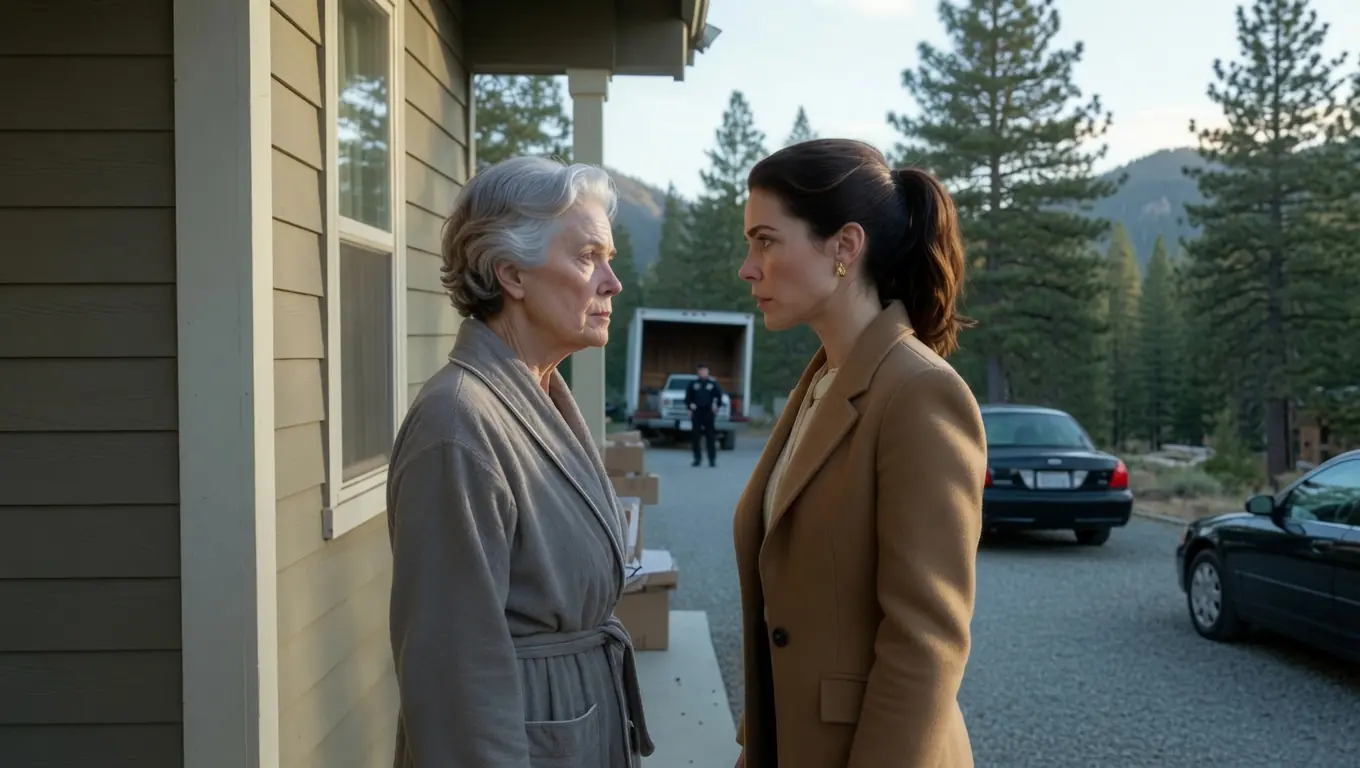
That was when I decided it was time. I stood, pulled on my robe, tied it neatly, and walked through the house toward the front door. My hands were steady. My breathing was calm. I opened the door and stepped onto the porch, teacup in hand, as if I had just woken from a peaceful sleep.
“Good morning, Melissa,” I said quietly. Every head turned toward me. The movers froze mid-step. The officer looked between us, and Melissa stared at me like she had seen a ghost. “You are supposed to be gone,” she whispered. “Gone where?” I asked. “This is my home. Why would I leave?”
Her mouth opened and closed, but no words formed. Color drained from her face as the realization settled in. She had been caught. The officer stepped forward. “Mrs. Harlan, are you the owner of this property?” “I am,” I said. “And I never gave this woman permission to enter my home or remove anything from it.”
Melissa’s voice broke. “You do not understand. She is confused. She does not remember signing the papers. I was trying to help.” “I remember everything,” I said calmly, “including the fact that I never signed anything you brought me, and that you forged my signature on documents you filed without my knowledge.” Her eyes filled with fury. She took a step toward me, and the officer moved between us.
“You set me up,” Melissa hissed. “This whole thing was a trap.” I met her gaze evenly. “No, Melissa. You built your own trap. I just made sure someone was watching when you walked into it.” The movers quickly packed up their equipment, apologized for the misunderstanding, and drove away. Their tires kicked up gravel as they disappeared down the driveway.
Melissa stood frozen, her face a mixture of shock and rage. She clutched her purse with trembling hands, her mind clearly racing for a way out. “This is not over,” she said. “You cannot prove anything. Those documents are legitimate.” I took a slow sip of tea. “I remember everything, Melissa. Every conversation, every document you brought, every signature you traced without my permission. And I have proof.”
Her eyes widened. “Proof?” I gestured toward the small camera mounted above the porch light. “This property has been under surveillance for weeks. Every visit you made. Every word you said. Including the day you broke in using a key you stole from my garden shed.” The color drained completely from her face. “You recorded me?” “I recorded someone entering my property without permission and claiming ownership. Yes.”
Another patrol car pulled up, followed by Ruth’s silver sedan. Ruth stepped out carrying her briefcase, calm and resolute. She handed the officer copies of the trust filing, sealed court order, forged documents, notary information, and evidence of identity theft and elder financial exploitation. The officer’s expression grew more serious with each page. “This is extensive,” she said.
“We have been building the case for weeks,” Ruth replied. “Mrs. Harlan suspected fraud and came to me for legal protection. Everything we did was by the book.” Melissa turned desperate. “She is a lonely old woman who does not understand what she signed. I was helping her. Daniel wanted me to help her.” “My son wanted no such thing,” I said quietly. “You manipulated him the same way you tried to manipulate me.”
The second officer told Melissa she needed to come with them for questioning. Her composure finally shattered. “You cannot do this. I have rights. I will call my lawyer. I will call Daniel.” “You are welcome to call anyone you like from the station,” the officer said. “But right now, you need to come with us.”
They escorted her to the patrol car. She turned back one last time, her eyes meeting mine. The fury was still there, but underneath it was fear, the realization that she had lost. “This is your fault,” she said. “You did this. You set me up.” I stepped to the edge of the porch. “I protected myself from someone who tried to steal everything I own. You built this trap, Melissa. Every lie, every forged document, every rumor. I only made sure there were witnesses when you revealed who you really are.”
When the patrol car drove away, the driveway fell silent except for the sound of birds beginning their morning songs. Ruth stood beside me, watching the taillights disappear. “You did well,” she said quietly. “Not everyone has the courage to fight back.” “I am a teacher,” I replied. “I have dealt with manipulation before. Just never from family.”
Ruth promised to handle the legal proceedings from there. Melissa would likely face charges for fraud, forgery, trespassing, and attempted theft. Then Ruth asked about Daniel. I knew he deserved the truth. After she left, I went back inside, locked the door, and finally allowed myself to breathe. The cabin felt lighter, as if a shadow had been lifted.
I called Daniel later that morning. “We need to talk,” I said gently. “Can you come to the cabin today?” He arrived around ten, concerned and confused. I made coffee, and we sat at the kitchen table. “Where is Melissa?” he asked. “She will not be coming,” I said.
I told him everything: the forged documents, the lies she had spread, the way she had tried to steal the property, the cameras, the recordings, the police. At first, he did not believe me. He shook his head, tried to argue, and insisted there had to be a mistake. But when I showed him the footage, when he heard her voice claiming the cabin as her own, and when he saw the forged signatures beside my real one, his face crumbled.
“I did not know,” he whispered. “Mom, I swear I did not know.” “I know you did not,” I said, reaching across the table to take his hand. “She fooled both of us at first. But I saw through it before it was too late.” Tears filled his eyes. “I should have listened to you.”
“You loved her,” I said. “That is not a crime. Trusting people is a good quality. She took advantage of it.” He stayed for hours. We talked. He cried. He apologized over and over until I finally told him to stop. By the time he left, the sun was beginning its descent behind the mountains.
Six weeks later, the court proceedings concluded. Melissa entered a plea agreement, admitting to forgery, attempted fraud, and trespassing in exchange for a reduced sentence. She received two years of probation, community service, and a permanent restraining order preventing her from contacting me or coming within five hundred feet of my property. The fake notary she had used faced separate charges. Investigators discovered she had been running a small operation forging documents for clients willing to pay.
Daniel filed for divorce three weeks after that morning on the porch. The proceedings were quiet, handled mostly through lawyers. He called me once during that time, his voice heavy with exhaustion. “I keep thinking about all the signs I missed,” he said. “The way she isolated me from you, the way she always had an answer ready before I could even form the question.” I told him love makes us see what we want to see, and that being human was not the same as being weak.
By early autumn, Daniel had moved into a new apartment closer to the mountains. We began having dinner once a week, slowly rebuilding the closeness we had lost during the months when Melissa controlled the narrative. He seemed lighter, freer, like someone who had been carrying a weight he did not recognize until it was finally lifted. As for me, I made a decision that surprised even myself. I started volunteering at a women’s resource center in town.
I taught workshops on financial protection, trusts, documentation, and recognizing manipulation. I called the sessions Safeguarding Your Future, and they filled up within days. I taught women how to recognize elder exploitation, protect their assets, document everything, and trust their instincts when something felt wrong. Every time I saw relief in their eyes, I knew I had turned something painful into something meaningful.
Spring arrived early the following year. Snow melted from the roof in steady drips, and wildflowers began pushing through the thawing ground. The mountains glowed under the morning sun, and the air smelled clean and new. I sat on my back porch with tea, watching mist rise off the trees. My phone buzzed with a text from Daniel, saying he was coming for dinner that weekend and wanted to bring fresh trout.
Life had returned to what it should have been all along: peaceful, simple, mine. I thought about that morning when Melissa stood on my porch, certain she had won, and the look on her face when she realized I had been three steps ahead the entire time. People often think revenge has to be loud, explosive, and cruel. But I learned something different. Revenge does not always roar. Sometimes, it simply signs the right papers one day earlier.
I took another sip of tea, the mountains stretching endlessly before me, and felt nothing but gratitude for the quiet strength that had carried me through. Melissa had underestimated me because of my age. She assumed I was weak, confused, and easily manipulated. She was wrong about all of it. I had protected my home, my son, and my peace, not by shouting louder, but by watching carefully, waiting patiently, and trusting the truth to expose itself.