The night I stopped feeding Lauren, the dining room smelled like butter, roasted chicken, and peach cobbler. I had spent the entire day in my kitchen, rolling biscuit dough, stirring gravy, checking the pot pie crust, and setting the table the way Michael used to like it. The plates were warm, the napkins were folded, and my grandchildren, Emma and Benjamin, were already sneaking glances at the dessert on the sideboard. For a few minutes, I let myself believe it might be a peaceful Sunday dinner.
Then Lauren slid her plate away from her with two fingers. She did it slowly, making sure everyone at the table saw the movement. Her manicured nail tapped the rim once, then twice, as if the food had personally offended her. “Nobody eats food like this anymore, Erica,” she said with a smirk.
The room went still. My son Ryan looked down at his plate, his shoulders tightening, but he did not say a word. Emma stopped reaching for a roll, and Benjamin looked from his mother to me with the confused expression children wear when adults turn cruel. I stood beside the table holding the serving bowl, feeling the warmth from the food rise against my hands.
Lauren leaned back in her chair. “Honestly, the only thing you’re good at is feeding people,” she added. “And even that feels outdated.” A few people gave nervous little laughs, not because the joke was funny, but because people often laugh when they are too uncomfortable to do what is right. Ryan kept staring at his plate.
That silence hurt more than Lauren’s words. I could have handled her sharp tongue if my son had looked up and said, “That’s enough.” I could have swallowed the insult if he had even touched my arm or given me one apologetic glance. Instead, he sat there like a man hoping the storm would pass if he did not move.
My name is Erica Knight, and for most of my life, food was the way I said love. My husband Michael and I once owned a small family restaurant outside Columbus, Ohio, called Knight’s Kitchen. It was never fancy, never modern, never the kind of place people photographed for magazines. But on cold evenings, the windows glowed, the rolls came out hot, and people came in tired and left feeling cared for.
Michael used to say people might forget the recipe, but they would never forget how the meal made them feel. For thirty years, we cooked side by side, serving pot pies, beef stew, biscuits, cobblers, roasts, and soups that warmed whole families. We watched children grow up, couples get engaged, widows find company, and tired workers sit down like someone had been waiting for them. Then cancer took Michael faster than I knew how to understand.
After he died, I sold the restaurant because every corner carried his voice. The back counter remembered his laugh, the stove remembered his hands, and the dining room remembered him walking table to table with coffee. I told everyone I was retiring, but the truth was quieter and sadder. I was hiding from a life that hurt too much to keep living the same way.
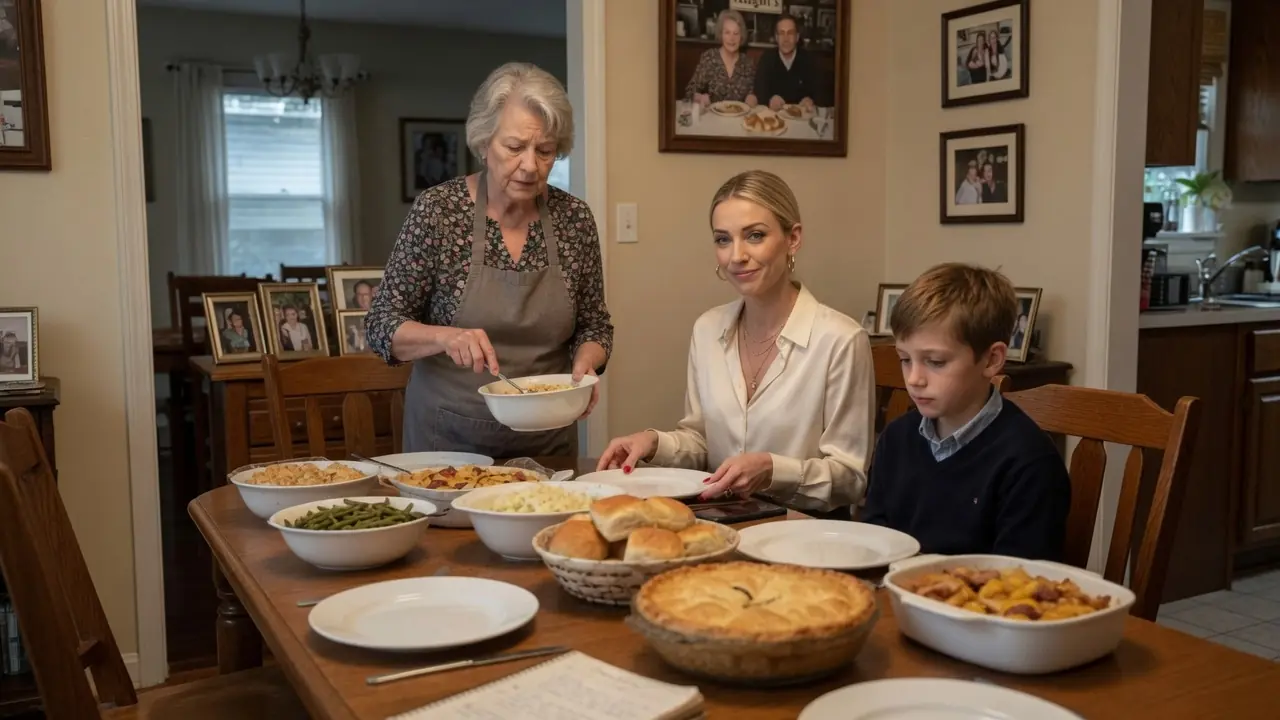
Cooking for my family became the one part of that old life I could still bear. Ryan loved my chicken pot pie, Emma loved baking apple pie with me, and Benjamin would eat three rolls before dinner if no one watched him. So I kept cooking, not because anyone forced me to, but because feeding them made me feel connected to who I had been before grief shrank my world. I did not realize that generosity without boundaries can slowly turn into something people expect instead of appreciate.
Lauren had not always been openly cruel. When Ryan first brought her home, she was polished, confident, and quick with compliments that sounded almost sincere. She worked in marketing, dressed beautifully, and spoke about trends, branding, image, and presentation as if every part of life had to be packaged properly. At first, I thought she was simply different from us.
The first little comment came a few months after their wedding. I had made roast chicken, mashed potatoes, green beans, and homemade biscuits, the same meal Ryan had requested every birthday since he was twelve. Lauren took one bite, laughed softly, and said, “Wow, people really ate like this every week back then?” I laughed too because I wanted to believe she was joking.
But the jokes kept coming. Too much butter, too many carbs, too heavy, too plain, too old-fashioned, too much like church-basement food. She always cleaned her plate, always packed leftovers, and always found time to criticize what she had eaten. That was the strange part: she wanted the food, but she wanted to look down on it too.
One Thanksgiving, after I spent two full days preparing dinner, Lauren walked around the table and said, “Every meal here feels like a museum exhibit.” Another time, she posted a picture of my casserole online with a caption about recipes that should have stayed in the last century. A church friend showed me the post by accident, and I still remember the burning in my face as strangers laughed at something I had made for my family. I handed the phone back and pretended it did not matter.
It mattered. Of course it mattered. Food was never just food to me; it was Michael, our restaurant, our hard years, our good years, and the way we held families together one meal at a time. Every insult from Lauren felt like she was laughing at pieces of my life.
Still, I kept cooking. I kept setting the table, wrapping leftovers, preparing birthday cakes, and pretending I was not hurt. Ryan’s answer was always the same when I mentioned anything. “She doesn’t mean it, Mom,” he would say, as if intentions mattered more than the wound they left behind.
But that Sunday evening, watching Lauren push the plate away and hearing my son’s silence, something inside me finally became clear. I did not raise my voice. I did not cry. I did not defend the meal, my recipes, or myself.
I simply smiled, picked up the serving bowl, and walked back into the kitchen. Behind me, the dining room remained quiet in that heavy way people get when they know something has shifted. I placed the bowl on the counter, untied my apron, and stood for a long moment looking at the food I had made with love. Then I made a decision.
Lauren Knight would never eat another meal from my kitchen.
The next morning, I woke before sunrise and sat at the kitchen table with coffee growing cold in my hands. For the first time in years, I was not planning the next family meal. I was not thinking about what Ryan liked, what Emma wanted to bake, or what Lauren would complain about while still asking for seconds. I was just thinking.
Memories returned in painful little waves. Christmas dinners, birthday parties, graduation gatherings, Sunday meals, school bake sales, church events, and every tray I had carried into someone else’s celebration. I remembered Lauren’s comments, Ryan’s silence, and my own weak laughter as I tried to make disrespect sound harmless. I saw the pattern clearly, and once I saw it, I could not pretend anymore.
Three days later, someone from my past reminded me who I used to be. I was standing in the produce section of the grocery store, choosing peaches by smell the way Michael had taught me, when I heard a familiar voice. “Erica Knight,” the man said, warm and surprised. I turned and saw Samuel Whitmore.
Samuel had been a regular at Knight’s Kitchen decades earlier. Back then, he owned a small construction company, wore work shirts with paint on the sleeves, and came in every Friday for pot roast. Now his hair was gray, his glasses were expensive, and people in town knew him as a successful developer with more projects than he could count. But his smile was the same.
We talked beside the peaches for nearly twenty minutes. He asked about Michael, about Ryan, about the grandchildren, and finally about cooking. “Do you still cook?” he asked. I smiled sadly. “Every week.”
“Good,” he said, and he meant it. “You have no idea how many people still talk about your food.” I assumed he was being kind because people often praise the past when they do not know how to talk about loss. But Samuel’s expression stayed serious.
“Erica, I’m not exaggerating,” he said. “Knight’s Kitchen comes up all the time when people talk about places this town misses.” I looked away because I did not know how to receive that. After years of Lauren calling my food outdated, hearing someone speak of it with respect felt almost impossible to believe. Samuel noticed more than I wanted him to.
Before he left, he handed me a business card. “Have lunch with me this week,” he said. “I want to talk to you about something.” I asked if he needed cooking lessons. He laughed and said, “No, I need you to remember who you are.”
That sentence followed me home. It sat beside me while I made coffee, while I folded towels, while I looked at the old photograph of Michael and me standing in front of Knight’s Kitchen on opening day. I had spent years letting Lauren’s voice become the loudest one in my head. Samuel’s voice sounded like a door opening.
That evening, Ryan called. His voice had the cheerful tension he used when he wanted something but hoped I would make it easy. “Mom, Lauren is planning a dinner party next month,” he said. I closed my eyes because I already knew where the conversation was going.
“How many people?” I asked. “Maybe thirty-five,” he said. Then, after a pause, “Could be closer to forty.” I looked at my quiet kitchen, at the recipe notebook still resting on the counter. “And Lauren wants me to cook?”
“Well, help with the food,” Ryan said. Help was a soft word for what he meant. Lauren wanted me to shop, prep, cook, bake, package, deliver, and probably clean up while she took credit for the presentation. I could hear the old expectation underneath his careful voice.
Then he said the part that made everything colder. “She wants it to look professional, so she doesn’t really want people to know family prepared it.” I stared at the wall. “So she wants my food,” I said, “but she does not want people to know I made it.”
“Mom, it’s not like that,” Ryan said quickly. But it was exactly like that. Lauren wanted the benefits of my labor without the embarrassment of acknowledging me. She wanted my cooking hidden behind her image.
“If my food embarrasses Lauren so much,” I asked, “why does she keep asking me to cook?” Ryan went quiet. The silence lasted long enough to answer for him. When he finally whispered, “I don’t know,” I almost believed him.
Two days later, Lauren appeared at my front door without calling. She wore expensive sunglasses and carried a designer handbag that probably cost more than the oven I used every week. She stepped inside before I invited her, sat at my kitchen table, and pulled papers from her purse. They were not requests; they were instructions.
The menu was detailed. Appetizers, main courses, side dishes, desserts, serving times, plating suggestions, and even notes about what should be carried in first. At the bottom of the second page was a section labeled “staff instructions.” Under it, one line read, “Kitchen personnel should remain in preparation areas during guest hours.”
I looked up slowly. “Am I the kitchen personnel?” Lauren shifted in her chair. “Erica, don’t make this weird.” I tapped the paper gently. “You made it weird when you asked me to cook for forty people and hide in the kitchen.”
Her smile thinned. “This dinner matters.” “I know,” I said. “So you’ll do it?” she asked, as if the answer had already been settled. I looked at her and saw the truth: Lauren did not believe I would say no.
But I did. Not then, not to her face, not fully. I folded the papers and slid them back across the table. “I’ll think about it,” I said, and Lauren left looking satisfied.
Three days later, Ryan called again. I could hear Lauren somewhere in the background, probably pretending not to listen. “Mom,” he said, “you’re helping with the dinner, right?” I took a breath so deep it almost hurt.
“No, Ryan,” I said. “I’m not.” The silence on the line was so complete that I wondered if he had dropped the phone. Then he said, “What?”
“I’m not cooking for the dinner.” My voice shook, but the words stood firm. “I have spent ten years being criticized, laughed at, and treated like my work is embarrassing until someone needs it. I love you, but loving you does not mean accepting disrespect forever.”
Ryan said he did not know I felt that way. That almost broke my heart because part of me believed him. I had smiled too often, swallowed too much, and laughed at jokes that hurt me. Maybe I had taught everyone that hurting me had no consequence.
Lauren left six voicemails the next morning. I listened to one. She called me selfish, dramatic, bitter, and said I was punishing Ryan over “a few jokes.” I deleted it before the end. For once, I did not call back to smooth things over.
The dinner party fell apart faster than anyone expected. The catering company Lauren hired canceled less than a week before the event, and every replacement wanted double the price. Lauren came back to my house that Thursday night looking stressed and sleep-deprived. “We need your help,” she said.
I sat across from her at the same kitchen table where she had once spread her instructions. “I’m sorry the caterer canceled,” I said. Her eyes narrowed. “But your answer hasn’t changed?” “No,” I said. “It hasn’t.”
“This could hurt Ryan’s career,” she said. There it was: guilt wrapped in my son’s name. A month earlier, it might have worked. That night, it did not.
“I love Ryan,” I said. “But this dinner is not my responsibility.” Lauren laughed bitterly. “I can’t believe you’re doing this.” I looked at her calmly. “I’m not doing anything. You made choices. Actions have consequences.”
She left angry, and I sat in my kitchen shaking after the door closed. Standing firm still felt unfamiliar, like walking on legs that had been asleep for years. But underneath the fear was something stronger. Peace.
Meanwhile, Samuel’s mysterious lunch became the beginning of something I never expected. He was developing a new restaurant called The Sunday Table, a place built around family-style meals, comfort food, tradition, and community. He wanted my recipes, my memory, my sense of hospitality, and my understanding of how food could make strangers feel like they belonged. He did not want me hidden in a kitchen like a secret.
He introduced me to Olivia Bennett, the young project manager helping shape the restaurant. Olivia nearly gasped when she realized who I was. Her grandmother had loved Knight’s Kitchen, especially the peach cobbler. Hearing that from a thirty-two-year-old woman who had never eaten there herself made something inside me ache in the best possible way.
For the first time in years, I spent my afternoons testing recipes with people who respected them. Olivia tasted my chicken pot pie and closed her eyes like she had found exactly what she was looking for. Samuel called my rolls “the anchor of the table.” I kept waiting for someone to laugh at me, but no one did.
Lauren’s dinner party happened on a Saturday night, and by ten o’clock Ryan texted me four words. It’s a disaster. Later he called and told me the caterers arrived late, two dishes were missing, the food was lukewarm, and one executive asked quietly if everything was all right. Lauren had spent weeks trying to create an image, and the image had collapsed under the weight of her own pride.
“I thought this was about food,” Ryan said on the phone. His voice sounded tired, but different somehow. “It wasn’t, was it?” I looked out my kitchen window into the dark. “No, sweetheart. It was never just about food.”
After that, things got worse before they got better. Lauren posted online, implying that an older family member had refused to support Ryan during an important moment out of pride. She wrote about loyalty, sacrifice, and people who “weaponize kindness.” She never used my name, but everyone knew.
The comments did not go the way she expected. Some people supported her at first, but then former customers, church friends, and old neighbors began asking questions. If my cooking was so terrible, why had she wanted it for such an important dinner? If I was so selfish, why had I cooked for every family event for years? Questions are dangerous when someone’s story depends on missing information.
Ryan called me the next day. His voice was quiet. “Lauren lied,” he said. For a long moment, I could not answer. Hearing my son say those words after years of excuses felt like a door opening in a room I had been locked inside.
He told me Lauren had been messaging people privately too, telling different versions of the story to coworkers, neighbors, and friends. In one version, I had abandoned the family. In another, I was jealous of Lauren’s success. Ryan sounded ashamed as he repeated the words.
“I should have protected you,” he said. That sentence nearly undid me. For years, I had waited for him to say something at the table, at holidays, on the phone, anywhere. Now the words had finally come, and they carried more sadness than victory.
Two days later, he came to my house alone. We sat in my kitchen for nearly two hours, talking about Michael, Lauren, the restaurant, and all the years I had stayed silent. Ryan admitted he knew Lauren’s comments bothered me, but he avoided conflict because it felt easier. “I told myself I was keeping peace,” he said. “But I was letting you pay for it.”
That was the truth. It hurt, but truth often does before it heals. I told him he could not change the past, but he could decide who he wanted to be from that moment forward. When he hugged me before leaving, it was the first real hug I had felt from him in years.
Lauren made one final attempt to regain control. She came to my house and suggested we “work together” on recipe videos and social media content around my story. She spoke quickly about branding, family traditions, and building an audience. The irony was almost breathtaking.
“You spent years insulting my recipes,” I said. “You embarrassed me publicly. You told people my food belonged in the past. Why would you suddenly want to build a brand around it?” Lauren looked uncomfortable, not sorry. “People change,” she said.
“People can change,” I answered. “But change requires honesty.” She asked what it would take, like respect was a negotiation. That told me everything I needed to know.
“No,” I said. She stared at me. “You’re not trying to fix this, Lauren. You’re trying to benefit from it.” Her face changed because the truth had finally reached a place she could not cover with a smile.
Before she left, she asked if I hated her. I did not. Hate requires more energy than I wanted to give. “I’m not doing this to you,” I told her. “I’m finally doing something for myself.”
The Sunday Table opened on a crisp Friday evening in early autumn. I stood outside the restaurant before the doors opened, staring at the sign with a nervousness I had not felt in decades. It was not Knight’s Kitchen, but somehow it felt like the life I had lost was finding a new shape. Samuel stood beside me and said, “You earned this.”
Inside, the tables filled quickly. Families laughed, friends leaned across plates, children reached for rolls, and the scent of pot pie, roast chicken, biscuits, and cobbler moved through the dining room like memory. People stopped me all night to share stories about Knight’s Kitchen. Some had been children when they ate there; others had heard about it from parents or grandparents.
At seven o’clock, Ryan arrived with Emma and Benjamin. The children ran to me first, shouting “Grandma” so loudly that half the restaurant turned. Ryan looked nervous when I hugged him. “I’m glad you’re here,” I said, and his eyes reddened.
Lauren did not come. Emma mentioned it before Ryan could stop her, saying her mother was not feeling well. Maybe it was true, maybe it was not. For the first time, I did not care enough to wonder.
Later that night, Samuel gave a short speech. He talked about community, memory, and the old restaurant people still missed. Then he pointed to me and told the room that The Sunday Table existed because Erica Knight had once taught an entire town how food could make people feel at home. The applause started slowly, then grew until people were standing.
I cried. Not because I needed applause, but because for years I had believed I was becoming invisible. Now I understood I had never been invisible at all. I had simply listened to the wrong voices.
After the restaurant closed, Ryan found me near the kitchen. He looked around at the empty tables, the stacked plates, and the last soft glow from the dining room lights. “I’m proud of you,” he said. Three simple words, but they reached a place in me that had waited a long time.
I never cooked another meal for Lauren. Not because I wanted revenge, and not because I wanted to punish her forever. I simply learned that access to my love, my labor, and my table required respect. Without respect, there would be no meal.
I still cook for Emma and Benjamin. I cook with them, actually, teaching them how to roll dough, season broth, and listen for the sound a pie crust makes when it is ready. Ryan joins us sometimes, and he washes dishes afterward without being asked. That small thing means more than he probably knows.
As for Lauren, our relationship is distant and polite. Maybe one day she will understand what she broke. Maybe she will not. That part is no longer mine to manage.
Lauren once said the only thing I was good at was feeding people. For years, those words hurt me. Now I know she was wrong in more ways than one.
I was not valuable because I cooked.
I cooked because I was valuable.
And once I remembered that, I finally stopped serving people who only came to the table to look down on what I gave them.