I should have known something was wrong the moment Brixton smiled at me. Not the thin, polite smile she usually gave me at family dinners, the one that said she was enduring my presence for Colin’s sake. This smile was bright, eager, almost sweet, and that was what made it frightening. In eight years of being my daughter-in-law, Brixton had never looked genuinely happy to see me before.
My name is Norma Whitfield, and I was sixty-three years old that night. I had called a small family dinner at my home to discuss my will, my late husband’s belongings, and the future of the house Colin grew up in. It was meant to be calm, practical, and private. Instead, it became the night I learned how far greed can go when it wears a pretty dress and calls itself family.
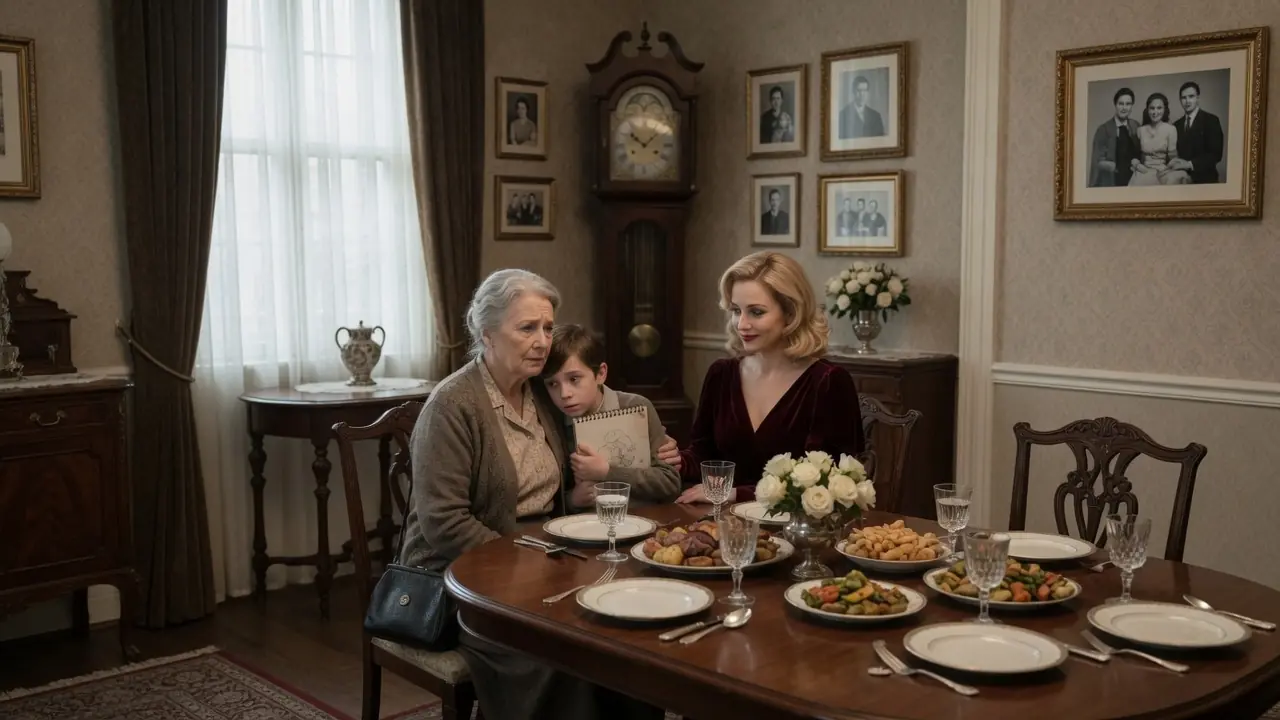
The dining room looked perfect when they arrived. The mahogany table gleamed beneath the crystal chandelier, white roses sat in the center, and my best china waited beside folded linen napkins. A roast dinner rested on the sideboard, the air carrying the smell of beef, buttered vegetables, and apple pie cooling in the kitchen. Soft natural indoor light from the tall windows mixed with the gentle ceiling glow, making the room feel warm enough to hide the coldness inside it.
Brixton stepped through the front door wearing a deep burgundy dress, styled blonde hair, flawless makeup, and expensive perfume that entered the hallway before she did. She kissed my cheek as if we were close, though her lips barely touched my skin. “Norma, you look absolutely radiant tonight,” she said. The compliment landed wrong, too shiny, like a coin placed over a dead man’s eye.
My son Colin followed behind her, looking tired from work and distracted the way he often did now. He was thirty-six, an architect with his father’s gentle eyes and his father’s weakness for believing the best of people. He hugged me quickly and thanked me for dinner, already glancing at his phone. Colin had no idea he had walked into a trap built inside his own family.
Then I saw Tommy. My twelve-year-old grandson stood in the doorway clutching his sketchpad against his chest. He had always been quiet, always watching, always drawing what adults tried not to say aloud. That night, his face was pale, his eyes darting between Brixton and me as if something terrible had already happened and he was waiting for the room to catch up.
“Tommy, sweetheart,” I said, opening my arms. “Come give Grandma a hug.”
He crossed the room slowly. When he wrapped his arms around me, I felt him trembling beneath his sweater. “Hi, Grandma,” he whispered, and there was fear in his voice, not shyness. Brixton’s hand came down on his shoulder immediately, possessive and firm.
“He’s just tired,” she said quickly. “Soccer practice after school, homework, too much screen time. You know how children exaggerate everything when they’re worn out.”
Tommy nodded because his mother expected him to. But when his eyes met mine, I saw the truth he was too afraid to speak. My grandson was not tired. My grandson was terrified.
We sat down to dinner with me at the head of the table, Tommy to my right, and Colin and Brixton across from us. Brixton talked too much. She praised the roast, admired the roses, asked where I bought the candles, and complimented my silver hair even though she had once suggested I dye it because “gray makes people look defeated.” Every sentence she spoke felt rehearsed.
As I carved the roast, she began talking about shopping downtown. New curtains, imported throw pillows, shoes she simply had to have, and a jewelry boutique on Fifth Street with a diamond necklace in the window. “Fifteen thousand dollars,” she said, eyes sparkling. “But worth every penny if you understand quality.”
I set the carving knife down carefully. “That is quite a lot for a necklace.”
“Oh, Norma,” she said, laughing softly. “You of all people should understand heirloom jewelry. You have that beautiful diamond necklace from your mother, don’t you? The vintage one worth about the same.”
The room tightened around me. I had not worn my mother’s diamond necklace in years, and I had never told Brixton what it was worth. It stayed locked in the jewelry box upstairs, wrapped in blue velvet, a piece my mother had worn on her wedding day and given to me before she died. For Brixton to mention it so casually felt like finding a stranger’s fingerprints on a locked door.
Her smile flickered, just for a breath. “Colin mentioned it once, I think.”
Colin looked up from his plate. “I don’t remember talking about Mom’s jewelry.”
The silence that followed was small but sharp. Brixton recovered quickly, taking a sip of wine and changing the subject as if she had not just stepped on a hidden wire. Tommy stared down at his plate, pushing food around without taking a bite. I could see his fingers trembling beside his sketchpad.
Then Brixton’s attention shifted to my purse. “Norma, where is that black leather bag you usually carry?” she asked. “The one with all the little compartments?”
I glanced toward the living room, where my brown purse rested on a side chair. “Upstairs, I think. I decided to use the brown one tonight.”
“Oh, you should use the black one,” she said quickly. “It looks so much better with your outfit. More elegant. More organized.”
“It’s only dinner,” I said.
“But this is a special family evening,” she insisted. “We are discussing important matters, aren’t we? Your will, your jewelry, the house. You should have everything important with you.”
Tommy’s fork clattered against his plate. Colin frowned at him, but I saw something close to panic cross the boy’s face. Brixton’s eyes flashed toward him, warning him without words. That look told me more than any confession could have.
I stood slowly. “Maybe I will get the black purse.”
Brixton rose at once. “I’ll help you find it.”
“That won’t be necessary,” I said.
“I insist,” she replied, already moving toward the stairs. “Besides, I’d love to see your bedroom again. It must be lonely keeping all this house by yourself.”
My bedroom felt smaller with Brixton inside it. She touched the frame containing my husband’s picture, studied the dresser, and glanced toward the jewelry box as if measuring distance. I retrieved the black leather purse from the closet and held it close. Brixton watched it with satisfaction she thought she had hidden.
“You know,” she said softly, “a house like this is a lot for one woman your age. Have you ever considered moving somewhere more manageable?”
“This is my home.”
“Of course,” she said. “For now.”
I turned to look at her. For a moment, the polite mask slipped, and I saw hunger underneath it. Not anger, not simple dislike, but hunger for things that belonged to me. Then she smiled again, smooth and empty, and followed me back downstairs.
Dinner continued, though none of it felt real anymore. Brixton asked about the house, my savings, my plans for the future, whether the will had been updated, and whether Colin knew where all my important documents were kept. She wrapped each question in concern, but I had taught school for thirty years before retiring. I knew when someone was testing answers for later use.
Colin, sweet fool that he was, heard only worry. “Mom,” he said, “Brixton does have a point. You live alone, and if something happened, who would know?”
“I am not helpless, Colin.”
“No one said helpless,” Brixton said. “But forgetfulness happens. Confusion happens. Last month you called the doctor’s office three times about the same appointment.”
“That appointment was changed twice.”
“And the dinner you forgot we were coming to?”
“You changed the date,” I said, looking straight at her.
Colin shifted uncomfortably. Brixton lowered her eyes as if wounded by my tone. She was good. So good that if I had not seen Tommy’s fear, I might have wondered if I really was becoming suspicious in my old age. That, I later understood, was the point.
When I served dessert, Tommy suddenly stood. “Grandma, can I show you something in the kitchen?”
Brixton’s hand tightened around her fork. “Tommy, sit down. We are eating.”
“Please,” he said, voice cracking. “It’ll only take a second.”
I rose before she could stop him. “I’ll be right back.”
The kitchen was only a few steps from the dining room, but it felt like entering another world. The white cabinets, blue tile, and window overlooking my rose garden had always calmed me. Tommy moved close to me, pretending to point at something near the counter. Then he hugged me tightly, his face pressed against my cardigan.
“Grandma,” he whispered, barely breathing. “Mommy put the diamond necklace in your purse.”
I froze.
“What?”
“She took it from your jewelry box upstairs when you were downstairs earlier,” he whispered. “She put it in your black purse. She’s going to call the police and say you stole it from that jewelry store.”
The room tilted. I gripped the counter so hard my fingers ached. My own daughter-in-law had not simply stolen from me. She had stolen my mother’s necklace, placed it in my purse, and planned to make me look like a thief.
“Are you sure, Tommy?”
He nodded, tears spilling down his cheeks. “I heard her on the phone. She said once the police find it, Dad will believe you’re getting confused. She said you’re too old to handle your own house and money.”
Every strange word from that evening snapped into place. The purse. The jewelry store. The questions about my will. The suggestions that I was forgetful. Brixton was not just trying to get me embarrassed; she was trying to make me look incompetent.
If the police found stolen jewelry in my bag, Colin would panic. Brixton would cry and say she had been worried for months. Then would come the lawyers, the doctors, the talk of power of attorney, the “safe facility,” the sale of my house for my own good. My life would be taken from me by people claiming they were protecting me.
I looked at my grandson’s frightened face. “You were brave to tell me.”
“I didn’t know what else to do.”
“You did exactly right.” I opened the black purse with shaking hands and felt inside. My fingers found the necklace almost immediately, cold and heavy beneath my wallet. I pulled it free, and the diamonds caught the kitchen light like tiny sparks of grief.
For one second, I wanted to storm back into the dining room and accuse her. But fury without proof would be exactly what Brixton wanted. She would say I was confused, emotional, paranoid. So I took a breath, slid the necklace into my cardigan pocket, and made a decision.
“Tommy,” I whispered, “go back to the table and act normal. Can you do that?”
He swallowed. “What are you going to do?”
“I am going to let your mother think her plan is working.”
I walked back into the dining room with the purse at my side and my mother’s necklace hidden in my pocket. Brixton looked at the bag first, then at my face. “Everything all right?” she asked sweetly. “You were gone a while.”
“Tommy wanted to show me a drawing,” I said.
Her eyes narrowed at him, and he shrank slightly in his chair. I wanted to reach across the table and shake her for making her own child so afraid. Instead, I sat down, lifted my fork, and took one calm bite of apple pie.
Ten minutes later, Brixton’s phone buzzed. She glanced at it, then widened her eyes in a performance so obvious I wondered how Colin had never seen through her. “Oh my goodness,” she said. “That was the jewelry shop on Fifth Street. Apparently a diamond necklace has been reported stolen.”
Colin frowned. “Why would they call you?”
“I was there today,” she said quickly. “They must be contacting people who visited. They said the police may come ask questions.”
“How strange,” I said.
Brixton looked at my purse. “Very strange.”
The doorbell rang at 9:15. Colin stood, but Brixton moved faster. “I’ll get it,” she said, smoothing her dress. “It’s probably about the necklace.”
Two officers entered behind her a moment later. The older one introduced himself as Sergeant Williams, and the younger one as Officer Chen. They were polite, professional, and clearly uncomfortable walking into a family dinner. Brixton stood beside them with her face arranged into worried reluctance.
“I hate to say this,” she began, “but my mother-in-law has been having some memory issues. Confusion, forgetfulness, odd behavior. I’m afraid she may have picked up something without understanding what she was doing.”
Colin turned toward me, devastated and confused. “Brixton…”
“I’m only trying to help,” she said, her voice trembling. “We all know Norma has not been herself lately.”
Sergeant Williams looked at me gently. “Mrs. Whitfield, would you mind if we looked in your purse? Just to clear this up.”
“Not at all,” I said.
I placed the black purse on the table and opened it. One by one, I removed my wallet, reading glasses, tissues, keys, and a small grocery list. Then I turned the purse upside down and shook it lightly. Nothing fell out.
Brixton’s smile disappeared.
“That’s everything,” I said.
The sergeant looked puzzled. Brixton stepped forward, her voice tight. “Maybe there’s another pocket.”
“You seem very familiar with my purse,” I said calmly.
Her face flushed. “I was only saying.”
Then I reached into my cardigan pocket and drew out my mother’s diamond necklace. “I do have a diamond necklace,” I said, letting it hang from my fingers beneath the chandelier. “This one belonged to my mother. It never leaves my house unless I take it for cleaning.”
Both officers leaned closer. Colin stared at it. Tommy held his breath.
Brixton went completely white.
“That proves nothing,” she said too quickly. “Maybe she has another one hidden somewhere. Maybe she moved it.”
Sergeant Williams turned toward her. “Ma’am, why are you so certain Mrs. Whitfield has stolen jewelry?”
“I’m concerned,” Brixton snapped. “Is concern a crime now?”
“No,” he said. “But filing a false police report is.”
The room went silent.
Then Tommy stood up.
His small voice shook, but it did not break. “Officer, I heard my mom say she put the necklace in Grandma’s purse. She was going to make Grandma look like she stole it.”
Brixton spun toward him. “Tommy, stop lying.”
“I’m not lying,” he said, tears on his face. “You said Grandma had to be out of the way.”
Colin stood slowly, his face draining of color. “Brixton, what is he talking about?”
She looked from Tommy to the officers to me. For the first time since I had known her, she had no perfect answer ready. The mask cracked, and panic showed through.
Sergeant Williams looked at her handbag resting near the sideboard. “Ma’am, would you mind if we checked your bag as well?”
“That is ridiculous,” she said.
“Then you refuse?”
“I did not say that.”
With shaking hands, she opened her designer bag and began removing items. Wallet. Lipstick. Phone. Keys. Compact mirror. Then Officer Chen pointed toward the bottom of the bag, where something bright caught the light.
A diamond necklace lay there.
Not mine.
The officer lifted it carefully. “Is this the item reported stolen?”
Brixton stared at it as if it had appeared by magic. “No. No, that was not there. She put it there.”
“Who did?”
“Norma,” she shouted. “She’s framing me.”
I looked at her quietly. “Interesting choice of words.”
Colin’s voice came out hollow. “Did you do this?”
Brixton’s face twisted. “I did this for us. For our future. She is sitting on this house and money while we drown in bills, and you worship her like she is some saint.”
“We are not drowning in bills,” Colin said.
She laughed bitterly. “You have no idea what we owe because you never ask. You just design buildings and pretend love pays for everything.”
The officers watched as Brixton destroyed herself with every word. She spoke of credit cards Colin did not know about, money she needed, my house, my savings, the life she believed she deserved. She admitted she had been building a story about my decline for months. She even said one arrest would have made Colin finally listen.
Officer Chen took out handcuffs.
Brixton looked at Tommy then, and the hatred in her eyes made my heart hurt. “My own son chose an old woman over his mother.”
Tommy stepped closer to me. “Grandma didn’t scare me into lying. You scared me into telling the truth.”
Those words ended the room.
Brixton was arrested in my dining room, beneath my chandelier, beside the white roses she had admired at the start of the evening. Neighbors watched from their porches as the police led her outside. Her perfect burgundy dress looked strange under the flashing lights, like a costume from a play that had gone terribly wrong.
After the officers left, Colin sat at the table with his head in his hands. Tommy curled against me on the sofa, shaking from everything he had carried. I held him and looked at my son, who appeared older than he had an hour before. Sometimes truth does not arrive gently. Sometimes it kicks the door open and leaves everyone staring at the wreckage.
“I should have listened,” Colin said.
“Yes,” I answered softly. “You should have.”
He flinched, but I did not take it back. Love is not protected by pretending pain did not happen. My son had trusted his wife so completely that he had ignored his child’s fear and his mother’s dignity. Forgiveness could come later, but first there had to be honesty.
Tommy asked if he could show the officers something else the next day. He brought out his sketchpad and a small recorder he had hidden from his mother. Page after page showed Brixton going through my mail, standing near my jewelry box, whispering on the phone, taking pictures of my documents. The recorder held conversations that made even Sergeant Williams go quiet.
Brixton had planned more than theft. She had planned control. She wanted Colin to take power of attorney, sell my house, and place me somewhere I could no longer interfere. She had even visited care facilities, choosing where I might be sent once she convinced everyone I was unfit.
The evidence turned the case into something much larger than a stolen necklace. Brixton was charged with theft, false reporting, attempted fraud, and elder exploitation. Her bail was set high, and Colin filed for emergency custody of Tommy the same week. The boy moved into my house with his father, and for the first time in months, he slept without locking his bedroom door.
The trial months later was painful but necessary. Tommy testified with quiet courage, describing what he heard and saw. Colin testified too, admitting how Brixton had manipulated him into doubting his own mother. I took the stand last, wearing my mother’s necklace, not as jewelry, but as proof that some legacies survive the hands that try to steal them.
Brixton received a long sentence. Not as long as my anger wanted, perhaps, but long enough for silence to return to my home. When they led her away, she did not look at me. She looked at Tommy, but he turned his face into Colin’s shoulder and did not give her the power of one last wound.
A year later, my dining room changed. I still kept the mahogany table, but I replaced the white roses with yellow ones because Tommy said they felt happier. Colin came for Sunday dinners and helped clear the dishes without being asked. Tommy brought his sketchpad every week, but now he drew sunlight on the table, biscuits in a basket, his father laughing, and me standing in the kitchen with flour on my sleeves.
One morning, he showed me a drawing of that terrible dinner. In it, Brixton sat in shadow, but Tommy had drawn a beam of light falling across my purse and his hand reaching for mine. “This is when I decided,” he said. “I was scared, but I knew I had to tell you.”
I kissed the top of his head. “You saved me.”
He shook his head. “You saved yourself, Grandma. I just gave you time.”
Maybe he was right. Brixton had counted on me being old, polite, trusting, and too stunned to fight back. She had mistaken kindness for weakness and silence for surrender. But she forgot that women like me had spent entire lives surviving storms without making speeches about it.
I still live in my house. My roses still bloom outside the kitchen window. My mother’s necklace stays locked away most days, but sometimes I take it out and hold it in my palm, feeling the weight of four generations of women who refused to disappear. And every Sunday, when my grandson sits beside me at the table, I remember the whisper that changed everything.
“Grandma, Mommy put the diamond necklace in your purse.”
Those words could have broken my life.
Instead, they saved it.