The morning my daughter-in-law tried to hand me my future in a coffee cup, the house looked peaceful enough to fool anyone. Sunlight slipped through the tall Beacon Hill windows, laying bright squares across the walnut floors and the stone fireplace where my husband Charles used to stand with his morning paper. Quarterly reports sat neatly on the coffee table beside legal folders, company charts, and the blue porcelain cup I had used for more than twenty years. Everything looked like a family business meeting, but in truth, it was the first act of a betrayal planned with a smile.
My name is Evelyn Whitmore. I was sixty-four years old that October, a widow, a mother, and the owner of Whitmore Industries, a manufacturing company worth twelve million dollars. Charles and I had built it together from one struggling workshop and a line of small local contracts. After he died from a heart attack fifteen years earlier, people assumed I would sell, retire, and let men in suits tell me what my life should become.
I did not sell. I learned every part of the business, from supplier negotiations to payroll, from factory schedules to client dinners. I made mistakes, corrected them, and grew the company beyond anything Charles and I had dared to imagine. I was proud of that, not in an arrogant way, but in the way a woman is proud when she survives the thing everyone expected to break her.
My son, Carlton, joined the company five years before that morning. He was thirty-nine, tall, well-dressed, and capable enough when he wanted to be. He was not brilliant, but he was family, and I believed family deserved patience. His wife, Ever, came in two years later as marketing director, and at first, I thought she brought energy and polish we needed.
Ever was the kind of woman people trusted too quickly. She had blonde hair styled in perfect waves, bright green eyes, and a voice that could soften even the sharpest insult. She remembered birthdays, sent handwritten notes, and made every room feel like she had entered it with a gift. But there was something in her attention that often felt less like love and more like management.
That Tuesday morning, Carlton had asked for a family meeting about succession planning. He said he and Ever wanted to discuss the future of the company and make sure we were all on the same page. I agreed because I had been thinking about that future too. At my age, it was reasonable to consider how Carlton might take more responsibility over time.
Reasonable, however, did not mean immediate. Whitmore Industries was still my company, still my responsibility, and still a living piece of my marriage to Charles. I was not ready to sign over control because someone thought silver hair meant weakness. I had planned to listen, review, and make careful decisions, exactly as I had done for decades.
Rosa Martinez had been with my household for twenty years. She was in her early fifties, Latina American, quiet, practical, and so careful with my home that she could carry a tray of crystal glasses without a single sound. She knew how I liked my coffee, where Charles’s old cufflinks were kept, and which family photographs I dusted myself because I could not bear anyone else touching them. In all those years, I had never once seen her truly clumsy.
Carlton arrived at exactly ten o’clock. He wore a navy suit, a pale tie, and the expensive watch Ever had given him for their anniversary. He kissed my cheek in the quick, polished way he had adopted in recent years, more gesture than affection. Then he sat in Charles’s old armchair as if he had already inherited it.
Ever arrived fifteen minutes later with pastries and an insulated coffee carrier. That alone struck me as strange because Rosa had already made my usual coffee in the kitchen. Ever smiled brightly and said she had stopped by a new place on Newbury Street because she wanted me to try something special. “You work so hard, Evelyn,” she said, setting the carrier down. “You deserve to be spoiled for once.”
The words were sweet. Her eyes were not. She poured the coffee into my favorite blue porcelain cup instead of one of the disposable cups from the carrier. She knew I loved that cup because it had belonged to my mother, and that knowledge made the gesture feel intimate, almost tender. I thanked her, though a small unease settled in my chest.
Carlton opened his leather briefcase and pulled out a thick stack of papers. “Mom, before we get emotional, we should be practical,” he said. “The company needs a transition plan, and Ever and I have already had some lawyers look over the basic structure.” He slid the papers toward me as if he were offering help instead of pressure. “It’s mostly a formality.”
I looked at the first page but did not pick up the pen. The language was dense, full of transfer clauses, authority changes, and legal phrases that sounded far too permanent for a first discussion. “This looks more advanced than a conversation,” I said. Carlton’s smile tightened. Ever leaned closer and touched my wrist lightly, as if calming an elderly woman who did not understand her own benefit.
“Evelyn, darling,” she said softly, “you do not have to carry everything alone anymore.” Then she nudged the coffee cup toward me with two fingers. “Drink first. You look tired.” That was when I noticed she was watching the cup more than she was watching me. Carlton was watching it too.
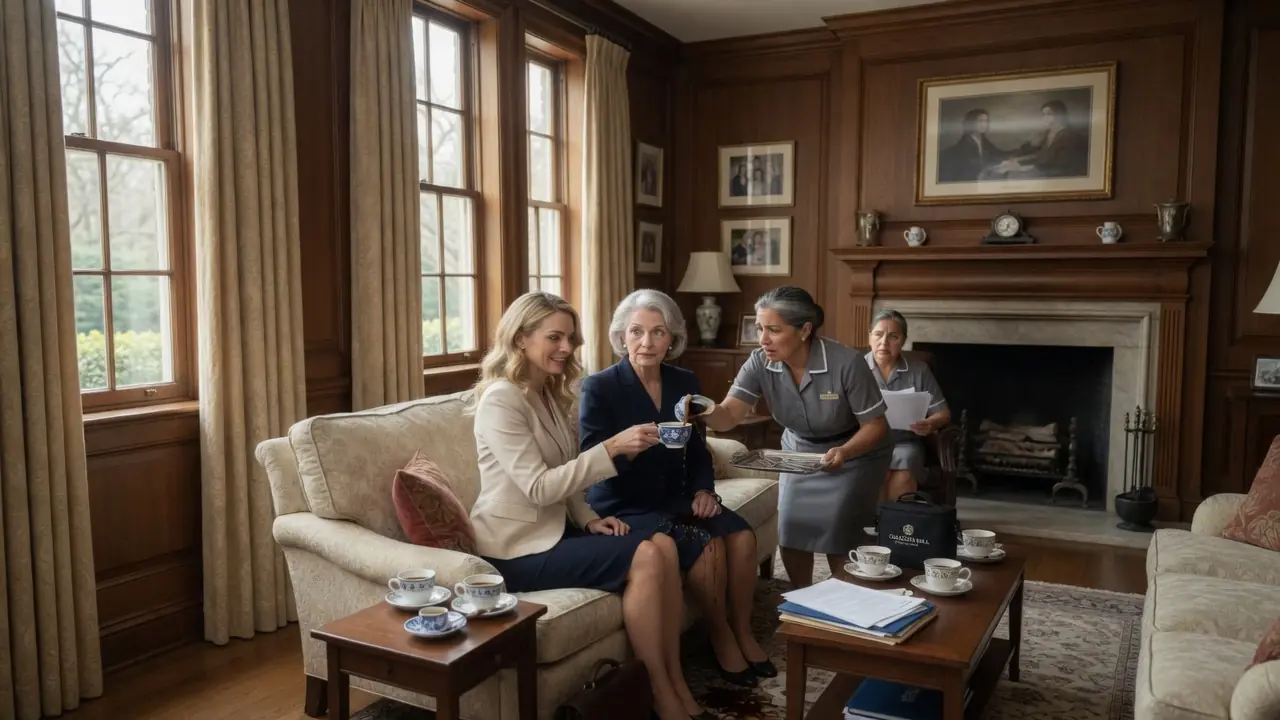
I lifted the cup to my lips and took a small sip. The flavor was sharper than I expected, slightly bitter beneath the rich roast. Almost immediately, a strange warmth moved through my chest, and a faint heaviness settled behind my eyes. I told myself I was anxious, that business meetings with family could make anyone tense. Still, I set the cup down.
Ever noticed. “You barely drank any,” she said, her smile still bright but her voice tighter now. She reached for the cup and pushed it toward me again. “Don’t let it get cold.” Carlton tapped the stack of documents with two fingers, an impatient little slap against the paper. “Mom, we need to get through this today.”
Rosa appeared beside my chair at that exact moment. She carried a tray of silverware that had no reason to be in the living room. Her face was pale, her mouth pressed into a line. As she leaned down to place the tray on the side table, she stumbled hard into my arm.
The blue porcelain cup tipped. Coffee splashed across my lap, the rug, and the edge of the coffee table. Ever jerked backward as if the spill had struck her instead of me. “Rosa!” she snapped, her polished mask cracking. “What is wrong with you? Are you completely useless today?”
Rosa dropped to her knees with a cloth before anyone else could move. “I am sorry, Mrs. Whitmore,” she said loudly, but when she looked into my eyes, her voice fell to a whisper. “Do not drink any more. Just trust me.” The words were so quiet they barely moved the air. Yet they hit me harder than if she had shouted.
For twenty years, Rosa had never spoken to me like that. She had never inserted herself into family business, never dramatized, never exaggerated. The fear in her eyes was real. In the space of one breath, the living room changed from a meeting room into a stage where only I had finally noticed the props.
Ever stood over Rosa, pointing toward the stained rug with a stiff finger. “You ruined a complete set,” she said. “Do you have any idea what that cup means to Evelyn?” The insult was absurd because Ever had been the one who used the cup. Carlton stood too, his face flushed with anger. “Rosa, get out if you cannot do one simple thing properly.”
“No,” I said. My voice was not loud, but it stopped them both. I looked down at the spilled coffee, then at the documents, then at Ever’s face. “Let her stay.” Ever blinked, and for the first time all morning, she looked uncertain.
Ever recovered quickly and grabbed her own cup. “Here,” she said, forcing a laugh. “Take mine. I barely touched it.” She lifted it as if to pour into another porcelain cup, but Rosa moved again. This time she bumped Ever’s wrist, and the coffee splashed across the transfer papers on the table.
Carlton exploded. He slammed his hand down so hard the legal folders jumped. “Enough! Are you drunk, Rosa? Or just stupid?” Rosa flinched but did not answer. Ever stared at the wet papers with a look so cold and panicked that it told me more than any confession could have.
I sat very still. The warmth in my chest had faded, but the heaviness behind my eyes remained. I had taken only one small sip, yet something in me felt wrong enough to notice. Ever, who had been so eager for me to drink, suddenly seemed eager to postpone the entire meeting.
“Well,” she said, touching her hair though not a strand was out of place, “maybe we should reschedule. The papers are ruined, Evelyn is upset, and Rosa is clearly having some kind of episode.” She laughed again, but the sound was thin and brittle. “No need to push through a mess.”
“Actually,” I said, reaching for the soaked documents, “I would like to read them now.” Carlton’s jaw tightened. Ever sat slowly on the sofa, her eyes moving from me to Rosa and back again. I could feel the room holding its breath.
The first few pages were difficult to read beneath the coffee stains, but enough was visible. The transfer was not temporary. It would remove me from daily control, place Carlton as acting chief executive, and give Ever expanded authority over company communications and accounts. A separate page mentioned health-related contingencies that had never been discussed with me.
I looked up. “Who drafted these?” Carlton said our attorneys had reviewed them. I asked which attorneys. He hesitated, and Ever cut in too quickly. “Evelyn, don’t turn this into an interrogation. This is exactly why Carlton worries about you. You make everything combative.”
There it was. The first open push toward making me look unstable. I heard it clearly now, the shape of the plan beneath her words. If I questioned the documents, I was combative. If I refused to sign, I was confused. If I felt dizzy after drinking what she handed me, I was declining.
Rosa stood near the fireplace, pretending to wipe the spilled coffee from the floor. But her eyes stayed on me, pleading silently. She had saved me from finishing the cup. She had saved the documents too, not by preserving them, but by forcing Ever and Carlton to reveal how desperate they were.
Carlton picked up the wet pages and threw them onto the table with a crude slap. “This is ridiculous,” he said. “You asked me for years to prepare for leadership, and now that I’m ready, you act like I’m stealing from you.” Ever leaned forward, her sweet voice gone. “Maybe if you stopped clutching that company like a frightened old woman, your son would not have to drag you into the future.”
The words were ugly enough to clear the last fog from my mind. I looked at Ever, then at Carlton. “A frightened old woman?” I repeated. Ever’s face tightened, but she did not apologize. Carlton looked away.
I stood, slower than I wanted to because my body still felt heavy. “This meeting is over.” Carlton scoffed. Ever rose too, smoothing her skirt. “Evelyn, don’t be dramatic,” she said. “You spilled coffee, the papers got wet, and now you’re inventing a conspiracy.”
Before I could answer, Ever swayed. It was slight at first, just a loss of balance as she reached for the arm of the sofa. Then her face changed. She pressed one hand to her forehead and said, “I feel strange.” Her voice had lost its sharpness.
Carlton rushed to her side. “Honey?” he asked, suddenly all concern. Ever tried to stand, but her knees weakened, and she sank back onto the sofa. Her skin looked pale, her eyes unfocused. Rosa went completely still.
“Call 911,” I said. Carlton grabbed his phone. For all his visible panic, something in his performance felt wrong. It was not the desperate terror of a husband watching his wife collapse. It was the terror of a man watching a plan go off course.
The paramedics arrived quickly. Ever was taken to Boston General, and Carlton insisted I ride with them. During the ambulance ride, he held Ever’s hand and said all the correct things. “Stay with me, baby. You’re going to be fine.” But his eyes kept cutting toward me, measuring how much I understood.
At the hospital, doctors took Ever inside while Carlton and I waited in a room that smelled of disinfectant and fear. He paced, called someone, hung up when I looked at him, then called again. When a doctor said Ever had consumed something harmful and that police might need to test the remaining coffee, Carlton’s jaw shifted. “I should call Rosa and have her clean up the mess before anyone gets to the house,” he said.
“No,” I said quietly. “Leave everything exactly where it is.” He turned toward me too fast. “Why?” I looked at him carefully. “Because if something was in that coffee, the police will need to see the room as it was.” For one second, fear flashed in his eyes before anger covered it.
I excused myself and walked outside. My hands trembled as I called Rosa. She answered on the first ring, breathless, as if she had been waiting with the phone pressed to her palm. “Mrs. Whitmore,” she said. “Is Mrs. Ever alive?”
“She is alive,” I said. “Now tell me what you know.” Rosa was silent for a moment. Then she said words that made the sidewalk tilt beneath my feet. “Mrs. Ever has been putting something in your coffee for weeks. I have notes. I have pictures. I finally could not watch it anymore.”
I closed my eyes. The headaches, the weakness, the strange dizziness before board meetings, the moments when I had wondered if age was finally catching me. It had not been age. It had been betrayal, served in porcelain and stirred with a smile.
Rosa asked to meet at a small café six blocks from the hospital. I went without telling Carlton. When I arrived, she was already sitting in the corner with a notebook and a folder clutched in her hands. She looked terrified, but when she saw me, she stood like someone ready to testify before God himself.
She showed me dates, symptoms, photographs, and notes written in precise handwriting. She had seen Ever arrive early before meetings, take over the coffee service, and add drops from a small vial into my cup. She had noticed I only became ill on mornings when Ever handled my coffee. That morning, Rosa said, Ever had used much more than usual.
“I heard her tell Mr. Carlton that everything would be finished today,” Rosa whispered. Her eyes filled with tears. “I knew it was not just to make you weak anymore.” She gripped my hand with both of hers. “You helped my daughter when she needed surgery. You treated me like family. I could not let her hurt you.”
“Carlton knew?” I asked, though I already knew the answer. Rosa nodded. She told me he had been meeting with lawyers, moving business funds, and discussing changes to my will. She had seen paperwork about insurance policies I had never authorized. The words landed one by one, each heavier than the last.
I sent Rosa straight to the police with everything she had gathered. Then I returned to the hospital, where Carlton was now standing beside an expensive lawyer named David Richardson. He introduced him as the family attorney, though I had never hired him. David smiled smoothly and said we needed representation because police investigations could become complicated.
“How thoughtful,” I said. Carlton looked relieved, mistaking my calm for ignorance. The doctor returned soon after and confirmed that Ever had consumed a dangerous substance. The police had already been notified. Carlton’s face went pale, but he recovered quickly enough to ask whether his wife would survive.
She would. That mattered to me, though perhaps not for the reason he hoped. Ever would live long enough to explain herself. More importantly, she would live long enough to face what she had tried to do.
By evening, detectives had spoken to Rosa, searched parts of the house, and secured the coffee cups, carrier, and documents. Detective Sarah Chen interviewed me at the station. She had sharp eyes and a calm voice that made lying feel pointless. I told her everything, from Rosa’s staged spill to the strange meetings and Carlton’s insistence on having the mess cleaned.
Detective Chen listened without interruption. Then she told me Rosa’s evidence matched what the police had begun to find. There were suspicious financial transfers, hidden policies, and items in Ever’s office that confirmed the danger had been deliberate. Hearing it from a detective made the truth feel final in a way my suspicions had not.
Carlton called me that night while I sat in a hotel room I had checked into because I could not return home. At first, he sounded frantic. He said Rosa was lying, Ever would never hurt me, and the police were twisting everything. When I told him I knew about the money, the insurance, and the coffee, his voice changed.
“You can’t prove anything,” he said. There was my son, stripped of performance. Not frightened for me, not ashamed, not heartbroken, only calculating. I stared out at the Boston skyline and felt something inside me break quietly. “This family ended the moment you decided I was worth more gone than alive,” I said, then hung up.
The next morning, Carlton was arrested. Ever was charged from her hospital bed after investigators found enough evidence to show she had not been a victim of circumstance. The news spread quickly because wealthy families falling apart in ugly ways always attract attention. Reporters gathered outside Whitmore Industries, eager to turn my grief into headlines.
I refused interviews. I had no interest in becoming a spectacle. Instead, I focused on protecting the company, supporting Rosa, and cooperating with the investigation. Rosa was shaken because Carlton had tried to frame her as the easiest suspect, the housekeeper with access to the cups. But she had been smarter than they expected.
The trial months later was brutal. Recordings were played. Financial records were presented. Rosa testified with quiet dignity, explaining how she had watched, recorded, and finally acted when she believed that morning’s cup was meant to end my life. Ever sat at the defense table with her perfect hair gone dull, no longer able to hide behind charm.
Carlton’s lawyer tried to paint him as manipulated by Ever. Ever’s lawyer tried to suggest Carlton was the mastermind. Listening to them blame each other would have been almost funny if the truth had not been so devastating. They had loved each other only until accountability entered the room.
When I gave my victim statement, I did not look at Ever. I looked at Carlton. I told the court that the worst part was not fear, illness, or even the company theft. The worst part was realizing my own son could smile at me across a living room while waiting for a cup of coffee to finish what his greed had started.
“I forgive you because I will not carry hatred for the rest of my life,” I said. “But forgiveness is not trust, and it is not reconciliation.” Carlton lowered his head, but I could not tell whether it was shame or strategy. By then, I no longer needed to know.
The jury convicted them both. Their sentences were severe, and I did not attend the final hearing. I had heard enough of their voices and watched enough of their faces. On the day they were sentenced, I sat with Rosa at the kitchen table in a temporary apartment and drank coffee from a plain white mug.
For months afterward, I could not drink coffee without thinking of that morning. Rosa noticed, of course. One day, she placed a cup in front of me and said, “This one is safe because I made it.” She smiled gently, and for the first time in a long while, I laughed. It was small, but it was real.
I sold the Beacon Hill house. Too many rooms had been poisoned by memories, and I did not want to grow old inside a crime scene dressed as a home. I bought a smaller colonial in Wellesley, with a garden, good light, and a guesthouse that Rosa eventually moved into. She refused at first, saying it was too generous, but I told her family does not live out in the cold.
Whitmore Industries survived. I rebuilt the leadership team, removed every person Carlton had placed for his own benefit, and hired independent auditors to repair the damage. The company stabilized faster than anyone expected. Perhaps betrayal had made me sharper, or perhaps I had always been stronger than Carlton believed.
A year after the trial, I started the Whitmore Foundation with Rosa as executive director. Its mission was to help older adults facing financial abuse, coercion, and danger from the people closest to them. We worked with banks, hospitals, law enforcement, and social workers to identify warning signs early. I funded it with money Carlton had tried to steal.
Rosa became the heart of the foundation. She understood quiet fear, the kind victims carry when the danger lives at the dinner table. She knew how to listen without judgment, how to ask the question people were afraid to answer, and how to see the truth behind polite family smiles. Every time she helped someone, I thought of the silver tray in her hands and the coffee spilling across my lap.
Years passed. I never saw Carlton again. He wrote letters, but I returned them unopened because some doors should stay closed after people try to bury you behind them. Ever wrote nothing, which suited me perfectly.
Ten years later, I still begin most mornings with coffee. I am seventy-four now, older than the woman Ever tried to erase, and far more alive than she ever expected me to be. Rosa and I sit in the garden when the weather is clear, two silver-haired women sharing a ritual that once nearly became my ending. Every cup reminds me that love does not always come from blood.
My daughter-in-law handed me coffee before a meeting. My housekeeper spilled it on purpose. At the time, it looked like clumsiness, disrespect, maybe even a ruined morning. But that one crude, desperate, beautiful act saved my life and opened my eyes.
Carlton and Ever thought they were clever because they understood paperwork, money, and appearances. They forgot that loyalty has eyes. They forgot that the people they dismissed as servants, old women, and obstacles could still think, watch, remember, and act. Most of all, they forgot that a woman who built a twelve-million-dollar company after losing her husband was not going to disappear just because someone handed her a cup and smiled.