Walter Brandt stood in the doorway of his son’s clean modern kitchen with a stuffed bear tucked under one arm and his heart already trying to forgive the coldness before it even happened. The house in Oakville looked perfect from the outside, with trimmed hedges, a swept porch, and white curtains pressed neatly against the windows. Inside, everything smelled of lemon cleaner and expensive coffee, but somehow the air felt less like a home and more like a place where permission had to be granted. He had driven nearly an hour from Hamilton just to spend two hours with his grandson Noah, and he had told himself all the way there that today might be different.
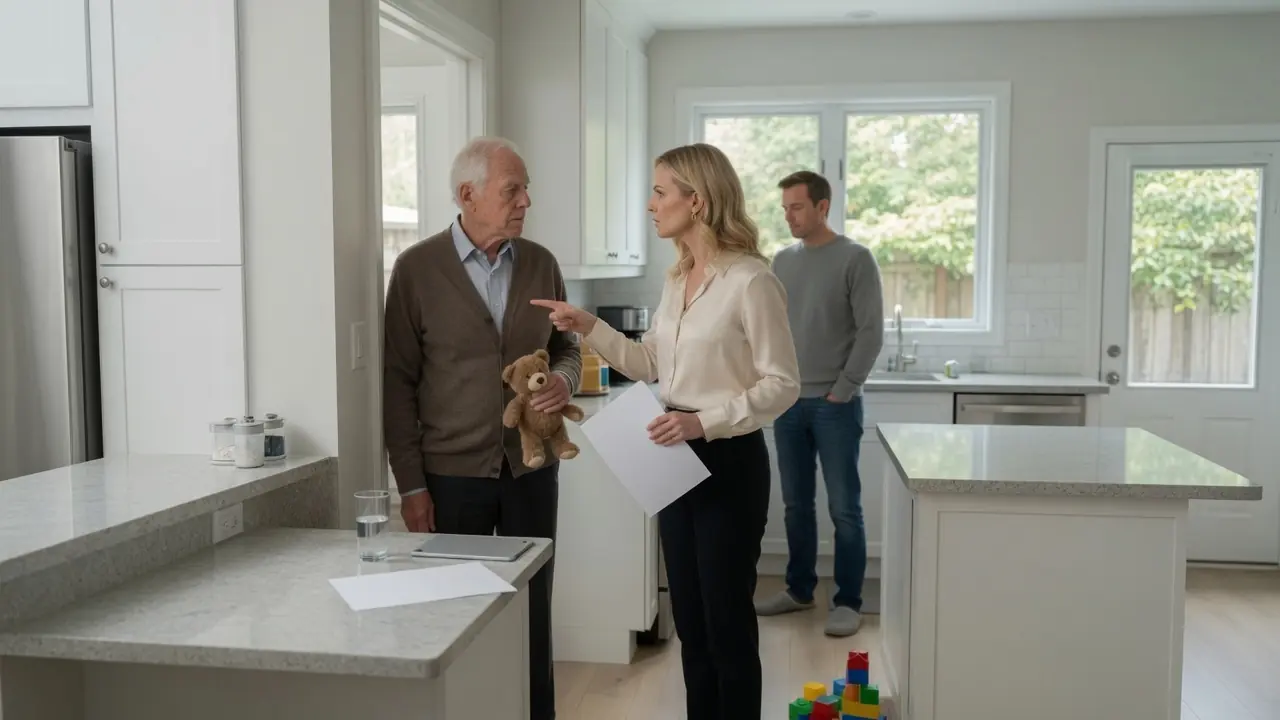
Vanessa Brandt made sure it was different for the wrong reason. She stood across from him beside the kitchen counter, polished and sharp in a cream blouse, black tailored pants, beige heels, and gold earrings that flashed whenever she moved her head. Her blonde hair was perfectly styled, her green eyes were cold, and her mouth had the tight smile of someone who had rehearsed being reasonable while preparing to be cruel. In one hand, she held a laminated sheet of paper, and with the other, she pointed one stiff finger toward Walter’s chest.
“You don’t walk in here like this is your home, Walter,” she said loudly. Her voice carried through the kitchen, past the hallway, and toward the back room where Noah was playing with blocks. Walter looked down at her finger, then at the bear under his arm, and for a second he felt foolish for bringing something soft into a room that had no softness left in it. He was sixty-seven years old, a retired civil engineer, a widower, and a grandfather, yet Vanessa spoke to him as if he were an unwanted repairman who had entered through the wrong door.
“I only came to see Noah,” Walter said quietly. That was the truth, and it was simple enough that he hoped it might still matter. Vanessa laughed once, not because she found anything funny, but because she wanted Michael to hear it. Michael stood near the back of the kitchen in a gray sweater and jeans, looking down at the floor as if the tiles had answers he was too ashamed to ask his father for.
“Then learn your place,” Vanessa snapped, pointing harder now. “Grandfather does not mean you get access whenever you want.” Walter’s face remained calm, but something in his chest sank slowly, like a beam giving way under weight it had carried too long. He had not come unannounced; he had called two days earlier, just as Vanessa required. He had parked on the street, not the driveway, just as Vanessa required, and he had brought a toy instead of food because food now needed prior approval.
The laminated rule sheet slapped against the kitchen counter when Vanessa set it down. “I made this so there can be no confusion,” she said. “No unapproved gifts, no financial conversations with Michael, no asking Noah personal questions, no taking photos, and no visits longer than two hours.” She tapped the bottom of the page with one manicured nail. “And if you want continued access, you sign it.”
Walter heard the word access and felt his late wife Diane move through his memory like a warm hand on his shoulder. Diane had held Noah in the hospital just two weeks before her cancer diagnosis, looking at the baby as if God had handed her a candle for the road ahead. She used to say Noah was the universe giving her something beautiful to see before leaving. Now Vanessa had turned that beauty into terms, clauses, and conditions.
Michael cleared his throat, but it was not a defense. “Dad, Vanessa just wants things to run smoothly.” Walter looked at his son, and the disappointment was so heavy he had to breathe before answering. Michael was forty-one now, with tired blue eyes, brown hair, and the nervous posture of a man who had spent years confusing peace with obedience.
Three years earlier, Walter had not imagined it would come to this. Back then, he had stood in the same kitchen with a stuffed bear for Noah’s third birthday while Vanessa slid the first version of the rule sheet toward him like she was presenting a lease. No unannounced visits. No bringing food. No taking Noah anywhere without written consent forty-eight hours in advance. He had read it twice and smiled because what else could he do when the woman his son married handed him a document to govern how he loved his grandchild?
At first, Walter told himself Vanessa was just particular. Some people needed structure, and he had spent his entire career respecting structure. As a civil engineer, he understood load, pressure, boundaries, and the invisible stresses that made things crack if nobody measured them properly. But families were not bridges, and love was not supposed to require signatures before it could stand.
After Diane passed, the house in Hamilton became too quiet. Walter would wake before sunrise expecting to hear her spoon tapping against a mug, then remember she was gone. Sunday visits with Noah became the one bright square on his calendar, the one place where grief did not win the whole day. Noah had serious gray-blue eyes, Diane’s eyes, and he said “Grandpa Walter” as if both words were part of a magic spell.
Then the visits began shrinking. Two hours became ninety minutes. Sunday became Saturday only. Gifts required approval, photos became forbidden, and one afternoon Walter drove nearly an hour only for Vanessa to open the door and tell him Noah was tired. He stood on the porch for four minutes, listening to his grandson laugh somewhere inside the house he had helped them buy.
That was another wound Walter rarely touched in public. When Michael and Vanessa bought the Oakville house, Walter had given them sixty thousand dollars from a small inheritance his father had left him. No conditions, no contract, no repayment schedule, no hidden pride attached to it. He had written the check because they were family, and family money was supposed to help roots grow deeper.
Vanessa seemed to remember the money differently. To her, the sixty thousand had not made Walter generous; it had made him useful. Over time, he felt her measuring him, deciding how much access a widowed grandfather deserved in exchange for what he had already given. Then came the proposal that finally made the room go cold inside him.
Michael had asked to meet at a Tim Hortons halfway between Hamilton and Oakville. He sat across from Walter with a coached expression and explained that Vanessa believed regular contact with Noah should include a monthly family support contribution. Eight hundred dollars a month, transferred to an account Vanessa controlled, as a condition for predictable visits. Walter looked at his son and realized he was being asked to pay rent on his own blood.
He did not shout in the coffee shop. He did not call Vanessa names, and he did not shame Michael in public. He simply said he needed time to think, then drove home in a silence that pressed harder than anger. That night, he sat at the kitchen table where Diane used to sort recipes and admitted to himself that peace had become another word for surrender.
The next morning, he called Reginald Forsyth, a family law attorney in Hamilton whose card had been sitting in a drawer for months. Reginald was patient, precise, and not easily shocked. He told Walter to save every email, every text, every rule sheet, and every canceled visit. Then he told Walter to call his accountant and pull the records related to the sixty thousand dollars.
Sandra Obi, Walter’s accountant, had handled his taxes for twenty years and kept files with almost frightening discipline. When she pulled the transfers, she found something Walter had not noticed clearly before. Part of the money he gave Michael and Vanessa had moved through their joint account, then slowly into a separate account under Vanessa’s name. Roughly twenty-two thousand dollars had been shifted over fourteen months in small transfers that did not look dramatic until they were placed in a timeline.
Walter stared at the documents in Sandra’s office for a long time. The betrayal did not feel loud at first. It felt like seeing cracks in a wall he had trusted, then realizing the cracks had been there for years. He wondered whether Michael knew, and the more he thought about it, the more certain he became that his son did not.
For the next seven weeks, Walter said nothing. He kept calling ahead for Saturday visits, kept parking on the street, kept bringing only approved gifts, and kept sitting on the beige sectional while Noah showed him puzzles and dinosaur drawings. Vanessa watched from the kitchen as if supervising a contractor. Michael drifted in and out, always kind enough to avoid being cruel, never brave enough to be good.
Noah asked him once why he looked sad. Walter touched the boy’s hair and said, “I’m just thinking.” Noah tilted his head and asked, “About what?” Walter smiled then, because the answer was the only part of the whole mess that remained simple. “About how much I love you.”
When Reginald finally called and said the documents were ready, Walter felt no triumph. He felt tired, but steady. The legal demand letter was clean and exact, explaining the sixty thousand dollars, the redirected funds, the unreasonable restrictions, and Walter’s intention to pursue formal access if necessary. Sandra prepared a financial summary with every transfer, every date, and every account clearly listed.
Walter placed both documents in a large brown envelope. He did not show it to Vanessa first because Vanessa had controlled enough doorways already. He called Michael and asked to come by that Saturday as usual. Michael said yes, his voice distracted and weary, not knowing that his father was bringing something heavier than a stuffed bear.
That Saturday, Walter drove to Oakville with the envelope on the passenger seat. He wore his brown cardigan, pale blue shirt, dark trousers, and simple black shoes. He brought Noah a small nature book about herons because Noah had once called them big gray birds during a walk near the creek. He also brought the stuffed bear again, not because he expected Vanessa to approve it, but because a grandfather should not have to arrive empty-handed like a man on probation.
Vanessa opened the door and immediately looked at the bear. “I told you gifts need approval.” Walter nodded once. “I know.” Her eyes narrowed because calm annoyed her more than argument. “Then why are you standing here with that?”
Before Walter could answer, Noah’s footsteps pattered somewhere in the hallway. Vanessa turned sharply, then looked back at Walter with that hard public smile. “We are not doing this today,” she said, pointing at his chest again. “You don’t get to test me in my own house.”
Michael appeared behind her, his expression already anxious. “What’s going on?” Vanessa pointed at the bear. “Your father is ignoring the rules again.” Walter looked past Vanessa and held out the envelope to Michael. “I brought this for you.”
Michael hesitated before taking it. Vanessa tried to snatch it first, but Walter pulled it back gently and kept his eyes on his son. “No. This is for Michael.” The words were quiet, but the line was clear enough that even Vanessa paused.
Michael opened the envelope in the kitchen doorway. Walter stood in front of him, Vanessa at his side, Noah half-visible in the hall with his hands wrapped around a toy truck. The kitchen was spotless, the counter clear except for the laminated rule sheet, a glass of water, and a closed tablet. In that clean, controlled room, the brown envelope looked almost rude.
Michael read the first page. Confusion passed over his face, then concern, then something darker. He turned to the second page, and the color left his cheeks. Vanessa leaned closer, trying to see, but Michael turned slightly away from her without realizing he had done it.
“Dad,” he said slowly. “What is this?” Walter kept his voice steady. “A letter from my lawyer and a report from my accountant.” Michael looked at Vanessa, then back at the pages. “What account?”
Vanessa’s face changed. It was the smallest shift, but Walter saw it because he had spent weeks waiting for the truth to touch her. She laughed too quickly. “This is ridiculous. Walter is upset because we asked for boundaries.” Walter looked at her. “The transfers are documented, Vanessa.”
Michael stared at her. “What transfers?” Vanessa’s lips tightened. “Household savings.” Walter said nothing and let the papers do their work. There are moments when silence is not weakness but proof that the truth no longer needs help standing.
Michael read further, his hands shaking slightly now. “Twenty-two thousand dollars into an account only in your name?” Vanessa folded her arms, but her confidence had begun to crack. “I was protecting Noah’s future.” Michael looked up. “Why didn’t you tell me?”
Noah whispered, “Daddy?” and Michael’s face broke for a second. He crouched, kissed his son’s forehead, and asked him to play in the living room. Noah looked at Walter first, and Walter managed a soft smile. “I’ll be right here, buddy.”
When Noah disappeared, Vanessa turned on Walter with fury. She pointed at him again, closer this time, her finger trembling with anger. “You had no right to bring this into my house.” Walter looked at the finger, then at Michael. “I helped pay for this house, and I have every right to defend myself when my grandson is used as leverage.”
Vanessa’s voice rose. “You are not his parent. You are not in charge here. You are a lonely old man who can’t accept that this family has rules.” Michael flinched, but this time he did not look at the floor. Walter saw it. Something in his son had finally reached its limit.
“Vanessa,” Michael said, his voice low. “Stop.” She turned toward him, shocked, as if his refusal had broken a law older than marriage. “Excuse me?” Michael held up the financial report. “Did you move my father’s money into your account?”
Vanessa began explaining. She said it was for Noah, for household stability, for emergencies, for planning, for things Michael did not understand because she was the one keeping everything together. The words came fast, then faster, each one trying to cover the last. Walter sat down at the kitchen table without being invited because he had stood long enough.
Michael remained standing. His face looked less angry than wounded, which was worse. He had the expression of a man realizing that the pressure he had mistaken for structure was control, and the peace he had defended had been purchased with his father’s humiliation. Vanessa kept talking until she ran out of story.
Then the room went quiet. The laminated rule sheet sat on the counter between them like evidence of another kind. Michael picked it up and read it again, perhaps for the first time not as a husband trying to avoid conflict, but as a son seeing what his father had been made to endure. His mouth tightened.
“Dad,” he said, barely above a whisper. Walter looked at him. Michael’s eyes shone, but Walter did not rush to comfort him. Some realizations need to hurt long enough to become useful.
“I’m sorry,” Michael said. Vanessa made a scoffing sound, but Michael did not look at her. “I’m sorry I let this happen.” Walter felt the words land inside him, not enough to heal everything, but enough to mark the first honest sentence spoken in that kitchen in years.
Vanessa grabbed the rule sheet from Michael’s hand. “You’re letting him manipulate you.” Michael turned to her fully. “No. I let you manipulate me.” That sentence struck harder than any shout could have. Vanessa stared at him as if he had become a stranger.
The argument that followed was not loud at first. It was worse than loud. It was specific. Michael asked about the account, the eight hundred dollar demand, the canceled visits, the rule sheets, the way Vanessa spoke to Walter, and why every family boundary somehow seemed to leave her with more control and his father with less dignity.
Walter did not enjoy watching his son suffer. He had not brought the envelope to destroy Michael’s marriage, though Vanessa would later accuse him of exactly that. He brought it because truth hidden for too long becomes poison. If Michael’s home could only stay peaceful while Walter paid, obeyed, and stayed silent, then the peace was not real.
Noah wandered back into the kitchen during a pause, clutching the toy truck. “Can Grandpa stay?” he asked. The question was small, innocent, and devastating. Michael looked at Walter, then at Vanessa. For once, he answered without checking her face first. “Yes. Grandpa can stay.”
Vanessa left the kitchen, saying she needed air. Her heels struck the hallway floor with sharp little sounds. Michael sat across from Walter at the table, the documents spread between them. For several minutes, neither man spoke.
Finally, Michael said, “I didn’t know about the account.” Walter nodded. “I hoped you didn’t.” “But I knew enough,” Michael said. “I knew how she talked to you. I knew the visits were getting smaller. I knew you were hurt.” Walter’s throat tightened, but he kept his voice calm. “Knowing and acting are two different things.”
Michael covered his face with both hands. “I was tired of fighting.” Walter looked around the spotless kitchen. “So you let me do the losing.” Michael lowered his hands, and the shame in his face was no longer avoidant. It was awake.
That day did not fix everything. Real life rarely turns on a single envelope and becomes easy. There were phone calls with Reginald, meetings with financial advisors, hard conversations between Michael and Vanessa, and arguments Walter was not invited to hear. The marriage did not break because of the envelope; it broke because the envelope revealed where it had already cracked.
Six months later, Michael and Vanessa separated. Walter did not celebrate it. He understood that divorce was not a victory parade, especially when a child stood in the middle of it holding questions no adult could answer cleanly. But Noah began spending Saturday mornings with Walter again, not as a privilege Vanessa rationed, but as part of a real schedule Michael defended.
Their first Saturday together after the separation was cold and bright. Walter picked Noah up at nine, and the boy ran to the car with a backpack bouncing behind him. They drove to the conservation area near Hamilton, where the creek moved dark and slow under bare branches. Noah spotted a heron near the water and shouted, “Big gray bird!”
Walter laughed, the sound surprising him. It had been months since laughter had left his body without effort. He wanted to correct the word heron, then decided not to. Diane would have loved big gray bird better anyway.
They walked for nearly an hour, talking about leaves, mud, school, and whether frogs slept in winter. Noah held Walter’s hand when the path grew slippery. The grip was small and trusting, and it reminded Walter of everything Vanessa had tried to turn into policy. Love, when it is healthy, does not need to point a finger to prove its authority.
Later, back in his Hamilton kitchen, Walter placed the stuffed bear on a chair beside Noah’s drawing paper. Noah named it Mr. Buttons and gave it a job guarding the crayons. Walter watched him play in the afternoon light and thought of Diane holding him in the hospital. He wished she could have seen this day, but some part of him believed she was near enough to know.
The sixty thousand dollars was eventually addressed during Michael and Vanessa’s separation. Not every dollar returned. Not every wound found a neat ending. Reginald told Walter that some losses were not worth chasing forever, and Walter understood because he had spent his career knowing which repairs mattered most.
What mattered was Noah calling him again without fear in his voice. What mattered was Michael learning that being a good husband did not require being a silent son. What mattered was that Walter no longer stood in kitchen doorways waiting for permission to be family.
Vanessa’s pointed finger stayed in his memory, but it no longer controlled him. It became a symbol of the moment he finally understood that being calm did not mean being powerless. The envelope had not been revenge. It had been a load-bearing truth, placed carefully where the whole structure could no longer ignore it.
Walter still kept copies of everything in a file cabinet. Emails, rule sheets, transfer records, legal letters, and the final visitation schedule. Not because he wanted to live in suspicion, but because documentation had taught him what kindness alone could not. Love needs trust, but trust should never require blindness.
Sometimes Michael came over for coffee after dropping Noah off. The conversations were still awkward, but honest awkwardness was better than polished denial. He apologized more than once, and Walter accepted each apology without pretending all the pain had vanished. Forgiveness, he had learned, was not a switch; it was a road, and no one had the right to demand he reach the end before he was ready.
On Noah’s seventh birthday, Walter brought the stuffed bear back with a small blue ribbon tied around its neck. No one asked for approval. No one handed him a rule sheet. Noah hugged the bear, then hugged Walter, and Michael looked away with wet eyes.
That night, after driving home, Walter set a photo of Noah on the kitchen windowsill beside the photo of Diane holding him as a baby. The boy’s gap-toothed grin filled the frame, bright and careless in the way only children can be when adults finally stop making love complicated. Walter stood there for a long time with one hand resting on the counter.
He thought about the day Vanessa pointed at his chest and told him to learn his place. He had learned it, though not the way she meant. His place was not outside the door, not beneath a rule sheet, not at the mercy of a woman who mistook control for motherhood. His place was beside his grandson, beside the truth, and beside the quiet dignity he had nearly surrendered just to keep the peace.
And the next Saturday morning, when Noah called from the front step, “Grandpa Walter, hurry up,” Walter smiled as he opened the car door. No contract. No permission slip. No laminated rules. Just a boy, his grandfather, and a love that had finally found its way back home.