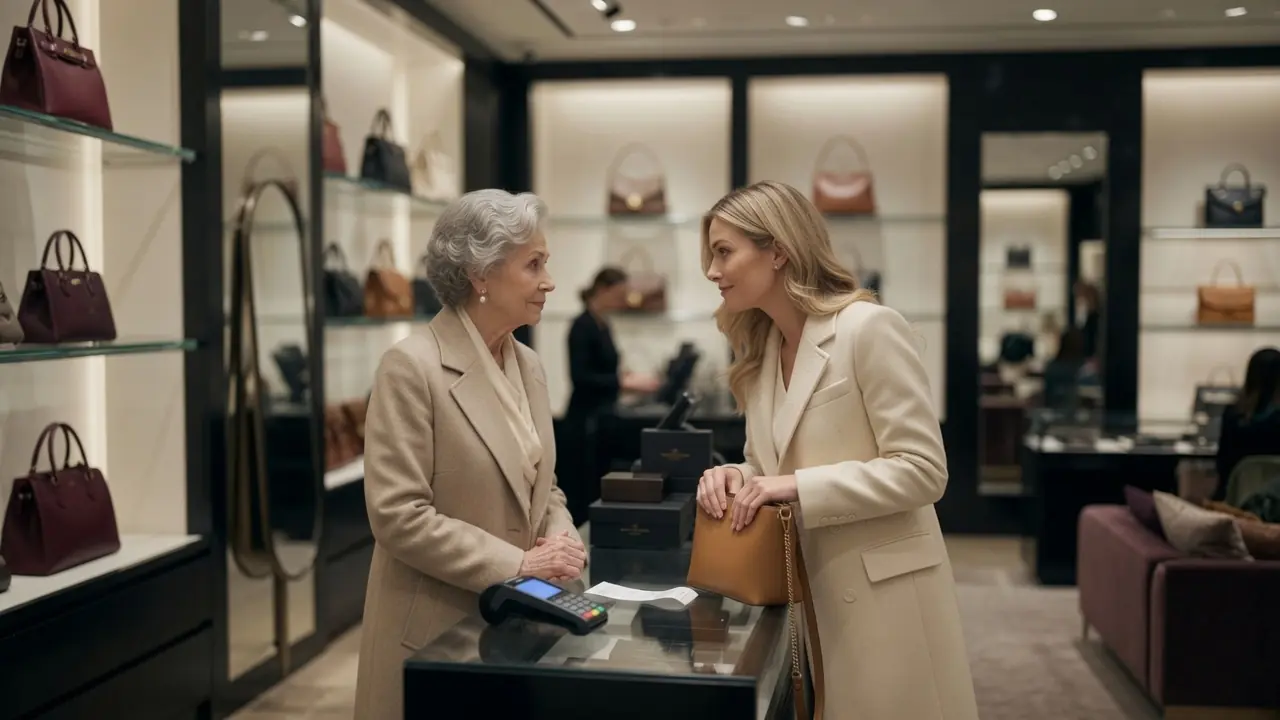
Carla Moreno knew something was wrong the moment Bianca touched her purse and smiled. They were standing inside a luxury handbag boutique in Fresno, surrounded by glass shelves, soft lighting, polished mirrors, and handbags displayed like museum pieces. Carla stood on the left side of the checkout counter in her beige wool coat, hands folded neatly in front of the card reader, while her daughter-in-law stood beside her in a cream designer coat, pretending to search through a tan shoulder bag she had opened three times already. On the counter between them sat a boutique receipt for an ivory leather handbag, and Carla could feel the trap forming before Bianca said a word.
Bianca Moreno was thirty-four, beautiful, polished, and very skilled at turning other people’s discomfort into her convenience. She had married Carla’s only son, Daniel, seven years earlier, and at first Carla had tried hard to like her. Bianca was charming when she wanted something, affectionate when someone important was watching, and delicate enough with words that insults often arrived dressed like jokes. For a long time, Carla told herself the girl was simply young, ambitious, and raised in a different kind of family.
That afternoon had been sold as a “girls’ shopping day.” Bianca had texted Carla the night before, saying she wanted to spend time together without Daniel in the middle. Carla had been surprised, even touched, because Bianca rarely invited her anywhere unless a holiday required it. She ironed her cream blouse, put on her pearl earrings, and drove herself to the boutique with the quiet hope that maybe, after all these years, her daughter-in-law finally wanted more than polite distance.
The boutique was the kind of place Carla would have walked past in her younger years without even checking the window. Every bag cost more than her first month’s rent after her husband Luis died, and the sales associates spoke softly, as if full voices might damage the merchandise. Bianca moved through the store as though she belonged there, touching leather, comparing colors, and asking questions about seasonal collections. Carla followed slowly, smiling when expected, though she felt the old pinch of not being quite the right kind of woman for the room.
Bianca chose an ivory leather handbag with a gold clasp and placed it on the counter with practiced confidence. “This one is perfect,” she said, turning toward Carla with that bright little smile that never quite reached her eyes. “Elegant, clean, not too flashy.” Carla nodded politely and said it was lovely, though she had no intention of encouraging such an expensive purchase.
Then Bianca picked up a second handbag, a brown designer tote with soft handles and a matching scarf tied around one side. “Mom would love this,” she said casually. Carla blinked. “Your mother?” Bianca laughed lightly, as if Carla was slow. “Yes, Tessa. She’s been having such a hard month, and I told her I’d bring her something beautiful.”
Carla’s smile faded a little, but she said nothing. Tessa Lane had never treated Carla as family, only as a useful older woman connected to Daniel. She called Carla “sweetheart” in a tone that made the word feel smaller than kindness, and she often spoke about money as if other people’s generosity was a sign of good manners. Carla had paid for Tessa’s brunch once, then salon parking, then a birthday arrangement Bianca claimed would be reimbursed later.
At the checkout, Bianca laid both handbags on the glass counter. The sales associate, a young woman named Erin, smiled professionally and scanned each item with careful hands. The total appeared on the small black screen, and Carla felt her stomach tighten. Bianca’s bag alone was already outrageous, but with Tessa’s tote, the number climbed high enough to make even Erin glance once toward Bianca’s purse.
That was when Bianca patted her bag. Once. Twice. Then she opened it wider, tilted her head, and widened her blue eyes in a performance Carla had seen before. “Oh my God,” Bianca said, loud enough for Erin to hear. “I think I left my card at home.”
Carla did not move. Bianca laughed softly and touched Carla’s arm as if they were sharing a cute family moment. “You can handle this one, right, Carla?” she said. “I’ll get you back later.”
There it was. Later. The favorite word of people who borrow without intending to repay. Carla looked at the receipt, then at Bianca’s perfectly shaped nails resting near the card reader. She remembered the restaurant dinner where Bianca’s payment app had suddenly frozen, the spa deposit that somehow landed under Carla’s name, the florist bill for Tessa’s birthday that Daniel said was “not worth making awkward.”
“You chose both bags before checking whether you could pay,” Carla said quietly. Bianca’s smile tightened. “Don’t say it like that. I just forgot my card.”
“You said that last month at the salon,” Carla replied. Bianca’s eyes flashed. Erin lowered her gaze to the counter, pretending not to hear, but everyone who works a checkout counter learns how to listen without looking. Bianca leaned closer, her perfume sweet and expensive. “Carla, don’t embarrass me over money.”
Carla felt something inside her become very still. For years, she had allowed that exact fear to control her: don’t embarrass the family, don’t upset Daniel, don’t make Bianca feel judged, don’t make a scene. She had paid bills she did not choose because she worried that saying no would make her look cold. But standing in that boutique beside two handbags Bianca had selected without permission, Carla suddenly saw the pattern clearly enough to name it.
“You’re asking me to pay for your pride,” Carla said. Bianca’s mouth opened slightly, shocked less by the words than by the fact Carla had spoken them in public. Then the shock turned to contempt. “Please,” Bianca said, her voice sharpening. “You act like you’re poor every time the bill comes out.”
The words hit harder than Carla expected. She had never been poor in the way people whispered about, but she had lived carefully, especially after Luis died. Every dollar had been tracked, saved, invested, stretched, and protected because widowhood teaches a woman that stability can disappear in one hospital hallway. Bianca saw thrift and mistook it for weakness.
“I am not acting,” Carla said. “I am deciding.” Bianca gave a small laugh that sounded like a slap. “Deciding what? Whether you want to help your daughter-in-law in front of a stranger?”
Erin’s face remained professional, but her cheeks had turned pink. Carla looked at the young cashier and felt a flash of sympathy. No employee should have to stand inside someone else’s family performance. Bianca, however, seemed to enjoy having an audience, because an audience made pressure stronger.
“You’re the mother-in-law,” Bianca said, louder now. “This is what you’re supposed to do.” Carla turned slowly toward her. “No, Bianca. I am not here to pay for your image.”
Bianca’s smile vanished completely. “Wow,” she said. “So now you’re making me look cheap.” Carla looked at the two handbags, the receipt, and the card reader waiting like a judge. “No. I am letting the bill show who ordered it.”
For a second, Bianca said nothing. Then she grabbed her phone from her purse and began typing furiously. Carla knew who she was texting before the screen even lit up with Daniel’s name. Bianca never argued alone for long; she always called in Carla’s son like a manager summoned to calm a difficult customer.
“My husband is going to be furious,” Bianca muttered. Carla folded her hands again. “Then he can be furious with the truth.”
Daniel called less than a minute later. Bianca answered on speaker without asking Carla’s permission. “Danny, your mother is humiliating me in public,” she said, instantly changing her voice into something trembling and wounded. “I forgot my card, and she’s acting like I’m trying to use her.”
Carla watched the lie form and settle comfortably on Bianca’s tongue. For years, she had wondered how Bianca twisted stories so quickly. Now she understood that the speed came from practice. Daniel’s voice came through the phone, tired and cautious. “Mom? What’s going on?”
Carla stepped closer to the counter. “Your wife chose two designer handbags, one for herself and one for Tessa. The total came up, and only then did she remember that she forgot her card again.” Daniel was silent for a moment. Bianca jumped in quickly. “I was going to pay her back.”
Carla looked at Bianca. “Like the salon deposit? The birthday dinner? The spa package? The boutique deposit from last Christmas?” Another silence came from Daniel’s end, and this one told Carla he knew more than he had ever admitted. Bianca’s face tightened when she heard it too.
“Mom,” Daniel said carefully, “maybe just cover it today, and we’ll sort it out later.” Carla closed her eyes for one second. There it was: Daniel’s peace, wrapped in her money. He did not want to confront his wife, so he asked his mother to absorb the cost and call it love.
“No,” Carla said. Bianca stared at her. Daniel exhaled. “Mom.” Carla’s voice stayed calm. “No, Daniel. I am not paying for handbags I did not choose so you can avoid an argument.”
Bianca’s cheeks flushed. “This is unbelievable.” Carla picked up the receipt and turned it toward Bianca. “Yes. It is unbelievable that you expected this to work again.” Erin stood behind the register, still silent, but Carla could feel her attention sharpen.
Bianca turned away from the phone, lowering her voice into a hiss. “You’re being cruel.” Carla almost laughed. Cruelty had become the word people used when generosity finally developed a boundary. She looked at Bianca’s expensive coat, perfect hair, and trembling hands, and realized her daughter-in-law was not frightened by poverty or embarrassment. She was frightened by losing access.
“I have been kind to you,” Carla said. “You turned that kindness into a habit.” Bianca looked toward the door as if escape had suddenly become more attractive than victory. “You don’t understand how family works.”
“I understand exactly how family works,” Carla replied. “Family asks. Family thanks. Family does not pretend to forget a card after choosing gifts for someone else.” Daniel’s voice came through the phone more softly. “Bianca, did you really pick a bag for your mom too?”
Bianca’s head snapped toward the phone. “That is not the point.” Carla looked down at the receipt again. “It became the point when you pushed both bills toward me.”
The young cashier finally spoke, quietly but clearly. “Ma’am, would you like me to separate the purchases?” Bianca turned on her immediately. “No one was talking to you.” Erin stiffened, and Carla felt anger move through her like a clean flame.
“You will not speak to her that way,” Carla said. Bianca blinked, thrown off by the firmness in Carla’s voice. “She is doing her job. The problem is standing beside me.”
Daniel said Bianca’s name in a warning tone. Bianca ignored him. “Fine,” she snapped, grabbing her purse. “Separate them. I’ll pay for mine when I get home.” Erin looked at the boutique policy card near the register. “We cannot release unpaid merchandise.”
Bianca laughed bitterly. “Obviously.” Carla looked at the handbags. “Then leave them here.” Bianca’s face changed as if Carla had suggested abandoning a child. “I already told my mother I got it for her.”
“That was your promise,” Carla said. “Not mine.” Daniel was quiet again, but Carla sensed something shifting through the phone. Perhaps for the first time, he was hearing the transaction without the soft blur of Bianca’s version.
Bianca pressed her lips together, then pulled a sleek black card from a side pocket in her purse. Carla saw it clearly. Erin saw it too. Daniel must have heard the silence because he asked, “Bianca, do you have a card?”
Bianca froze. Carla felt the truth enter the boutique like a door opening. “I thought you forgot it,” Carla said. Bianca’s hand tightened around the card. “This one is almost maxed out.”
The sentence sat between them, uglier than the lie. Carla felt no triumph, only a deep tiredness. Bianca had not forgotten anything. She had gambled that Carla would rather pay than expose her.
Erin ran the card for Bianca’s handbag first. It approved. Bianca looked both relieved and furious, as if the payment terminal had betrayed her by working. Then Erin ran the card for Tessa’s tote, and the terminal gave a sharp little beep.
Declined. Bianca’s face went pale. Daniel heard it through the phone. “What was that?” Bianca grabbed the card back. “Nothing.”
Carla looked at the second handbag, then at Bianca. “That was the part you wanted me to carry.” Bianca’s eyes filled with angry tears. “You’re enjoying this.”
“No,” Carla said. “I am finally seeing it.” Bianca picked up her own paid handbag and left Tessa’s tote on the counter like evidence she wished would vanish. Daniel said her name again, but she ended the call.
For a moment, the boutique was quiet. Carla looked at Erin and gave a small apologetic smile. “I’m sorry you had to witness that.” Erin shook her head gently. “You’d be surprised how often people try to make the wrong person pay.”
That sentence followed Carla out of the boutique. Bianca walked three steps ahead of her through the shopping center, gripping the ivory handbag like a prize she no longer wanted. Outside, the Fresno afternoon was bright and clean, too ordinary for the rupture that had just happened. Bianca reached her car, spun around, and pointed at Carla.
“You made me look pathetic,” Bianca said. Carla stopped beside the curb. “No. I stopped helping you hide it.”
Bianca’s face twisted. “Daniel and I are struggling. You know that.” Carla nodded slowly. “I know Daniel is tired. I know you like expensive things. I know Tessa likes gifts when someone else pays.”
Bianca’s mouth tightened. “My mother has nothing to do with this.” “She had everything to do with the second handbag,” Carla replied. “And you had everything to do with placing it near my wallet.”
Bianca stepped closer. “You don’t know what it’s like trying to keep up.” For the first time, the anger in her voice cracked into something more honest. “Everyone around us has money, Carla. Everyone has the right clothes, the right vacations, the right houses, the right bags. Do you know how humiliating it is to always feel behind?”
Carla studied her daughter-in-law carefully. There it was, under all the entitlement: fear. Not enough to excuse her, but enough to explain the desperation. Bianca had built a life around appearances, and appearances are hungry things.
“I know what it is to be afraid of money,” Carla said quietly. “I do not know what it is to solve that fear by using someone else.” Bianca looked away, jaw tight. For a second, Carla thought she might apologize.
Instead, Bianca said, “You could have helped me without making a scene.” Carla’s heart sank, not because she was surprised, but because hope always hurts a little when it fails. “No, Bianca. Helping you would have meant telling the truth before the cashier printed the receipt.”
Bianca got into her car and slammed the door. Carla stood alone in the parking lot as the engine started. Bianca drove away without offering her a ride, leaving Carla beside the curb with her beige coat, pearl earrings, and a heart heavier than any handbag in the store.
Daniel arrived at Carla’s house that evening. He looked tired, tie loosened, face drawn, phone still in his hand as if Bianca had been calling the entire drive. Carla was in the kitchen, making tea the way she did when she needed her hands to stay busy. Daniel stood in the doorway like a boy waiting to be told whether he was in trouble.
“Mom,” he said. Carla did not turn immediately. “Tea?” He shook his head. She poured him a cup anyway because she was still his mother, even when disappointed.
They sat at the small kitchen table beneath a framed photo of Luis. Daniel looked at the picture for longer than usual. “Dad would be angry with me,” he said. Carla stirred her tea. “Your father disliked waste. Especially wasted respect.”
Daniel flinched, but he did not defend himself. That mattered. “I didn’t know she had a card,” he said. “I thought she really forgot it sometimes.”
“Sometimes?” Carla asked. Daniel lowered his eyes. “I should have asked more questions.” Carla looked at him with both love and exhaustion. “No, Daniel. You should have asked me.”
He nodded slowly. “I kept thinking it was easier to keep peace.” Carla set her spoon down. “Peace for whom?” The question silenced him.
Daniel rubbed both hands over his face. “For me,” he admitted. “If you paid, Bianca didn’t get upset. If Bianca didn’t get upset, I didn’t have to fight at home.” Carla’s chest hurt, but the truth was better than another excuse. “So you let me buy quiet for your marriage.”
Daniel’s eyes reddened. “I’m sorry.” Carla believed he meant it, but apology was not repair. It was only a receipt for understanding, and even that had to be paid with change.
“I need you to stop bringing me bills disguised as family,” Carla said. Daniel looked up. “I will.” She held his gaze. “That includes emotional ones.”
He understood. Slowly, painfully, he understood. His phone buzzed on the table, and Bianca’s name lit up the screen. Daniel looked at it, then turned the phone face down.
Carla noticed. It was a small action, but small actions often begin the work large apologies only promise. Daniel took a breath. “She says you embarrassed her.” Carla nodded. “I know.”
“What do you say?” he asked. Carla looked toward the kitchen window, where Luis’s rose bushes leaned gently in the evening wind. “I say embarrassment is what happens when a performance loses its audience.”
Daniel almost smiled, then looked sad instead. “I don’t know what happens now.” Carla wrapped both hands around her teacup. “Now you decide whether your marriage requires everyone else to keep paying for it.”
The next week was louder than Carla expected. Bianca sent long messages accusing Carla of cruelty, control, and ruining her relationship with Tessa. Tessa called once and left a voicemail saying Carla had humiliated “two women who only wanted a pleasant afternoon.” Carla deleted it after saving a copy, because she was done letting other people tell her that consequences were attacks.
Daniel did not ask her to apologize. That was new. He did not forward every message or beg Carla to “smooth things over.” Instead, he told Bianca that if she wanted a luxury handbag, she needed to pay for it before leaving the house, not after placing the bill near his mother.
Bianca did not like that. She accused Daniel of taking Carla’s side, which told Carla that Bianca still believed truth had sides. But Daniel held firm in ways he had not held firm before, and the more he stood up, the more Carla saw how heavy the old pattern had been on him too.
A month later, Carla received a handwritten note from Bianca. It was short, stiff, and imperfect. Bianca wrote that she had been embarrassed by her own finances and had handled it badly. She apologized for making Carla feel used, though even that line sounded like it had been fought out of her pride one word at a time.
Carla read the note twice. She did not cry, and she did not forgive everything instantly. She simply placed it in a drawer beside her old budget notebooks, where she kept records of things that mattered.
Then she wrote Bianca back. Not a warm letter, not a cruel one, just honest. She said that help must be asked for directly, not staged at counters. She said gifts must be chosen by the giver, not demanded by the receiver. She said she loved Daniel and wanted peace, but never again at the price of her own dignity.
Months passed before Carla and Bianca stood in the same store again. This time it was a small flower shop, not a luxury boutique. Bianca picked up a bouquet, checked the price, and paid before Carla even reached the counter. Then she looked back awkwardly and said, “I’ve got this one.”
It was not a grand apology. It did not erase the boutique, the spa bills, the salon deposits, or the years of small humiliations. But it was different, and different was where change had to begin.
Carla smiled politely. “Thank you,” she said. Bianca nodded, uncomfortable but trying. For once, no bill slid across the counter.
That evening, Carla sat alone at her kitchen table with Luis’s picture beside her and a fresh bouquet in a vase. She thought about how many years she had confused paying with belonging. She had believed that if she stayed useful, she would stay loved, but usefulness was a poor substitute for respect.
Bianca had not forgotten her card that day. She had forgotten that Carla was a person, not a backup payment method. Daniel had forgotten that keeping peace by using his mother’s silence was not peace at all.
Carla had remembered for all of them. She remembered that generosity without consent becomes exploitation. She remembered that family does not mean automatic access to someone’s wallet, time, or dignity. And most importantly, she remembered that saying no at the counter can sometimes be the first step toward getting your name, your money, and your self-respect back.