The first thing Brenda said when she walked into my dining room was not hello. It was not how are you, Renata, or thank you for inviting us, or even the polite compliment people usually give before they start touching another woman’s furniture. She stood beside my polished oak table, looked around at the bright windows, the clean sideboard, the framed family photos, and said, “What a beautiful house. My mother will love it. We’re moving in next month.”
She said it so calmly that for one second, I thought I had misheard her. I was sitting at the head of the dining table with a coffee cup in my hand, watching the sunlight come through the wide windows of the home my late husband and I had built piece by piece. There were two dessert plates on the table, two coffee cups, a folded napkin beside each saucer, and a small slice of Black Forest cake I had cut because Brenda said she liked it. Everything in that room was clean, quiet, and exactly where I wanted it.
My name is Renata Walsh. I was sixty-seven years old then, widowed for six years, and living alone in a quiet suburb outside Chicago. I had spent four decades turning that house into a home, and after my husband Arthur passed away, I kept it carefully because taking care of it felt like keeping a promise. I was not lonely in the tragic way Brenda liked to imply. I was peaceful.
Brenda, my daughter-in-law, had never understood the difference. She believed silence meant emptiness, space meant waste, and age meant weakness. She was thirty-six, polished, blonde, and always dressed as if life were a meeting where she expected to win. That afternoon, she held a small metal measuring tape in one hand, and the moment I saw it, I understood she had not come to visit.
She had come to claim.
My son Trevor was not in the room at that exact moment. He had stepped outside to take a phone call, or at least that was the excuse he used whenever Brenda’s plans became too uncomfortable for him to witness. Trevor was forty, kind in a tired way, but weak where it mattered. He had spent years avoiding hard conversations, which meant people like Brenda learned to have them for him.
Brenda walked toward the hallway like she was already seeing boxes stacked against my walls. “The guest room upstairs gets the best morning light,” she said, stretching the measuring tape between her fingers. “Mom will love that. She’s always said natural light is good for her mood.”
I set my coffee cup down gently. The porcelain made a small sound against the saucer. Brenda kept talking as if my silence were agreement.
“And the downstairs study can become a home office for Trevor and me,” she continued. “The basement is practically wasted as storage. We can make that into a den, maybe a little sitting area for Mom if she needs space.”
I looked at the hallway she was pointing toward. That study still held Arthur’s old desk, the one with the worn corner where his wrist used to rest when he paid bills. The basement held boxes of Christmas ornaments, gardening tools, my sewing cabinet, and the cedar chest my mother left me. None of it was wasted because none of it belonged to Brenda.
“You have been thinking about this,” I said.
Brenda turned back with a smile that was almost bright enough to pass for kindness. “Of course. Someone had to. This house is too big for a woman who is already past the point of needing it, Renata, and we are trying to put it to better use.”
There are sentences that do not explode when they land. They freeze the air. That one did. I remember looking at her face and seeing no shame there, no hesitation, no sense that she had just spoken to her husband’s mother like an expired item on a shelf.
I folded my hands beside my coffee cup. “You are speaking as if this house is already yours.”
Brenda gave a small laugh, the kind people use when they think an older person is being difficult but harmless. “Don’t be dramatic. We are family. Trevor and I are trying to help you before things become unmanageable.”
“I manage very well.”
“For now,” she said. “But stairs don’t get easier, houses don’t get smaller, and you cannot pretend forever that living alone is practical.”
I had heard softer versions of that speech before. At birthdays, Brenda would mention how hard it must be for me to keep up with repairs. At holidays, she would look around my living room and say it was such a shame so many bedrooms sat empty. Whenever Trevor visited alone, he would ask if I had considered downsizing, always looking embarrassed, always using words that sounded like they had been placed in his mouth.
I did not answer quickly. That was another habit Brenda disliked. She loved speed because speed helped her push people past their instincts. I had spent a lifetime learning that a quiet pause could reveal more than a loud argument.
“Where is your mother now?” I asked.
Brenda’s smile tightened. “Lorraine is still in Phoenix, but we ended her lease.”
“You ended her lease?”
“Yes. She is arriving in two weeks.”
“And you did that before asking me.”
Brenda’s eyes sharpened. “We knew you would need a little time to adjust, so we took care of the hard part.”
There it was, the shape of the trap. They had made the decision, created the urgency, and now expected me to accept the consequences because refusing would make me look cruel. It was an old strategy, but Brenda delivered it with impressive confidence. She had mistaken my manners for surrender.
“No,” I said.
One word.
Not loud. Not angry. Not shaking.
Just no.
For the first time since she entered my dining room, Brenda stopped moving. She blinked at me as if the word had come from somewhere else. The measuring tape sagged between her fingers. I could see her mind trying to rearrange reality around the answer she had not prepared for.
“Excuse me?” she asked.
“No,” I repeated. “Lorraine is not moving into my house. You and Trevor are not moving into my house. No one is assigning rooms, measuring walls, clearing closets, or turning Arthur’s study into your office.”
Brenda stared at me for a long moment. Then her face hardened. The smooth daughter-in-law mask slipped just enough for me to see the woman underneath it.
“You are being selfish,” she said.
“I am being clear.”
“You have all this space.”
“Yes,” I said. “And it is mine.”
She looked toward the hallway, then back at me. “Trevor said you would understand.”
“Trevor did not have the right to promise what is not his.”
“He is your son.”
“And I love him,” I said. “But love does not turn my home into his storage plan.”
Brenda stepped closer to the table. “My mother gave up her apartment because we trusted you to be decent.”
“No, Brenda. Your mother gave up her apartment because you made a promise you had no authority to make.”
Her cheeks flushed. I could tell she wanted to shout, but the neat room, the afternoon light, and the quiet weight of my stare made shouting feel less useful. She picked up her purse from the chair, sliding the measuring tape into it with a sharp motion.
“This is not over,” she said.
“No,” I replied. “But your plan to move in is.”
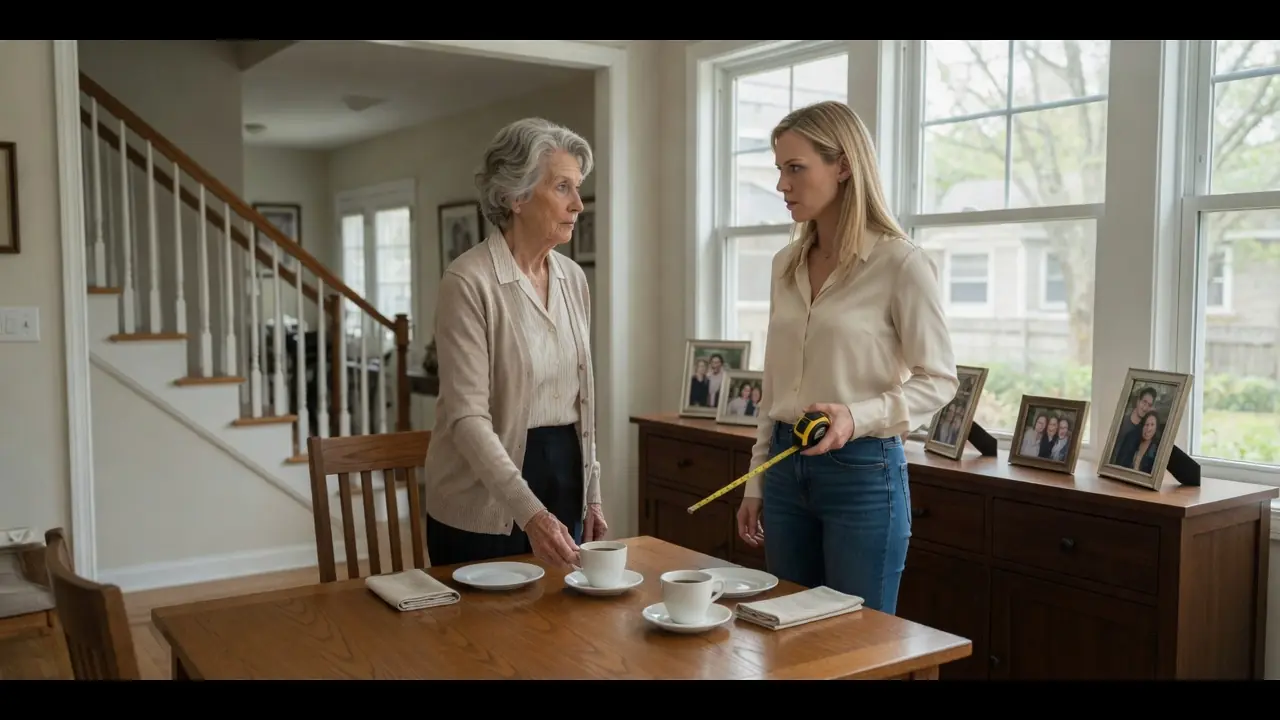
She left without finishing her cake. I stayed at the table for several minutes after the front door closed, listening to the house settle around me. My hand was steady when I lifted my coffee cup again, but inside, something old and tired trembled. Not fear. Recognition.
For years, Brenda had tested boundaries in little ways. She borrowed things without returning them, used my garage for storage without asking, left her coats in my hall closet as if marking territory. She called my house “the family house” whenever guests were present, as though repeating the phrase would slowly change the deed.
Trevor never corrected her.
That evening, my son called. His voice had the strained softness he used when trying to calm a storm he refused to name. “Mom, Brenda is upset.”
“I imagine she is.”
“She says you embarrassed her.”
“In my own dining room?”
He sighed. “She was just trying to make a plan. Lorraine has nowhere to go now.”
“That is unfortunate. But it is not my responsibility.”
“Mom.”
I knew that tone. It carried disappointment, guilt, and a request he did not want to speak plainly. For most of his life, that tone had worked on me. I had paid bills, changed plans, softened answers, and swallowed frustration because I loved him and did not want him caught between people.
This time, I stayed still.
“Trevor,” I said, “did you tell Brenda your mother could move in here?”
There was silence.
“Did you?”
He cleared his throat. “We talked about it.”
“That is not what I asked.”
Another silence. Then he said, “Brenda thought it would make sense.”
“Brenda thinks many things make sense when they benefit her.”
“That is not fair.”
“What is not fair,” I said, “is ending Lorraine’s lease and using her as leverage against me.”
He did not answer.
I closed my eyes for a moment. I could see Trevor as a boy, standing in the kitchen with jam on his fingers, asking if he could keep a stray kitten he had found near the fence. Back then, he could not bear the thought of anything being left out in the cold. Now he was asking his mother to open her home because his wife had created a crisis.
“I am not changing my mind,” I said.
“Brenda says if you do not help, she may not feel comfortable bringing the kids around for a while.”
There it was. The grandchildren. Caleb and Sophie. My heart tightened, but my voice did not.
“Are you threatening me with my grandchildren, Trevor?”
He rushed to answer. “No, Mom. I am just telling you what she said.”
“Then tell Brenda that using children as punishment does not make her case stronger. It only makes her character clearer.”
He was quiet for a long time.
“I do not know what to do,” he said finally.
“Start by telling the truth,” I said. “To your wife, to Lorraine, and to yourself.”
The next week, Brenda tried a different approach. She arrived on Tuesday morning with two large cardboard boxes in the trunk of her car. I watched from the front window as she carried them to the porch, her face set with determination. She rang the bell and smiled when I opened the door.
“Just a few of Mom’s things,” she said. “We can keep them in your basement until the move.”
“There is no move.”
“Renata, please. It is just temporary.”
“No.”
Her smile twitched. “You are making everything difficult.”
“No, Brenda. I am making everything clear.”
She set the boxes down anyway, right beside the door. “I have another appointment. Trevor will call you.”
She walked back to her car as if leaving the boxes there would magically make them my problem. I waited until she drove away, then went to the garage and brought out my hand truck. The garage was clean, as Arthur had always kept it, with tools hung neatly on the pegboard and bins labeled by season.
I wheeled both boxes back onto the covered porch, placed them neatly beside the steps, and sent Trevor a text.
Brenda left boxes here without permission. They are outside under the porch. Please pick them up by tonight.
Trevor called twenty minutes later.
“Mom, you put Lorraine’s things outside?”
“Yes. Neatly and safely.”
“That is rude.”
“What is rude is using my house as storage after I said no.”
He groaned. “You are making me choose sides.”
“No, Trevor. You chose when you allowed Brenda to make promises about my home. I am simply making sure my side of the property line is respected.”
That evening, he picked up the boxes alone. He did not come inside. I watched from the kitchen window as he loaded them into his trunk, shoulders slumped, face tired. He looked older than forty, and for a moment, pity tugged at me.
But pity is not permission.
Two days later, I heard a key scrape in my front door lock. It was ten in the morning, and I was in the hallway arranging fresh flowers in a vase. The door opened, and Brenda stepped inside with two empty tote bags over her shoulder.
“I figured I would help clear the basement,” she said, already moving past me. “Mom has a sewing machine, and we will need space.”
I stepped in front of her. “Give me the key.”
She laughed as if I had made a joke. “What?”
“The key. Now.”
“Trevor gave it to me for emergencies.”
“This is not an emergency. This is entering my home after I said no.”
Her eyes flashed. “You are unbelievable. You sit here on your throne while everyone else struggles.”
“The key, Brenda.”
She stared at me, then dug into her purse and slammed the key onto the side table. “You will regret this.”
“I regret allowing this much already.”
She left in a fury. I did not call Trevor. I called a locksmith.
By noon, every exterior lock was changed. The locksmith handed me three new keys, and when he asked if I wanted extra copies for family, I said no. He did not ask questions. Good locksmiths, like good lawyers, know when a story is bigger than a lock.
After he left, I sat in my kitchen and reviewed my finances. For years, I had been sending Trevor and Brenda a monthly amount for the children. It was not small. I intended it for activities, school clothes, books, and little pleasures.
That afternoon, I changed the arrangement. The money would now go into savings accounts for Caleb and Sophie, accessible only when they turned eighteen. I did not cut the children off. I cut Brenda off.
The first of the month proved she had been counting on that money. My phone rang just after noon, and Brenda’s voice was sharp before I even said hello.
“What happened to the kids’ money?”
“It is still the kids’ money,” I said. “It is now in accounts for their future.”
“We needed it now. We already paid deposits for camp.”
“Then you should speak with Trevor about your household budget.”
“You have no right to control money meant for my children.”
“I have every right to control money from my account.”
She inhaled sharply. “You are punishing us because we asked for help.”
“No, Brenda. I am protecting my money because you tried to take my house.”
For once, she had no immediate answer.
The silence was satisfying, though I did not enjoy it as much as people might imagine. I did not want war with my son’s wife. I wanted peace in the home I had earned. But peace without boundaries is only surrender dressed politely.
Two weeks passed with no visits. I tended the garden, read in Arthur’s old chair, and met my friend Helen for bridge. The quiet felt different now, heavier at first, then gradually cleaner. Every time I locked the door at night, I felt my house return to me.
Then Lorraine came.
I saw her car pull into the driveway one afternoon. She sat behind the wheel for several minutes, staring at the house. Lorraine was Brenda’s mother, a small woman in her late sixties with careful hair and nervous hands. I had never disliked her, though I had always sensed she let Brenda lead because it was easier than resisting her.
I opened the front door. “Hello, Lorraine.”
She startled, then stepped out of the car. “Renata. I was just passing by.”
“No, you were not.”
Her face crumpled slightly. “No. I suppose not.”
I invited her in for tea.
In the kitchen, she sat with both hands around the cup. She looked tired and embarrassed. “Brenda told me you asked us to come. She said you did not want to be alone anymore.”
“Brenda lied.”
Lorraine closed her eyes.
“I gave up my apartment,” she whispered. “I sold most of my furniture.”
“I am sorry,” I said. “Truly. But I never invited you to live here.”
She nodded slowly, as if each word hurt but also freed her from confusion. “She said you had so much room.”
“I do.”
“And you still will not?”
“No,” I said gently. “Room is not consent.”
Lorraine looked at me then, really looked at me. For the first time, I saw not Brenda’s mother, but another older woman standing at the edge of someone else’s plan. She had been used too, just differently. Brenda had turned her into the emergency that would force my door open.
“There is a senior community near the park,” I said. “It is clean, quiet, and has openings. I can give you the number.”
Lorraine’s mouth trembled. “Would you?”
“Yes.”
When she left, she did not look victorious. She looked sad, but straighter. Sometimes truth does that. It hurts first, then returns your spine.
News of Lorraine’s visit must have enraged Brenda, because the next Sunday she arrived with Trevor, Lorraine, and a folder of papers. I opened the door but did not move aside. Brenda held the folder like a weapon.
“We need to talk,” she said.
“If you are here as guests, you may come in,” I replied. “If you are here to discuss ownership of my house, you may leave.”
Brenda’s face went pale with anger. “This is a living trust draft. It would make more sense for taxes if the house transferred to Trevor now. You would keep lifetime rights.”
“Where would I live?”
She hesitated. “The basement can be made comfortable.”
I almost laughed. The basement. In the house where I had raised my son, hosted birthdays, cared for my dying husband, and slept beside Arthur for nearly forty years. Brenda wanted to move me under my own floorboards and call it security.
I looked at Trevor. “Did you agree to this?”
He stared at the ground. “It might be better for everyone.”
“For everyone,” I repeated. “Or for Brenda?”
He said nothing.
That silence did what Brenda’s arguments never could. It showed me that my son might love me, but he was still willing to let me be pushed if it made his marriage easier. I felt sadness then, but not surprise.
I took the folder from Brenda’s hand, opened it, and looked at the first page. Then I closed it and handed it back.
“No.”
Brenda’s voice rose. “You cannot just keep saying no.”
“I can. Watch me.”
“You are going to die alone in this house.”
“Then I will die in my house.”
Lorraine reached for Brenda’s arm. “Enough, Brenda.”
Brenda pulled away. “Do not start.”
Lorraine surprised all of us by standing firm. “No. You lied to me. You lied to Renata. This is enough.”
For a moment, nobody moved.
Then Trevor took the folder from Brenda and lowered it to his side. He looked exhausted, ashamed, and finally aware that something inside his family had gone terribly wrong. Brenda glared at all of us as if betrayal had surrounded her from every direction.
I stepped back and closed the door.
The next few months were quiet. Not easy, but quiet. I missed the children, though I sent letters and gifts through Lorraine when I could. Trevor called occasionally, never saying much, but not asking for anything either.
Then one November evening, he came alone.
He stood on my porch with dark circles under his eyes and a duffel bag in one hand. I opened the door and knew before he spoke.
“Brenda and I separated,” he said.
I let him in.
He sat at the kitchen table like he had as a boy after a bad day at school. “Lorraine moved into the senior community. Brenda blamed me. Then she blamed you. Then she blamed everyone.” He rubbed both hands over his face. “She wanted me to sue you for early inheritance.”
“And what did you say?”
“I said I was done trying to sell my mother for peace.”
That sentence did not erase everything, but it was a beginning.
I made him coffee. We talked late into the evening, not as mother and child exactly, but as two adults standing in the aftermath of a storm. He admitted he had been weak. He admitted he let Brenda push because it was easier to disappoint me than confront his wife.
“You were safe,” he said quietly. “I think I took advantage of that.”
“Yes,” I said.
He nodded, accepting it.
I allowed him to stay in the guest room for three nights. Not forever. Not open-ended. Three nights while he found a short-term apartment. This time, he did not argue or assume. He thanked me and respected the limit.
That was how trust began again, not with grand apologies, but with a boundary honored.
A year later, the house is still mine. The dining room still catches sunlight in the afternoon, the oak table still shines, and the sideboard still holds family photos in neat frames. Caleb and Sophie visit every other weekend with Trevor, and we bake cookies, tend roses, and play board games at the same table where Brenda once tried to claim my home.
Brenda does not enter my house anymore. She sees the children on her own schedule, and I do not interfere. Lorraine visits sometimes for tea, and we have become something like friends, two older women who learned the hard way that our children’s plans are not the same thing as our obligations.
Trevor is stronger now. Not perfect, but stronger. He asks instead of assumes. He knocks before entering. He does not bring papers, plans, or guilt to my door.
The other day, Sophie asked why I have such strong locks. I brushed hair from her eyes and told her, “Because the people who are truly welcome will always knock first.”
She thought about that, then nodded with the seriousness of a child storing wisdom for later.
I still drink my coffee black. I still sleep on the left side of the bed, though the right side has felt empty since Arthur left this world. I still walk through every room in the morning, opening curtains and touching small things that remind me of the life we built.
People think old women fear being alone.
Some do.
But I can tell you there are worse things than being alone in a house that respects you. There is being surrounded by people who see your love as access, your age as weakness, and your home as an opportunity. I chose peace over occupation.
Brenda thought she could walk into my dining room with a measuring tape and a plan.
She thought I would fold because family was watching.
She thought a widow with gray hair and a quiet voice would rather surrender than be called selfish.
She was wrong.
I said no.
And that one word saved my house, my dignity, and eventually, even my son.