Otis Shaw sat at the far end of the Thanksgiving table with one hand resting beside his water glass, listening to his daughter-in-law slowly turn his own home against him. The dining room looked perfect in the way Lahi liked things to look perfect: white plates lined evenly, polished silverware placed just so, wine glasses catching the soft indoor light, autumn napkins folded beside the good dishes, and the golden turkey sitting in the center like proof of a peaceful holiday. Mashed potatoes, cranberry sauce, green beans, cornbread stuffing, and pumpkin pie filled the table with the smells of every Thanksgiving Otis had ever known. But beneath the comfort of the food and the clean desert evening outside the window, something cold moved through the room.
He had cooked all of it himself. He had been up before sunrise, seasoning the turkey, peeling potatoes, mixing cornbread, roasting vegetables, and checking temperatures with the same steady patience he had once used while feeding entire firehouse crews after long shifts. For thirty-two years, Otis had been the man people trusted when pressure rose and fear made others freeze. He knew how to stay calm when flames climbed walls, when smoke filled hallways, and when every second mattered. Yet somehow, the hardest place for him to breathe had become the house he once owned.
Lahi sat near the middle of the table with a wine glass in her hand and a smile that made every compliment sound like an insult waiting to happen. She was thirty-four, polished and sharp, wearing a fitted cream sweater dress and jewelry that caught the light every time she moved. Beside her sat Ethan, Otis’s son, thirty-eight years old, tired-eyed and silent, staring at his plate as if the mashed potatoes could excuse him from the conversation. Ethan had been silent for years.
The guests had praised the meal at first. Brad said the turkey was perfect. Jennifer asked about the stuffing. Lula told Lahi the house looked stunning since she had “updated everything,” and Lahi accepted the compliment as if she had built the place beam by beam with her own hands. Otis carved the turkey, passed the plates, and kept his face neutral.
“This house really is perfect for a young family,” Lula said, looking around the dining room.
Lahi’s eyes flicked toward Otis. “It would be.”
Ethan shifted in his chair but said nothing. Otis lifted his water glass and took a slow drink. He had learned that not every fire needed immediate water. Sometimes you let it show you where it wanted to spread.
Lahi leaned back, her wine glass balanced between two fingers. “Of course, we only have two bedrooms available right now.”
Brad looked confused. “I thought you said it was a three-bedroom.”
“It is,” Lahi said lightly. “One room is occupied.”
Everyone understood. The little pause afterward made that clear. She was talking about Otis’s room, the room he had kept when he signed the house over to Ethan five years earlier, the room protected by the lifetime residence rights written into the deed.
Otis looked down at his plate and cut a small piece of turkey. He had spent five years trying to make himself easy to ignore. He cooked his own meals when Lahi made the kitchen feel like borrowed space. He kept his old photographs in drawers after she redecorated the living room. He moved through hallways quietly, trying not to seem like a burden in a house he had paid for with firefighter wages and decades of overtime.
Lahi took another sip of wine. “You know, people really do need to know when it’s time to make space for the next generation.”
Jennifer gave a nervous smile. “That’s one way to put it.”
“It’s true,” Lahi said. “Some people cling to old stories, old furniture, old memories, old glory days. They don’t understand that life moves forward.”
Otis could feel every eye near the table wanting to look at him and trying not to. He had heard versions of this before. Old man aesthetic. Pathetic. Clinging to a house because he had nothing else. She had said those words on the phone the night before Thanksgiving, not realizing Otis had been standing near the kitchen.
He had recorded the truth afterward, his voice steady as he documented the date, the words, the pattern. He had found the deed papers again, pulled them from the file box in his closet, and reread the clause he had skimmed past five years earlier. Lifetime residence rights. Irrevocable except in cases of gross ingratitude or documented abuse by the residing party. At the time, it had sounded like legal language for problems that happened to other families.
Then Lahi had thrown his late wife’s photos in the trash.
That had been the first moment his body understood what his heart had been denying. The silver frames had stuck out of the garbage bag in the driveway, cracked glass catching the street light like a signal. Inside were pieces of his first life: his wedding day, his wife laughing, little Ethan on his hip, the early years in the house before grief and silence began swallowing everything. Lahi had not accidentally removed them. She had climbed into the spare closet, taken them down, and decided they belonged outside with trash.
At the table, Jennifer tried to change the subject. “Otis, Lahi mentioned you were a firefighter. That must have been intense work.”
Otis looked up. “Thirty-two years. Started at Station 7 on McDow Road in 1988.”
“That’s incredible,” Brad said. “Any memorable rescues?”
Otis felt an old memory rise, and for one brief second, the dining room softened. “In 1995, we got a call about an apartment fire near downtown. Fourth floor was fully involved when we arrived. A family of four was trapped near the back stairwell, and—”
“Otis,” Lahi cut in.
The room went still.
She smiled, but there was nothing kind in it. “Nobody wants to hear stories from thirty years ago. We’re trying to have a modern conversation.”
Brad cleared his throat. “Actually, I thought it sounded interesting.”
“Trust me,” Lahi said, waving one hand. “We’ve heard them all.”
Ethan stared at his plate.
Otis set his fork down slowly. He did not look at Ethan yet. If he looked too long, the hurt might turn into something visible, and he did not want Lahi to have the satisfaction. He simply picked up his water glass, drank, and set it back down.
The meal continued, though the air had changed. Lahi talked about her online boutique, about social media marketing, about how younger people understood branding in ways older generations never could. Lula leaned in, praising every word. Ethan laughed once or twice, hollow little sounds that disappeared quickly.
“Well, some of us adapt to change,” Lahi said, glancing toward Otis. “Others cling to the past.”
Otis said nothing.
That seemed to irritate her more than if he had argued. Cruel people often need reaction to feel powerful. His calm gave her nothing to hold. So she reached for something sharper.
“Otis, you’re sixty-five now?” she asked.
“Sixty-four.”
“Close enough. That’s the age people usually downsize, right?”
Ethan’s jaw tightened. “Lahi.”
“What? I’m just making conversation.” She looked toward Lula. “Your parents moved to a senior community, didn’t they?”
“They did,” Lula said, too eager to help. “They love it. Less upkeep. Less feeling like they’re in anyone’s way.”
“In anyone’s way,” Lahi repeated softly.
Otis looked at his son.
Ethan did not look back.
There it was again: the familiar little death of hope. When Ethan’s mother died, Otis had raised him alone, working impossible hours and still showing up for school events, doctor visits, heartbreaks, and every ordinary moment that makes a parent a parent. When Ethan lost his first wife, Otis gave him the house because grief had nearly hollowed him out. He thought a home might save his son.
Instead, the gift had given Lahi a stage.
Lahi swirled the wine in her glass. “Honestly, Otis, you have to understand what it feels like from our side.”
“Your side?” Otis asked.
“Yes. We’re trying to build a future. A family. A real life. But every room in this house still feels like it belongs to you.”
“It did belong to me.”
She gave a sharp laugh. “Exactly. That’s the problem.”
Ethan looked up now, alarm in his face. “Maybe we should not do this at dinner.”
“No, Ethan,” Lahi snapped. “Maybe we should. Maybe we should finally say what everyone knows but no one wants to say.”
Brad and Jennifer exchanged uncomfortable glances. Lula set her wine down. The turkey cooled on the table. The Thanksgiving decorations looked suddenly ridiculous, little pumpkins and leaves sitting between people who had stopped pretending this was a holiday.
Otis folded his hands in front of him. “Go ahead, Lahi. Say it plainly.”
She stood, one hand gripping the back of her chair. Her cheeks were flushed with wine and anger, and her confidence had turned reckless. “You live here like this is still your house.”
“It is my home.”
“It was your home. Then you gave it away.”
“I gave it to my son,” Otis said. “With conditions.”
She laughed again, louder this time. “Conditions. You mean control.”
“I mean the right to live in the bedroom we all agreed on.”
“The bedroom we need,” she shot back. “The room that could be a nursery. The room that makes this house feel like ours instead of yours. The room that reminds me every single day that we are not free to live our lives because you are still here, taking up space.”
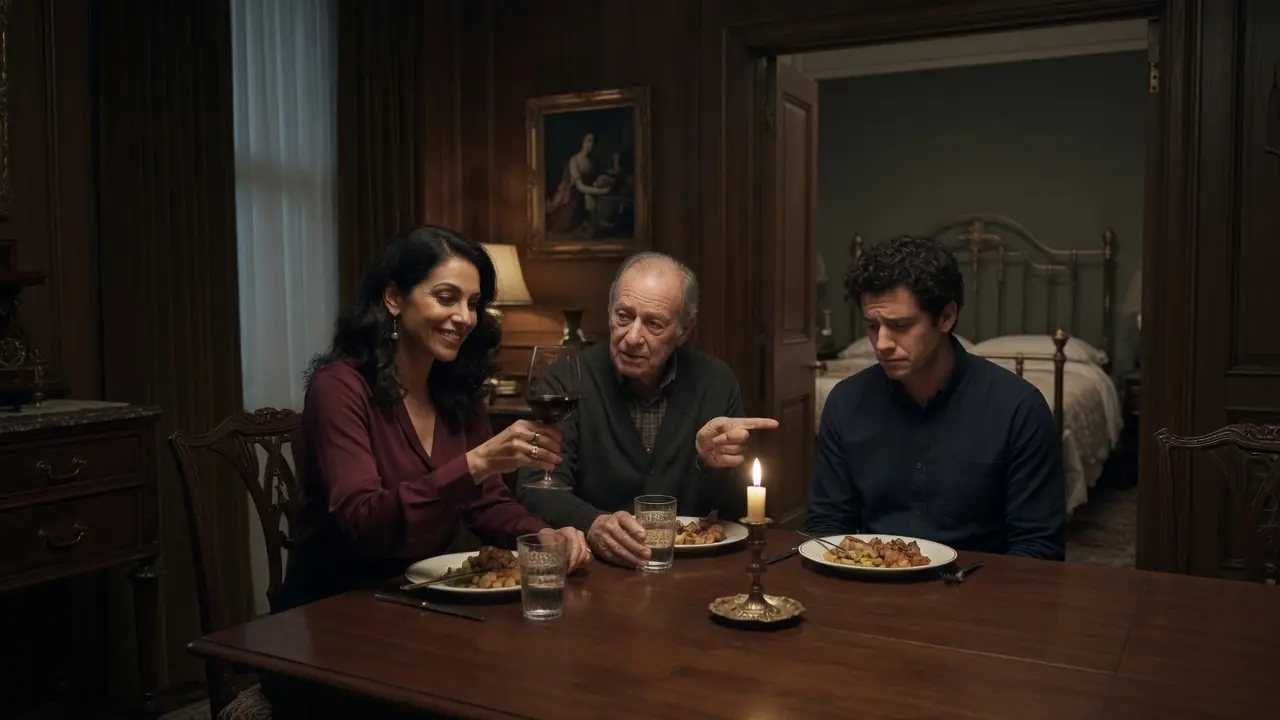
Ethan stood halfway. “That’s enough.”
But it was not enough, because he said it like a plea, not a boundary. Lahi heard the weakness and stepped right through it.
“No, it isn’t enough. I have been patient for five years. I have watched him haunt this house, telling old stories, holding onto old pictures, judging every choice I make. We redecorated, and somehow his past still hangs over everything.”
Otis thought of the wedding photos in the trash.
“My past was not yours to throw away,” he said.
Lahi’s eyes flashed. “Oh, please. A few dusty frames in a closet? You act like I burned down a museum.”
Brad looked down quickly. Jennifer’s mouth tightened. Ethan closed his eyes.
Otis let the silence last long enough for the words to settle. Then he said, “Those were photos of my wife.”
Lahi’s expression flickered, but only for a moment. “And she is gone.”
Ethan whispered, “Lahi, stop.”
But Otis already knew she would not. Not now. She had waited five years to say all of this in front of an audience, and now that the audience was here, she could not resist performing.
“You are living in the past,” she continued. “Your old marriage, your old job, your old hero stories. Everything about you is old, Otis. This house needs life in it. Young life. Future life. Not a retired man sitting at the end of the table acting like he still matters.”
Otis felt something cold and precise lock into place inside him.
“When was the last time someone needed you?” Lahi asked, leaning forward. “Really needed you? When was the last time you mattered to anyone?”
The table fell completely silent.
Ethan stood still, pale and frozen.
Lahi looked around, saw the horror on the guests’ faces, and still did not stop. “You sit here like some wounded saint, but maybe people are tired of you. Maybe they are tired of tiptoeing around a man who gave away a house and still acts like he owns everyone inside it.”
Otis looked at Ethan one last time.
His son looked at the table.
Not at him. Not at Lahi. The table.
That silence answered every question Otis had been avoiding for five years. Ethan loved him in theory. In memory. In soft moments when nothing difficult was required. But when love needed a spine, Ethan folded.
Lahi straightened, breathing hard. Her voice dropped into something ugly and triumphant. “You know what, Otis? You’re a hateful man. How does it feel to be the man everyone hates?”
The room froze.
Jennifer’s fork slipped against her plate with a small clatter. Brad stared at Lahi like he had just realized he had accepted an invitation to a disaster. Lula’s face lost its amused sharpness and turned uncertain. Ethan did not speak.
Otis slowly set down his water glass.
The sound was soft, almost gentle.
Then he smiled.
It was not warm. It was not forgiving. It was the kind of smile he had once worn before ordering a crew out of a building because he had recognized the signs of structural collapse before anyone else did. Calm. Certain. Final.
Lahi’s confidence cracked first. “What?”
Otis stood slowly at the far end of the table. “I don’t know how it feels to be hated by everyone,” he said. “But I can tell you how it feels to realize someone is homeless starting today.”
Brad made a nervous sound, almost a laugh, then stopped when no one joined him.
Lahi stared. “Excuse me?”
“You heard me.”
Ethan gripped the table. “Dad, what are you talking about?”
Otis turned to him. “Five years ago, I gave you this house. You remember that.”
Ethan nodded slowly. “Yes.”
“I kept lifetime residence rights.”
“I know.”
“And there was another clause.” Otis looked back at Lahi. “Revocation in cases of gross ingratitude or documented abuse by the residing party.”
Lahi scoffed, but the sound was thin. “You are bluffing.”
“No.”
“This is our house.”
“It is a gift you dishonored.”
Her face twisted. “You can’t just take it back because your feelings are hurt.”
“This is not about hurt feelings,” Otis said. “This is about five years of disrespect, public humiliation, thrown-away family photos, insults about my age, my food, my room, my history, my existence, and now a Thanksgiving dinner with witnesses.”
He turned slightly toward Brad, Jennifer, and Lula. “Thank you for coming.”
Lula looked like she wanted to disappear.
Lahi’s voice rose. “This is insane. I asked one question.”
“You asked how it felt to be hated in the house I gave you,” Otis replied. “You made sure everyone heard you. That was generous of you.”
Ethan stepped away from the table. “Dad, please. We can talk about this.”
“We have had five years to talk.”
“I know I should have said something.”
“Yes,” Otis said. “You should have.”
Ethan’s face crumpled slightly, but Otis did not look away. For years, he had softened because Ethan was his son. For years, he had translated cowardice as stress, distance as marriage pressure, silence as conflict avoidance. Tonight had removed the last excuse.
Lahi was crying now, but the tears were furious, not sorry. “You’re heartless.”
“No,” Otis said. “Heartless would have been letting me disappear slowly while you enjoyed everything I built.”
Brad stood abruptly. “We should go.”
“Yes,” Otis said. “Dinner is over.”
The guests left quickly. There were awkward murmurs, chairs scraping, coats gathered, and the front door opening and closing more than once. Soon the house was quiet except for Lahi’s uneven breathing and Ethan’s low voice trying to calm her. The table remained full of Thanksgiving food, everything Otis had cooked, everything they had eaten while treating him like a problem to solve.
Lahi pointed at him. “We will fight this.”
“I expect you to.”
“You will lose.”
“Maybe,” Otis said. “But I have the deed, the clause, the recordings, the photos you threw away, and the witnesses you invited.”
Her mouth opened, then closed.
Ethan looked at him. “Recordings?”
Otis met his eyes. “November twenty-seventh. She called me pathetic while speaking to Lula. Said I was clinging to this house because I had nothing else. Said getting rid of my old man aesthetic opened up the space.”
Lahi went pale.
Ethan turned toward her. “You said that?”
She snapped, “He was listening.”
“I was standing in my kitchen,” Otis said. “In my home.”
The words fell hard.
For once, Lahi had no clever response ready.
Otis stepped away from the table. “I am going to my room. I have calls to make in the morning.”
“Dad,” Ethan said.
Otis paused but did not turn.
“I’m sorry.”
Otis closed his eyes for one second. “No, you’re scared. There is a difference.”
He walked down the hallway to his bedroom, entered, and locked the door for the first time in five years. Behind him, he could hear Lahi crying and Ethan speaking in low, desperate tones. The sounds did not move him the way they once would have. Something had changed, and it was not changing back.
He sat on the edge of his bed and looked at the rescued wedding photos stacked on his nightstand. His late wife smiled from behind cracked glass, young and bright, before sickness, before grief, before Ethan grew up and forgot who had held him together. Otis touched the frame gently. “I should have done this sooner,” he said.
The next morning, Otis woke before sunrise. He had slept better than he had in months. There were no dreams, no heaviness pressing behind his ribs, no sense that he was trespassing in his own life. He made coffee in the small machine he kept on his dresser, opened his laptop, and searched for a real estate attorney in Scottsdale.
By 9:01, he was on the phone with an office on Scottsdale Road.
“What is this regarding?” the receptionist asked.
Otis looked at the locked bedroom door, then at the deed papers beside his laptop. “Revoking a property gift on grounds of gross ingratitude.”
The attorney, Richard Hunt, reviewed the documents that afternoon. He was a steady man with silver at his temples and the kind of handshake that felt like an assessment. He read Section 7, Paragraph 3 twice, then looked up. “This is not used often,” he said. “But based on what you have described, you have a foundation.”
Otis told him everything. The photos in the trash. The comments. The phone recording. Thanksgiving. Ethan’s silence. Lahi’s question.
Hunt took notes. “You will need witnesses.”
“I have them.”
“They will argue you are acting out of spite.”
“They can argue.”
Hunt smiled slightly. “You sound prepared.”
“Thirty-two years as a firefighter teaches you to plan before you act.”
“Good,” Hunt said. “Then we file Monday.”
The weeks that followed were quiet in the house, but not peaceful. Ethan and Lahi moved through the rooms like people living beside a storm they could not stop. Lahi posted online about a cruel father-in-law taking back a gift. Otis did not answer. He forwarded every post to Hunt and let her words build their own case.
By January, the legal process had begun. By March, the witnesses were in court. Brad testified that Lahi’s comments had been personal and cruel. Jennifer confirmed that nobody defended Otis. Lula tried to soften the truth, but under oath, she admitted Lahi had asked how it felt to be hated by everyone.
Judge Morrison listened without theatrics.
The court did not move with the drama of Thanksgiving dinner. It moved with documents, testimony, clauses, appraisals, and deadlines. But it moved. Eventually, the judge recognized the pattern of gross ingratitude and allowed the revocation process to proceed, with fair compensation for documented improvements to the property.
Otis paid what was fair.
He did not fight every dollar. He had never wanted to cheat anyone. He only wanted his house, his dignity, and his life back.
When the final order came, Lahi tried once more. She came to his bedroom door wearing no makeup, her voice soft, almost humble. “Otis, please. We are family. I know I hurt you, but people can change.”
Otis opened the door only halfway. “You are not changing because you understand. You are changing because you lost.”
Her softness disappeared. “Your own son is about to be homeless, and you do not care?”
“My son chose silence for five years,” Otis said. “He is facing the consequences of that silence.”
“You are cruel.”
“No,” Otis said. “I am done.”
He closed the door.
The house sold quickly after that. Otis bought a small ranch house in Tempe, two bedrooms, one bath, a covered patio, and enough quiet to hear himself think. He moved with the rescued photographs, the deed papers, his clothes, his books, and the kitchen tools that had survived Lahi’s modern renovations. Everything that mattered fit into fewer boxes than he expected.
On the day he signed the sale papers, Otis felt grief but not regret. The old house had been his home for decades, then his prison for five years, and finally just a building someone else would love. He drove past once as Ethan and Lahi loaded boxes into a truck. He did not stop.
Months later, Marcus came over for dinner at the new place. They ate grilled chicken on the back patio while the desert evening cooled around them. Marcus looked around and said, “This feels like you.”
“That’s the point,” Otis replied.
“You lonely?”
“Sometimes,” Otis said. “But I am not disrespected. Not small. Not invisible.”
Marcus nodded. “Fair trade.”
“Fair trade.”
That night, after Marcus left, Otis washed the dishes in his own kitchen. Nobody criticized the meal. Nobody mocked the way he stood, ate, cooked, remembered, breathed, or existed. He stepped onto the patio and looked up at the clear Arizona sky.
He thought about Lahi’s Thanksgiving question.
How did it feel to be the man everyone hated?
Otis knew a better question now.
How did it feel to be free?
It felt like silence that belonged to him. It felt like locking his own door without fear. It felt like cooking breakfast without commentary and sleeping without tension. It felt lonely sometimes, yes, but loneliness was lighter than humiliation.
Otis Shaw had given away a house because he loved his son.
Then he took it back because he finally loved himself enough to stop disappearing inside it.