The moment I saw my own face hanging at the entrance of my daughter’s wedding, something inside me went quiet.
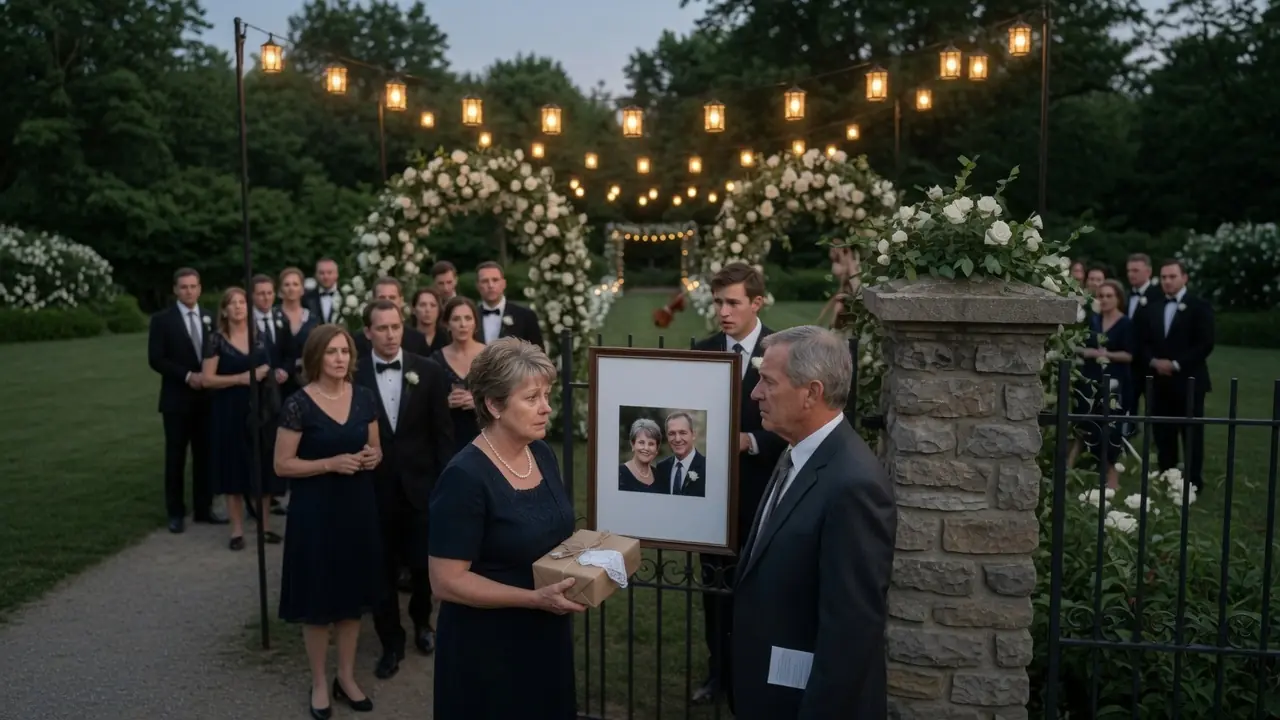
Not angry at first. Not even shocked in the way people imagine shock feels. It was deeper than that, colder than that, like my heart had stepped out of my body because it could no longer stand being inside me. Under two rows of glowing garden lights, beside white flowers and ribboned chairs, there was a large board with a photo of me and my husband, Mark.
Beneath our picture, in bold letters, it said, “Do not let these two people in. By order of the bride.”
I stood there in my navy dress, holding a small wrapped wedding gift with both hands. Inside was a white lace handkerchief my mother had left me, a family heirloom I had saved for the day my daughter became a bride. I had imagined placing it gently in Meline’s hands before the ceremony, maybe telling her that every woman in our family had carried it through a turning point in life. I had imagined tears, an embrace, and a memory that would soften with age.
Instead, I stood outside the gate like a stranger.
Mark stood beside me in his dark suit, one hand touching the folded speech in his jacket pocket. He had spent the night before rewriting it three times, wanting every word to be perfect. He had planned to tell Meline how proud he was, how he remembered teaching her to ride a bicycle in our driveway, how he hoped Andrew would cherish her the way a good husband should. Now his face went red, then pale, and his hand shook so badly he could not pull the speech out.
“Evelyn,” he whispered, “what is this?”
I could not answer.
Guests in formal clothes slowed down as they walked past us. Some stared at the sign, then at our faces, then quickly looked away because embarrassment is contagious when people know cruelty is happening in front of them. Others whispered behind manicured hands. A few pretended not to notice at all, which somehow felt worse.
A young hotel attendant stepped toward us with panic in his eyes.
“I’m really sorry,” he said, his voice low and strained. “I was instructed that if the two of you showed up, we can’t let you in. This is a direct order from the bride.”
The bride.
My daughter.
Meline Carter, my only child, the girl I once held through feverish nights while Mark drove through snow to find medicine. The girl whose hair I braided before school, whose lunch boxes I packed, whose college tuition I helped pay by standing in a laundromat until my feet throbbed. The girl I thought would turn and search for me on her wedding day, needing my face in the crowd.
That girl had put my picture on a warning board.
I looked through the gate, past the flowers and chairs and lights, toward the dream wedding glowing beyond us. It was beautiful. Of course it was beautiful. It had cost ninety-two thousand dollars, every cent secretly paid from savings Mark and I had built over thirty years.
Meline did not know that.
The Whitmore family did not know that I had paid. Or maybe they did not care enough to ask how the wedding was funded after they made their grand promises. Andrew’s family had claimed they would handle everything, presenting themselves as generous, powerful, and elegant. But when the event planner told me weeks earlier that no payment had arrived, I had transferred the money myself.
I did it because I could not bear the thought of my daughter being embarrassed.
I did it quietly because I did not want Meline to feel guilty.
I did it because a mother’s love can become foolish when it refuses to see what is standing directly in front of it.
Mark gently touched my arm. His eyes were full of a pain I had never seen in him before. We had been married for more than forty years. I had seen him exhausted, angry, disappointed, frightened during my health scares, and broken when his own father died. But I had never seen him look ashamed because of his own child.
He nodded.
Neither of us made a scene. Neither of us begged the attendant. Neither of us demanded that someone bring Meline to the gate. We turned around slowly and walked back toward the parking lot while the wedding music floated behind us, soft and elegant, like it belonged to people who had never known humiliation.
Every step felt heavier than the last.
When we reached the car, I leaned against the door because my legs almost gave out. Mark opened the passenger side for me, but I could see his hands trembling. He was trying to be strong for me, and I hated that he had to be strong because of our daughter. I climbed in, still clutching the little gift, unable to loosen my fingers from the ribbon.
The drive back to the hotel felt unreal.
Outside the window, the evening looked normal. Cars moved through traffic. Streetlights came on. People walked along sidewalks, unaware that my whole understanding of motherhood had just been torn apart in front of a wedding gate.
Inside the car, I cried silently.
Images of Meline rushed through my mind. Her messy hair on school mornings. Her bright laugh when Mark chased her through the yard. Her tiny hand gripping mine outside kindergarten because she was scared to walk in alone. I had built my life around protecting that child from feeling unwanted, and now she had made sure I felt unwanted in the most public way possible.
“Did I do something wrong?” I asked Mark when we stopped outside the hotel. “Are we too ordinary for her now?”
“No,” he said firmly. “We did nothing wrong.”
His voice was gentle, but tired.
“She changed when she got involved with the Whitmores,” he continued. “And Evelyn, I know this hurts, but endless kindness can make selfish people think they have the right to walk over you.”
I looked down at my hands. They still carried faint lines from decades of work, thin scars from hot machines, and the wear of a life spent earning slowly. I thought of Andrew’s mother, Margaret Whitmore, scanning me from head to toe the first time we met, lingering on my shoes, my simple dress, my inexpensive handbag. She had smiled as if I were a charity case who had wandered into the wrong room.
Andrew had been no better.
He spoke with polite coldness, the kind that never says anything openly cruel but makes every word feel like a measurement. He talked about business contacts, investments, real estate, and family standards. Meline had sat beside him glowing, dazzled by the world he promised her. She did not notice how often his family looked past Mark and me as if we were furniture.
Or maybe she noticed and decided it was easier to pretend not to.
That was the part I could no longer ignore.
This wedding gate was not the first wound. It was the final one. Before that came the dinner where Margaret Whitmore called my dress “simple” in a tone that made the word sound dirty. Before that came Andrew looking around our home as if appraising how much it was worth. Before that came Meline asking me to cut relatives from our side of the guest list because they did not serve any purpose for her future.
Family has limits too, Mom.
Those were her words.
I had stood in my kitchen holding a towel, feeling the world tilt under me as my daughter asked me to uninvite the people who had helped raise her. My cousins, my nieces, my elderly aunt, old family friends who babysat her when I worked double shifts. I called them one by one and lied, saying it was a seating issue. Each one answered with kindness, and that kindness made the lie hurt more.
Mark had wanted to tell Meline the truth.
“You paid all ninety-two thousand dollars,” he had said. “She wouldn’t treat us like this if she knew.”
But I had refused.
I kept believing the wedding day would change everything. I thought that when Meline saw me there, she would remember who I was. I thought she would understand the years, the sacrifices, the soup on sick nights, the tuition bills, the thrift-store dresses, the extra shifts. I thought love had a way of returning at important moments.
I was wrong.
Back in the hotel room, I placed the little gift on the bedside table and sat on the edge of the bed. Mark loosened his tie but did not take it off. His folded speech lay beside the gift, untouched and useless. For a while, neither of us spoke.
Then my phone rang.
Unknown number.
Mark shook his head, silently telling me not to answer. But something in me, something I could not explain, made me pick up.
“Hello?” I said, my voice rough.
A young woman answered, trembling slightly. “Mrs. Carter? My name is Chelsea Rivera. I’m one of the event coordinators at Linden Garden tonight.”
I sat straighter.
“I saw what happened at the gate,” she said. “I’m so sorry. I was inside when they put the sign up. I couldn’t stop it.”
I closed my eyes. “Why are you calling me?”
“Because I checked the contracts,” Chelsea said. “Every receipt, every payment record, every signature has your name on it. You are the only person who paid for this wedding. There isn’t a single payment from the Whitmore family.”
My fingers went numb.
“I know,” I whispered.
“There’s more,” she said. “Two hours before the ceremony, I passed the bridal suite. I heard the bride and the Whitmore family talking about you.”
The room seemed to shrink.
“What did they say?”
Chelsea hesitated, and that hesitation told me enough.
“They called you poor. They said the wedding would look better if you and your husband didn’t show up. I heard them laughing about the sign. Mrs. Carter, your daughter smiled when they said it would solve the problem.”
I sank onto the bed.
I did not cry. There were no tears left in that moment, only a cold, clean emptiness. Mark sat beside me and took my hand, but I could barely feel him. Chelsea’s voice continued through the phone, small but steady.
“You have the right to stop the entire event,” she said. “You are the contract holder. If you request that the music, lights, catering, and venue service stop, we have to follow your instruction.”
I stared at the wall.
For sixty-one years, I had believed power belonged to other people. People with polished shoes, expensive last names, and voices that never shook. People like the Whitmores. People like Andrew. People like Margaret, who knew how to make a laundromat worker feel invisible with one raised eyebrow.
But suddenly, the truth sat in my hand.
Every flower, every chair, every glass, every violin note, every tablecloth, every perfect light in that garden existed because of my money. The woman they banned from the gate was the woman holding the contract. The mother they erased was the reason their dream wedding could happen at all.
Chelsea spoke softly. “You only have to say the word.”
I thanked her and ended the call.
Mark looked at me carefully. “Evelyn, what are you thinking?”
I lifted my head. My tears had dried. My breathing had steadied. For the first time that night, I felt something besides pain.
“I’m thinking,” I said, “that she needs to understand actions have consequences.”
Mark did not argue.
He looked tired, heartbroken, and afraid, but he did not tell me to be gentle. He had watched me be gentle for years. He had watched our daughter confuse my softness for weakness. He had watched me excuse every slight, every missed call, every cold comment, every dismissal, because I wanted to believe motherhood could survive anything.
“I will stand with you,” he said.
That was all I needed.
I opened my laptop and gathered the files I had kept hidden. Contracts. Invoices. Bank transfer receipts. Emails from the event planner. Every document showed my name. Every payment came from my account.
Then I wrote an email to Margaret Whitmore.
Dear Mrs. Whitmore,
Thank you for proudly telling everyone that your family covered tonight’s wedding expenses.
That must feel wonderful.
Attached are the contracts, invoices, and bank payment records in case you would like to refresh your memory.
Every dollar of the ninety-two thousand dollars spent on this wedding was paid by me.
Not you.
Not Andrew.
Not anyone named Whitmore.
Sincerely,
Evelyn Carter.
I attached everything.
Then I scheduled the email to send at 8:30 p.m., when dinner would be underway and Margaret would likely be sitting among guests still wearing her borrowed pride like diamonds.
After that, I called my sister Linda.
She answered on the second ring, cheerful at first, expecting to hear that the wedding was beautiful. By the time I finished telling her what happened, her breathing had changed. I could hear a chair scraping back in her house, then muffled voices asking what was wrong.
“Tell everyone,” I said quietly. “Every relative Meline cut from the guest list. Tell them I paid for the wedding. Tell them she banned us at the gate. Tell them she said our family did not serve her future.”
Linda’s voice shook with anger. “You want them to know?”
“Yes,” I said. “When Meline tells her version later, I want the truth already waiting.”
“I’ll do it,” Linda said. “Tonight.”
Then I called my attorney.
His name was Mr. Jackson, and he had prepared a draft of my will months before. I had planned to revise it after the wedding to make Meline’s inheritance clearer. Now I knew exactly what needed to change.
“I want Meline removed from the will,” I said.
He was silent for a moment.
“The house, savings, life insurance, everything,” I continued. “If Mark passes before me, I want the assets directed to a fund supporting older women trying to leave toxic families.”
“Are you certain?” he asked.
“Yes,” I said. “Tonight I learned where I stand in her life. I am placing her where she chose to place me.”
Outside the window, the wedding lights still glowed in the distance.
At 8:10 p.m., Chelsea texted.
They’re all seated. Appetizers are about to go out.
I looked at Mark.
He reached for my hand.
“Are you sure?” he asked.
This time, I did not answer with words. I squeezed his hand, picked up the phone, and called the venue manager, Christopher Harris. He answered as if he had been waiting.
“Mrs. Carter?”
“It’s time,” I said.
There was a brief pause.
“Yes, ma’am. We’ll proceed immediately.”
I set the phone down.
For a few minutes, nothing happened in the hotel room. The walls stayed still. The lamps kept shining. The air conditioner hummed. But somewhere across town, inside the wedding my daughter had tried to keep me out of, everything began to stop.
Chelsea’s messages arrived one by one.
The sound is off. Everyone is confused.
The decorative lights are off. Only emergency lights remain.
Staff have stopped service. No appetizers are going out.
Meline is asking who authorized this.
Manager Harris showed Andrew the contract and pointed at your name.
I read each message calmly.
In my mind, I saw the perfect wedding unravel. The music disappearing first. Then the lights fading from the floral arches, the tables, the garden pathways. Waiters stopping beside trays of food. Guests turning in confusion. Andrew demanding answers. Margaret Whitmore’s face tightening as the truth walked into the room wearing my signature.
Then came the message I had expected.
Margaret opened your email.
A minute later, Chelsea wrote again.
She is frozen. Her hands are shaking. People are asking what’s wrong.
I exhaled slowly.
I did not feel joy.
That surprised me a little. I thought revenge might feel bright, sharp, satisfying. Instead, what I felt was relief, deep and heavy, like setting down a burden I had carried for years without admitting how much it weighed.
The truth was finally speaking.
It did not need me to shout.
At 8:47 p.m., Meline called.
I stared at her name on the screen for a long time before answering.
When I pressed the phone to my ear, chaos flooded through the line. Voices shouted in the background. Chairs scraped. Someone demanded the manager. Then my daughter’s voice broke through, panicked and crying.
“Mom, please help me.”
I closed my eyes.
For years, those words would have moved me instantly. I would have reached for my purse, my keys, my checkbook, my last ounce of strength. I would have rushed toward her, even if she had been the one who pushed me away. But that night, something inside me had changed.
“There is nothing to save,” I said.
“What do you mean?” she cried. “Everything was normal, then the lights went off, and the staff stopped, and that email went out. Everyone is looking at me like I lied.”
“Because you did.”
She sobbed harder.
“You let Andrew’s family take credit for a wedding they never paid for,” I said. “You let them call us poor. You cut our relatives from the guest list. You banned your own parents at the gate. You were ashamed of where you came from.”
“Mom, I just wanted everything to look perfect.”
Her words were small now, frightened.
“That is the problem,” I said. “You cared more about how things looked than who you hurt.”
Then Andrew grabbed the phone.
“What the hell do you think you’re doing?” he snapped. “You ruined our wedding.”
“No,” I said. “I turned off the things I paid for.”
“You’ll pay for this. I’ll sue you.”
I laughed softly, and the sound shocked even me.
“For what?” I asked. “For stopping services under contracts in my name? My signature is on every page, Andrew. My money paid every invoice. Your family built a performance on my savings, then banned me from watching it.”
He went quiet.
Meline took the phone back, breathless. “Mom, please. I’m begging you. I need you right now.”
“No,” I said. “You needed me when I raised you. You needed me when I paid your tuition. You needed me when your wedding was about to collapse because the Whitmores never paid. But when I arrived at the gate with your father and a family gift, you decided I did not belong.”
“I didn’t mean for it to happen like this.”
“But you meant for us to stay outside.”
She had no answer.
I let the silence sit between us.
“Meline,” I said quietly, “I did not ruin your wedding. You did. You built your dream on humiliating the people who raised you, and you believed there would be no cost.”
“Mom, please don’t hang up.”
“I cannot save someone who does not want to save herself.”
Then I ended the call.
Afterward, I blocked Meline, Andrew, and every Whitmore number that had already begun lighting up my phone. Mark sat beside me and put his hand on my back. He did not speak. He did not need to. That night, I changed out of my navy dress, placed the lace handkerchief back in its box, and slept more deeply than I had in years.
Six months passed.
The wedding became a story people whispered about for weeks. The Whitmores lost their shine quickly once people learned they had taken credit for money they never spent. Andrew lost business connections. Margaret Whitmore stopped appearing at social events with the same lifted chin. The marriage survived legally, but from what I heard, it became smaller, harder, and far less glamorous than Meline had imagined.
I did not celebrate any of it.
I simply kept living.
Then one afternoon in June, while I was watering sunflowers on the porch, a worn sedan stopped near the gate. Meline stepped out. She had lost weight. Her hair was tied carelessly, her face tired, her eyes ringed with sleeplessness. She looked less like a polished bride and more like the daughter I had almost forgotten beneath all that borrowed arrogance.
“Mom,” she said hoarsely. “Can we talk?”
I opened the gate but stayed where I was.
She began crying almost immediately.
“I’m sorry,” she said. “I lost everything. No one is on my side. Please forgive me.”
The mother in me wanted to run to her.
The woman I had become did not.
I placed one hand lightly on her shoulder. “You did not lose me, Meline. You lost the right to assume I would endure forever.”
She looked up, hope breaking through her tears.
“I’ll do anything,” she said. “I just need you to hold me.”
My heart ached.
But love without boundaries had nearly destroyed me once. I would not let it happen again.
“Forgiveness is not something people receive by crying,” I said gently. “It is something they earn through action. I am not closing the door forever, but I will not open it all the way because of one apology.”
Meline lowered her head.
For the first time in years, she did not argue.
“I understand,” she whispered. “I’ll come back when I deserve to.”
She left quietly.
A month later, Mark and I sold the laundromat. It had carried us for thirty years, but it also carried the weight of every sacrifice I had made while waiting for gratitude that never came. We moved to a small house near the coast in North Carolina, where evenings smelled like salt and the sound of the waves made my chest feel open again.
I updated my will.
My assets would go first to Mark, then to a fund for older women rebuilding their lives after being trapped by cruel families. Meline would receive nothing unless time and consistent action proved she had truly changed. Not tears. Not promises. Action.
My relatives, the ones Meline erased, came back into my life with more love than ever.
Linda called every week. Nieces and nephews sent letters. Old friends visited. I realized the family that truly mattered had never left. I had simply been looking too hard at the one person who kept turning away from me.
One evening, Mark and I sat on the porch watching the sky change over the water.
“Do you feel lighter?” he asked.
I nodded.
“Not just lighter,” I said. “Free.”
For years, I believed unconditional love meant enduring every wound without stepping away. But love without respect is not devotion. It is a shackle wrapped in pretty paper. Sometimes the door that saves you is the one you close with trembling hands.
That night at the wedding, the lights went out.
But something inside me turned back on.
I am Evelyn Carter, sixty-one years old, a mother, a wife, and finally a woman who understands her own worth.
My daughter banned me from the wedding I paid for.
So I stopped paying for the lie.