My wife Catherine held the gift box on her lap the entire six-hour drive, as if it were a living thing that might break if she loosened her fingers. It was wrapped in pearl-white paper with a blue ribbon she had tied and retied three times before we left home. Inside was a pair of small diamond earrings that had belonged to her mother, meant to be something old, something precious, something our daughter Sarah could wear on the day she became a wife. I drove slowly because Catherine kept saying she did not want the ribbon crushed.
My name is William Carter, but most people call me Bill. I was seventy-two years old that June afternoon, with gray hair, weathered skin, and hands that had spent most of my life building things other people were proud to stand inside. Catherine was sixty-nine, still graceful, still gentle, wearing a clean navy dress, a light tailored coat, and the pearl necklace I had given her on our thirtieth anniversary. We were not rich-looking people, but we were clean, respectful, and dressed with all the dignity two parents could carry into their only daughter’s wedding.
Sarah was getting married at Golden Oaks, the most expensive resort in the state. The place had iron gates, limestone pillars, fountains with water dyed an impossible blue, and lawns that looked like no human foot had ever been allowed to bend a blade of grass. When Sarah first told us about the venue, she said Jason’s family had handled the cost because they were “old money.” Catherine cried from happiness when she heard that, believing our daughter had found a man whose family would cherish her.
I said nothing then. I already knew the truth.
Three months earlier, Sarah had called me in tears, saying there had been a problem with the wedding deposit. She said Jason’s funds were tied up, his bank was delaying a transfer, and they might lose the venue if the money was not wired that week. She never directly asked me to pay, but she knew she did not have to. By the next morning, the full Golden Oaks package had been paid through the Carter Trust, anonymously, because I did not want Sarah to feel small on her big day.
What Sarah did not know was that the Carter Trust was mine. She did not know I had sold my construction company years earlier for more money than most people ever see. She did not know I owned apartment buildings, commercial land, and a silent share of the hospitality group that controlled Golden Oaks. She judged my worth by my old truck, my plain cabin, and the fact that I preferred work boots to polished shoes.
Catherine knew more than Sarah did, but even she did not know everything. I had always kept our life simple because simple felt honest. Money had made some people around us louder, greedier, and harder to recognize. I did not want our daughter to grow up worshiping numbers in a bank account, but perhaps I had hidden too much, because Sarah had mistaken modesty for failure.
The closer we got to Golden Oaks, the quieter Catherine became. She smoothed her dress, checked her lipstick in the visor mirror, then looked down at the gift box again. “Do you think she’ll be happy to see us?” she asked. That question hurt more than it should have.
“She’s our daughter,” I said. “Of course she will.”
But I was not sure. In the last few years, Sarah’s phone calls had become shorter, her visits rarer, and her words sharper. She had begun correcting Catherine’s clothes, sighing at my truck, and laughing nervously whenever Jason made jokes about “country people” and “old-fashioned parents.” Catherine always told me Sarah was just stressed, but mothers are sometimes too loving to see when a child has learned to be cruel.
When we turned onto the private drive, I saw rows of white flowers, valet attendants in crisp jackets, and guests stepping out of luxury cars. My old truck rolled forward carefully, its engine rumbling in a way that made two young men at the valet stand glance over and smirk. Catherine noticed and sat straighter. She touched my sleeve and whispered, “We look fine, Bill.”
“You look beautiful,” I told her.
At the security gate, a guard stepped out before I could even put the truck in park. He was broad-shouldered, wearing a black suit, an earpiece, and sunglasses that made him look like he was guarding a president instead of a wedding. He looked at the truck first, then at me, then at Catherine. His face held no welcome at all.
“Names,” he said.
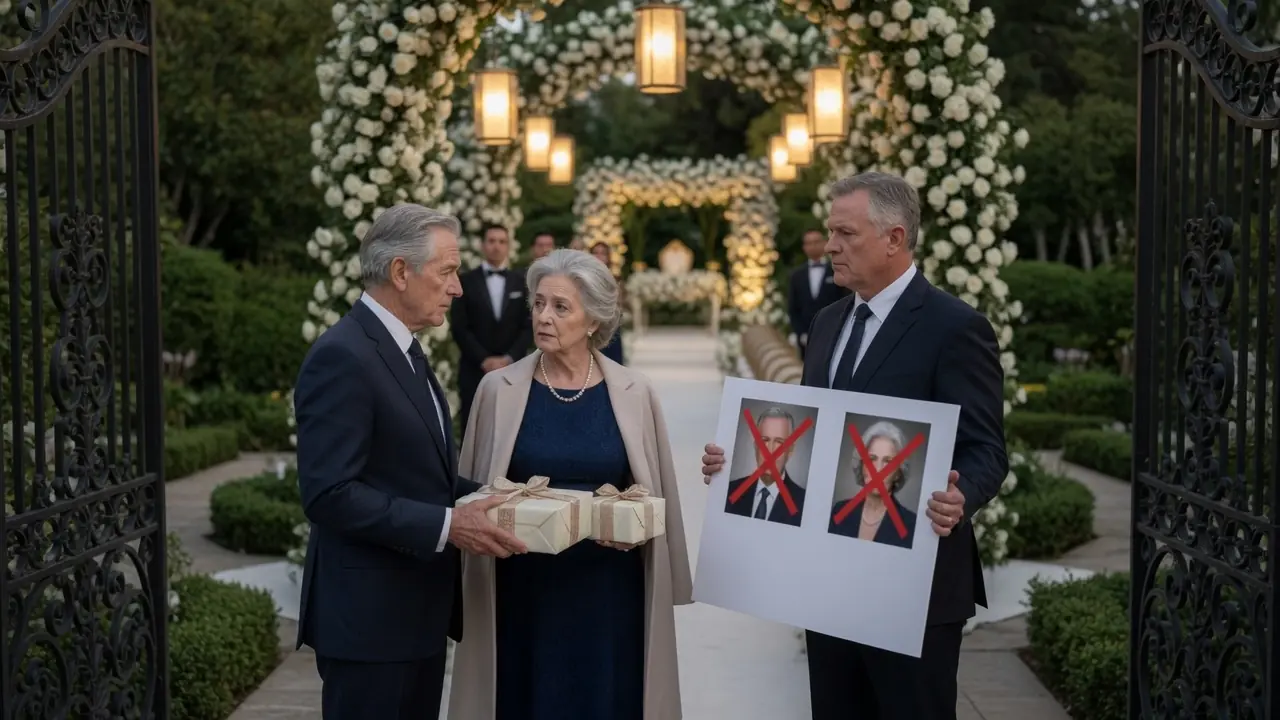
He did not check a guest list. He did not ask for identification. He reached into the booth, pulled out a laminated sheet, and held it up in front of my window. On it were two photos, one of me standing outside my cabin, the other of Catherine leaving church with a grocery bag in her hand. Both faces had been crossed out with a thick red line.
Under the photos were words I could not fully read from the driver’s seat, but I understood enough. We were not to be admitted. We were not welcome. Our own daughter had made sure security would recognize us before we ever reached the aisle.
Catherine’s hand flew to her mouth. The gift box slid slightly on her lap, and she caught it before it fell. “There must be a mistake,” she whispered, but her voice already knew there was no mistake.
“I’m Sarah’s father,” I said slowly. “This is her mother. We are here for the wedding.”
The guard leaned closer. “The bride gave strict instructions. Neither of you is allowed inside.”
Catherine stared at him. “Sarah said that?”
The guard shifted his weight, almost uncomfortable for the first time, then his expression hardened again. “I don’t make the list, ma’am. I only enforce it. The bride said she did not want disruptions, old family issues, or anyone hurting the image of the ceremony.”
The image of the ceremony. I had poured foundations in freezing rain so my daughter could sleep warm. Catherine had skipped meals in our early years so Sarah could have birthday cakes and school dresses. We had raised her, protected her, paid for college, comforted her heartbreaks, and now we had become a threat to an image.
My phone buzzed on the console. I looked down and saw Sarah’s name. For one second, hope rose in me like a foolish old dog hearing a familiar whistle.
I opened the message.
Dad, please don’t make this harder. I saw your truck at the gate. Jason’s family is very sophisticated, and they won’t understand you and Mom. I need today to be perfect. Please just go home. I’ll send pictures later.
Catherine read it over my shoulder. Her face changed in a way I will never forget. It was not anger at first. It was grief, quiet and immediate, as if something inside her had been cut loose and dropped into a well.
“She doesn’t want us,” Catherine said.
I looked past the guard, past the iron gate, toward the white floral arch where I was supposed to walk my daughter down the aisle. I saw guests turning to watch us. Some looked curious, some looked pitying, some looked entertained. I could feel Catherine trying not to cry beside me, holding that little gift box like it was the last bridge between mother and daughter.
I did not shout. I did not beg. I did not explain to the guard that the land under his shoes belonged to a company I controlled. I did not tell him that the flowers, the food, the lights, the music, and the champagne inside that gate existed because I had chosen to protect Sarah from embarrassment. I only nodded.
“Understood,” I said.
I backed the truck away from the gate. Catherine did not speak as I turned around and drove back down the cypress-lined road. In the rearview mirror, I saw the guard lower the laminated sheet, and beyond him, I saw a piece of the wedding world my daughter had built without room for the people who built her. The white flowers disappeared behind us.
For nearly ten minutes, the only sound in the truck was the engine and Catherine’s uneven breathing. Then she untied the ribbon on the gift box, opened it, and looked at the earrings inside. “My mother wore these when she married my father,” she said. “I thought Sarah would understand what that meant.”
“She may understand one day.”
“She understood enough to ban us,” Catherine said, and that was the hardest sentence I had ever heard from her.
I pulled onto a quiet side road and stopped beneath a row of trees. The wedding invitation sat between us on the seat, printed on thick cream paper with gold lettering. Catherine picked it up, stared at Sarah’s name, then placed it face down. “What do we do now?”
I took out my phone and called Arthur Henderson, my lawyer and the one man who knew exactly how Golden Oaks had been paid for. He answered on the second ring.
“Bill,” he said, “aren’t you at the wedding?”
“I was at the gate,” I said. “They refused us entry.”
There was a pause. “They refused you?”
“Both of us. Sarah’s orders.”
Catherine turned toward the window, wiping her eyes quietly.
Arthur’s voice lost its softness. “I have the event contract open. You insisted on clause 14C, remember? Benefactor protection. If the donor is refused entry or treated with indignity by the beneficiaries, funding can be withdrawn immediately.”
“I remember.”
“Do you want to use it?”
I looked at Catherine. She was still holding the earrings, her thumb moving over them as if they were prayer beads. My wife had given Sarah every soft part of herself. Sarah had taken that softness and decided it was something to hide.
“Yes,” I said. “Withdraw the funding.”
Arthur inhaled. “Bill, the ceremony is likely underway. This will stop everything.”
“I know.”
“The lights, catering, music, bar service, staff, suite access, everything connected to the Carter Trust payment will freeze. The venue will have to shut down the event unless someone else pays immediately.”
“Then they can ask Jason’s sophisticated family.”
Arthur understood. “I’ll make the calls.”
“And Arthur,” I added, “send me the live security feed.”
Twenty minutes later, Catherine and I were sitting in our living room at the cabin Sarah had once called a shack. The place was small, clean, and full of things we had chosen together over forty years. There were quilts Catherine had sewn, framed photos from Sarah’s childhood, and a wooden mantle I had carved myself. It was not Golden Oaks, but it had never needed a gate to prove its value.
Arthur sent the camera link. I opened it on my tablet, and the grand ballroom appeared. Crystal chandeliers hung over tables covered in white flowers, servers moved between guests, and Sarah stood near the head table in her wedding gown. She looked radiant, laughing with Jason’s arm around her waist.
Catherine let out a soft sound, half pain, half love. “She looks beautiful.”
“She does,” I said.
Then Catherine saw the two older people seated near Sarah. “Are those Jason’s parents?”
“That is what Sarah believes.”
Catherine looked at me sharply. “Bill.”
“I had Jason investigated after he asked Sarah to sell the cabin land for one of his investments.”
Her face tightened. “And?”
“His parents are not old money. Those two are paid actors. Jason is not a tech millionaire. He has debt, false business claims, and a long history of using people who trust him.”
Catherine closed her eyes. “And Sarah chose them over us.”
Before I could answer, the chandelier on the screen flickered. Once. Twice. Then the ballroom went dim, leaving only emergency lighting and the pale glow of candles. The music cut off in the middle of a song. Guests looked around in confusion, and Sarah’s smile vanished.
A man in a dark suit stepped onto the dance floor with a tablet in hand. I recognized him as Sterling, the resort manager. He raised his voice, and the security microphones carried it clearly through the tablet speakers.
“Ladies and gentlemen, I apologize for the interruption. Funding for this event has been withdrawn. All services are suspended effective immediately.”
Sarah rushed toward him, her dress sweeping behind her. Even without perfect sound, I could see her anger. She demanded explanations, pointed toward Jason, and gestured to the guests as if embarrassment could be undone by volume.
Sterling remained calm. “The event was paid in full by the Carter Trust. The donor, Mr. William Carter, has withdrawn support after being refused entry at the gate along with Mrs. Catherine Carter.”
The room changed. Guests turned toward Sarah. A wave of whispers spread from table to table, sharper than any music the DJ had played. Catherine covered her mouth, but she did not look away.
Sarah shook her head violently. She said something, and the microphone caught only part of it. “My father doesn’t have that kind of money.”
Jason stood behind her, pale and silent. The confident groom with the expensive tuxedo suddenly looked like a boy caught stealing. Sterling continued, explaining that the kitchen had closed, the bar had closed, and guests would need to leave unless another valid payment source was provided.
Then came the second collapse. The older couple Sarah had been calling her future in-laws stood and approached her. The man loosened his bow tie. The woman opened her purse and said, loud enough for the microphone to catch, “Our contract ended when the event ended. We still need to be paid.”
Catherine stared at the screen. “Oh, Sarah.”
The woman continued. She was not Jason’s mother. She was an actress hired by the hour. The man beside her was an actor too, annoyed that the performance had ended without payment. Around them, guests began pulling out phones.
Sarah looked from the actors to Jason. “Tell them,” she appeared to say. “Tell them who you are.”
Jason did not. He moved backward, away from her, away from the questions, away from the lie he had sold her. Then he slipped into the crowd and disappeared.
For the first time that night, I did not feel anger. I felt the terrible weight of being right too late. My daughter had not just banned us from her wedding. She had built her happiness on people who had no real love for her at all.
Catherine stood suddenly. “We have to go get her.”
I looked up. “Catherine.”
“That is our child.”
“That child just told security to keep us out like strangers.”
“And now every stranger in that room is watching her fall apart,” Catherine said. Her voice shook, but it was strong. “Bill, I am angry. I am hurt in places I did not know could hurt. But I will not sit here and watch our daughter be abandoned by everyone, including us.”
I wanted to say she had chosen this. I wanted to say Sarah needed to learn. I wanted to say that parents are not emergency exits children can lock from one side and open from the other whenever the fire starts. But Catherine was already reaching for her coat.
“She needs consequences,” I said.
“She will have them,” Catherine replied. “But consequences do not require cruelty.”
That was my wife. Even with her heart cracked open, she still knew where the line was.
We drove back to Golden Oaks, not quickly, not recklessly, but with purpose. By the time we arrived, cars were streaming out of the venue. Guests stood in small groups near the parking area, whispering, filming, laughing, and pretending not to be fascinated. The same security guard stood at the gate, but when he saw my truck, his face lost its color.
This time, he did not raise his hand.
Catherine stepped out before I did. Her navy dress was still neat, her pearl necklace still in place, but her eyes were different now. She looked past the guard and said, “Where is my daughter?”
He swallowed. “Ma’am, I was only following instructions.”
“I did not ask what you were following,” Catherine said. “I asked where Sarah is.”
He pointed toward the side garden near the reception hall.
We found Sarah sitting alone on a stone bench beneath a white floral arch. Her gown was still beautiful, but the beauty had no life in it now. Her veil lay beside her like something discarded. Her makeup had run down her cheeks, and her phone rested dark in her lap because no one she called had answered.
She looked up when she saw us. For one brief second, I saw relief. Then shame swallowed it.
“Mom,” she whispered.
Catherine stopped several feet away. She did not rush into Sarah’s arms. She did not pretend nothing had happened. She stood there holding the unopened gift box.
Sarah looked at me next. “Dad.”
I said nothing.
She began to cry. “I didn’t know. I didn’t know Jason lied. I didn’t know you paid for everything.”
“No,” I said. “You didn’t know that. But you knew we were your parents.”
Her face crumpled.
“You knew your mother spent two weeks choosing that dress so she would look proper at your wedding,” I continued. “You knew I bought a suit and polished my shoes. You knew we drove six hours because we loved you. And still you put our faces on a banned list.”
Sarah covered her mouth. “I was scared.”
“Of what?” Catherine asked quietly. “Of being loved by people who did not match your decorations?”
Sarah flinched harder from that than from anything I had said.
“I wanted everything to be perfect,” she whispered. “Jason said his parents were judgmental. He said they would look down on you. He said if they saw the truck, the cabin, the way we live, they might think I came from nothing.”
Catherine’s eyes filled. “You did not come from nothing. You came from us.”
Sarah slid off the bench and knelt on the grass before her mother. “I’m sorry,” she sobbed. “I’m so sorry. I thought I was becoming someone better.”
I looked at my daughter kneeling in the grass in a wedding gown paid for by the people she had tried to hide. I remembered her at five years old, asleep on my chest after a fever. I remembered her at twelve, crying because girls at school made fun of her homemade lunch. I remembered her at eighteen, promising she would make us proud.
“You were already someone,” I said. “That was the part you forgot.”
Catherine finally knelt and placed the gift box in Sarah’s hands. “These were your grandmother’s earrings,” she said. “I brought them because I wanted you to carry the women who came before you into your marriage.”
Sarah stared at the box through tears.
“But I cannot give them to you today,” Catherine continued. “Not as a wedding gift. Not while you are still measuring people by how expensive they look.”
Sarah nodded, crying silently.
“We are taking you home tonight,” I said. “Not to our cabin. To a small apartment I own on Fourth Street. It is clean, safe, and simple. You will stay there while you decide whether you want to keep chasing people who use you or learn how to build a life that belongs to you.”
Her eyes widened. “You’re sending me away?”
“No,” Catherine said. “We are giving you a place to stand. What you build from there is up to you.”
Sarah looked toward the emptying venue. The flowers, the lights, the music, the expensive guests, the false in-laws, and the groom who had vanished had all failed her. Only the two people she had banned were still standing in front of her.
“I’ll go,” she whispered.
One year later, Sarah invited us to dinner at her apartment. She cooked it herself, a simple meal of roast chicken, potatoes, and salad. The table was small, the plates mismatched, and the chairs wobbled if you leaned too far back. Catherine said it was one of the best meals she had ever eaten.
Sarah had changed. Not all at once, and not perfectly. She worked at Golden Oaks now, starting at the front desk, learning how the place truly ran from the service entrance to the executive office. She apologized often in the beginning, then less often as apology became action instead of words.
She sold the wedding dress and used the money to pay part of what she owed me. She closed the accounts Jason had opened in her name and filed police reports with my lawyer’s help. She stopped posting a perfect life online and started living an honest one offline.
That night, after dinner, she brought out the little white gift box Catherine had kept. “I don’t know if I deserve these,” Sarah said.
Catherine opened the box and looked at the earrings. “Deserving is not a place you arrive once and stay forever,” she said. “It is something you keep choosing.”
Sarah bowed her head while her mother fastened the earrings on her. They looked simple and beautiful, catching the soft light in her small apartment kitchen. No chandeliers. No white arches. No audience.
Just family.
Later, Sarah walked me to the door. She glanced down at my hands, the rough hands she had once been ashamed of, and took them in hers. “I used to think these hands meant you were less than the people I wanted to impress,” she said. “Now I know they built everything I ever had.”
I squeezed her fingers. “Then do something better with what they built.”
“I’m trying,” she said.
And she was.
The wedding at Golden Oaks became a story people whispered about for months, but that was not the ending that mattered. The real ending began afterward, in a small apartment, with honest work, hard lessons, and a daughter slowly learning that love is not proven by how beautiful a life looks from the outside. It is proven by who still comes back after the gates have closed.
My daughter banned both her parents from her wedding.
But in the end, she learned that the people she was ashamed to let in were the only ones who loved her enough to help her rebuild after everything fell apart.