My Dad Said They Didn’t Need Grease Monkeys Like Me - Then I Came Back to Buy His Company
My dad pointed at me in front of the entire staff and said, “We don’t need grease monkeys like you. We need real businessmen.”
The room went completely silent. Nobody looked at me except Uncle Jack, and even he looked like he had been waiting years for me to finally hear the truth out loud. My father, Rick Carter, stood at the head of the conference table in his old black Carter Auto shop jacket, gripping a stack of finance reports like they were proof of authority. My younger brother, Evan, sat beside him with a smug little smile, acting as if he had just won a promotion instead of presenting the worst business plan I had ever seen.
I was twenty-nine then, the oldest son, the one who had spent nearly his whole life trying to prove he belonged in the family business. Carter Auto sat on the corner of Main and Highland in suburban Michigan, a customization and restoration shop my dad had started when I was a kid. He always called it a legacy at every barbecue, every holiday, every family event where he wanted people to admire what he had built. I believed him. I believed it so much that I spent four years at Michigan State getting a mechanical engineering degree, then another two years earning specialized certifications in automotive electronics and classic car restoration.
All that time, I worked weekends at Carter Auto for basically gas money. Growing up, I breathed cars. My bedroom walls had posters of Lamborghinis, Ferraris, and a 1967 Shelby GT500. By fourteen, I could diagnose most engine problems by sound alone. I thought that made me valuable, but in my father’s eyes, it only made me useful.
Everything changed when Evan became old enough to enter the business. Evan never had to prove himself the way I did. He got a business management degree from an online college that advertised during daytime television, and Dad immediately made him shop manager when he graduated. No questions. No years of training. No certifications. Evan could not tell a carburetor from a catalytic converter, but Dad said he had people skills and business vision.
What that really meant was that Evan knew how to flatter customers and pitch grand ideas that required more money than they ever generated. Our uncle Jack was the only one who saw through it. He ran a small garage across town, nothing flashy, just honest work and a reputation strong enough to bring vintage Ferraris from three states away. He warned me more than once. “Ronnie, they’re never going to see what you bring to the table,” he told me. “Not until you’re gone and they need it.”
I did not listen. I thought I could change things from inside the business. That was my first mistake. Carter Auto had good bones, six service bays, decent equipment, and a prime location, but Dad refused to update the diagnostic systems, billing software, or specialty tools we needed. “We’ve always done it this way,” was practically the company motto.
It all blew up during one morning staff meeting. Dad was reviewing the quarterly finances with everyone present, including Tony, our head mechanic, Sarah, the office manager, and Uncle Jack, who sometimes consulted for us on classic restorations. The numbers were bad. Revenue was down twelve percent compared to the same quarter the year before. Customer retention had slipped to sixty-eight percent, well below the industry standard. Cash reserves were shrinking because we had spent too much on cosmetic upgrades to the customer lounge, all because Evan insisted it would elevate the brand experience.
Instead of addressing the real problems, Evan presented his brilliant expansion plan. He wanted to open a second location in the expensive part of town. His PowerPoint had flashy animations and almost no substance. The lease numbers were wrong, the equipment budget was unrealistic, and the projected customer base ignored three high-end shops already operating within a few miles. I sat there taking notes, trying to stay calm.
When Evan finished, Dad asked if anyone had questions. “Yeah,” I said, flipping open my notepad. “I have a few.” I pointed out that the lease he listed as eight thousand dollars a month was actually twelve thousand five hundred. I pointed out that the equipment list was missing an alignment rack that would cost at least thirty thousand. I pointed out that the market research did not account for the competition nearby.
The room went quiet. Evan rolled his eyes and called me a pessimist. Dad gave me the look I knew too well, the one that asked why I could not just play along. Uncle Jack nodded slightly from the corner, and that gave me enough confidence to continue. “I’m not being a pessimist,” I said. “I’m being realistic. This plan burns through our cash reserves in six months, and that assumes we get customers we probably will not get.”
Dad slammed his hand on the table. “Enough. Your brother put a lot of work into this.” I laughed once, not because it was funny, but because I was tired. “He copied this from a franchise proposal template on the SBA website,” I said. “Look. It still has the sample text in the footer.” Evan’s face went red, and Dad’s expression turned cold.
“At least I’m trying to grow the business,” Evan snapped, “instead of just fixing the same old cars every day.” Dad stood up then, pointing at me like I was the problem. “Your brother is thinking big. That is what this business needs. Visionaries, not mechanics. The world is full of guys who can change oil and rotate tires.”
That hit harder than I expected. Eight years of education, specialized certifications, and the custom 1967 Mustang restoration that got us featured in Auto Enthusiast magazine were reduced to changing oil. That Mustang had been my showcase project, six months of nights and weekends bringing it back from the dead. When we unveiled it at the regional car show, it brought in three high-end clients and around three hundred thousand dollars in revenue. Now Dad was acting like I was just some grunt with a wrench.
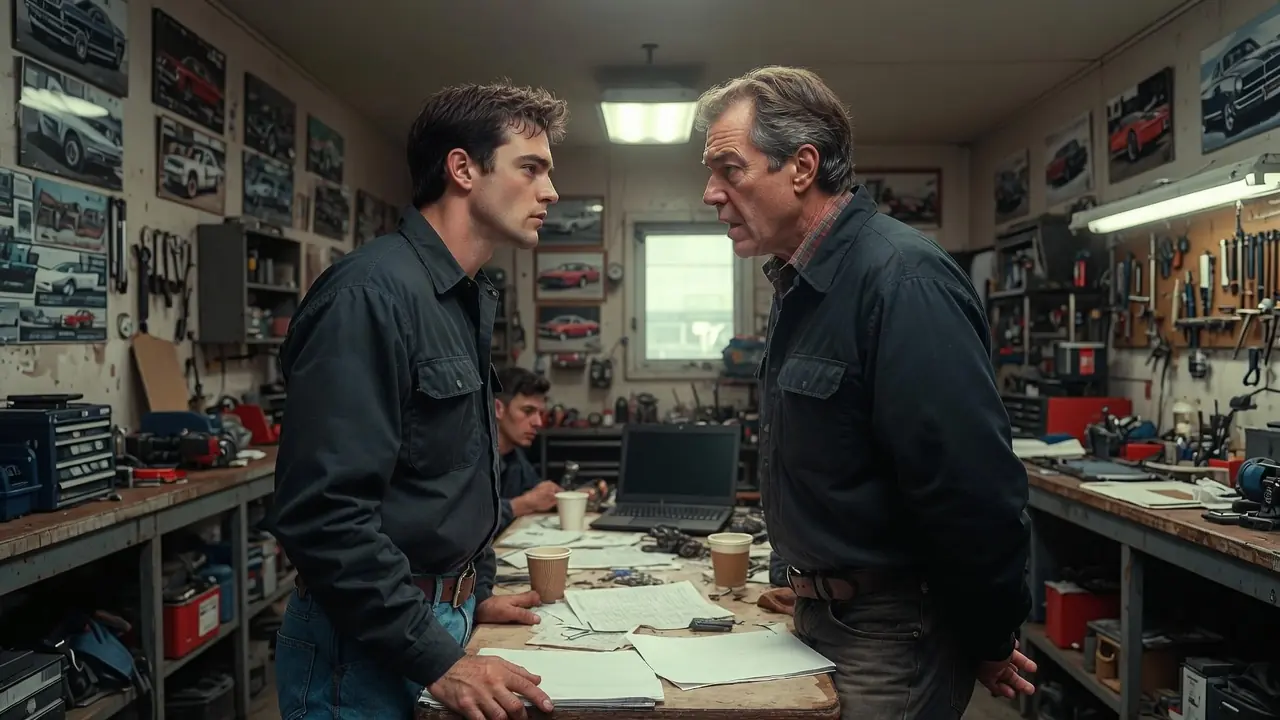
“I built our reputation on quality work,” I said, keeping my voice level even though heat was rising in my neck. “The classic car division you pushed me to start now brings in forty percent of our revenue.” Dad gave me that patronizing smile. “And we are grateful for that, Ronnie. But we need leadership now, not just technical skills.” Uncle Jack spoke up. “Rick, you’re making a mistake. Ronnie knows what he’s talking about.”
Dad cut him off. “I didn’t ask for your input, Jack. This is a family decision.” Jack stared at him. “I am family.” Dad muttered, “You know what I mean,” then turned those cold eyes back to me. “We need businessmen, not grease monkeys. You don’t belong in the decision-making part of this company.”
That was it. The room went dead silent. I stood up slowly and gathered my notes. Dad looked surprised. “Where are you going?” he asked, as if he expected me to swallow the insult and sit back down like usual. I looked at him and said, “If I’m just a grease monkey, then I quit. Effective immediately.”
I walked out. I ignored my mother’s gasp from the doorway and Evan’s smug little smirk. Uncle Jack followed me into the parking lot. “You’re doing the right thing,” he said quietly. “Should have happened years ago.” I looked back at the building, the place I had believed would someday be mine to protect. “What the hell am I supposed to do now?” I asked.
I had about forty-two thousand dollars saved and no real plan. Uncle Jack put a hand on my shoulder. “Come work with me,” he said. “Not forever. Just until you figure out your next move.” I nodded because I was too angry to say much else. That night, I packed up my apartment and crashed on his couch. I was twenty-nine years old and starting over from scratch.
Part of me had always known Carter Auto was not my future. I just had not had the courage to make the break myself. Dad’s dismissal hurt like hell, but it was also strangely liberating. No more meetings where my input was ignored. No more watching Evan get credit for ideas he did not understand. No more compromising on quality to match my father’s outdated standards.
Working with Uncle Jack gave me room to see how bad the family dynamic had been for years. The favoritism had never been subtle. Evan got a brand-new Jeep at sixteen, while I got two thousand dollars toward a used car I had to make payments on. When Evan wrecked his Jeep, Dad covered the repairs. When my car needed work, I was told to figure it out because that was how people learned responsibility.
The worst example came during my senior year of college. I had been accepted into a prestigious automotive engineering internship with a major manufacturer. It was paid, respected, and could have changed the course of my career. Dad called and said they needed me at the shop because they were short-staffed, so I turned it down to help the family. Later, I found out they were not short-staffed at all. Dad just did not want to pay another mechanic for the summer.
Six months before I quit, I overheard Dad talking to Mom in the hallway. He said that when he retired, Evan would take over as CEO. I could run the service department if I wanted, but all major decisions would go through Evan. Mom weakly asked whether that might upset me, considering I was older and had put in so much time. Dad said I was a great mechanic, but I did not have what it took to lead. He had already promised Evan. It was decided.
That was when I should have left. Instead, I held on for six more months, hoping something would change. Nothing did. At Uncle Jack’s garage, I focused on honest work. His shop was smaller than Carter Auto, just three bays and a tiny office, but it ran like clockwork. If I said a car needed a timing belt, nobody questioned my assessment or tried to upsell the customer something useless.
I knew Jack’s shop was not my long-term destination. He had built exactly what he wanted and had no interest in expanding beyond what he could personally oversee. I respected that, but I had bigger ambitions. At night, after the shop closed, I sketched out ideas for my own place. Restoration and customization kept pulling me back. Plenty of shops could handle basic repairs, but very few had the expertise or patience for full classic car restorations and high-end customization work.
Three months in, opportunity arrived in the form of a 1970 Dodge Charger. A client named Bob Henderson brought it in after it had been sitting in a barn for thirty years. It was rough, but the bones were good. More importantly, it was a genuine R/T with the 426 Hemi engine option, one of fewer than two hundred ever made. Restored properly, it could be worth more than two hundred thousand dollars.
Another restoration shop had quoted Bob sixty-five thousand dollars, which nearly gave him a heart attack. After a thorough inspection, I told him I could do it for forty-eight thousand, but I needed half upfront for parts and materials. He looked suspicious and asked what corners I was cutting. “None,” I told him. “I do not have their overhead, and I will be doing most of the work myself.” He trusted Uncle Jack’s recommendation and agreed.
The next day, twenty-four thousand dollars hit my account. I used sixteen thousand of it to rent a small warehouse on the edge of town, buy essential equipment, and get to work. I hired a semi-retired painter named Marcus who had forty years of experience and wanted flexible hours. Uncle Jack let me use his lifts on Sundays. That Charger became my obsession.
I spent fourteen-hour days on it, seven days a week. The engine rebuild alone took six weeks because I insisted on original-spec parts and documented everything for certification. The body required donor panels sourced from junkyards across three states instead of cheap reproduction pieces. Marcus recreated the original Plum Crazy Purple paint like an artist. Six months later, the Charger was a masterpiece.
When we fired the engine for the first time, the sound of that Hemi echoing through the warehouse felt like music. Bob brought three collector friends to see it, and within a month, I had four new restoration projects lined up. Every one was high-dollar. Every one came with a fifty percent deposit. That was when I officially launched Precision Performance with the Charger as my portfolio piece.
The early days were brutal. I kept overhead low, worked ridiculous weeks, and sometimes slept at the shop. Restoration projects tied up cash flow for months, but the margins and reputation were worth it. A year in, I hired three full-time specialists. Marcus handled paint, Diego handled wiring and electronics, and Tom recreated interiors from scratch. Uncle Jack consulted on complex engine builds whenever I needed him.
We were still operating out of the warehouse then, but I gradually improved it with better lighting, a small customer lounge, and a dedicated clean room for engine assembly. It was not fancy, but it was functional. Clients cared more about the quality of the work than whether we had Italian espresso in the waiting area. Then I met Ryan Matthews, a tech entrepreneur with money to burn and a passion for restomods. He brought me a rusted-out 1965 Mustang shell and said, “Make it look classic but perform like a supercar.”
The budget was one hundred seventy-five thousand dollars. I spent weeks designing the build before cutting a single piece of metal. We installed a modern Coyote 5.0 crate engine, a six-speed manual transmission, redesigned suspension geometry, and Brembo brakes all around. The body stayed mostly classic, with subtle changes for wider tires and cooling. When it was finished, the Mustang appeared in three automotive magazines and won best restomod at a major car show.
Ryan became an unofficial brand ambassador. His friends became customers, and eventually, he became a silent investor when I was ready to expand. By the end of year two, Precision Performance had a ten-month waiting list, and I moved into a proper fifteen-thousand-square-foot facility. I hired Tony, Carter Auto’s former head mechanic, offering him twenty thousand more per year plus profit sharing. Dad never found out I was the one who hired him away.
Tony brought insight into Carter Auto’s operations, pricing, vendor issues, and customer complaints. I did not use that information to attack my father’s business directly, but it helped me avoid making the same mistakes. I stayed focused on what I did best, taking historic cars and making them exceptional. I never launched a service I could not deliver perfectly. That became the rule that built everything.
The turning point came when I met Sophia Reeves, a marketing consultant who specialized in luxury brands. She came to the shop with her brother, who was picking up a restored BMW 2002, and immediately started asking smart questions. She told me I was doing premium work while marketing myself like a local garage. I was skeptical at first, but she convinced me that better positioning did not mean sacrificing quality. It meant making the right people understand what quality was worth.
Sophia rebuilt our image. New logo, high-end website, better photography, strategic media presence, and proper storytelling around the craftsmanship. Our waiting list grew to fourteen months, and I raised rates by thirty percent. Then she introduced me to Daniel Kang, a former operations executive for a luxury car manufacturer. After one tour, he told me our quality was impeccable, but our processes were killing our margins. I hired him as COO with equity, and it was one of the smartest decisions I ever made.
Daniel streamlined everything without compromising craftsmanship. He implemented inventory management, bulk ordering, and workflow planning based on the project pipeline. He reorganized specialists into teams that moved through projects together instead of working in isolation. Turnaround time dropped by twenty-five percent. Errors went down. Clients got happier. With Sophia managing brand perception and Daniel managing operations, I could focus on cars and training the next generation.
We started an apprenticeship program with technical colleges. I had never seen myself as a teacher, but I discovered I had a knack for it. There was something satisfying about watching a nineteen-year-old who had never held a wrench become a skilled craftsman. By year four, we opened a second location in Arizona, focused on rust-free classics from the Southwest. A year later, we opened a third shop in Florida.
Meanwhile, through the grapevine, I heard Carter Auto was struggling. Dad had approved Evan’s expansion plan, and the second location lasted only nine months before they had to break the lease, losing over one hundred twenty thousand dollars. Evan blamed market conditions. I knew better. They lost experienced mechanics, hired cheaper replacements, and watched quality collapse. Customer complaints piled up, and longtime clients started going elsewhere.
Uncle Jack kept me updated occasionally. “They are still afloat,” he said during one fishing trip. “But they are taking on water fast.” I nodded and cast my line again. I had my own ship to steer. In my fifth year, Precision Performance hit 8.2 million dollars in annual revenue across all locations. We had forty-seven specialists, a growing media presence, and a reputation as one of the top restoration shops in the country.
Then Classic Car Collector named us restoration shop of the year after our historically accurate restoration of a rare 1956 Mercedes 300 SL. The article called our work museum quality and called me a mechanical artist. I framed it in the office, not out of ego, but as a reminder of what happens when standards matter. Around that time, acquisition offers started coming in. Some were tempting, but I remembered what happened when Dad chose money over craftsmanship. I was not going to make that mistake.
The call came on a Wednesday afternoon. I was reviewing designs for a custom carbon fiber dashboard on a Ferrari restoration when my assistant buzzed in. “There’s an Alyssa Carter on line one. She says she is your mother.” Five years of silence, and now she was calling. I considered ignoring it, but curiosity won.
“Hello, Mom,” I said. Her voice sounded strained. She told me Dad had suffered a heart attack and needed bypass surgery. I told her I was sorry to hear it and hoped he recovered quickly. Then she said there was more. The business was not doing well. Evan had made decisions that had not worked out.
Through industry contacts, I already knew Carter Auto was close to bankruptcy. They had expanded too fast, taken on too much debt, and cut too many corners on quality. Mom told me there was also a lawsuit involving a Porsche repair. They were being sued for two hundred twenty-five thousand dollars. That meant someone had made a serious mistake, because Porsche owners do not sue over small problems. They sue when the damage is expensive and the repair is unforgivable.
“What are you hoping I’ll do?” I asked. There was a pause. “We need your help, Ronnie,” she whispered. “The bank is threatening to call in the loans. We could lose everything, including the house.” I told her I would think about it and hung up.
Twenty minutes later, Evan called. He did not bother with pleasantries. He said he knew we were not on the best terms, but this was about family. I almost laughed. “Is it?” I asked. “Because I remember being told I was not really part of the decision-making family five years ago.” He sighed like I was being difficult and said Dad was wrong. Then he asked for a loan.
“How much?” I asked. “Three hundred thousand,” he said. This time, I actually laughed. He said it would be a legitimate business loan with interest, and they would put up the original shop as collateral. I asked if he meant the shop the bank was about to foreclose on. He had no answer.
I told him I would come by the next day. Before making any offer, I had my lawyer look into the Porsche lawsuit. It was real and ugly. They had tried to rebuild the PDK transmission in a 911 GT3, a job that should have gone directly to Porsche. They botched it so badly they caused about one hundred eighty thousand dollars in engine and drivetrain damage. My lawyer said any settlement under two hundred fifty thousand would be a win.
That night, I called Uncle Jack. He was not surprised. “They finally swallowed their pride, huh?” he said. I asked how bad it really was. He sighed and told me it was worse than they admitted. Evan had been cooking the books to hide losses from Dad. There were tax liens, unhappy customers, and three mechanics threatening to sue for unpaid wages.
I stayed up late running numbers. By dawn, I had a plan. The next day, I walked into Carter Auto for the first time in five years. The place looked smaller and shabbier than I remembered. Tools were scattered everywhere, oil stains covered the concrete, and two lifts had out-of-order signs taped to them. The pride Dad once took in a clean workspace was gone.
Dad was there, looking older and frailer than I expected. His face was gray, and he moved slowly, still recovering from the heart attack. Still, his eyes carried the same stubborn pride when he saw me. Evan appeared from the back office wearing an ill-fitting suit, looking like a kid playing businessman. “Ronnie,” he said. “Thanks for coming. Let’s talk in the office.”
For two hours, I went through their books and asked questions that made Evan squirm. They were about four hundred twenty thousand dollars in debt, not the three hundred thousand Evan had claimed. They had not paid parts suppliers in ninety days. The bank was threatening to seize their equipment. Customer retention had fallen to forty-two percent, meaning less than half of their customers ever came back. Their online reviews were terrible.
When I closed the ledger, Evan asked if I could help. I said yes, but not with a loan. His eyebrows shot up. “Then what?” I looked at him, then at Dad. “I’ll buy the business.”
The words hung in the air like smoke. Dad finally spoke, offended by the idea. “This is a family business.” I answered flatly, “It is a failing business. One that will be gone in sixty days if someone does not stop the bleeding.” He scoffed and asked if I thought I was the savior because I built my little hobby shop. I cut him off. “That hobby shop made eight million dollars last year.”
Dad tried to stand tall, but he barely filled out his old shop jacket anymore. “This place has my name on it,” he said. I looked him in the eye. “Not for long.” He opened his mouth, but nothing came out. Evan finally broke the silence. “Dad, he’s right. We don’t have a choice.”
I laid out the deal. I would assume the four hundred twenty thousand dollars in debt and pay one hundred thousand in cash. Dad and Evan would stay on salary for one year as consultants during the transition. After that, they were out. Dad called it insulting. I said, “No, what you did to this business is insulting. I’m just cleaning it up.”
They asked for time to think. I gave them forty-eight hours. Two days later, my lawyer got a call. They accepted.
The transition was smoother than expected. I merged Carter Auto into Precision Performance, kept the original location, upgraded everything from the diagnostic equipment to the coffee machine, and retained most of the staff with better wages and proper training. We closed for two weeks to renovate and retrain everyone. Dad lasted three months as a consultant before his health forced him to step away. Evan stayed the full year, quietly watching the business recover.
The shop went from losing thirty thousand dollars a month to breaking even by month four. By month six, it was profitable. It took seventy-hour weeks, rebuilt supplier relationships, updated systems, and a service model Carter Auto should have adopted years earlier. The grand reopening gave me the kind of satisfaction revenge never could. Longtime customers came back, toured the renovated facility, and praised the transformation.
One customer told me right in front of Dad and Evan, “You really saved this shop. It was going downhill fast these last few years. I had started taking my BMW elsewhere.” Dad’s face tightened, but he said nothing. Later that night, Evan approached me in the customer lounge. He looked defeated. “I really thought I could do it,” he said quietly. “Run the business like Dad.”
I poured him coffee from the new machine. “The problem was trying to be like Dad at all,” I said. “He built this place through hard work, but he stopped evolving. You can’t keep doing the same thing and expect different results.” Evan nodded slowly. Then he apologized for how things went down before.
I accepted it because Evan had never really been the enemy. He was the favorite son who had never faced consequences until they arrived all at once. A few weeks later, I offered him a sales position at our main location. Not out of charity, but because I genuinely thought he could excel there with structure. To my surprise, he accepted. Even more surprising, he thrived.
It turned out Evan was excellent at building relationships with high-end clients when he had a quality product to sell and was not responsible for operations. Dad was the last holdout. A year later, Classic Car Collector featured us in an issue about family businesses. They interviewed both of us about the successful merger. To his credit, Dad told the truth.
“Ronnie saw what I couldn’t,” he said. “Craftsmanship matters more than expansion. He built Precision Performance from nothing because he believed in doing things the right way, not the fast way.”
Taking over Carter Auto was not revenge. It was redemption. When I look back at that day five years earlier, when Dad pointed at me in front of the entire staff and said they needed businessmen, not grease monkeys, I understand something now. It might have been the best thing that ever happened to me. It forced me to walk away from a place that did not value me and build something that did.
The lesson was not just about cars. It was not even really about business. It was about knowing when loyalty has turned into self-betrayal. It was about having the courage to leave a room where your worth is treated like a joke. And it was about building something so undeniable that one day, the people who dismissed you have no choice but to read the name on the door and realize they were wrong.