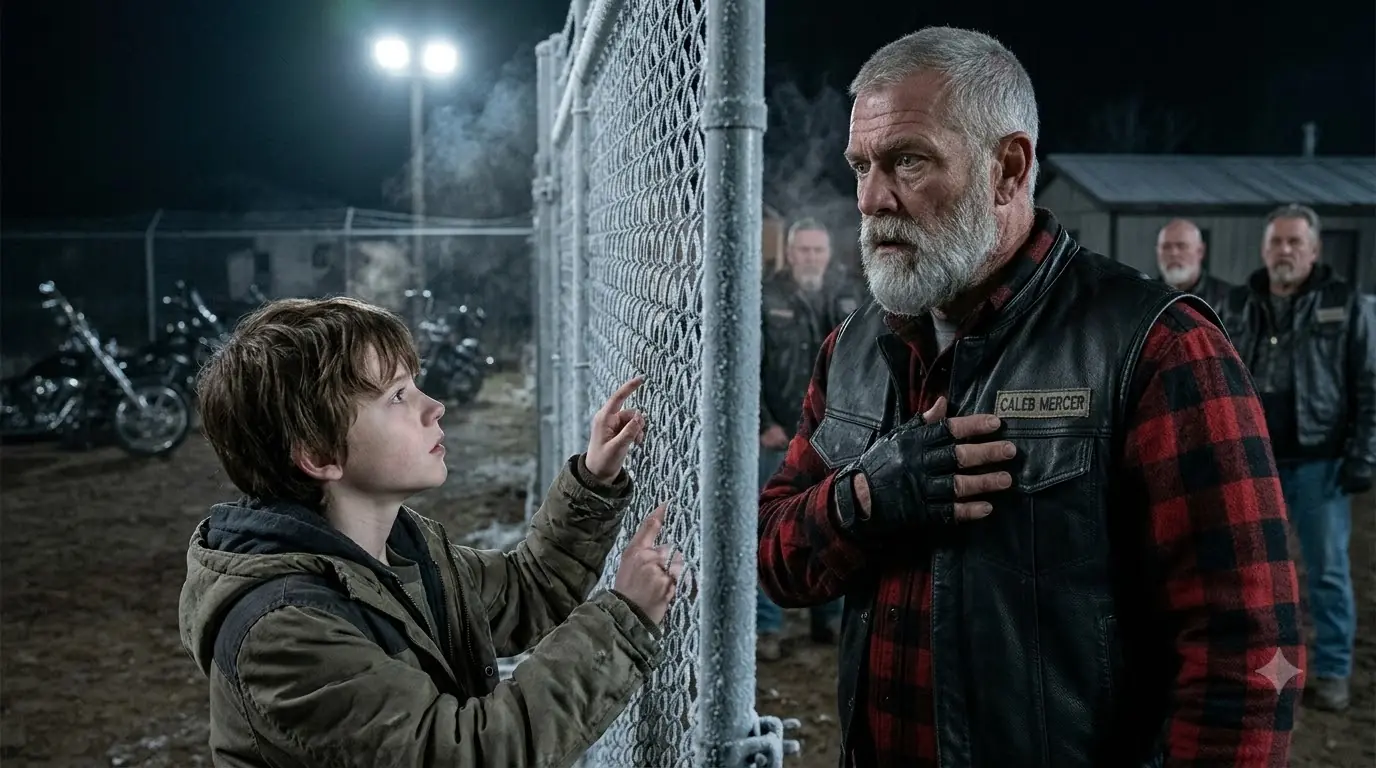
The boy walked three miles through freezing darkness before the sun had any intention of rising. 13 years old, no coat, no money, hadn't eaten a real meal in three days. Ahead of him, behind a chain-link fence wrapped in frost, roughly 100 motorcycles sat idling like a metal army that hadn't decided whether to charge or stand down. The men wearing leather didn't move when they saw him. They just watched.
The way predators watched something small cross an open field. The boy stopped at the gate. He looked at the insignia stitched across the nearest man's chest, a patch the size of a fist, worn and darkened at the edges, and his jaw tightened the way jaws tighten when someone is holding everything they have left inside their teeth. Then he said the seven words that silenced 100 men. My dad's name is on your vest.
The cold that settled over Ridgerest County in the final week of November wasn't the polite kind of cold that showed up in wool sweater commercials and smelled like cinnamon. It was the bone mean kind. The kind that came down off the high ridge line before dawn and got into the gaps between things between the boards of a porch floor, between the pages of a book left too long by a drafty window, between a boy's ribs when he'd been breathing it long enough. Eli Mercer had been breathing it for 3 days, not because he couldn't find shelter. He was home.
He lived inside four walls with functioning windows and a propane heater that still had a quarter tank of fuel left in it. He was cold because he hadn't turned the heater on since Tuesday, and it was now Friday. And the reason he hadn't turned it on was the same reason the refrigerator held nothing except a jar of expired pickle brine and half a box of baking soda. The utility bill was $32 overdue. He knew the exact number because he'd found the final notice tucked into the mailbox 3 weeks ago, carried it inside, set it on the kitchen table next to his mother's coffee cup, and waited.
He'd waited 4 days. Then he'd moved it to the counter beside the sink where she'd have to see it every time she filled a glass of water. He'd waited six more days. Then he'd put it directly on top of the TV remote, which was the one object in the house his mother still reached for with any regularity. That had been nine days ago.
The notice was still there. His mother hadn't moved it. She hadn't paid it. She hadn't asked him about it, mentioned it, or given any sign that she understood the difference between a warning and a deadline. So Eli had made a decision.