My dad has your exact bike. Cole Harker set his coffee cup down so slowly the whole diner seemed to hold its breath. He looked up at the girl, young, blonde, hands steady, but eyes screaming something her mouth couldn't say out loud. He'd been in enough rooms to know the difference between someone making conversation and someone throwing a lifeline. This was a lifeline.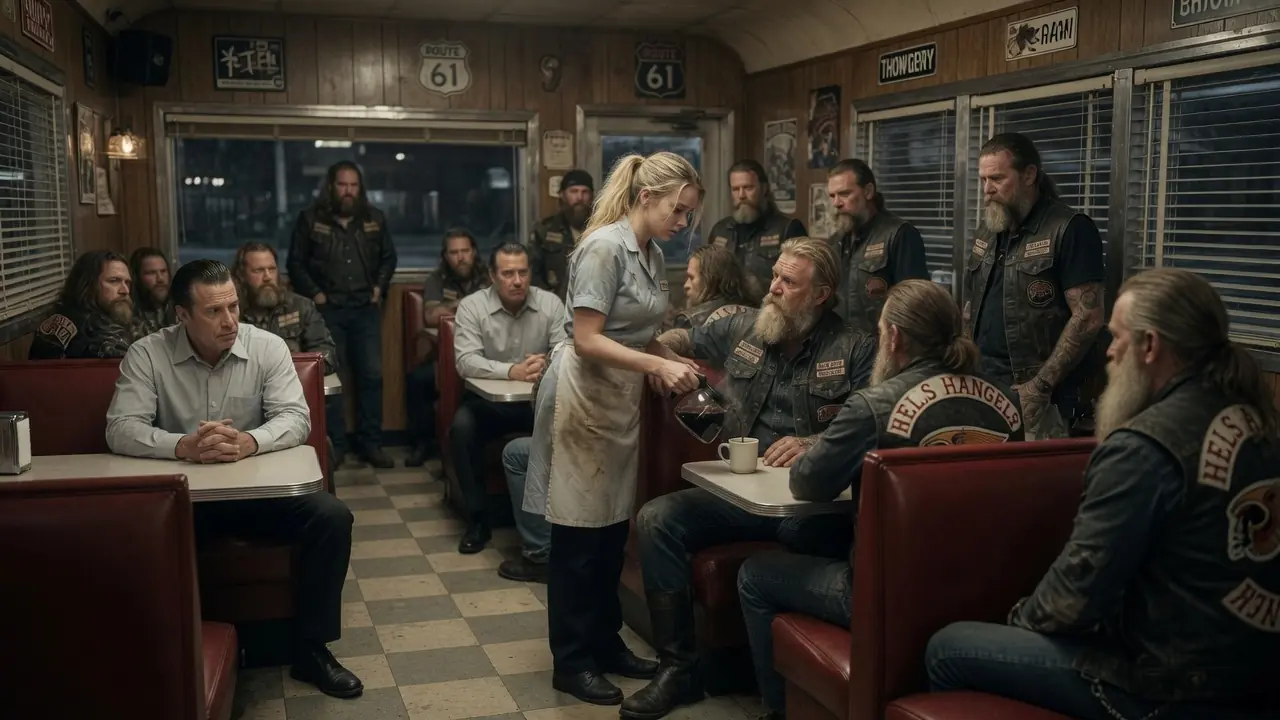
The morning had started the way all of Emily Carter's mornings started, with counting. She counted the distance from the kitchen door to the counter, eleven steps. She counted the number of tables she had to cover before Derek came in, six. She counted the minutes between the time she arrived and the time she was allowed to take her first break, two hundred and forty. She had been counting things like this for eight months.
Ever since the morning Derek Lawson sat across from her at this very diner and told her with a smile that didn't reach his eyes that he owned her schedule, her debt, and her next six months of income, whether she liked it or not. She had signed something. She still wasn't entirely sure what it said. She had been desperate and exhausted and two weeks out from being evicted. Derek had offered her a job, a small weekly advance against her wages, and a place to stay in the apartment above the diner.
What he hadn't told her, what was buried in the paperwork, was that the advance would accrue interest, that the housing would be deducted from her pay at a rate he set unilaterally, and that if she left before what he called the agreement period, she would owe him everything she'd earn, plus what he deemed a penalty for breach of contract. She had tried to talk to a lawyer once. Derek had found out within twenty-four hours. She still didn't know how. After that, he moved her schedule so she was never off work before nine at night.
He docked her pay for a broken glass she hadn't broken. He stood in the kitchen doorway one evening and said very quietly that it would be a shame if someone reported her father's old property in Oklahoma for unpaid tax liens. He didn't raise his voice. He never raised his voice. That was the thing about Derek. The most dangerous thing he ever did was smile.
So Emily counted. She counted because counting gave her mind something to hold on to when everything else felt like it was underwater. Eleven steps from the kitchen to the counter. Six tables. Two hundred and forty minutes before she could breathe. She had not called her father in three months.
Not because she didn't want to. Because she knew that if she called him and he heard something in her voice, and he always heard something, Michael Carter had radar for distress that she had never fully understood, he would get in his truck and drive here. And whatever happened after that, she was certain it would not be good for him. Her father was fifty-eight years old and lived alone in a house outside Tulsa with a garage he kept locked and a past he kept quieter than the garage.
Emily had grown up knowing pieces of that past without ever knowing the whole shape of it. She knew there had been a time when her father rode with people. Hard people her mother used to say and then change the subject. She knew there were men whose names came up sometimes in old conversations. Men her father spoke of with a particular combination of respect and grief that she had come to associate with people who had mattered enormously and then disappeared.
She knew about the bike. The nineteen seventy-nine Shovelhead sat in the back of the locked garage under a canvas tarp that her father resecured every time she came home for a visit. He never rode it. He never talked about it. But when she was seventeen and her parents' marriage was finally ending in that slow grinding way that felt less like a breakup and more like a building settling into its own collapse, her father had taken her into the garage one night.
He pulled back one corner of the tarp. He had let her look at the machine in silence for a long moment before he said anything. If you are ever somewhere you can't get out of, he said, and you see one of these outside, a Shovelhead seventy-nine, you'll know it from the engine sound before you even see the tank. You say one thing. You say my dad has your exact bike. Nothing else. You look the person in the eye and you say it.
She had been seventeen. She had thought he was being dramatic. What does that do? She had asked. It tells the right person that you're mine, he said, and that you need help. She had asked him what kind of person. He had covered the tarp back up and walked inside without answering.
For six years she had carried that sentence around like a stone in her pocket. Solid but unused. The kind of thing you hold on to so long it starts to feel like habit rather than plan. My dad has your exact bike. She had thought about it sometimes when things got hard during the year she spent in a bad apartment with a worse roommate, during the six months she worked for a restaurant manager who docked tips for minor infractions, during the long stretches of her early twenties that felt like nothing but treading water. But she had never used it. Because she had never seen the bike until this morning.
She was wiping down the counter when she heard them. She heard them before she saw them. The particular thunder of multiple engines arriving in formation. The kind of sound that didn't belong to commuters or retirees or the usual Route sixty-one weekday traffic. She looked up through the front window. There were seven motorcycles pulling into the lot.
Her eyes moved across them the way her father had taught her, faster than she expected, her brain cataloging before her conscious mind caught up. Six of the bikes were newer. But the one at the far end of the row, the one parked slightly apart the way a man sets something down that he doesn't want bumped, was old. She could tell even through glass and distance. The lines were wrong for anything modern.
The tank had a shape she recognized from a photograph she had seen once taped to the inside of the garage door. Her cloth stopped moving on the counter. She stood completely still and stared at it. She was not entirely certain. She was maybe seventy percent certain, but seventy percent was more than she'd had in eight months and something in her chest cracked open like a fault line shifting.
Derek liked bikers as customers because they tended to order a lot of food, tip in cash, and not ask for itemized receipts. He did not appear concerned. He appeared if anything slightly pleased with himself the way he always looked when he felt like he had the situation structured in his favor. The door opened. They came in the way people come in when they're used to taking up space, not rudely, not loudly, but with a particular completeness as though they brought their own atmosphere with them.
Seven men, leather cuts, the kind of road worn that wasn't costume, the kind of tired that came from distance not performance. The man who entered last was the one who drew her attention. He wasn't the biggest, he wasn't the loudest. He was tall, maybe six two with blonde hair that had begun going silver at the temples and a face that had the particular quality of someone who had learned a long time ago to absorb whatever was thrown at it without changing expression.
He wore his cut the way her father wore an old jacket like something that was part of him, not something he put on. His eyes when they swept the room moved the way water moves when it's looking for the lowest point. Efficient, unhurried, missing nothing. He was the president. She didn't know how she knew, she just knew.
The group settled into the large booth along the far wall. Emily picked up her notepad. Her hands were steady. She was proud of that. She had learned steadiness from eight months of performing it under pressure. At the corner table, Derek tracked her movement with the particular attention he used when he wanted her to know she was being watched.
She didn't look at him. She walked to the booth. "Morning," she said, "coffee to start?" A chorus of yes and yeah ensued. The man at the end of the booth, the one she'd pegged as the president, looked at her when she reached him and said, "Please." She poured without looking at his menu. She took the orders. She went back to the counter.
She did not look at the window. She was three steps from the kitchen when she stopped. She turned and looked through the glass at the parking lot. The bike at the end of the row had a gas tank with a very specific shape, a curve that her father had once traced with one finger in the dim garage while she stood beside him and tried to understand why it mattered. She was not seventy percent certain anymore. She was certain.
She stood at the counter for exactly twelve seconds. She counted them, and then she made a decision that her body had already made before her mind finished processing it. Because that's how it works when something you've been carrying for six years suddenly finds the door. It was always meant to open. She poured a fresh cup of coffee. She carried it to the booth.
"Anyone need a refill?" A chorus of cups extended toward her. She poured. She moved down the row. She reached the end of the booth. The man with the silver blonde hair looked up. She held the coffee pot steady with both hands and met his eyes.
"My dad has your exact bike," she said. The sentence was quiet. It was direct. It did not waver. The sound of the diner continued for exactly one more second, clinking dishes, the hiss of the kitchen. Derek's chair scraping slightly in the corner, and then for Emily Carter, everything else went distant, like someone had adjusted the volume on the world around her and brought only this man's face into focus.
He looked at her. She had expected many things, confusion, dismissal, the particular blank politeness of someone who didn't know what she was talking about and was trying to be kind about it. She had not expected his entire body to go still, not tense, still, the way something goes still when it stops pretending to be something other than what it is. He set the coffee cup down.
The motion was slow and deliberate in the way that slow and deliberate things are when a person is choosing exactly what they do next. What year, he said. His voice was low. It didn't carry past her. Seventy-nine, she said. She watched his face.
Something moved through it, not surprise, something older than surprise, something that had been sitting in a particular part of his chest for a long time and had just been told it was allowed to move. He looked at her for another second, then he looked past her toward the corner table. She didn't turn around. She didn't need to. She could feel Derek watching.
Sit down when you get a chance, the man said quietly. Not now, when it's natural. She nodded once. She moved back to the counter. She did not shake. She would be astonished about that later. She did not shake and she did not cry and she did not look at Derek when she passed his table because some moments require you to be more controlled than you have ever been in your life precisely because of how uncontrolled everything inside you is.
Her father had planted this seed six years ago in a dark garage and told her to carry it. She had carried it and it had just in the space of a single quiet sentence taken root. At the booth along the far wall, Cole Harker, president of the Hells Angels, a man who had spent twenty years learning to read rooms the way other men read maps, sat with a coffee cup he was no longer drinking and thought about Michael Carter.
He thought about the man's voice on the last night he had heard it fifteen years ago in a parking lot outside Tulsa. He thought about the argument and the silences and the way Michael had finally said, "I'm out, Cole. I've got a daughter and I'm out." And Cole had said something he had regretted for fifteen years and hadn't known how to unsay. He thought about the Shovelhead, Michael's bike, the machine the man had built with his own hands over the course of two years in a garage in Oklahoma while his wife was pregnant with that daughter.
The bike he rode for eight years like it was part of his body. The bike he had simply stopped riding the day he walked away. The girl's face had told him everything before she spoke a word. But when she spoke the word, when she said seventy-nine with the particular calm of someone who had been holding that number close for a long time, something settled in Cole's chest like a key turning over.
Michael had given his daughter a distress signal. He had built it in the language they both knew, motorcycle years and model names, in the unspoken geography of the outlaw world, and he had given it to a twenty-something girl who was working in a roadside diner on Route sixty-one and had at some point in the last unknown stretch of time needed to use it. Cole looked at the man in the corner. He had a very particular way of assessing threat. It wasn't about size or physical presence, it was about pattern. It was about watching how someone moved in space they considered theirs.
The man in the corner moved like someone who believed the entire room belonged to him, not with obvious aggression, but with the quiet structural confidence of a person who had organized everything around himself and hadn't been successfully challenged in long enough that he'd stopped anticipating it. Cole had seen that pattern before. He knew exactly what it did to the people inside it. He looked at the girl behind the counter, watched her take an order without expression, refill a coffee without making eye contact, navigate from table to table with a particular economy of movement of someone who has learned to be small in a space that has tried to reduce them.
She was surviving. She had been surviving for a while. He leaned toward the man to his left. Ramos, his road captain, who had been riding with him for eleven years and could read a shift in Cole's posture the way other people read a sentence and said very quietly, "That man in the corner, what do you see?" Ramos didn't look immediately. He picked up his coffee, drank, set it down, let his eyes drift naturally.
"Watching the girl like she's a clock he wound." He said, "Yeah." Cole said, "What's the situation?" "Working on that." The food arrived twenty minutes later. Emily brought it herself. She organized the plates with the same efficiency, the same controlled face, the same countlessness that Cole now understood had nothing to do with being a bad waitress and everything to do with surviving in a room with a man who weaponized her smallest mistakes.
When she set his plate in front of him, he said without looking up, "How long?" She didn't pretend to misunderstand. "Eight months." "Can you talk?" "Not now." Her eyes moved almost imperceptibly toward the corner. "He watches the kitchen cameras, too."
Cole picked up his fork. "Okay." He said, "Eat first." She almost laughed. It came out as a breath, a small involuntary exhale that carried eight months of pressure in it. "I haven't had an appetite in eight months." She said. "I know." Cole said, "Go."
She went. At the corner table, Derek Lawson watched the biker pay attention to his waitress and felt the first small bloom of something he didn't yet recognize as the beginning of the end. He told himself it was nothing. Bikers talk to waitresses. It was a highway diner. People talked.
He told himself this even as he watched the tall blond man eat his breakfast with the unhurried patience of someone who had already made a decision and was simply waiting for the right moment to act on it. He told himself this even as he noticed that two of the other men at the table were not eating. Were in fact watching the room the way you watch the room when you were responsible for what happened in it. Derek shifted in his chair. He picked up his phone.
He sent a text to no one in particular, a habit he had developed for situations where he wanted to appear occupied. He was not occupied. He was watching. And for the first time in eight months, so was Emily Carter. She was watching Cole Harker move through the end of his meal with a specific attention of someone who had been told in a dark garage by a father she loved that the right person would understand.
She was watching him the way you watch a signal fire when you're lost, not with hope exactly, but with the particular intensity that comes from having only one thing to look at. When the group finished and Cole approached the register to pay, he handed her a folded bill and a receipt that he had written on with a pen from his cut pocket. He put it on the counter in front of her with two fingers, the way you set something down that you don't want to draw attention to. She rang up the bill. She did not look at the receipt.
"Thank you." She said loud enough for Derek to hear. Professional, practiced. Cole looked at her one more time. "Tell your dad." He said the words casual enough to mean nothing to anyone listening and everything to her, "that his timing's still good." He turned and walked out.
At the counter, Emily Carter unfolded the receipt once Derek's attention shifted to a couple coming in through the front door. There were six words on it written in the deliberate hand of a man who had learned to say exactly what he meant. "Stay. We're coming back tonight." She folded it again, put it in her apron pocket, picked up her cloth.
Eleven steps to the kitchen. Six tables. Two hundred and forty minutes before her break. She started counting again. But for the first time in eight months, she was counting toward something. The note stayed in her apron pocket for the rest of the morning, like a coal small dense throwing off heat she could feel but couldn't show.
"Stay. We're coming back tonight." Six words. She had read them four times in the bathroom on her break, then folded the receipt so small it was practically a pellet, and tucked it back into the deepest corner of her pocket where Derek's eyes couldn't reach, even if he frisked her, which he had never done, but which she had always understood was a line he was capable of approaching. She went back out and worked her tables. She smiled at the couple by the window. She refilled the trucker at the counter without being asked.
She cleared plates from table three and reset it in under ninety seconds, which was what Derek required, and she did all of it with the same controlled face she had been wearing for eight months. But underneath the face, underneath the practiced movements and the counted steps and the managed breathing, something had changed. Something had shifted that she could not explain and did not try to. It was the difference between holding your breath because you have no choice and holding your breath because you are about to surface.
She was terrified the feeling would show. It didn't. She made sure of it. Derek came to the counter at eleven thirty, which was earlier than usual. He set both hands flat on the surface and looked at her the way he sometimes looked at her when he was working something out internally and wanted her to feel the weight of it.
"Those bikers," he said, "they say anything to you?" Ordered the usual, eggs, bacon, coffee. She kept her voice level. "One of them asked if we had whole wheat." "We don't." "That it?" "That's it."
He held her gaze for a beat longer than necessary. That was one of his techniques. The extended silence, the waiting, the assumption that discomfort would eventually produce confession. She had learned to exist inside his silences without flinching. She looked back at him with the mild, slightly tired expression of a woman who had nothing to hide because she had long since stopped believing in the concept of having anything at all.
"Tip well?" he asked. "Average," she said. He pushed off the counter and went back to his table. She breathed, not visibly. Just internally, the small, controlled release of someone who had just passed through a checkpoint and come out the other side intact.
She picked up her cloth and started wiping the counter, which didn't need wiping because she needed something to do with her hands. The lunch rush came in at noon, and she was grateful for it. Grateful for the noise and the movement and the volume of tasks that required all of her surface attention and left her internal life free to do what it needed to do, which was replay the morning over and over like footage she was trying to understand.
The way Cole Harker had gone still, the way he had said "What year?" the way you say something you already know the answer to but need confirmed. The way he had eaten his breakfast, unhurried, deliberate, the calm of a man who had made decisions in louder rooms than this one, and learned that patience was not the absence of action but its most effective form. She thought about her father. She hadn't let herself think about him directly in weeks because thinking about him too long made something in her chest ache in a way she couldn't afford during a shift.
But now she thought about him in the garage, standing in that half-dark with his hand on the tarp. He would be in his late fifties now. She wondered if he still kept the garage locked the same way. She wondered if he thought about her the same way she thought about him, sideways, at angles, because the direct approach was too much to look at straight.
She wondered if he knew. If he had some sense, the way he sometimes seemed to have a sense about things, that she had finally used the sentence. At one fifteen, the lunch crowd thinned. Emily was resetting table four when she heard it. Not loud, not a roar, just the initial distant note of engines, the particular frequency that she now understood her body had been calibrated to recognize. And her hands paused on the fork she was placing.
She did not look up. She finished setting the table, straightened the napkin, moved to table five. Through her peripheral vision through the front window of the diner, she registered movement in the parking lot. There were more of them this time. She was certain of it without counting. The sound had a density to it, a layering of multiple engines arriving together that was different from the morning.
Seven bikes in the morning. This was more than seven. Derek heard it, too. She tracked him without looking at him, which was a skill she had developed the way you develop all survival skills through repeated necessity. She heard his chair adjust, heard the particular quality of his silence change.
The door opened. Cole Harker walked in first. He looked different at one fifteen than he had at nine in the morning, which was to say, he looked exactly the same, but the room around him was different because he had been in it before, and the relationship between a man and a room changes the second time when the room already knows what he is. Behind him came five of the men from the morning, and behind them came three she hadn't seen before. Nine total.
Derek stood up. It was a small movement. He was not a man who made large movements when he was trying to manage a situation, but Emily noticed it and understood what it meant. It meant he had done his internal calculus and decided that a standing greeting was the correct posture. Authority projected through hospitality. She had watched him do it with health inspectors and with the man from the bank and with the occasional difficult customer whose complaint had enough witnesses to require careful management.
"Welcome back," Derek said, moving toward the group with the careful warmth of a man who had spent years perfecting the performance of friendliness. "Sit anywhere you like." Cole looked at him. It was not a hostile look. It was not aggressive. It was simply a look that did not do what Derek expected looks to do, which was to complete the social exchange, to acknowledge the greeting, to participate in the script.
Cole looked at him the way you look at something you've already assessed and categorized and set aside in your mind, and then he moved to the large booth along the far wall. The same one as the morning as though Derek had not spoken at all. Derek stood in the middle of the diner for exactly two seconds. Emily counted them. Then he smiled the smile that meant something entirely different from what it appeared to mean and went back to his table.
Emily took the orders. When she reached Cole, he looked up at her and said very quietly, "How are you doing?" "Fine," she said. The automatic answer. The eight-months answer. "Try again," he said. She looked at him.
Something about his directness, the way he asked the question like it deserved an actual answer, knocked her slightly off the rhythm of her performance. "I'm scared," she said. It came out barely above a whisper. "That's the right answer," he said. "It means your instincts are working."
She wrote down his order. Her hand was steady. She was getting very good at having internal earthquakes that didn't register on the surface. "My guys are going to be here a while," he said, still quiet, still casual in appearance. "Order a lot of food. Take your time with the refills. Derek will notice if I'm at this table too long."
"Then don't be at this table too long," Cole said. "Be at all the tables. We're just customers." She went back to the counter. She called the orders through. She moved through the diner with the practiced efficiency of someone who had learned to make surveillance comfortable, to give the watcher what they expected to see, so that what was actually happening could happen underneath it.
At his corner table, Derek was on his phone. She couldn't hear what he was saying. She could see from the angle of his jaw and the way his thumb moved that he was texting, not calling, and she noted this the way she had learned to note all his behavioral shifts, cataloging them without appearing to. He was checking something. She brought water refills to table two. She checked on the couple by the window.
She swung back toward the far booth and topped off cups without stopping, the way she did dozens of times a shift. Nothing unusual about it, just a waitress doing her job. As she poured for the man named Ramos, she had learned his name from the morning, the way he'd said it when Cole leaned toward him. He said without moving his head, "You got any friends here? Anyone who's got your back in this place?" "No," she said.
"Anyone in town?" She thought about it honestly. "My last friend stopped coming in after Derek told her I wasn't taking personal visitors during work hours." Ramos absorbed this. His jaw moved slightly. "When's closing?" "Nine." "You ever leave before nine?" "Not since March."
She moved on before he could say more. She did not rush. She did not slow. She maintained the exact same pace she always maintained because Derek's eyes had returned from his phone to the room, and the room needed to look the way it always looked. Two hours passed. Two hours of ordinary diner operations of coffee and food and cleared plates and reset tables, two hours during which Cole Harker's table ordered three rounds of food and enough coffee to fuel a long haul drive, and during which Derek sat at his corner table and watched and texted and occasionally walked the room with the proprietary ease of a man confident in the architecture he had built around himself.
It was at the three o'clock mark that the first crack appeared. A man came in who wasn't a biker and wasn't a regular customer. He was in his forties, nondescript, wearing a jacket that was slightly too warm for the afternoon. He sat at the counter. He ordered coffee. He opened a notebook.
Derek looked at him. The man looked back. Something passed between them that Emily couldn't interpret. She brought the coffee. The man thanked her without looking at his notebook and without looking at her and looked only at his coffee, which he then did not drink. She went to the kitchen. She counted the steps, eleven.
When she came back out, Derek was at the counter. He was talking to the man quietly. She stayed at the far end refilling the napkin holders, which didn't need refilling because she needed to be close enough to hear tone without appearing to listen. She couldn't hear words. She could hear the particular clipped quality of Derek's voice when he was managing something he hadn't anticipated and she could hear the other man's voice, which was flat in the way that flat voices are when they belong to people who are paid to be unreadable.
Derek came back past the counter. He looked at her and said, "Take your break." It was two fifteen. Her break wasn't until three thirty. "Tables still need" "I said take your break." She took her break. She went to the back hallway and stood against the wall and thought very carefully about what it meant that Derek wanted her out of the front room at this specific moment.
She took out her phone. She had Cole's number from the receipt. She had memorized it and destroyed the paper the way her father had told her to destroy anything written. Always in situations where information was a liability. She typed a single line. "Man at counter, not a customer. Derek sent me to the back." She sent it.
The response came in forty seconds. "I see him. Stay back there. Give us five minutes." She counted the five minutes. She had gotten very good at counting. When she came back out, the man at the counter was gone. His coffee sat untouched exactly where she had placed it.
Derek was at his corner table with his phone face down and his hands flat on the surface and his expression had the particular quality of someone who had just recalibrated. Cole was eating a slice of pie he had ordered apparently while she was in the back. He did not look at her. He did not look at Derek. He ate the pie with the same unhurried patience he had applied to everything else since he walked through the door the first time.
Ramos leaned across the table and said something to the man beside him and the man beside him laughed not loudly but genuinely, the unguarded laugh of someone who found something actually funny. It humanized the table in an instant. It made nine leather-clad men in a highway diner look for one moment like nine guys having a late lunch on a Tuesday afternoon. It was deliberate. Emily understood that now. Everything Cole did was deliberate.
At four o'clock with the diner quiet in the pre-dinner low, Derek came to the counter. He looked at the far booth. He looked at Emily. He picked up a coffee cup, turned it in his hand, set it down. "Who'd you talk to this morning?" he said, "at that table?"
"I took their orders." "Don't give me the waitress answer." he said, "You know what I'm asking." She looked at him. She made her face do the thing it had learned to do, the mild, slightly confused expression of someone who genuinely doesn't understand the question because they genuinely don't understand the question. "I talked to everyone." she said, "That's the job."
"One of them said something to you. I saw it." "The guy with the gray in his hair asked if the eggs were from a local farm. I told him I didn't know. He said, 'Okay.'" She paused. "That was it." Derek studied her face for a long moment. She had never been more grateful for the eight months of training his own behavior had given her or he had taught her through repeated exposure how to survive his scrutiny.
It was the particular irony of his entire system, the more he had pressed her, the better she had become at the one thing that could defeat him. He turned and walked away. She waited until his back was to her and then exhaled slowly, controlled. Behind her she heard Cole's voice not directed at her, directed at his table at a normal conversational volume. You know what I like about old diners? They keep records of everything.
Food orders, employee hours, receipts. All of it. Paper and digital. One of his men said, "That's right." "Paper doesn't lie." Cole said. "It just sits there being exactly what it is until someone looks at it."
Emily kept her back to the booth. She did not smile, but something in her chest moved. At five thirty the dinner crowd began filtering in. Emily worked. Cole's table ordered dinner. The routine of the diner resumed its familiar shape, but the shape was different now in the way that all familiar shapes are different when you know something is underneath them.
It was at six o'clock exactly as the sun was hitting the front windows at the angle that always made the afternoon shift harder that Derek's phone rang. Not a text, a call. He answered it, listened, his face went through three expressions in rapid succession, none of which she could fully read from across the room, but the third one, the one he settled on when he lowered the phone was one she had never seen on him before. It took her a moment to identify it. It was uncertainty.
Derek Lawson, who had maintained complete confidence in his own control for every day of the eight months she had known him, looked uncertain. He stood up. He walked to the kitchen. He did not tell her where he was going. Cole's eyes followed him. Then Cole looked at William, then looked at Emily. He held up one finger. "One minute." She nodded once almost imperceptibly.
One minute passed, then two. Derek did not come back from the kitchen. Cole set down his coffee. He said to Ramos quietly, "Go check the parking lot." Ramos left. Cole looked at Emily directly across the room. He didn't beckon her. He didn't gesture. He just looked at her with the particular steadiness of someone who is about to say something that matters and wants to be sure the other person is ready to hear it.
She walked to the booth. "Sit down," he said. She looked at the corner table. Empty. She sat down. "Derek just got a call from someone who works for someone who works for a man who used to do some accounting for him," Cole said. "That's a lot of distance on purpose because the people Derek does business with are very careful about distance."
"What that call probably told him is that someone has been looking at his employment contracts." Emily stared at him. "You've been" "Not me directly. I made a phone call this morning before we left the parking lot." "I know people who know how to look at paper the right way." He picked up his coffee, set it down. "How much does he say you owe him?"
"He changes the number," she said. The words came out strange in her mouth. She had never said them to anyone out loud. "When I asked him to write it down, he said the terms were in the original contract." "When I asked to see the original contract, he said he didn't have it on him, but it was filed properly." "Does he have your signature on the housing deduction agreement?" "I don't know. He said I signed something agreeing to it."
"Did you?" "I signed things. I was I wasn't in a position to read everything carefully." "I was two weeks from losing my apartment, and he offered" She stopped. "I signed things." "Okay," Cole said, and the word contained no judgment, only acknowledgement. "That's not what you think it is. That's not stupidity." "That's a man who understood exactly how much pressure it took to get a signature and applied it at the right moment."
She looked at him. "You sound like you've seen it before." "I have," he said. "Different buildings, same structure." He leaned forward slightly. "Emily, I need to ask you something directly, and I need you to answer me directly." "Okay." "Are you in danger right now? Physical danger?"
She thought about it honestly. "Not in the way you mean. He's never He doesn't do it that way. He does it with the money and the schedule and the" "The walls," Cole said. "Yes. Those are real walls," he said. "Don't let anyone tell you they're not." She nodded. Her throat was doing something she didn't want it to do.
Here's what's going to happen, Cole said. Tonight, when the dinner shift ends, you are not going to be alone. There are going to be people in the parking lot, not making a scene, not creating a situation, just present. Derek will see them. That's fine, Cole said. Derek is going to be occupied with some other things by tonight. What things? The kind of things that happen when the right people start looking at the right paperwork.
He held her gaze. You trust me? The question was so direct, it almost felt like a test. She thought about the garage. She thought about her father's voice. She thought about the fact that she had said four words to this man this morning, and he had, in the span of a single day, done more to dismantle the architecture of her trap than she had managed in eight months of surviving inside it. I trust my father, she said. And he trusts you. So, yeah.
Cole almost smiled. It was a slight thing, more in the eyes than the mouth, but it was real. You know what your father told me last time I saw him? Cole said. She shook her head. He said the most dangerous thing he ever gave away was that bike. Because he said whoever he gave it to would know what it meant. And whatever it meant, they'd be responsible for it.
Cole looked at his coffee. I told him he was being dramatic. I was wrong about a lot of things that night. From the kitchen, she heard Derek's voice, not words, just the tone of it. The particular clipped urgency that meant he was on the phone and not happy about what he was hearing. She stood up smoothly.
She picked up two cups from the table and carried them toward the counter, like she had come to clear dishes, which was what she looked like she had come to do. Cole returned to his pie. Ramos came back in through the front door and sat down and said something low that made Cole nod once. At the corner table, Derek's chair was still empty.
Emily stood at the counter and looked at his empty chair and thought about eight months of mornings that started with counting and nine o'clock nights that ended the same way and a receipt with six words on it that she had memorized and destroyed. Stay. We're coming back tonight. They had come back. And Derek Lawson's empty chair was the first evidence she had seen in eight months that the room might not belong to him anymore.
She picked up her cloth. She wiped the counter. She waited. Derek came back from the kitchen at six forty. Emily knew it before she heard his footsteps because the quality of the room changed the way a room always changed when Derek entered it with something on his mind. There was a pressure shift, subtle but real. The kind of thing you stop noticing after the first month and started noticing again only when you understood what it meant.
She was at table two clearing plates. She did not look up. He walked past her without speaking. Went to his corner table. Sat down. Set his phone face up on the surface this time, which he never did, which meant he was expecting a call he needed to answer immediately when it came.
She carried the plates to the kitchen. Eleven steps. She set them in the rack. She came back out. At the far booth, Cole was drinking his third cup of coffee with the patience of a man who had nowhere else to be, which she understood by now was not the same thing as a man with nothing else to do.
The dinner crowd was mid-peak. Tables five and seven needed checks. The couple at the window had been waiting on dessert for eight minutes. She moved through it all with the automatic competence of someone whose body had learned the job well enough to run it without full conscious participation, which freed her mind to do what it was actually doing, which was tracking every variable in the room simultaneously.
Derek on his phone, his jaw tight, his thumb moving. Cole still, patient, watching nothing in particular and everything at once. Ramos near the door who had ordered pie twenty minutes ago and eaten approximately none of it. The dinner customers oblivious, grateful for that. At six fifty-two, Derek stood up again.
This time he didn't go to the kitchen. He walked directly toward the far booth. Emily's hands stopped on the counter. She watched him cross the room. She watched the careful managed walk of a man who had decided that the direct approach was his best remaining option. She watched him stop at Cole's table.
"Help you with something?" Derek said. Cole looked up. He said nothing. "You've been here since one." Derek said. "That's almost six hours." "Good coffee." Cole said. "I run a business. This isn't a place to camp." "We've been ordering food." Cole said, steadily. "Would you like to see the receipts?"
Something flickered across Derek's face. "I'd like you to think about wrapping up your evening." Cole picked up his coffee cup, turned it once in his hands, set it down. "I'd like to finish my coffee." he said. "When I'm done, I'll go." "That work for you?" The two men looked at each other.
Emily had stopped pretending to work entirely and was standing at the counter with a cloth in her hand and absolutely no blood in her extremities. Derek said, "What's your interest in my waitress?" "She took our orders." Cole said. "That's typically how diners work." "You talked to her more than once." "I talk to people." Cole said. "It's a character flaw."
"I don't appreciate customers interfering with my staff." Cole looked at him then with the full weight of his attention, which Emily now understood was a different thing from his ordinary attention. His ordinary attention was already more than most people could manage. His full attention was something else entirely. "I haven't interfered with anything," Cole said. "But since you're asking, the girl looks tired. Feed her occasionally. It's good for business."
Derek's face went through something complicated. He straightened. He looked at Emily who immediately started wiping the counter with the dedication of someone who had not been listening to a single word. "Enjoy your coffee," Derek said and walked back to his table. Cole returned to his cup. Emily realized she had been holding her breath and released it through her nose slowly without moving her shoulders.
Two minutes later, her phone buzzed in her apron. She slipped it out at the counter angled away from Derek's sightline. The text was from a number she didn't recognize. It said, "This is Ramos. Cole wants you to know county sheriff's office received a complaint this afternoon. Employment violations. Anonymous. They'll send someone tomorrow morning. Tonight we're making sure you get out clean." She read it twice. Put the phone back in her apron.
County sheriff. Tomorrow morning. Tonight. She thought about the word clean. She thought about what it meant in the context of eight months of anything but. At seven fifteen, two things happened within the same ninety-second window and the collision of them was the first moment Emily Carter understood that the structure Derek had built around her was not just bending, it was breaking.
The first thing was a car pulling into the parking lot. Not a motorcycle. A car. An older model sedan with two people in it who sat for a moment before getting out. She tracked this through the window without appearing to. The two people who got out were a man and a woman, both in their thirties, both dressed in the particular functional plainness of people who were not trying to make an impression.
They stood in the parking lot and looked at the diner and then looked at each other and the woman wrote something down. The second thing was Derek's phone ringing. He answered it, listened for four seconds, and then his face did something she had never seen it do in eight months. It went blank. Not the managed blankness of performed calm, the actual blankness of someone whose internal system has just received information it doesn't have a prepared response for.
The blankness of a man who has spent years building a room and has just been told by someone he trusted that the walls are made of paper. He stood up. He walked to the back of the diner. He did not look at Emily as he passed. She looked at Cole. Cole was already looking at her. He gave her one small nod.
She did not know exactly what was happening. She knew enough. She knew that eight months of being managed and watched and controlled and docked and threatened and isolated had led to this specific Tuesday evening in this specific diner and that the man who had built the room she was trapped in was currently standing in a hallway finding out that the room had a door he hadn't put there. She set down her cloth. She walked to the far booth.
"Who are they?" she said, "in the parking lot?" "People who do employment law," Cole said, "specifically the kind that involves wage theft and coercive contracts." "How did you" "I made some calls this morning," he said. "After we left, people I know, people they know." He looked at her steadily. "None of this happened fast, Emily. Some of it's been building since before today. What today did was give it a specific address."
She processed this. "He's going to know it was me." "He doesn't have proof of that." "He'll assume. Let him," Cole said, and the simplicity of it hit her in a way she hadn't anticipated. "Let him," as though Derek's assumptions no longer had structural power. As though the architecture of control that had organized her life for eight months was already sufficiently dismantled that what Derek believed or assumed or decided had become functionally irrelevant.
She sat down without meaning to. Her legs made the decision before she did. I don't know how to She stopped, tried again. I don't know what happens now, practically. I live above the diner. My stuff is up there. You won't sleep here tonight, Cole said. But by dawn we're There's a motel four miles east on Route sixty-one. Room's already paid for. Ramos will drive you when your shift ends. Your stuff? We'll get your stuff tomorrow when there are more witnesses.
She stared at him. You did all this today? Most of it was phone calls, he said as though that diminished it, which it didn't. You didn't even know me this morning. Cole looked at her for a moment. I knew your father, he said. That's enough. From the back hallway, Derek's voice rose slightly. Not words, just volume, the first crack in the managed register he had maintained all day.
Emily and Cole both heard it. Neither of them looked toward the hallway. He's going to come back out and he's going to be different, Cole said quietly. Men like him, when the control starts slipping, they don't go quieter. They make a play. Direct this time because the indirect routes aren't working. He might try to get you alone. He might try to do something with your contract or your belongings. He might just try to scare you back into place.
What do I do? You stay where I can see you, Cole said, and you do your job. Tables need clearing. She almost laughed. It came out as a sound she hadn't made in eight months. Not quite a laugh, but the direct ancestor of one, something that lived in the same neighborhood. She stood up and went back to work.
Derek came out of the hallway at seven thirty-four. She counted the seconds between hearing his footsteps and seeing his face, which gave her time to be fully occupied with table seven's check when he emerged. He looked different. The blankness had resolved into something with more shape to it, a compressed inward-facing anger that he was working to keep below the surface. She had seen him angry before, but always the managed kind, the kind he chose to deploy. This was something he was containing rather than deploying, which was new, and which told her the phone call had been worse than she'd estimated.
He went to the counter. He stood there. "Emily," he said. She came over, kept her face in the familiar register, attentive, slightly tired. Professionally pleasant. "Do you know anything about a complaint to the sheriff's office?" he said. "No," she said. "Anonymous complaint. Employment practices." "That's got nothing to do with me," she said. "Someone talked to someone," Derek said. "This morning after those bikers came through."
"Derek, I served them a breakfast. I don't know anyone at the sheriff's office. I barely know anyone in this town." She said it with the flat truthfulness of a woman who had been genuinely isolated for eight months because it was genuinely true. He looked at her for a long time. The extended silence. The assessment. She had spent eight months being assessed. She had never been better prepared for it than she was at this specific moment.
"Okay," he said finally. He said it the way you say a word when it means the opposite of what it says, not agreement, not acceptance, but the verbal placeholder for a decision not yet executed. He went back to his table. Ramos appeared at the counter three minutes later, ostensibly for a coffee refill. Without looking at her, he said, "Two of our guys are outside the back exit. You need anything use the back." She nodded almost invisibly. "I won't need anything." "Good girl," he said, which would have irritated her in a different context, but in this one landed as the straightforward approval it was meant to be.
The dinner rush peaked and began to ebb by eight fifteen. Tables cleared. The diner got quieter, the particular quality of quiet that comes after a long service when the machinery of a busy place winds down and the spaces between things get larger. Cole's table had been the last full booth. By eight thirty it was only Cole and Ramos still there, the others having filtered out across the course of the evening in ones and twos, which Emily understood now was not casual, but deliberate, a slow reorganization of presence rather than a sudden departure.
At eight forty Derek stood up. He walked to the far booth. Emily's hand stopped on the coffee pot. Cole looked up. "We're closing soon," Derek said. "It's nine o'clock closing," Cole said. "It's eight forty. I'm calling it early tonight." "You're allowed to do that," Cole said. "We'll finish up."
Derek stood there. There was something in his posture that Emily recognized, the gathering of a man who has decided to push past the managed approach into something harder. She had seen it once before in March when she had told him she was considering leaving before she understood the full extent of what he had built around her. He had made a very specific choice that night, a quiet one, but specific. "I want to ask you something directly," Derek said to Cole. "Go ahead." "Who are you?"
Cole looked at him. "Cole Harker," he said. "I ride motorcycles. I eat breakfast. Today I also ate dinner." He paused. "Who are you?" Derek's jaw tightened. "I'm the man who owns this business." "Okay," Cole said. "And that girl," Derek said, his voice dropping to the register he used when he wanted words to land with weight, "has a contract with this business. Legal and signed. Whatever anyone's told her, whatever she thinks she can" "I haven't told her anything about her contract," Cole said. "You've been talking to her all day." "I've been a customer all day."
Cole's voice didn't change. It was infuriatingly completely level. "If you have a concern about your employment agreements, that's something to discuss with your lawyer." He picked up his coffee. Or with the county sheriff's office, I imagine, since they're apparently looking into some things. Derek went very still. Cole drank his coffee. "That was you," Derek said. "I told you who I am," Cole said. "I ride motorcycles." "You had someone file a complaint." "I had breakfast," Cole said. "And then I came back for dinner because the eggs were good."
Derek looked at him, looked at Ramos, looked at the door. Did the math of the room, two men at a booth, but how many outside in the parking lot? In the positions that a man who spent twenty years moving through difficult situations would think to put people in. The math did not come out in his favor, and he knew it. "I want you out of my diner," Derek said. "We'll be out before nine," Cole said pleasantly. "We'll leave a good tip."
Derek stood there for three more seconds. Then he turned and walked to Emily, who had not moved from the counter. He came very close. Close enough that this would have been, three months ago, a technique, the proximity as pressure, the reminder of his size relative to hers. He did it now, and it registered on her body the same way it always had, the involuntary stiffening, the controlled breathing. Eight months of conditioning didn't evaporate in a single day. But it didn't own her the way it had this morning.
"You think you're protected," he said very quietly, meant only for her. "You think these people are your friends. You've known them for twelve hours." She met his eyes. "I know," she said. "When they leave." "I know," she said again. He frowned. He had expected more response than that. The technique required reaction, fear, or defensiveness, or the particular crumbling that eight months had taught him to produce. She was giving him nothing. Not defiance, not performance, just the steady, specific calm of a woman who has made a decision and finished making it.
"Your contract doesn't disappear because you have biker friends," he said. "Okay," she said. "You walk out of that door without my authorization and you owe me every cent of the advance plus penalties. That's legally binding." "Okay," she said. He stared at her. "You understand what I'm telling you?" "Yes," she said. "I understand what you're telling me." She looked at him with the face she had spent eight months perfecting, the one that gave him nothing, and she said, "Is there anything else you need before close?"
He walked away. She stood at the counter and the counter held her up and she was grateful for it. At eight fifty-eight, Cole and Ramos stood up. Cole left cash on the table, more than the bill as promised. He walked to the counter. He set his hands flat on the surface and looked at her. "You good?" He said. "I don't know," she said. "That's honest," he said. "I'm scared," she said. "Still, even with all of I'm still scared." "That's okay," he said. "You don't have to not be scared. You just have to take the next step."
"What's the next step?" "Your shift ends in two minutes," he said. "You get your jacket and your bag. You come out the front door. Ramos is going to be right there. You get in the car. That's it." She looked at him. "What about Derek? He's right there." "He's not going to do anything," Cole said. "Not tonight. Not with the people who are outside right now and with a complaint already filed." He held her gaze. "He's going to stand there and watch you leave and do the math one more time, and the math is going to come out the same way it came out ten minutes ago."
She looked at Derek's corner table. Derek was watching them. She looked back at Cole. "My father," she said. "Does he know? Have you talked to him?" "Not yet," Cole said. "That's tomorrow. Tonight is just you." She nodded. She untied her apron. She folded it and set it on the counter, which was where it went at the end of every shift, which was such a small and ordinary action for such an extraordinary moment that it almost broke the composure she had been maintaining since nine in the morning.
She got her jacket from the hook by the kitchen door. She got her bag from the shelf above it, the small bag she kept there every shift. Deliberately small, deliberately portable because some part of her had always been half ready to move and had never quite believed the opportunity would come. She walked out through the front door. The night air hit her like the first real thing she'd felt against her skin in eight months. Ramos was there.
He was leaning against a car with his arms crossed and when she came out, he pushed off from the door and said, "You hungry? There's a place near the motel that does a decent pie." She stared at him. "You seriously want to talk about pie right now?" "We've been talking about heavy things all day," he said. "Sometimes you got to land somewhere normal." She thought about it. "What kind of pie?" "Cherry," he said, "or peach. It's the South, they do both."
She got in the car. Through the diner window, she could see Derek standing at the counter where she had stood for eight months. He was watching the car. His face had the expression of a man watching something he was certain he owned until the moment it walked out the door. She didn't look away from him. She let herself look, let herself look at the room and the counter and the corner table and all eleven steps from the kitchen to the register, and then Ramos pulled out of the lot and Route sixty-one opened up ahead of them and the diner was behind her and the night was wide and dark and full of the particular silence that exists only after something is finally, finally over.
Her phone buzzed, a number she didn't recognize. Not Ramos's number, a different one. She answered it without thinking. "Emily?" The voice was rough and quiet and immediately, devastatingly familiar. "You okay, baby?" She pressed her hand against her mouth. Her father had known. Of course he had known. "Yeah, Dad," she managed after a moment. "I'm okay."
There was a silence on the line. The kind of silence that carries more than words. She could hear him breathing and she could hear in his breathing the eight months of not calling and the six years of carrying a sentence in her pocket and the seventeen-year-old girl in a garage looking at a bike under a tarp and all the distance between then and now. Cole called me, her father said. "I know," she said though she hadn't known until this moment. He said you used the line. "I did." Another silence. "I didn't think you'd ever need it," he said and his voice did something in the middle of it that told her he was less composed than he was trying to sound. "It worked, Dad," she said. "Yeah," his voice cleared. "Yeah, it did."
She watched Route sixty-one unroll ahead of them in the headlights and she thought about an old bike under a tarp in a locked garage in Oklahoma and about signals that travel across years of silence and about a father who had built a door into the darkest room his daughter might ever find herself in before she was old enough to know she'd need it. "I'm going to come see you," she said, "soon, when this is settled." "I'll be here," he said. "Is the bike still there?" A pause. Something shifted in it. Something she hadn't heard in his voice in a long time. "Still there," he said. "Always been there."
She slept for eleven hours. She hadn't slept more than five consecutive hours in eight months and when she woke in the motel room to pale morning light and the distant sound of Route sixty-one traffic. Her first instinct was to count the steps to the counter, the tables, the minutes and then her body caught up with where she was and the counting stopped and she lay still for a long moment in the specific silence of a room that belonged to no one who wished her harm. It felt strange. Safety felt strange. That was the thing no one told you about getting out of a bad situation that the absence of threat didn't feel like relief right away. It felt like waiting for the threat to reappear.
Her nervous system had been calibrated to Derek's rhythms for so long that the absence of them registered as wrongness before it registered as freedom. She sat up, checked her phone. Three texts from Cole sent across the early morning hours. The first at six forty-two, Sheriff's office made contact with Lawson this morning. They're requesting documentation. Employment attorney we connected you with will call at nine. The second at seven fifteen, don't go back to the diner without one of us. Your stuff we'll keep. The third at eight fifty-one, nine minutes before she woke leaving for Tulsa this morning. Your father knows I'm coming, you should too.
She read that one twice. Cole was going to Tulsa. Cole was going to see her father. The two men who had not spoken in fifteen years were going to be in the same room and she was going to be in a motel four miles east of the diner where she had spent eight months surviving and none of it was something she had the vocabulary to fully hold at once. She called her father. He answered on the second ring. "You sleep eleven hours. Good." She could hear him moving around his kitchen, the particular sound of a man who lived alone making breakfast for one which she had heard on every phone call for three years and which now made something in her chest tighten in a way that was entirely different from the tightening of the last eight months.
Cole's coming, she said. "I know." You're okay with that? A pause that had history in it. "Yeah," he said. "I think it's time." "What happened between you two?" She said. "You never told me." Another pause, longer. She heard him set something down on the kitchen counter. "I made a choice," he said. "When you were born, I told Cole I was done. That the life wasn't that I couldn't ride with that world and be the kind of father I needed to be."
He stopped, started again. Cole thought I was abandoning something, brotherhood. He wasn't entirely wrong. I was. I just thought what I was going toward was worth more than what I was leaving behind. "Was it?" "You're asking me if you were worth it?" She hadn't meant it that way, but she understood why it landed there. "No," she said, "I'm asking if you think you made the right call." Her father was quiet for long enough that she thought the connection had dropped. Then he said, "I've been sitting in this house for fifteen years with a bike under a tarp that I can't ride and a past I can't talk about. I missed your graduation because I was too far in my own head to drive four hours. I let your mother carry things she shouldn't have carried alone because I was so deep inside my own guilt about who I'd been that I couldn't figure out how to be someone useful."
He exhaled. "And then you called me last night from the side of a highway after using a distress code I gave you when you were seventeen. And I had to ask Cole Harker, a man I haven't spoken to in fifteen years, to go rescue my daughter because I planted a signal and then made myself unavailable to be the one who answered it." She didn't say anything. "So, no," he said, "I don't know if it was the right call. I know I love you. The rest of it I've been working out." It was the most honest thing her father had said to her in years, possibly ever.
She sat with it for a moment, sat with the weight of a man in his late fifties standing in his kitchen, finally saying out loud the thing he had been carrying since she was born. "Dad," she said. "Yeah." "The bike's still there," she said. "You said so last night." "Still there," he said. "Maybe that means something," she said. He didn't answer right away. When he did, his voice was different, quieter in a way that was fuller, not emptier. "Maybe," he said.
The attorney called at nine oh three. Her name was Sandra Reeves, and she spoke with a particular efficient warmth of a woman who had done this work long enough to understand exactly what the person on the other end of the line had been through and what they needed, which was competence delivered without condescension. "I've reviewed the contract he claims you signed," Sandra said. "The housing deduction clause is unenforceable under state law. The advance with interest structure constitutes wage theft under two separate statutes. And the penalty clause for early departure is void on its face."
Emily sat on the edge of the motel bed and tried to absorb this. "He told me it was all legal." "He told you what he needed you to believe," Sandra said. "That's a pattern, not a mistake." A brief pause. "The sheriff's office has the complaint and they're treating it seriously. There may be other employees, current or former, with similar situations. That widens the picture."