Not all at once, and not in a loud, cruel way that would have made the moment easy to name. It came in small pieces, through sighs, little smiles, and voices that sounded tired of being bothered by the woman who had once cut the crusts off their sandwiches. I sat at my kitchen table with the heating bill, my pharmacy receipt, and Frank’s old reading glasses beside me, trying to explain that I only needed help until my Social Security check arrived. I did not ask for vacation money, a new car, or anything grand enough to embarrass them.
There was half a carton of milk in the refrigerator, two eggs, and a bag of vegetables soft enough that I knew I should have thrown them away the day before. My pantry held a box of crackers, a little rice, and one can of soup I had been saving for a colder night. I had stretched things before, more times than my children ever knew, but that week felt different. The medicine had cost more than expected, the furnace had needed a repair, and pride does not fill an empty refrigerator.
Michael was the first one I called. He was my oldest, a lawyer with a handsome house outside Columbus, a polished wife, and a way of speaking that made every conversation feel like a meeting he wanted to end. I told him I was a little short until my check came in and asked whether he could bring by some groceries or maybe send enough for a few bags. He sighed so deeply that I pulled the phone away from my ear. “Mom, you have to learn to manage better,” he said.
Jennifer answered while driving somewhere. I could hear traffic and the expensive calm of her car through the speaker. She had always been the emotional one as a child, the one who cried when birds hit the window and tried to rescue earthworms after rain. But adulthood had given her a hard little laugh that appeared whenever I needed something. “Groceries?” she said. “Mom, really? Maybe just buy less.”
David was my youngest, my charming boy, the one who had once followed me through the kitchen with a wooden spoon, pretending he was helping me cook. He answered on the third ring and sounded irritated before I finished my first sentence. When I told him what was happening, he gave a short laugh. “Eat less then,” he said. “You’re always saying you don’t have much appetite anyway.”
Eat less.
Those two words settled inside me like cold stones. No one asked if I had eaten dinner. No one asked whether I still had my medicine. No one said, “Mom, I’m coming over.” All three of them spoke as if hunger were a habit I should simply correct.
I stayed at the table long after the calls ended. The heater knocked in the wall, slow and uneven, the way it had since Frank was alive and promising to fix it next weekend. His reading glasses sat beside the bills, still in the same place I had left them after his funeral because some objects become too heavy to move. Outside, the porch light glowed over the leaning mailbox Frank had also promised to fix. I stared at that light and thought about every dinner I had ever cooked for the three people who now thought hunger was funny.
The next morning, everything changed.
I did not learn it from a phone call. I learned it from a man in a gray suit standing on my porch with a leather folder under his arm and sympathy in his eyes. His name was Mr. Alden, and he worked for a law firm in Cincinnati. He told me my late cousin Ruth had passed away quietly in her sleep three weeks earlier. Ruth and I had not spoken much in recent years, not because of anger, but because life can carry people to opposite corners and leave them there.
Ruth had never married and never had children. When we were young, I was the one who visited her after her surgery, brought casseroles, and sat by her bed when everyone else said they were too busy. I remembered that, but I never thought she did. Mr. Alden unfolded the papers and explained that Ruth had named me her sole beneficiary. After taxes, accounts, property sales, and investments, I had inherited approximately $4.2 million.
For a moment, I thought I had misunderstood. I looked down at my hands because they had begun to tremble. Four point two million dollars did not sound like a number that belonged in my kitchen. It sounded like something from another person’s life, someone who had never counted change in a grocery aisle or put meat back because the price looked too bold. Mr. Alden asked if I needed to sit down, and I told him I was already sitting.
He stayed for almost an hour, explaining what would happen next. There would be transfers, meetings, advisors, paperwork, and tax planning. He spoke carefully, as if afraid the news might injure me if delivered too quickly. I nodded at the right times, but my mind kept going back to Michael’s sigh, Jennifer’s laugh, and David’s voice saying, “Eat less then.”
After Mr. Alden left, I went to the pantry. I opened the door and looked at the crackers, the rice, and the single can of soup. Then I closed it gently. I did not call my children. I did not send a message to the family group chat. I did not announce anything at all.
That afternoon, I went to the pharmacy and bought my prescription. Then I went to the grocery store. For the first time in months, I did not put things back after checking the price. I bought salmon, real butter, potatoes, fresh green beans, apples, cream, coffee, good bread, and a bouquet of white tulips for the middle of the table.
At the register, I almost cried when the total appeared. Not because I could not pay it, but because I could. The young cashier smiled and asked if I wanted help carrying the bags. I said yes, even though I could have managed. Sometimes accepting help from strangers is easier than asking it from the people you raised.
The next morning, I called Mr. Alden and asked for an urgent appointment. I brought a notebook, Frank’s old pen, and the kind of calm that comes when pain finally turns into decision. We reviewed my estate plan, which had not been updated since Frank died. Back then, everything was simple. The house and my savings were to be divided equally among Michael, Jennifer, and David.
Mr. Alden asked what I wanted now. I looked at the polished desk, then at the framed law degrees on the wall, and said I wanted my grandchildren protected, not my children rewarded. I wanted each grandchild to have an education trust that no parent could touch. I wanted a large portion set aside for a food pantry in Frank’s name, one that would serve seniors who were too proud or too forgotten to ask twice. The rest, I said, would go to a foundation for elderly widows living alone.
Mr. Alden did not ask what my children had done. Good lawyers know when a client is not ready to tell the whole story. He simply took notes and said he would draft everything. Before I left, he handed me three cream-colored envelopes. “For your children,” he said. “As requested.”
The envelopes contained copies of the new estate documents, summaries of the trusts, and a short personal letter I had written to each of them. I had asked Mr. Alden’s assistant to write their names on the front in Frank’s old handwriting style, copied from Christmas cards I brought from home. I wanted them to see their father’s presence before they saw mine. Frank had always believed actions mattered more than promises. I wanted that table to feel like he was sitting there too.
I invited my children to dinner the next day.
No accusations. No crying over the phone. No mention of money. I simply told each of them I wanted one last family meal together, the old kind, before winter settled in. Michael hesitated because he had work. Jennifer asked if it was serious. David asked what I was cooking. I answered all of them gently.
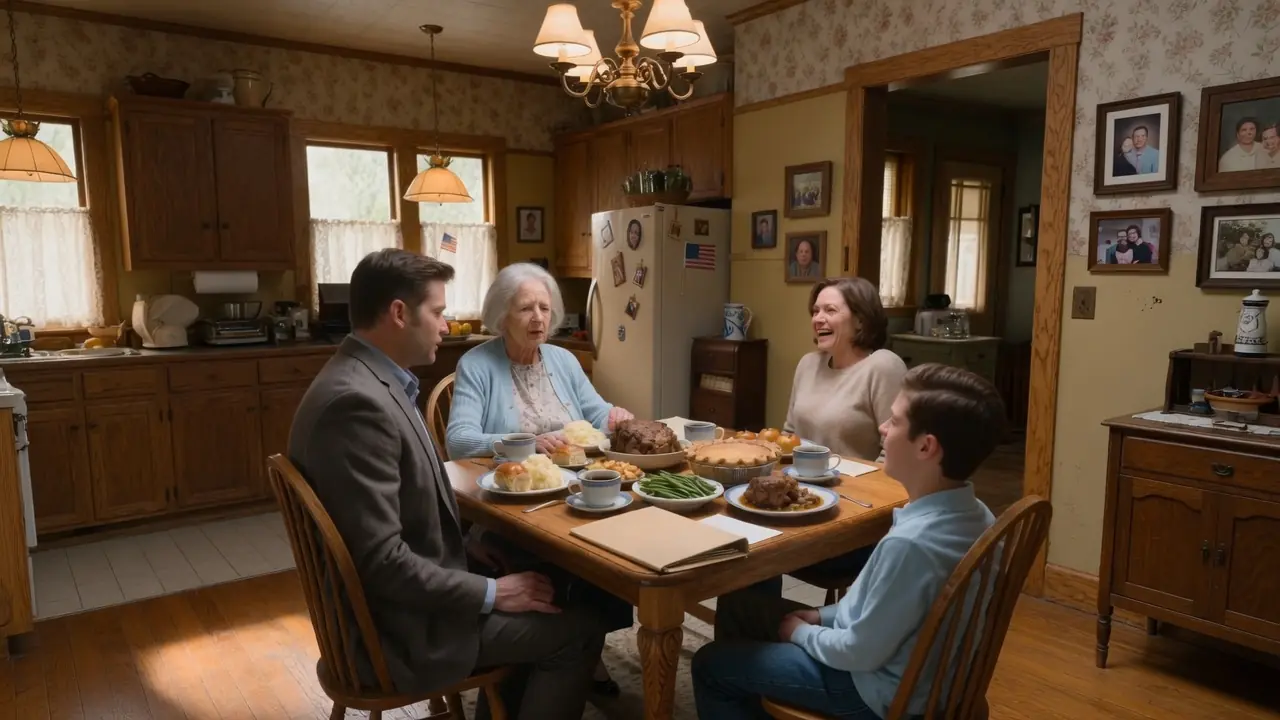
By five o’clock, the kitchen smelled like thirty years of motherhood. I made pot roast for Michael, the way he liked it when he came home from college. I made chicken and dumplings for Jennifer because she used to say no restaurant could make them right. I made meatloaf for David, with the ketchup glaze he had loved since he was six. On the side, I made mashed potatoes, green beans, rolls, apple pie, and coffee strong enough that Frank would have approved.
I took my best dishes out of the cabinet. They were the ones Frank and I used only for Thanksgiving, Christmas, and anniversaries before the children grew busy enough to treat holidays like scheduling problems. I polished the silverware and laid white napkins beside each plate. Beneath each napkin, I placed one envelope. Michael. Jennifer. David.
I sat in my chair for a moment before they arrived. The table looked beautiful, but my heart felt bruised. There is no anger quite like the anger of a mother who still remembers the weight of her children sleeping against her shoulder. It does not come cleanly. It arrives mixed with love, grief, memory, and the terrible knowledge that the people you would have gone hungry for had laughed when you said you might have to.
Michael arrived first. He wore a gray suit and checked his phone before taking off his coat. He kissed my cheek lightly and said the house looked nice, as if he were complimenting a waiting room. Jennifer came next, smelling of expensive perfume, carrying no dish, no flowers, no apology. David arrived last, smiling and asking whether there was pie.
They all sat at the table, and for a while, we ate like a family in a photograph. Michael talked about a case. Jennifer complained about the contractor renovating her bathroom. David told a story about his golf league. No one mentioned the phone calls. No one asked whether I had managed to get groceries.
I let them eat. I watched Michael reach for a second helping of pot roast. I watched Jennifer close her eyes after the first bite of dumplings, just like she had as a little girl. I watched David joke with his mouth full, and for one aching second, I almost wanted to pretend none of it had happened. Then he laughed at something Michael said and added, “Mom always worries too much. She’s tougher than she acts.”
That was when I put down my fork.
The sound was small, but all three of them looked up. I folded my hands beside my plate and looked at them one by one. “Two nights ago,” I said, “I called each of you because I could not afford groceries until my check came in.”
Michael’s face tightened. Jennifer looked away. David shifted in his chair. No one spoke.
“I did not ask for a luxury,” I continued. “I did not ask you to fix my life. I asked whether my children could help me buy food.” My voice stayed calm, which seemed to make them more uncomfortable. “And the answer I received from this table was that I should eat less.”
Jennifer rubbed her forehead. “Mom, I didn’t mean it like that.” “You laughed,” I said. She lowered her hand. Michael leaned back with that lawyer face he used when preparing to explain someone else’s emotions to them. “Mom, you caught us at a bad time. You made it sound like an emergency, and honestly, we assumed you were exaggerating.”
“I had two eggs,” I said. “Half a carton of milk. One can of soup.” Michael’s mouth closed. David stared at his plate.
I reached for my coffee cup and took a slow sip. “Yesterday morning, I learned that Cousin Ruth passed away and left me her estate.” Jennifer looked up first. Michael followed. David frowned as if trying to calculate the importance of the name before I finished. “After taxes and liquidation, I inherited $4.2 million.”
The kitchen went completely still.
Michael’s eyes sharpened. Jennifer’s lips parted. David actually sat up straighter, as if money had corrected his posture. I watched the change happen across their faces, and it hurt more than I expected. Hunger had bored them. Wealth had their full attention.
“Mom,” Michael said carefully, “that’s incredible.” Jennifer reached across the table like she might touch my hand, then stopped when I did not move mine. “Why didn’t you tell us sooner?” David laughed in disbelief. “Four point two million? Are you serious?”
I nodded toward their plates. “Under your napkins are envelopes.” For a moment, none of them moved. Then Michael lifted his napkin first. Jennifer followed, her fingers trembling slightly. David opened his quickly, careless as always, until he saw the documents inside.
Michael read the first page in silence. Jennifer covered her mouth. David flipped through the pages, confusion slowly turning into alarm. “What is this?” he asked.
“It is my updated estate plan,” I said. “Your children will be taken care of through education trusts. They will have opportunities, but their parents will not control the money.” I looked at each of them slowly. “As for the rest, the majority will fund the Frank Whitaker Senior Food Pantry and a foundation for elderly widows.”
Michael’s jaw tightened. “So you’re cutting us out?” “No,” I said. “Your choices did that.” Jennifer began crying softly, but I had raised children long enough to know the difference between grief and panic. “Mom, we were stressed. People say things. You cannot punish us forever over one mistake.”
“One mistake?” I asked. “Do you remember last winter when I told you the furnace was making noise and none of you came over?” No one answered. “Do you remember my birthday dinner that all of you canceled because it was inconvenient?” Silence. “Do you remember how often I said I was fine because I knew asking would make me feel smaller?”
David pushed his chair back slightly. “This is insane. You’re giving millions to strangers because we joked once?” His voice had risen, and the old version of me would have rushed to calm him. I did not. I looked at my youngest child, the boy I had once carried through a snowstorm because he had a fever, and said, “Hungry people are not jokes.”
Michael recovered fastest. “Mom, we should discuss this rationally. Estate decisions made after an emotional shock can be challenged.” There he was, my oldest son, turning my pain into a legal issue. I almost smiled. “Mr. Alden said you might say that. The documents were drafted properly. I was evaluated, witnessed, and recorded. There will be nothing to challenge.”
Jennifer was crying harder now. “I would have helped if I knew it was that bad.” “I told you it was that bad,” I said. “You chose not to hear me.” She pressed the envelope against her chest as if it could become forgiveness if she held it long enough. “I’m sorry, Mom.”
I believed she was sorry in that moment. I also believed sorrow often arrives when consequences knock, not when cruelty leaves. Both things can be true.
David stood abruptly. “So that’s it? You invite us here, feed us, then tell us we’re disinherited?” I looked at his full plate, then at mine. “I invited you here because I wanted one last dinner before I stopped pretending we are the kind of family I spent my life trying to build.”
His face flushed. “You’re being dramatic.” Michael snapped, “David, sit down.” Jennifer whispered, “Please don’t make it worse.” For the first time all night, I saw them look at each other not as siblings, but as people realizing the same door had closed.
I stood and began clearing plates. Michael immediately rose. “Mom, don’t. Sit down. We can help.” I looked at him, and he froze with his hands halfway toward the table. “You had your chance to help,” I said quietly.
That broke something in him. His polished expression slipped, and beneath it I saw the little boy who used to run to me after nightmares. “I thought you were just being proud,” he said. “I thought you had money somewhere and wanted attention.” I nodded once. “You thought everything except that your mother might be hungry.”
No one ate pie.
They left separately. Jennifer hugged me at the door, and I allowed it because I did not hate her. David walked out angry, muttering that I would regret humiliating them. Michael lingered the longest. He stood on the porch under the yellow light, looking older than he had when he arrived.
“I don’t know how to fix this,” he said. “I don’t either,” I replied. “And for once, Michael, it is not my job to fix it for you.” He nodded, tears bright in his eyes, and went to his car.
After they left, I returned to the kitchen. The table was messy, the envelopes gone, the roast half eaten, the coffee cold. Frank’s reading glasses sat on the counter where they always did. I picked them up for the first time in years and held them in my palm. Then I placed them in the drawer beside the clean silverware.
The next few weeks were loud from a distance. Michael sent careful messages asking to talk. Jennifer left voicemails full of tears, apologies, and memories of chicken and dumplings. David sent one angry email and then nothing. I did not respond quickly to any of them.
Instead, I met with Mr. Alden, the bank, and the charity board. We bought a small building near the senior center, the one that had once been a pharmacy and still had good parking. I named it Frank’s Table. It would provide groceries, hot meals, pharmacy assistance, and emergency heating help for seniors who had been told to live within their means by people who had never seen their refrigerators.
The first day we opened, an eighty-year-old man came in wearing a coat too thin for the weather. He asked if he had to prove how poor he was before receiving a box of groceries. I told him no. He sat down in one of the folding chairs and cried quietly into a paper napkin. I thought of my children then, but not with bitterness. I thought of all the mothers and fathers who had fed people who forgot to feed them back.
Eventually, Jennifer came to volunteer. She arrived without makeup, wearing old jeans, and asked if she could stock shelves. I let her. She cried when an elderly woman thanked her for canned peaches. Something in my daughter softened that day, not all at once, but enough to notice.
Michael came next, offering legal help for the foundation. I told him he could review documents, but not control decisions. He accepted that, which surprised me. Over time, he began showing up every Thursday with groceries he paid for himself, never announcing the amount, never asking for praise. Sometimes repair begins as repetition.
David took the longest. Nearly a year passed before he came to the pantry. He stood in the doorway looking embarrassed, holding a bag of potatoes. “I didn’t know what to bring,” he said. “Food is a good start,” I answered. He looked down at the bag and whispered, “I’m sorry, Mom.”
I did not run to forgive him. I did not punish him either. I took the potatoes from his hands and told him where to put them. That was enough for that day.
The money changed many things, but not the way people imagine. I still live in my little house with the faded porch. I still use coupons sometimes because habits formed over fifty years do not vanish just because a bank balance changes. I still cook too much when the children come, though now they bring groceries without being asked.
The estate plan remains the same. My grandchildren will be cared for. Frank’s Table will continue after I am gone. My children know this, and if they resent it, they have learned not to say so at my table.
Sometimes I sit in the kitchen at night and remember the phone calls. Eat less. Two words that emptied a mother’s heart more thoroughly than an empty pantry ever could. But I also remember the dinner, the envelopes, and the silence that followed truth.
I do not think my children stopped loving me that day they laughed. I think they had grown used to receiving love from me without wondering whether I had enough left for myself. That is a dangerous thing to teach a family. It makes sacrifice invisible.
So I made mine visible.
I set the table one last time for the children who thought I would always stay quiet. Then I used what I had been given to feed strangers who knew the value of a full plate. In the end, that was not revenge. It was correction.
And I have never eaten less again.