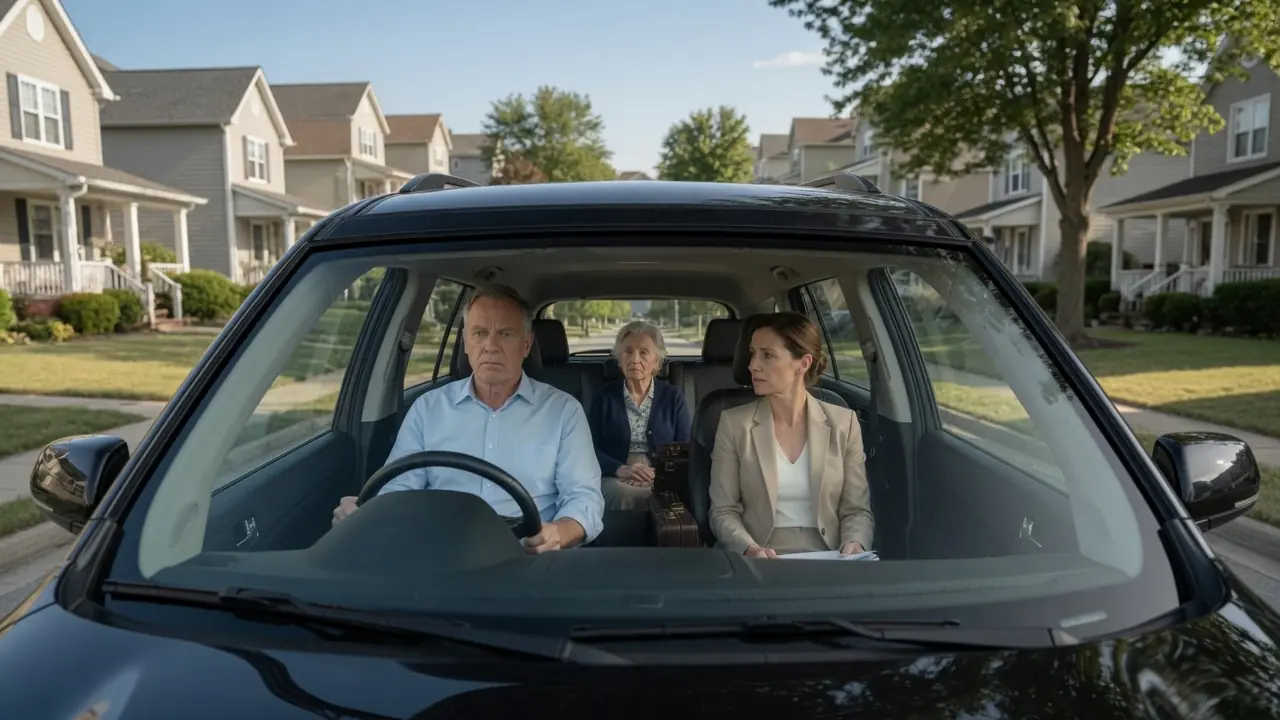
The car ride was quieter than any funeral I had ever attended. My son Richard drove with both hands on the steering wheel, his eyes fixed on the sunny road ahead as if looking back might turn him into someone with a conscience. My daughter Diane sat in the front passenger seat with a folder of paperwork resting neatly in her lap, every page arranged with the same precise care she brought to her banking career. I sat alone in the back seat, hands folded tightly together, watching clean suburban houses pass by the window like pieces of a life I was being driven away from.
No one mentioned the destination at first. They had already spoken about it so many times without including me that perhaps they had forgotten I could still hear, still think, still understand what was happening. The SUV smelled faintly of leather and Diane’s expensive perfume, and the silence between us felt polished and artificial. My small suitcase sat beside me on the seat, packed with a few clothes, two books, and the last photograph Howard and I took together before his illness made cameras feel cruel.
“It’s for the best, Mom,” Diane finally said, not turning around. “You’ll be looked after properly.”
Richard nodded as though she had said something wise. “You won’t be alone anymore. This is what you need.”
I looked at the backs of my children’s heads. Richard’s hair had gone gray at the temples, and Diane’s posture was as straight and controlled as ever. They had inherited pieces of me and Howard, but in that moment, I could not find either of us in them. “You both decided that before I ever got in this car,” I said.
Diane’s fingers tightened on the folder. “Please don’t make this harder than it has to be.”
That sentence told me everything. Not don’t be afraid. Not we love you. Not we are sorry this hurts. Just don’t make it harder, as if my grief were another inconvenience they had scheduled badly.
My name is Beatrice Warner, and I was seventy-five years old the day my children drove me away from my home. For forty-seven years, I had lived in the house Howard and I built together, a low brick home with wide windows, a lemon tree near the back wall, and shelves full of books collected through a lifetime of curiosity. It was not a mansion, though the land had become valuable after the neighborhood changed and developers began circling like polite vultures. To me, it was never an asset. It was where my husband had laughed, where my children had taken their first steps, and where I had learned how quiet a house becomes after the person you love most is gone.
Howard had been dead for two years by then. He had been an entrepreneur, the kind of man who saw possibilities long before other people saw markets. I had been a professor of applied mathematics at Arizona State, specializing in probability theory and statistical analysis. People remembered Howard as the bold one and me as the sensible wife, but he always laughed at that. He said I was the most dangerous person in any room because I could predict the consequences before anyone else admitted there would be consequences.
Our marriage worked because we trusted each other’s minds. Howard dreamed in wide arcs, and I calculated where the bridges needed to hold. We built businesses, raised children, hosted dinners, gave donations, paid taxes, and made plans for every future we could imagine. We even made plans for futures we prayed would never come.
Richard and Diane knew almost none of that. Children often assume their parents were born fully formed in the roles they remember. To them, I was Mom, then Widow, then Problem. They forgot I had been Dr. Warner, the woman who could read patterns in human behavior as easily as numbers on a board.
When the car finally stopped, I did not look immediately through the windshield. I knew if I saw the building too soon, I might give them the reaction they expected. Diane opened her door first, gathering the folder and smoothing her blazer. Richard came around to help with my suitcase, though not with the tenderness of a son helping his mother, but with the efficiency of a man unloading a task.
The place was called Golden Sunset Retirement Home. The name sounded warm, but the building was not. Its front entrance had clean glass doors, clipped hedges, and a tidy walkway, all carefully maintained to reassure adult children that leaving their parents there was an act of responsibility. Inside, the air smelled of disinfectant, overcooked vegetables, and surrender.
Diane handled the paperwork while I sat in a chair near the admissions desk. She signed where they told her to sign, asked about medication schedules, and spoke in the brisk voice she used when negotiating loans. Richard checked his watch twice, then pretended not to. His wife Victoria had not even come inside.
A nurse named Carla led us to my room. White walls, narrow bed, small dresser, one chair, one window looking over the parking lot. The room was clean, but it had no memory in it. No uneven shelf Howard had installed slightly crooked because he refused to measure twice. No faded rug from our first trip to New Mexico. No table where Diane once spilled grape juice and cried like she had ruined the world.
“Will you visit?” I asked.
Diane looked almost startled by the question. “Of course, Mom. As soon as things settle down at work.”
Richard gave me his persuasive smile, the one he had used since childhood when he wanted one more chance. “Next weekend. We’ll come next weekend.”
I nodded. “That will be nice.”
They seemed disappointed that I did not cry. Perhaps they needed tears to turn me into the unreasonable one. Perhaps they needed anger so they could tell themselves I was confused, difficult, or ungrateful. Instead, I smiled softly and watched them leave.
They did not call that night.
Or the next.
A week passed, then three. The first visit was postponed because Diane had an urgent meeting. The second was canceled because Richard had a client presentation. After that, plans became vague, then rare, then nonexistent. I was not surprised. By seventy-five, a woman has seen enough human weakness to recognize abandonment when it arrives dressed as concern.
Golden Sunset was not cruel in an obvious way. That would have been easier to fight. The staff were tired, underpaid, and moving too quickly from room to room. Meals were adequate, activities were dull, and residents were kept clean enough to satisfy visitors who rarely came. It was not neglect with teeth. It was neglect with paperwork.
I watched everything. Old habits returned quickly. The dining room schedule, staff rotation, medication errors, inspection dates, resident complaints, expense patterns, supply shortages. I became invisible in the way old women often do, and invisibility is useful if you know how to use it. People say things around those they no longer consider powerful.
I met Eleanor Pierce during my third week. She had been a bank executive before her children decided she was too frail to manage her own affairs. She still had a mind like polished steel and a memory for numbers that made Diane look careless. We drank tea together in the small common room and traded observations quietly.
“This place is being squeezed,” Eleanor told me one afternoon. “Not enough staff, cheap suppliers, deferred maintenance. Someone is milking it.”
“I know,” I said.
She looked at me with interest. “Do you?”
“Yes,” I replied. “I am waiting to see by how much.”
Eleanor smiled then, the first true smile I had seen from her. “You are not what you appear to be, Beatrice.”
“Few women are.”
Six months after I arrived, an orderly brought my mail while I was sitting with Eleanor near the window. Most of it was useless: insurance notices, charity requests, a magazine subscription I had never ordered. But one envelope stopped my breath. The handwriting was elegant, familiar, and impossible.
Howard.
I excused myself and carried the envelope back to my room. My hands trembled as I sat on the edge of the narrow bed. Inside was a card from his law firm, prepared years earlier, with one short message written in his hand.
My dearest Beatrice, if you are reading this, the contingency we discussed has come to pass. The trust has been activated. Marcus will contact you within the week. Dignity, always. All my love, Howard.
For the first time since my children left me there, I cried.
Not from pain. From recognition. From the strange comfort of being protected by a man who had known me well enough to plan for the day others might forget my worth. I pressed the card to my chest and let myself weep without shame.
Three days later, Marcus Williams came to Golden Sunset. He had been Howard’s attorney for decades and one of the few people who understood how much of Howard’s success had been built through quiet planning rather than public bravado. We sat in the small garden area where nobody listened because old people speaking to lawyers are considered sad, not dangerous. Marcus wore a gray suit and carried a leather folder.
“The conditions were met,” he said. “Richard and Diane removed you from your primary residence against your expressed preference, and the house was listed for sale within thirty days. The trust is now fully active.”
“How much?” I asked.
“Approximately forty-seven million dollars.”
I nodded. The number did not shock me because I had helped build the structure that created it. Howard had placed early shares from several companies into a special trust in 1992. At the time, it had been worth a little under two million, enough to matter but not enough to tempt careless children if they never knew about it. Over three decades, those assets had grown quietly, patiently, beautifully.
The terms were precise. The money remained dormant unless Richard and Diane, as secondary beneficiaries, removed me from my residence against my genuine wishes in order to access or liquidate property. If they did, they triggered the clause that disinherited them from that trust and gave me complete control. Howard called it his insurance policy for my dignity.
“There is something else,” Marcus said. “Golden Sunset’s ownership group is looking to sell. Confidentially. Asking price is twelve million.”
I looked around the garden. A cracked walkway. Plastic chairs. Three residents sitting alone under a tired shade sail. A nurse rushing past with two clipboards and a face full of exhaustion. I saw not a prison, but an opportunity.
“Begin the acquisition process,” I said.
Marcus smiled. “Howard predicted you might say that.”
“Howard knew me.”
Over the next eighteen months, I worked more quietly than I had in my entire career. I bought Golden Sunset through a holding company, then bought four more similar facilities across Arizona. I replaced managers who saw residents as billing codes. I increased staff pay, hired better nurses, improved meals, brought in physical therapy, music, art, legal counseling, and real gardens. Golden Sunset became Warner Senior Living Community, though my children still believed I was simply living out my days in the room they had chosen.
I did not call them. They sent gifts now and then. A tablet I did not need. A television I barely watched. A sweater in a color I had never worn. Diane remembered my birthday with flowers delivered two days late. Richard sent a card signed by his assistant.
Their visits became increasingly rare. When they did appear, they stayed fifteen minutes and spoke to me as if my mind had dimmed along with my social usefulness. Diane asked whether the staff were treating me well while checking her phone. Richard told me the house sale had been complicated but necessary. Neither asked what I wanted.
I let them underestimate me.
That was the easiest part.
Exactly two years after they left me at Golden Sunset, I asked my assistant to call them. “Tell them there is an urgent situation involving their mother,” I said. “No details.”
They arrived the next afternoon.
Diane came first, wearing a charcoal suit and the alarmed expression of a woman worried about liability. Richard followed in expensive casual clothes, and Victoria trailed behind him with sunglasses on despite being indoors. They were brought not to my old room but to the executive wing, where I sat at the head of a long conference table reviewing expansion plans with Marcus.
Diane stopped in the doorway. “Mom?”
I set down my reading glasses. “Hello, Diane. Richard. Victoria. Please come in.”
Richard looked around the room, taking in the polished table, the framed architectural renderings, the staff moving beyond the glass wall. His confusion was almost childlike. “What is going on?”
“I had you called because after two years, it seemed an emergency was the only reliable way to get my children to visit.”
Diane’s face flushed. Victoria removed her sunglasses slowly. Richard stepped farther into the room, his eyes landing on the gold nameplate on the table.
Beatrice Warner, CEO and Owner.
“You own this place?” he asked.
“Yes,” I said. “This place, and several others.”
Diane sat down without being invited, which told me her knees had weakened. “How?”
“Your father and I planned carefully.”
I opened the folder in front of me and slid the first document across the table. It was a copy of the trust agreement, cleanly marked and highlighted where necessary. Diane reached for it first because numbers were her language. She scanned the page, and I watched comprehension drain the color from her face.
“Forty-seven million dollars,” she whispered.
“Currently a little more, after restructuring.”
Richard stared at me. “Dad had this?”
“We had this,” I corrected. “Your father created the trust, but I helped design its conditions.”
Victoria leaned forward. “Why would Howard hide that kind of money?”
“Because he understood probability,” I said. “And human nature.”
Richard’s eyes narrowed. “What is that supposed to mean?”
“It means your father calculated a significant chance that after his death, you and Diane might prioritize the house over my wishes. The trust activated only if I was removed from my residence against my genuine preference by the secondary beneficiaries. You did exactly that.”
The silence was heavy.
Diane tried first. “Mom, we thought you needed care.”
“No,” I said. “You thought the house needed to be sold.”
Richard looked away.
I opened another file. “Let us not make this worse with dishonesty. I overheard your conversation in the hospital cafeteria before you moved me. Diane, you wanted your investment money. Richard, you wanted funds for the architectural studio and the vacation property. Victoria, you wanted liquidity before the market shifted.”
Victoria stiffened. “That is an unfair interpretation.”
“It is an accurate one.”
Diane swallowed hard. “If you had all this money, why did you let us put you here?”
“Because you needed to reveal who you were when you thought I had nothing left to offer.”
The words landed harder than I expected. Richard looked wounded, but not unfairly. Diane’s face closed into professional stillness. Victoria’s jaw tightened with anger.
Then I opened the second folder.
“There is another matter. While living here, I received financial notices for transactions I did not authorize. Retirement account transfers. Loans. Investment liquidations. Several documents contained signatures that were not mine.”
Diane’s head snapped up. Richard turned toward her. Victoria went pale.
“Mom,” Richard said slowly, “what are you saying?”
“I am saying that removing me was not your only mistake. You also forged my signature and used my assets while assuming I was too old, isolated, or uninformed to notice.”
Diane’s voice sharpened. “Richard benefited from that money too.”
Richard stared at her. “You told me Mom approved it.”
Victoria laughed once, brittle and nervous. “Do not pretend innocence now. Everyone wanted the funds.”
“Fascinating,” I said. “How quickly loyalty dissolves when evidence enters the room.”
Marcus placed a thick legal packet on the table. He had once been a federal prosecutor, which I had not told them. He specialized now in financial fraud and elder exploitation, which I also had not told them. Watching their faces as they understood this was the only moment that came close to satisfaction.
“Forgery, bank fraud, identity theft, elder financial abuse,” I said. “Marcus believes the case is strong.”
Diane whispered, “Are you sending us to prison?”
“I considered it.”
Victoria gripped the arms of her chair.
“But Howard would not have wanted his children imprisoned if there was another way to make them understand what they had done. So I am offering one alternative.”
I slid three agreements across the table. “You will sell everything purchased with stolen or misused money. The vacation property, the boat, the studio assets, the investment accounts funded through fraud. Proceeds will go to the Warner Foundation for Dignity in Aging, which provides care for seniors abandoned or financially exploited by their families.”
“This is extortion,” Victoria said.
“No,” I replied. “This is the polite version.”
Marcus added calmly, “The alternative is a formal complaint to federal authorities.”
Diane read the agreement first because she understood risk fastest. “Ninety days?”
“Ninety days to liquidate and transfer proceeds under supervision.”
Richard was still looking at me as if seeing me for the first time. “And after that?”
“There is one more condition,” I said. “You will each volunteer here one weekend a month for two years.”
Victoria recoiled. “Volunteer here?”
“Yes. Richard will assist with maintenance and design accessibility projects. Diane will help residents with financial planning and fraud prevention. Victoria, you will begin in laundry and resident services.”
Her face twisted. “You cannot be serious.”
“I have never been more serious.”
Richard leaned back slowly. “Why?”
“Because you need to see what happens when families discard people. You need to see the faces of those you considered inconvenient. Prison might punish you, but this may teach you.”
No one spoke.
For the first time in two years, my children had nothing clever to say.
The agreements were signed within the week. Their lawyers tried to object, then saw Marcus’s evidence and advised settlement. Assets disappeared from their lives quickly. Richard’s studio downsized, Victoria’s boat was sold, Diane’s investment portfolio was liquidated. Social circles whispered, colleagues questioned, and friends who had enjoyed their wealth became suddenly less available.
Their volunteer shifts began on a Sunday morning.
I did not watch openly. I had no desire for cheap humiliation. But I did pass through the halls with a clipboard and saw enough. Richard on his knees trying to repair a loose cabinet under the supervision of a maintenance supervisor who did not care where he went to school. Diane sitting with residents, helping untangle bills and pension statements, forced to listen to stories of children who had drained accounts with smiles. Victoria in a plain uniform folding sheets with the expression of a woman discovering that dignity can survive without designer labels.
At first, they hated it.
Then something shifted.
Richard began noticing room layouts that made mobility harder. He sketched better bathroom access, safer handrails, softer lighting, and private spaces that did not feel institutional. Diane began building workshops to help residents protect themselves from fraud. Her anger slowly redirected itself toward the systems that made exploitation easy. Victoria lasted longest in resentment, but even she changed after her own mother began showing signs of cognitive decline.
Six months in, Richard asked to design a new wing. Diane proposed a financial protection program. Victoria, after her divorce from Richard, returned and asked to complete her volunteer service in a new facility, saying her mother needed the kind of care she had once mocked. People do not change all at once. Sometimes they change because consequence strips away the performance and leaves them with the truth.
I did not forgive quickly. I am not sentimental about betrayal. But I watched. I measured. I allowed evidence to matter.
Two years after the confrontation, the Warner Foundation had grown to facilities across several states. Hundreds of elderly residents received dignified care because my children had tried to remove me from my own life. Richard became our director of accessibility design, creating spaces where aging did not feel like punishment. Diane became a fierce advocate against elder financial abuse, testifying before legislatures with the intensity she once used to grow bank profits.
Victoria became the most unexpected transformation. She did not become warm, exactly. But she became useful, disciplined, and unexpectedly compassionate with families facing dementia. She once told me that shame can either rot a person or remake them. I told her that was the first wise thing I had heard her say.
Three years after that silent car ride, I returned to my original home.
The developer who had bought it never completed his plans. Bankruptcy trapped the property for years, and Marcus quietly monitored it. When it became available again, I bought it back. Not to prove anything to Richard or Diane, not to reverse the past, but because I wanted to spend my remaining years where Howard and I had been happy.
The house had changed, but not beyond repair. The lemon tree still stood near the back wall. The wide windows still caught the afternoon light. The shelves were empty when I entered, but I could almost hear Howard saying, “Well, Beatrice, the probability of this outcome was low, but not zero.”
Diane helped me unpack books. Richard adjusted the front steps for safety without making them look medical. Victoria sent flowers with a note that said simply, Welcome home. I placed Howard’s photograph on the mantel, then stood in the living room alone after everyone left.
The silence was different from the silence of Golden Sunset.
That silence had been erasure.
This one was peace.
People often ask whether I got revenge. I did not. Revenge is too small a word for what happened. Revenge would have been destroying my children and letting bitterness sit beside me like a companion. What I wanted was dignity, accountability, and proof that being old does not make a person powerless.
My children left me in a nursing home because they thought my story was nearly over.
Two years later, they discovered I had been writing the next chapter without them.
And by the time they finally understood, I had already turned their betrayal into a legacy Howard would have loved.