For my seventieth birthday, I set eleven places at the table.
Eleven plates. Eleven folded napkins. Eleven glasses filled with ice water that slowly melted while the roast cooled in the kitchen. I had polished the silverware until my fingers ached, ironed the embroidered tablecloth my mother gave me when Thomas and I married, and baked the lemon cake my children used to beg for when they were small. By late afternoon, the house was so quiet I could hear the refrigerator humming and the clock ticking above the doorway like it was counting every excuse before it arrived.
I had put seven tall candles on the cake.
One for each decade.
Seventy small candles would have looked silly, I told myself, and besides, my hands shook too much to set them straight in the frosting. The tall candles looked elegant, almost intentional. That was what I kept telling myself as I stood in the kitchen, looking at a birthday cake no one was coming to eat.
My name is Marion Whitaker, and I am not a woman who asks for much.
For thirty-one years, I taught fourth grade at Riverside Elementary. I graded papers at the kitchen table, packed lunches before sunrise, washed uniforms, drove to soccer practice, sat through piano recitals, and kept track of everyone’s favorite meals, allergies, appointments, and disappointments. My husband, Thomas, worked long shifts at the plant, and I held the house together because that was what love looked like to me. You showed up, you did the work, and you did not keep score.
I should have kept score.
Thomas died fourteen months before my seventieth birthday.
Pancreatic cancer took him in eleven weeks, fast enough that people kept saying, “At least he didn’t suffer long,” as if that was supposed to comfort me. He was sixty-eight years old and still had tomato seedlings waiting in the garage. There was a library book on his nightstand with his glasses folded neatly beside it. Those were the things that broke me, not the hospital papers, not the doctor’s voice, but the seedlings and the book he never got to finish.
After the funeral, my children were wonderful for four days.
Daniel flew in from Seattle with his wife, Claire, and their two girls. Marcus drove up from Atlanta with Sandra and their boys. Patrice came from Phoenix with her husband, Elliot, and their youngest daughter. They hugged me, cleaned out a few of Thomas’s drawers, made coffee, answered the door, and told me I would never be alone.
Then they left.
And slowly, I became alone.
Not all at once. Loneliness is rarely that honest. It arrives politely, one missed phone call at a time, one delayed text, one “Sorry, Mom, things are crazy,” one holiday spent looking at pictures online instead of faces across the room. At first, I told myself they were grieving too, that everyone returns to life after death because life demands it.
Daniel stopped calling every Sunday.
Marcus sent photos instead of calling, and I loved those pictures because I loved my grandsons, but photographs do not ask if you slept last night. Patrice still answered when I called, but something in her voice had changed. She became careful with me, polite in a way that made me feel more like an obligation than a mother. I told myself grief had made her distant.
Then the money requests began.
Daniel was first.
He called one Sunday, sounding almost like his old self, and for ten minutes we talked about the weather and his daughters’ school. Then he mentioned the house he and Claire wanted to buy, a bigger place in a better school district. The down payment was a stretch, he said, and then he went quiet. I knew what that silence wanted.
I gave him twenty thousand dollars.
Thomas and I had saved carefully. We were not rich, but we had been responsible, and after Thomas died, there was enough to keep me comfortable. I told myself this was what parents did. Your children struggled, you helped. You did not let money sit in an account while family needed it.
Three months later, Marcus called.
Sandra’s mother was ill, he said, and there were flights, hotel costs, missed work, all of it piling up. His request was softer than Daniel’s, more embarrassed, but still a request. I sent fifteen thousand dollars. When he thanked me, his voice sounded relieved, and I felt useful again.
Patrice never asked directly.
She would mention a car repair.
Then pause.
She would mention tuition.
Then go quiet.
She would mention the roof, the medical bill, the unexpected expense, and I would feel the silence open between us like a hand waiting to be filled. Sometimes I filled it with five thousand. Sometimes three. Once, ten.
I was not foolish.
That is what hurts most to admit.
I knew what was happening. I saw the pattern. I knew my children called more warmly when they needed money and disappeared once the deposit cleared. But knowing a thing and being ready to face it are not the same. I had spent decades loving them into adulthood, and I could not bear to believe they had learned to love me only when my bank account was useful.
So I kept showing up.
I sent birthday checks. I mailed Christmas gifts. I remembered anniversaries, school plays, tournaments, dental surgeries, and college application deadlines. I wrote cards in my careful teacher handwriting and signed them Love, Mom, even when the thank-you texts came three days late. I told myself this was family. I told myself people were busy.
My seventieth birthday fell on a Saturday in April.
Six weeks before, I called each child.
I did not hint.
I did not say, “Maybe if you can.”
I said clearly, “I want everyone home for my birthday. Just one day. I will make roast and lemon cake, and I would like my children and grandchildren at my table.”
Daniel said, “Absolutely, Mom. We’ll be there.”
Marcus said, “Wouldn’t miss it.”
So I believed them.
I cleaned the house for three days.
I bought fresh flowers, washed the good china, and ironed the tablecloth twice because the first time I found one crease near the corner. I made the roast with rosemary, garlic, and the herbs Thomas used to grow. I baked the cake from my mother’s recipe, using real lemons, not bottled juice. I even set Thomas’s chair at the head of the table for a moment before moving his plate away because grief has rules that change every hour.
At noon, Patrice called.
The children had a birthday party for a classmate, she said. They had already committed. It would be rude to cancel on another child. Her voice was too bright, too fast, the voice people use when they want you to accept hurt politely. She promised we would have dinner next week.
She never scheduled it.
At one-thirty, Marcus texted.
Tournament today. Already here. We’ll make it up to you. Happy birthday. Love you.
There was a balloon emoji at the end.
I stared at that balloon for a long time.
At two o’clock, Daniel called.
For one foolish second, I thought he was calling from the airport or the highway. I imagined his daughters laughing in the backseat, Claire asking if I needed anything from the store, Daniel saying they were running late but on their way. Instead, he said they had taken the kids to the coast for a spontaneous weekend. He had forgotten.
Forgotten.
The birthday he confirmed six weeks earlier.
I stood by the dining room table and looked at the eleven places I had set.
“Daniel,” I said, gripping the phone as hope died in a way I could physically feel, “where are you? The plates are waiting.”
He sighed.
Not with sorrow.
With inconvenience.
“We have plans, Mom. We can’t make it.”
Before I could answer, Claire’s voice came through the background, loud enough that I knew she meant for me to hear it.
“Just eat alone, old woman. Don’t make everyone feel guilty.”
For a moment, I stopped breathing.
Daniel said nothing.
That hurt worse than what she said.
I waited for him to defend me.
I waited for, “Claire, don’t talk to my mother that way.”
I waited for even a small, embarrassed apology.
But there was only silence, and then Daniel said, “Mom, she didn’t mean it like that.”
I looked down at the table.
Eleven plates.
Eleven glasses.
Eleven napkins.
A roast in the kitchen.
A cake with seven tall candles.
My voice sounded strange when it came out.
“I see.”
Daniel rushed on.
“We’ll make it up to you. Don’t make this into a thing.”
A thing.
My seventieth birthday was a thing.
The empty table was a thing.
His wife calling me old woman was a thing.
The years of money, forgiveness, remembering, waiting, hoping, and pretending were all being folded into that one careless word.
I said, “Enjoy the coast.”
Then I hung up.
I stood there for a long time.
The house did not comfort me.
It witnessed me.
The dining room looked beautiful, almost cruelly beautiful, with sunlight shining across the polished wood and the good china waiting like guests who had better manners than my children. I walked to the kitchen and checked the roast because habit is stronger than heartbreak. It was still warm. Everything was still warm.
That was when I opened the drawer where I kept the matches.
I carried them to the cake.
One by one, I lit the seven candles.
My hands were steady now.
That surprised me.
The flames rose small and bright, reflected in the windows and in the silver coffee pot on the sideboard. I looked at them and thought of every decade I had survived. Childhood, marriage, babies, work, illness, grief, and now this. I did not make a wish.
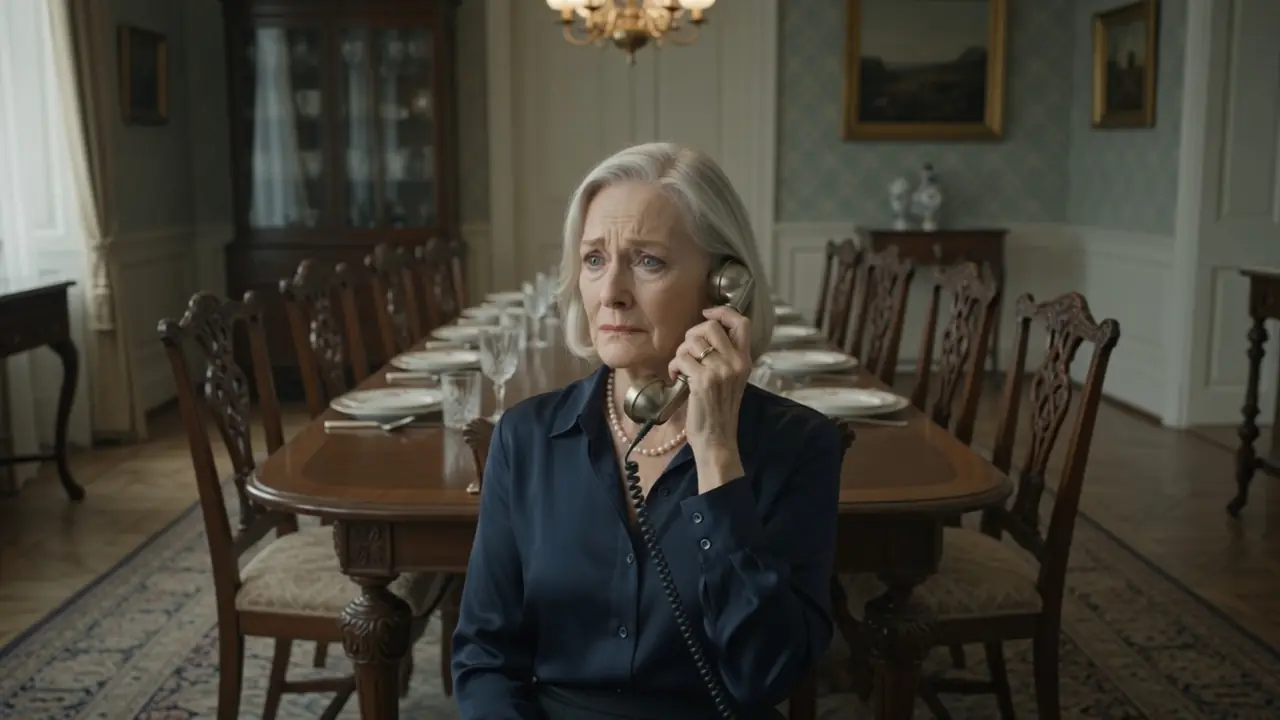
I picked up the phone again.
I called Daniel first.
He answered on the fourth ring, sounding irritated.
“Mom, is everything okay?”
I looked at the candles.
“No,” I said. “But it will be.”
“What does that mean?”
I smiled then.
It was not a happy smile.
It was the smile of a woman finally reaching the end of begging to be loved properly.
“Since none of you came,” I said, “I’ll celebrate with the truth instead. The bank account is empty.”
There was a pause.
“What?”
“The bank account is empty.”
His voice sharpened immediately.
“Mom, what did you do?”
That was when I knew.
Not because he asked if I was all right.
Not because he apologized.
Not because he suddenly remembered the dinner cooling on my table.
Because his first real fear was about the money.
I blew out one candle.
“I moved it.”
“Moved it where?”
“Somewhere it can no longer be mistaken for family property.”
Daniel’s breath grew heavy in the receiver.
“You can’t just do that.”
I looked around my own dining room.
“My money, Daniel. My house. My account. My birthday. I can do quite a lot.”
Claire’s voice snapped in the background.
“What is she saying?”
Daniel covered the phone poorly.
“She says the account is empty.”
“What account?”
“The savings.”
Then Claire came fully onto the line.
“What did you do, Marion?”
There was no “Mom” now.
No sweetness.
No pretending.
Just panic.
“I protected myself,” I said.
Claire laughed sharply.
“From your own children? Over one missed dinner?”
“No, Claire. Over years of being remembered only when someone needed a transfer.”
Daniel returned to the phone.
“Mom, this is dramatic. You’re upset. Don’t make big financial decisions because of a birthday.”
I blew out the second candle.
“The decision was made three weeks ago.”
Silence.
“What?”
“I met with an attorney three weeks ago.”
Daniel’s voice dropped.
“Why would you do that?”
“Because I finally looked at my bank statements the way I used to grade math tests. Carefully. Without excuses.”
I could hear Claire whispering something urgent.
I continued.
“In fourteen months, I gave you children more than seventy-three thousand dollars. That does not count birthday checks, Christmas checks, emergency gifts, school fundraisers, and the money I sent when someone hinted strongly enough.”
“Mom—”
“No.”
My voice came out sharper than I expected.
“No more.”
I blew out the third candle.
Daniel was silent now.
So I called Marcus next.
He answered from what sounded like a baseball field.
“Hey, Mom. Happy birthday again.”
“Marcus, where are you?”
He hesitated.
“I told you. Tournament.”
“The plates are waiting.”
He sighed.
“Mom, please don’t start. We can’t make it.”
“Sandra told you to send the text, didn’t she?”
He went quiet.
I had my answer.
“I moved the savings,” I said.
“What savings?”
The false innocence was almost insulting.
“The savings all of you seem to know about when life gets expensive.”
The noise behind him faded.
“Mom, what does that mean?”
“The bank account is empty.”
His voice changed instantly.
“Empty? Like… empty empty?”
I laughed once.
It sounded rusty.
“Yes, Marcus. Empty empty.”
“Mom, why would you do that?”
“Because you did not ask if I was eating alone. You asked about the money.”
He started to argue, then stopped.
Perhaps he heard himself.
Perhaps not.
I did not wait to find out.
Patrice was last.
She answered softly, already guilty.
“Mom?”
“Where are you, Patrice?”
A pause.
“Home.”
“The plates are waiting.”
She began to cry before I said anything else.
That nearly undid me.
“I’m sorry,” she whispered. “I knew I should have come.”
“Then why didn’t you?”
Her breath shook.
“Elliot said it was too expensive to fly. He said you’d understand. Then the kids had things, and I told myself we’d come later.”
“Later,” I repeated.
“I’m sorry.”
I looked at the fourth candle.
“Patrice, the bank account is empty.”
She was quiet.
Unlike her brothers, she did not immediately ask where the money went.
She only said, “Did we do this to you?”
There it was.
The first honest question of the day.
I sat down slowly at the head of the table.
“Yes,” I said. “And I let you.”
She sobbed then.
Not loudly.
Not performatively.
Just a small, broken sound that reminded me of the little girl who once crawled into my bed after nightmares.
“Mom, I’m sorry.”
“I believe you,” I said.
And I did.
But belief is not the same as erasing damage.
By sunset, all three of my children had called again.
Daniel was angry.
Marcus was confused and defensive.
Patrice was ashamed.
Claire sent a text I did not answer, accusing me of punishing the grandchildren and “destroying family trust.” Sandra sent nothing, but Marcus told me she was upset because they had been counting on help with summer camp fees. Elliot sent a polite message asking if we could “discuss things rationally.” I deleted that one.
At eight o’clock, I cut myself a slice of lemon cake.
Then I wrapped ten slices and placed them in the refrigerator.
Not because anyone deserved them.
Because wasting cake is a sin.
The next morning, Daniel appeared at my door.
He had flown in overnight.
Not for my birthday.
Not for the dinner.
For the empty account.
I opened the door but did not invite him in.
He looked tired, rumpled, and angry in a way he was trying to disguise as concern.
“Mom,” he said. “We need to talk.”
“No,” I said. “You need to listen.”
He blinked.
I stepped onto the porch and closed the door behind me.
He looked past me, toward the house.
“Can I come in?”
“No.”
His face tightened.
“That’s a little extreme.”
“So was leaving eleven places untouched.”
He rubbed his forehead.
“I said I was sorry.”
“No, Daniel. You said you forgot. Then you let your wife call me an old woman and told me not to make it a thing.”
His eyes dropped.
“She was frustrated.”
“She was honest.”
That landed.
He looked away.
“What did you do with the money?”
I folded my hands.
“I placed most of it into a trust.”
“For us?”
“For me.”
He stared.
“I don’t understand.”
“That is becoming clear.”
The trust was simple.
My attorney, Mr. Alvarez, had helped me create it after I finally admitted what I had refused to say aloud. I was giving away too much because loneliness had made me vulnerable. The trust would pay my living expenses, medical needs, home maintenance, and care if I ever needed it. My children could not pressure me into draining it.
I had also made donations.
Some to the library where Thomas had never finished his book.
Some to Riverside Elementary for children who needed coats, lunches, and field trip fees.
Some to the hospice nurses who had cared for Thomas with more gentleness than I knew how to repay.
And a portion, not small, went to a legal fund for elderly people facing financial pressure from family.
Daniel listened with growing horror.
“You gave it away?”
“I gave some away. I protected the rest.”
His voice rose.
“Mom, that was our inheritance.”
There it was.
Finally.
The sentence standing naked in the daylight.
I looked at my son, my first baby, the child I had once held against my chest through fevers, the boy who cried when his goldfish died, the teenager who promised he would buy me a house one day.
“Your inheritance,” I said slowly, “was never guaranteed payment for being my child.”
He flushed.
“I didn’t mean—”
“Yes, you did.”
For a moment, he looked ashamed.
Then fear covered it.
“What about the girls?”
“What about them?”
“You always said you wanted to help with college.”
“I do. Their college funds remain untouched, protected separately, and accessible only for education.”
Relief flickered across his face.
Then disappointment.
Because I had protected the children without giving control to him.
I opened the door.
“This conversation is over.”
“Mom, please.”
I looked at him.
“Daniel, I spent yesterday waiting for my family to come home. Today, I am done waiting for people who only come when money disappears.”
He stood on the porch as I closed the door.
I cried after that.
Not because I regretted it.
Because strength still hurts.
Over the next several weeks, my family changed shape.
Not gracefully.
Daniel barely spoke to me at first. Claire did not speak to me at all, which felt like a gift. Marcus called twice to argue, then once to apologize badly, then once to apologize better. Patrice flew in alone three weeks later and stood on my porch holding flowers, crying before I even opened the door.
She did not ask for money.
She helped me clean the dining room.
We finally washed the eleven glasses.
She cried when she saw the tablecloth still folded over the back of the chair. I let her cry. Then I made coffee, and we sat at the kitchen table while she told me the truth. She had been ashamed for months, she said. Ashamed of needing help. Ashamed of letting Elliot decide I would understand every absence. Ashamed that grief had made her avoid the house because everything in it reminded her of her father.
“I missed him,” she said.
“So did I.”
“And I left you alone in the middle of it.”
“Yes.”
She reached for my hand.
“I don’t know how to fix that.”
“You don’t fix it all at once.”
“Then how?”
I squeezed her fingers.
“You show up.”
So she did.
At first, once a week by phone.
Then every Sunday.
Then she came for a weekend with the children, and for the first time since Thomas died, the house sounded alive without feeling used.
Marcus took longer.
One evening, he called from his truck.
“I’ve been mad,” he admitted.
“I know.”
“Not just about the money. About what it says about me.”
I waited.
“I kept telling myself you liked helping. That it made you feel needed.”
“It did,” I said. “That was part of the problem.”
He was quiet.
“Sandra said you embarrassed us.”
“And what do you say?”
He breathed out.
“I say I’m embarrassed because you were right.”
That was the first time I heard my son again.
The real one.
Under the excuses.
Under the pressure.
Under whatever story he had told himself to make my giving feel endless and natural.
Daniel was the last.
Months passed before he came without anger.
When he finally did, he arrived alone. No Claire. No children. No speech prepared by panic. He stood at my door with a lemon cake from a bakery and looked so nervous that for a moment I saw the boy he used to be before adulthood taught him entitlement.
“I know it’s not your birthday,” he said.
“No, it is not.”
He held the cake awkwardly.
“I wanted to bring one anyway.”
I let him in.
We sat at the dining room table.
Not the kitchen.
The room deserved a better memory.
Daniel stared at the polished wood for a long time.
“I’m sorry I didn’t come.”
I said nothing.
“I’m sorry I forgot.”
Still, I waited.
“I’m sorry Claire said what she said.”
I looked at him.
“And?”
His throat moved.
“I’m sorry I didn’t defend you.”
That was the one.
My eyes filled.
He looked down.
“I heard her say it. I knew it was cruel. I let it pass because it was easier to manage you than confront her.”
The truth sat between us, heavy but clean.
I nodded slowly.
“Thank you for saying it.”
“I don’t expect you to forgive me today.”
“Good.”
He gave a small, sad laugh.
“I deserved that.”
“Yes, you did.”
We cut the bakery cake.
It was too sweet and not lemony enough.
Thomas would have hated it.
That made us both laugh, and then Daniel cried.
A year later, my seventy-first birthday came on a Sunday.
I did not set eleven places.
I set four.
One for me.
One for Patrice, who arrived first with flowers and no excuses.
One for Marcus, who came alone because Sandra still had opinions and he was learning not to let them become his.
One for Daniel, who arrived late but called twice from the road and brought his daughters the following weekend like he promised.
The table was smaller.
The dinner was simpler.
The love was quieter.
But it was real.
I still miss the family I thought I had.
I miss the fantasy of children who would always come when invited, always call when lonely, always understand without being told. But fantasies are expensive, and I had paid for mine long enough. The empty bank account was not revenge. It was the sound of a door closing between love and use.
I did not stop being their mother.
I stopped being their wallet.
I still help when I choose.
I still send gifts.
I still keep college accounts for the grandchildren.
But I no longer confuse giving money with being loved, and I no longer accept crumbs of attention as payment for years of devotion.
Sometimes, when the house is quiet, I still hear that refrigerator hum from my seventieth birthday.
I still see the eleven place settings.
I still hear Claire’s voice saying, “Just eat alone, old woman.”
But I also remember the match striking.
The candles lighting.
My hand steady around the phone.
And my own voice, calm at last, saying, “The bank account is empty.”
That was the night my children thought they lost access to my money.
But really, it was the night I found access to myself.