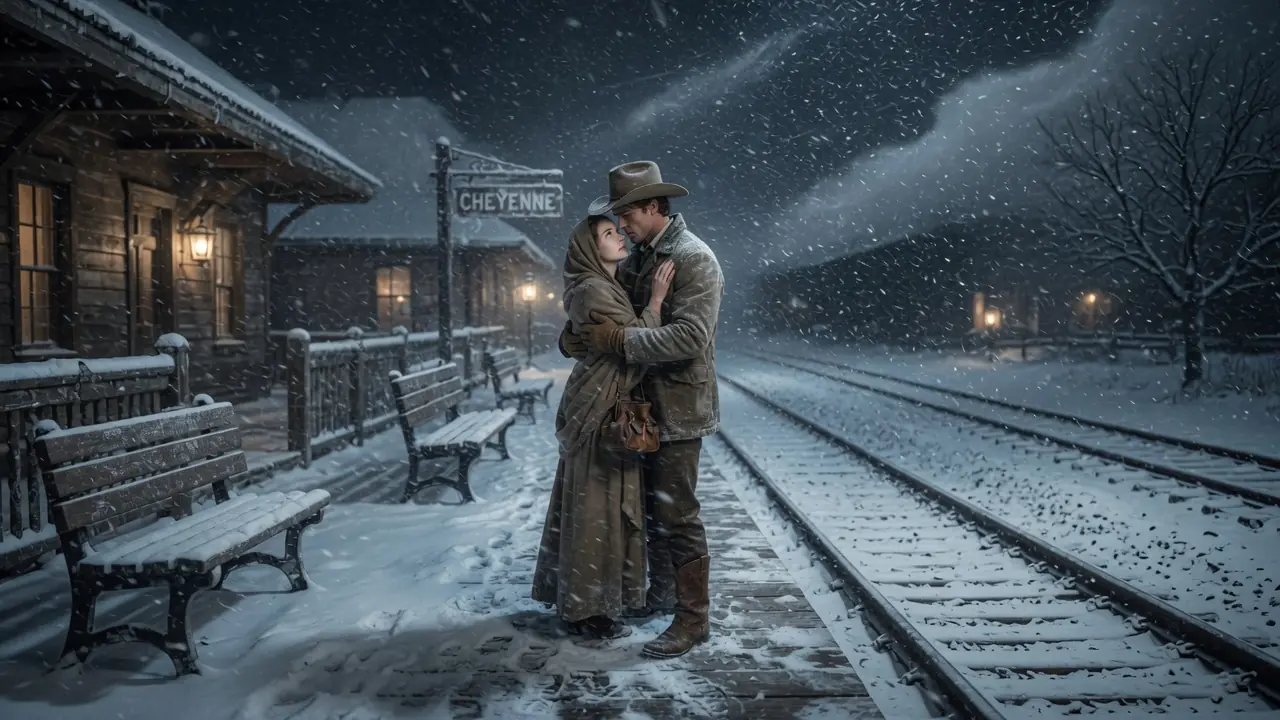
Winter of 1887 came down hard on Wyoming Territory. The blizzard howled through Cheyenne like a banshee’s cry, claiming lives, breaking hearts, and burying the railroad platform beneath sheets of white snow. At the lonesome train station, a young woman sat frozen on a wooden bench, her breath forming pale clouds in the bitter air. She clutched a small leather medical bag containing everything she owned: three dollars, a faded photograph, and a heart full of dreams that seemed as cold as the night itself.
Her name was Elizabeth “Libby” Montgomery, and only weeks earlier she had been a nurse in Philadelphia. She had worked in a charity hospital, tending wounds, delivering babies, comforting the dying, and believing that skill and decency would be enough to build a respectable life. Then Dr. Harrison tried to force himself on her, and when she fought back with the nearest thing she could reach, a bedpan, she broke his nose and destroyed her own future in the same moment. No one believed her word against his, and the hospital dismissed her while the scandal spread through the medical community like wildfire.
No respectable hospital back east would hire her after that. So Libby gathered the little money she had, bought a train ticket west, and hoped to find work in one of the mining towns where people were desperate for anyone with medical knowledge. But her money ran out in Cheyenne, and the boarding house turned her away when she could not pay for another night. Now she sat on a hard bench, watching the snow swirl in the lantern light, wondering if she would freeze to death before dawn.
Her fingers had gone numb hours earlier, and her lips were turning blue. The last train east had left three hours before, and the next would not come until morning, if the storm did not block the tracks. Her small leather medical bag sat beside her, the only valuable thing she had left, holding surgical tools, medicines, and certificates that proved her training. She pulled her thin shawl tighter around her shoulders, but the cold slipped through it as if it were made of paper.
The sound of horse hooves on frozen ground made her look up. Through the swirling snow, she saw a figure approaching on horseback. The man was large, wearing a heavy coat and a wide-brimmed hat pulled low against the wind. As he drew closer, she saw that his horse was a magnificent black stallion and that his clothes, though practical, were of fine quality.
He dismounted, tied his horse to the hitching post, and walked toward the station. His boots were expensive leather, and he moved with the confident stride of a man accustomed to responsibility. When he pushed through the station door, a gust of wind and snow followed him inside. “Evening, miss,” he said, touching the brim of his hat. “Mighty cold night to be sitting out here alone.”
Libby tried to speak, but her teeth were chattering too hard. She managed a small nod. The man studied her with concerned eyes. He was perhaps thirty years old, with dark hair, a mustache, and a weathered face that had seen years of sun and work, yet his eyes were kind.
“Name’s Jackson Thornton,” he said, pulling off his gloves. “Most folks call me Jack. I own the Double T ranch about twenty miles north of here. I was in town on business and heading home when I saw you through the window.”
His gaze fell to her medical bag and then to the way she was dressed. Her clothes were good quality but worn, and even in her poverty she had the bearing of an educated woman. “Are you a doctor, miss?” he asked gently. “No,” Libby managed through chattering teeth. “A nurse. Elizabeth Montgomery, from Philadelphia.”
Jack’s eyes widened. A trained nurse was rarer than gold in Wyoming Territory, where most towns were lucky to have a barber who could pull teeth and set bones. “Miss Montgomery, you’re going to freeze to death if you stay here much longer,” he said, his voice full of concern. “The storm’s getting worse, and this station isn’t heated. Please, let me take you somewhere warm.”
Libby looked at him with hope and weariness tangled together. She had learned not to trust men too easily, but she was desperate, and something about Jack Thornton seemed different from the men she had known back east. There was gentleness in his manner despite his obvious strength. “I don’t have money for a hotel,” she admitted, her voice barely above a whisper.
“That’s not your concern right now,” Jack said firmly. “Getting you warm and fed is what matters. We can sort out the rest later.” He shrugged out of his heavy coat and wrapped it around her shoulders. The warmth of it, still carrying his body heat, made her gasp with relief.
The coat smelled of leather, horses, and something clean, maybe pine soap. “Can you walk?” he asked. Libby tried to stand, but her legs were too stiff from the cold. Without hesitation, Jack scooped her into his arms, medical bag included, as though she weighed nothing.
“The hotel’s just across the street,” he said, carrying her toward the door. “We’ll get you warmed up and fed, and then you can tell me what brings a trained nurse to Wyoming Territory in the middle of winter.” As they stepped out into the storm, Libby found herself pressed against Jack’s chest, his strong arms holding her securely. For the first time in months, she felt safe.
The Cattleman’s Hotel was the finest establishment in Cheyenne, and when Jack Thornton walked through the front door carrying a half-frozen woman, every head in the lobby turned. The desk clerk, a thin man named Perkins, hurried over with obvious concern. “Mr. Thornton, sir, what happened?” he asked. “Found this lady at the train station, near frozen to death,” Jack said.
“I need your best room,” Jack continued. “Send up hot food, coffee, and plenty of blankets. Also, get Doc Williams if he’s still in town.” Perkins grabbed a key from the board and nodded quickly. “Room twelve, second floor. Shall I help carry her?”
“I’ve got her,” Jack replied, already heading for the stairs. Libby was aware of the stares and whispers as Jack carried her through the hotel, but she was too cold and exhausted to care about reputation. The warmth of the building made her fingers and toes tingle painfully as feeling returned. Jack carried her into a spacious room with a large bed, a fireplace, and fine furniture.
He set her gently on a chair by the fire and immediately began building up the flames. “The hotel will send up some lady’s clothes,” he said, not looking at her as he worked. “Yours are damp from the snow. We need to get you warm and dry.”
A knock at the door announced hot coffee, soup, and blankets. Jack tipped the boy generously and sent him away, then poured Libby a cup of coffee with hands surprisingly gentle for their size. “Drink this slowly,” he said, wrapping a blanket around her shoulders. “Too much heat too fast can be dangerous.”
Libby sipped the coffee gratefully, feeling warmth spread through her chest. “You seem to know something about medicine yourself,” she observed, her voice growing stronger. Jack smiled. “You learn a few things running a ranch. Men get hurt, animals get sick, and the nearest doctor might be a hundred miles away.”
He pulled up another chair and sat across from her. “But I’m no trained nurse. What brought you west, Miss Montgomery, if you don’t mind my asking?” Libby studied his face in the firelight. He had honest eyes, she decided, and after what he had done for her that night, he deserved some explanation.
“I worked in a hospital in Philadelphia,” she said carefully. “There was trouble. A doctor who wouldn’t take no for an answer. When I defended myself, I was dismissed. No hospital back east would hire me after that.”
Jack’s jaw tightened, and she saw anger flash in his eyes. “A man forced himself on you?” he asked. “He tried to,” Libby said. “I broke his nose with a bedpan.” Despite the seriousness of the conversation, Jack’s mouth twitched with the hint of a smile.
“Good for you,” he said. “I hope it hurt.” “It did,” Libby replied. For the first time in months, she almost smiled too. “But it cost me my career. I thought maybe out west, where doctors are scarce, my past wouldn’t matter so much.”
“It doesn’t,” Jack said firmly. “Out here, we judge people by what they do, not by the lies told about them back east. A trained nurse is worth her weight in gold in this territory.” Another knock interrupted them, and a hotel maid entered with an armload of women’s clothing. “Begging your pardon, sir, but these are the finest we have,” she said.
“Mrs. Patterson and her roommate donated them,” the maid added. “She said any woman caught in this storm deserves all the help we can give.” Jack stood. “Thank Mrs. Patterson for her kindness. I’ll wait downstairs while Miss Montgomery changes.”
“Mr. Thornton,” Libby called as he reached the door. “Why are you helping me? You don’t know me.” Jack paused, his hand on the doorknob. “Maybe because I know what it’s like to be alone in the world,” he said quietly. “And maybe because I’ve been praying for someone like you to come along.”
“Someone like me?” she asked. “A healer,” he said. “My ranch hands get hurt regular, and I’ve lost good men because there was no one to tend them properly. But more than that, I’ve been looking for someone special, someone with strength and courage.” He turned to face her fully. “Someone who would break a man’s nose rather than let him take what wasn’t his.”
With that, he left the room, closing the door gently behind him. Libby sat by the fire, staring at the closed door. She had expected many things when she came west, but she had never expected to meet a man like Jackson Thornton. He was rich enough to own his own ranch, kind enough to help a stranger, and respectful enough to leave her alone to change without being asked.
She looked at the clothes the maid had brought: a simple but well-made dress of blue wool, undergarments, stockings, and even a pair of boots that looked like they might fit. As she changed out of her damp, travel-stained clothes, she wondered what tomorrow would bring. For the first time since leaving Philadelphia, she felt a spark of hope. It frightened her almost as much as the cold had.
Libby woke to sunlight streaming through the hotel window and the distant sound of voices from the street below. The storm had passed, leaving the world covered in clean white snow. She had slept better than she had in weeks, warm and safe for the first time since leaving Philadelphia. A soft knock at the door made her sit up.
“Miss Montgomery, it’s Jack Thornton.” “Just a moment,” she called, quickly braiding her long brown hair and smoothing the borrowed dress. When she opened the door, Jack stood in the hallway with a breakfast tray. “Morning,” he said with a smile that made her heart skip. “Thought you might be hungry. How are you feeling?”
“Much better, thank you,” she said, stepping aside to let him enter. “Mr. Thornton, I don’t know how to repay your kindness.” “Jack,” he corrected, setting the tray on the small table by the window. “And you don’t owe me anything, though I was hoping we might talk about your plans.”
They sat across from each other while Libby ate eggs, bacon, biscuits, and jam. The food was delicious, and she realized how long it had been since she had eaten a proper meal. “I don’t have many plans,” she admitted. “I was hoping to find work in one of the mining camps, but I’m not sure how to get there or which camps might need a nurse.”
Jack leaned back in his chair, studying her. “Mining camps are rough places for a woman alone. Dangerous, too. Most of those men haven’t seen a decent woman in months, and they don’t always remember their manners.” Libby lifted her chin. “I can take care of myself.”
“I’m sure you can,” Jack agreed. “But there might be another option. My ranch covers fifty thousand acres, and I employ about sixty men year-round. During roundup and branding season, that number goes up to nearly a hundred. These men work hard and get hurt regularly: broken bones, cuts, burns, snake bites, you name it.”
Libby set down her coffee cup, interested. “You’re offering me work?” “I’m offering you a position as the ranch nurse,” Jack said. “Good pay, comfortable quarters, and all the medical supplies you need. You’d have your own cabin near the main house, and Cookie, our cook, would make sure you’re well fed.”
It sounded almost too good to be true. “What would you expect in return?” Libby asked. Jack’s expression grew serious. “Honest work for honest pay. Tend the men when they’re hurt, help with difficult births among the livestock when needed, and maybe teach some of the hands basic first aid. Nothing more than that.”
“And you would expect nothing personal?” she asked. Understanding dawned in Jack’s eyes. “Miss Montgomery, Libby, I’m not the kind of man who would take advantage of a woman’s desperate situation. If something personal were to develop between us, it would be because we both wanted it, not because you felt obligated.” Libby studied his face, looking for any sign of deception. His eyes were clear and honest.
“How far is your ranch?” she asked. “Twenty miles north,” he replied. “It’s called the Double T, after my initials, Jackson Thomas Thornton. We raise cattle and horses, some of the finest in Wyoming Territory. The work is hard but honest, and the men who ride for me are good people.”
“You said you’ve been looking for a healer,” she said. “Haven’t you tried to hire a doctor?” Jack laughed, but there was no humor in it. “I’ve tried. I posted notices in newspapers from Denver to Kansas City.”
“Most doctors want to practice in towns where they can build profitable careers treating wealthy patients,” he continued. “Ranch work is too uncertain, too dangerous, and not profitable enough for most of them.” Libby tilted her head. “But you would hire a woman?” Jack’s answer came without hesitation. “I would hire anyone with the skill and courage to do the job.”
Libby considered the offer. It was better than anything she had dared hope for, but it still seemed too perfect. “What aren’t you telling me?” she asked. Jack smiled appreciatively. “Smart as well as skilled. All right, here’s the truth of it.”
“The Double T is a working ranch, not a fancy estate,” he said. “The winters are hard, the summers are hot, and we’re twenty miles from the nearest town. You would be the only woman on the ranch most of the time, except for Cookie’s wife, Martha, who helps in the kitchen. It can be lonely.”
“I’ve been lonely in cities full of people,” Libby said quietly. “At least ranch loneliness would be honest.” Jack’s face softened. “There’s something else,” he continued. “I’m not just the owner of the Double T. My family has money, quite a bit of it.”
“My father made a fortune in shipping before the war, and I’ve done well with investments in addition to the ranch,” Jack said. “Some people might say you’re trying to catch yourself a wealthy husband.” Libby’s chin came up defiantly. “Let them say what they want. I know my own heart and intentions.”
“I believe you do,” Jack said softly. “But I wanted you to know what you might be walking into.” They sat in comfortable silence for a moment, watching the snow-covered street through the window. Finally, Libby spoke. “When would you want me to start?”
Jack’s face lit up with a smile that transformed his weathered features. “Does that mean you’ll take the position?” “It means I’ll try it,” Libby said carefully. “If it doesn’t work out for either of us, I’ll move on with no hard feelings.” Jack stood and extended his hand. “Fair enough. Welcome to the Double T, Nurse Montgomery.”
As Libby shook his hand, she felt a spark of electricity pass between them. From the look in Jack’s eyes, he felt it too. This job might be more complicated than she had thought. But for the first time in months, she was looking forward to the future.
The ride to the Double T ranch took three hours through snow-covered countryside that took Libby’s breath away. Jack had bought her a warm coat, riding boots, and other necessities in Cheyenne, refusing to take no for an answer when she protested the expense. “Consider it an advance on your salary,” he had said with a grin that was becoming familiar. Now, as they rode side by side through the Wyoming wilderness, Libby felt a sense of freedom she had never experienced back east.
The landscape was vast and beautiful, with snowcapped mountains in the distance and endless sky overhead. Jack pointed out landmarks along the way: a creek where they watered their horses, a grove of cottonwood trees that provided shelter during summer roundups, and finally the boundary markers of the Double T. “There she is,” Jack said with obvious pride as they crested a hill. Libby gasped at the sight below them.
The Double T ranch sprawled across a valley like a small town. The main house was large and well built, constructed of logs and stone with a wide front porch. Nearby stood a bunkhouse, stables, a corral, a blacksmith shop, and various outbuildings. Smoke rose from several chimneys, and men worked despite the cold.
“It’s beautiful,” she said honestly. “Wait until spring,” Jack replied. “When the grass is green and the wildflowers are blooming, there’s no prettier sight in all of Wyoming.” As they rode into the ranch yard, men began emerging from various buildings to greet them.
“Boys,” Jack called as he dismounted. “I want you to meet Miss Elizabeth Montgomery. She’s our new nurse.” A cheer went up from the assembled men, and Libby felt her cheeks warm. One grizzled cowboy with gray whiskers stepped forward.
“Name’s Tom Bradley, miss,” he said. “I’m the foreman here. Can’t tell you how glad we are to have someone with medical training on the ranch.” “Thank you, Mr. Bradley,” Libby said as Jack helped her down from her horse. “I hope I can be of help.”
“Oh, you will be,” said another man with a bandaged hand. “I cut myself on some barbed wire yesterday, and it’s been paining me something fierce.” “I’ll take a look at it after I get settled,” Libby promised. Jack led her toward a small but well-built cabin about fifty yards from the main house.
“This will be your home,” he said, opening the door. The cabin was simple but comfortable, with a main room that served as both living area and office, a small bedroom, and a kitchen with a wood stove. A fire had already been lit in the fireplace, and the rooms were warm and welcoming. “Cookie’s wife, Martha, stocked the kitchen with supplies,” Jack explained. “And I had some of the boys bring over furniture and linens.”
Libby walked through the cabin, touching the simple wooden furniture and admiring the views from the windows. One looked toward the mountains, another toward the main house and ranch buildings. It was perfect. Then Jack led her to a room she had not noticed. “There’s one more thing. I thought you might need this.”
He opened the door to reveal a fully equipped medical office. There was an examination table, cabinets full of supplies, surgical instruments, and medicines. Everything was clean and well organized, better equipped than some hospitals where she had worked back east. “Jack,” she breathed, overwhelmed. “This must have cost a fortune.”
“A good nurse is worth a fortune,” he said simply. “Besides, I ordered most of this months ago, hoping I’d eventually find someone to use it.” Libby felt tears prick her eyes. After months of rejection and hardship, this kindness was almost too much to bear.
“Thank you,” she whispered. “Don’t thank me yet,” Jack said with a smile. “Wait until you’ve seen what some of these cowboys can do to themselves. You’ll earn every penny of your salary.” As if to prove his point, there was a knock at the door.
Tom Bradley entered, supporting a young cowboy who was hopping on one foot. “Sorry to bother you, miss, but Billy here just got stepped on by his horse,” Tom said. “Bring him into the medical room,” Libby said, immediately shifting into professional mode. “Let’s get that boot off and see what we’re dealing with.”
As she examined Billy’s injured foot, which was bruised but thankfully not broken, Libby was aware of Jack watching from the doorway. After bandaging the foot and giving Billy instructions for care, she looked up and found Jack smiling. “What?” she asked. “Nothing,” he said. “Just thinking this might work out even better than I hoped.”
That evening, after treating three more minor injuries and meeting most of the ranch hands, Libby sat in her new cabin trying to process everything that had happened. Two days earlier, she had been freezing and penniless at a train station. Now she had a job, a home, and the respect of the men she would be working with. Then there was Jack Thornton himself.
He was nothing like the men she had known back east. He was not one of the refined but weak gentlemen of society, nor one of the crude men who tried to take advantage of vulnerability. Jack was strong but gentle, wealthy but unpretentious, and he treated her as an equal while still being protective. A soft knock at her door interrupted her thoughts.
When she opened it, Jack stood on her porch with a steaming cup in his hands. “Thought you might like some hot chocolate before bed,” he said. “Martha makes the best in Wyoming Territory.” “That’s very thoughtful,” Libby said, accepting the cup gratefully. “Would you like to come in for a few minutes?”
Jack hesitated. “I don’t want to compromise your reputation.” Libby smiled. “I think my reputation can survive a brief conversation with my employer. Besides, who’s going to see us way out here?”
Jack entered and took a seat by the fireplace while Libby settled into the chair across from him. The hot chocolate was indeed delicious, rich and warming. “How are you settling in?” he asked. “Better than I dared hope,” she admitted. “The men have been respectful, the cabin is perfect, and that medical room is better equipped than some city hospitals.”
“Good,” Jack said, then fell silent, staring into the fire. “What is it?” Libby asked, sensing something troubling him. “I want to be honest with you about something,” he said finally. “When I found you at that train station, it wasn’t entirely by chance.”
Libby set down her cup, suddenly wary. “What do you mean?” Jack answered carefully. “I had been in town on business, yes, but I was also making inquiries about finding a nurse or doctor for the ranch. The hotel clerk mentioned a woman with medical training had been asking about work earlier that day. I went to the station hoping to find you.”
“So you knew who I was?” she asked. “I knew a trained nurse was supposed to be on the evening train from the east,” Jack said. “I didn’t know your name or your circumstances until I found you there.” Libby considered this. “Why didn’t you tell me earlier?”
“Because I wanted you to take the job based on its merits,” he said. “Not because you felt obligated to the man who rescued you.” It made sense, and Libby respected him even more for his honesty. “Is there anything else I should know?” she asked.
Jack met her eyes directly. “Just this. I’m attracted to you, Libby. I have been since the moment I saw you sitting in that station. But your job here is secure regardless of your personal feelings toward me.”
“I won’t pressure you,” he continued. “And I won’t make your position here depend on anything other than your professional skills.” Libby felt her heart skip. The attraction was mutual, but she appreciated his straightforwardness. “Thank you for being honest,” she said softly. “And for the record, the attraction isn’t one-sided.”
They looked at each other across the firelight, both aware that something significant was beginning between them. But they also knew it was too soon and complicated by their employer-employee relationship. “Well,” Jack said, standing. “I should let you get some rest. Tomorrow, Cookie wants to show you the kitchen gardens, and Martha is eager to give you the full tour of the ranch.”
“Jack,” Libby called as he reached the door. He turned. “Thank you for everything,” she said. “I haven’t felt this hopeful about the future in a very long time.” Jack’s voice softened. “Neither have I.” Then he was gone, leaving Libby alone in the warm glow of possibility.
Spring came early to Wyoming Territory that year, and with it, Libby settled into her new life at the Double T. She treated everything from broken bones to snake bites, delivered foals and calves, and even helped Martha in the kitchen garden when her medical duties were light. The cowboys came to trust and respect her, often seeking advice on matters that had nothing to do with medicine. But it was her growing relationship with Jack that occupied most of her thoughts.
He was careful to maintain professional boundaries during the day, but their evening conversations on her cabin porch became a cherished routine. They talked about everything: his dreams for the ranch, her experiences back east, and their hopes for the future. One evening in late April, as they watched the sunset paint the mountains gold and purple, Jack brought up a subject that had been weighing on him. “Libby, there’s something I need to tell you about my past,” he said.
She set down her coffee cup and gave him her full attention. “What is it?” “I was married before,” Jack said quietly. “Her name was Rebecca. We were childhood sweethearts back in Texas and married when I was twenty-two.”
Libby felt a stab of jealousy, followed immediately by guilt. Of course, a man like Jack would have been married before. “What happened to her?” she asked gently. “Fever took her three years ago,” Jack said, pain evident in his voice. “We had been trying to have children, but it never happened. When she died, I thought my chance at happiness died with her.”
“I’m sorry,” Libby said, reaching over to squeeze his hand. “She must have been very special.” “She was,” Jack agreed. “But she was also nothing like you. Rebecca was gentle and delicate, content to stay home and tend her flowers. You are strong, independent, and willing to face challenges head-on. I love that about you.”
Libby’s heart stopped. “Jack...” “I know it’s too soon,” he said quickly. “I know we work together, and that complicates things, but I can’t pretend anymore that my feelings for you are just professional respect.” Libby took a breath. “Mine aren’t either. But you’re right. It is complicated.”
Before she could say more, Tom Bradley came running up to the cabin, his face pale with worry. “Boss, Miss Libby, there’s been an accident. Lightning spooked the horses, and young Danny got trampled. He’s hurt bad.” Libby was on her feet instantly, her personal feelings pushed aside by professional duty. “Where is he?”
“Bunkhouse,” Tom replied. “Cookie and some of the boys carried him there.” Libby ran to the medical room for her supplies while Jack saddled horses to ride for the doctor in Cheyenne. But when she reached the bunkhouse and saw Danny’s injuries, she knew there was no time to wait.
The eighteen-year-old cowboy was unconscious, his chest crushed, his breathing labored, and internal bleeding obvious. “Clear a table,” she ordered the gathered men. “I need lots of light, hot water, and clean sheets. Tom, I need you to assist me.” Tom hesitated. “Miss Libby, shouldn’t we wait for the doctor?”
“He’ll be dead before the doctor gets here,” Libby said firmly. “I’ve done this surgery before. We can save him, but we have to act now.” For the next three hours, Libby worked over Danny’s broken body, repairing internal damage and setting bones. The cowboys watched in awed silence as she performed what seemed like miracles with her skilled hands.
When she finally stepped back, exhausted but triumphant, Danny’s breathing was steady, and his color had improved. “He’ll live,” she announced, and the bunkhouse erupted in cheers. Jack, who had returned with the doctor an hour earlier, watched from the doorway with undisguised admiration. When the doctor examined Danny and pronounced Libby’s work as fine as any surgeon in Denver could have done, Jack’s pride was evident to everyone present.
Later that night, after Danny had been moved to the cabin next to Libby’s for easier monitoring, she and Jack finally had a chance to talk. “What you did tonight was incredible,” Jack said as they sat on her porch in the moonlight. “You saved that boy’s life.” “It’s what any trained nurse would have done,” Libby said modestly.
“No,” Jack said firmly. “It is what you did, and it is why I love you.” There it was, out in the open. Libby looked at the man who had rescued her from freezing, given her a home and meaningful work, and now looked at her as if she were the most precious thing in the world. “I love you too,” she said simply.
Jack leaned over and kissed her then, gentle and sweet under the star-filled Wyoming sky. When they broke apart, both were breathing hard. “Marry me, Libby,” Jack said. “I know it’s fast. I know it’s complicated, but I can’t imagine my life without you now.”
“Jack,” Libby began, but he held up a hand. “You don’t have to answer tonight,” he said. “Just promise me you’ll think about it.” “I will,” she promised, though in her heart she already knew her answer. Word of Jack’s proposal spread through the ranch faster than wildfire.
To Libby’s surprise, the reaction was overwhelmingly positive. The cowboys had come to love and respect her, and they could see how happy she made their boss. Even Tom Bradley, once skeptical about having a woman on the ranch, gave the match his wholehearted approval. “Never seen the boss smile so much,” he told Libby one morning as she checked on Danny’s recovery. “You’re good for him, miss. Good for all of us.”
The wedding was planned for the first Saturday in June, and it became the social event of the season in that part of Wyoming Territory. Cowboys from neighboring ranches, townspeople from Cheyenne, and even some of Jack’s business associates from Denver came to witness the union of the millionaire rancher and his nurse. Libby wore a dress of ivory silk that Jack had ordered specially from San Francisco, and Martha wove wildflowers from the prairie into her hair. Tom Bradley proudly escorted her in place of the father she had lost years earlier.
Jack waited at the altar on the front porch of the main house, dressed in his finest black suit and looking more nervous than Libby had ever seen him. When their eyes met, however, his nervousness disappeared, replaced by pure joy. The circuit preacher spoke about love, commitment, and partnership, and his words seemed especially meaningful given how Jack and Libby had found each other. When he asked Jackson Thomas Thornton if he took Elizabeth Rose Montgomery to be his lawfully wedded wife, Jack’s answer carried clearly across the crowd.
“I do,” Jack said firmly. When the preacher asked Elizabeth Rose Montgomery if she took Jackson Thomas Thornton to be her lawfully wedded husband, Libby replied with a voice strong and sure. “I do.” When the preacher pronounced them husband and wife, Jack’s kiss was passionate enough to draw cheers and whistles from the cowboys, and Libby blushed but did not pull away.
The celebration that followed was legendary. Cookie had outdone himself with roasted beef, fresh trout, vegetables from Martha’s garden, and a three-tiered wedding cake transported carefully from Denver. There was music, dancing, and storytelling that went on well into the night. But the most meaningful moment came when Danny, still recovering but determined to attend, stood to make a toast.
“To Mrs. Thornton,” he said, raising his glass of lemonade because he was still too weak for alcohol. “The woman who saved my life and made our boss the happiest man in Wyoming Territory. May your love story inspire generations to come.” The crowd erupted in agreement, and Libby cried happy tears as Jack squeezed her hand. As the evening wound down, they found themselves alone on the porch of the main house, which would now be their home together.
“Well, Mrs. Thornton,” Jack said, taking her hands in his, “how does it feel to be a married woman?” “It feels like coming home,” Libby replied honestly. “Like everything that happened before was just preparing me for this moment.” Jack pulled her close, and they danced slowly to the music drifting from the bunkhouse.
“I have something for you,” Jack said, reaching into his jacket pocket. He pulled out a small velvet box and opened it to reveal a beautiful gold locket. “Jack, it’s beautiful,” Libby breathed as he fastened it around her neck. “Open it,” he urged.
Inside was a tiny photograph of the two of them taken earlier that day. Engraved on the opposite side were the words, “Forever and always, JT.” “Now you’ll always have me close to your heart,” Jack said softly. “I already do,” Libby whispered, then kissed him beneath the star-filled Wyoming sky.
The first year of marriage brought both joys and challenges to Jack and Libby Thornton. Libby continued her work as the ranch nurse, but now she also took on the role of ranch wife, helping Jack with the business side of the operation and entertaining visitors who came to buy cattle and horses. She proved to be a natural at both roles. Her medical skills became legendary throughout the territory.
She successfully treated a cholera outbreak in nearby Silver Creek, delivered twins during a blizzard, and even removed a bullet from a wounded sheriff who had been chasing rustlers. But it was her partnership with Jack that truly made their marriage special. She had a keen mind for business and often suggested improvements to ranch operations that saved money and increased efficiency. Jack valued her opinions and never made important decisions without consulting her first.
Their love story became the talk of Wyoming Territory. Newspaper reporters came from as far away as Chicago to write about the millionaire cowboy and his nurse wife. The story of how Jack had found Libby freezing at the train station was retold around campfires and in saloons from Colorado to Montana. But their happiness was tested when Libby’s past came back to haunt them.
In the spring of 1889, Dr. Harrison, the man who had tried to assault her in Philadelphia, arrived in Cheyenne, claiming to investigate medical malpractice by unlicensed practitioners. “He’s come to cause trouble,” Libby told Jack as they read the telegram warning them of Harrison’s arrival. “He’s never forgiven me for what I did to him.” “Let him come,” Jack said grimly. “He’ll find that things are different out here.”
Harrison arrived at the ranch three days later, accompanied by a territorial marshal and carrying official papers questioning Libby’s right to practice medicine without a license. He was thin and pale, with calculating eyes and a permanent sneer that made Libby’s skin crawl. “Mrs. Thornton,” he said with mock politeness. “Or should I say Miss Montgomery? I’m here to investigate reports of illegal medical practice.”
“My wife is a trained nurse,” Jack said, stepping protectively in front of Libby. “She has certificates proving her education and experience.” Harrison smiled coldly. “Certificates that mean nothing if she was dismissed from her position for moral turpitude. Did you tell your husband about your behavior back in Philadelphia, my dear?”
“I told him about a coward who tried to force himself on me and got his nose broken for his trouble,” Libby said, her voice steady despite her racing heart. “Your word against mine,” Harrison said. “And I am a respected physician, while you are just a woman of questionable virtue.” That was as far as he got before Jack’s fist connected with his jaw, sending him sprawling into the dirt.
The marshal reached for his gun, but found himself facing thirty angry cowboys who had appeared seemingly from nowhere. “Now see here,” the marshal said nervously. “I’m a federal officer.” “And I’m a citizen of Wyoming Territory,” Jack said calmly, though his eyes blazed with anger. “You want to question my wife’s credentials? Fine. Let’s go to town and have a proper hearing.”
The hearing was held in Cheyenne’s courthouse three days later, and it seemed like half the territory came to support Libby. Patient after patient testified about her skill and compassion. The doctor from Cheyenne spoke eloquently about her surgical abilities. Even the territorial governor, who had met Libby at a social function, sent a letter praising her contributions to medical care in the territory.
Harrison’s accusations fell apart under scrutiny. It was revealed that he had been dismissed from his own hospital position for drinking and incompetence and that he had harbored a grudge against Libby for years. When Tom Bradley testified about how Libby had saved Danny’s life by performing surgery no one else in the territory could have done, the judge’s decision was swift. “Mrs. Thornton,” the judge said, “your service to this territory has been exemplary.”
“Your nursing certificate is hereby officially recognized by the territorial government,” the judge continued, “and you are authorized to practice medicine throughout Wyoming Territory. As for you, Dr. Harrison, I suggest you leave our territory immediately before these good people decide to show you the same hospitality you have shown their beloved nurse.” The courtroom erupted in cheers. Libby found herself swept into Jack’s arms as he spun her around in celebration.
“It’s over,” he whispered in her ear. “He can’t hurt you anymore.” “We did it together,” Libby replied, looking into his eyes. “We can face anything together.” That night, as they celebrated with friends and neighbors, Libby realized her love story with Jack had become bigger than personal happiness.
They had become symbols of the American dream, proof that in the West, people could reinvent themselves and that hard work, courage, and love could overcome almost any obstacle. By 1892, five years after their marriage, Jack and Libby Thornton had become one of the most influential couples in Wyoming Territory. The Double T had expanded to over one hundred thousand acres, and their cattle and horses were renowned throughout the West. But their contributions to the community set them apart even more than wealth did.
Libby established the first real hospital in the territory, a modern facility in Cheyenne that served patients from hundreds of miles around. She also started a nursing school, training young women to provide medical care in remote areas. Her innovations in frontier medicine were written about in medical journals back east, and she was invited to speak at medical conferences in Boston and New York. Jack became a political force as well, serving in the territorial legislature and advocating for statehood.
He invested in railroads, mining, and businesses that brought prosperity to the region. But perhaps his greatest achievement was the town he built on the southern border of the ranch, Thornton, Wyoming, complete with schools, churches, shops, and homes for the families of his employees. Their love story inspired countless others to take chances on love and new beginnings. Their greatest joy, however, came from the three children they were blessed with.
Twin boys were born in 1890, followed by a daughter in 1892. Little Thomas and Jackson Jr. already showed signs of their father’s love for the land and their mother’s compassionate nature. Baby Rebecca, named for Jack’s first wife with Libby’s blessing, was the light of their lives. “She’s going to be a healer like her mother,” Jack said one evening as they watched their daughter sleep in her crib.
“Or a rancher like her father,” Libby replied with a smile. “Those hands look strong enough to handle horses.” “Maybe both,” Jack said, pulling his wife into his arms. “In this family, we believe in unlimited possibilities.” As they stood together, watching their children sleep, Libby reflected on the journey that had brought them there.
From that freezing night at the train station to this warm, love-filled home, it had been an adventure beyond her wildest dreams. “Do you ever regret it?” Jack asked, as if reading her thoughts. “Leaving Philadelphia, coming west, taking a chance on a rough cowboy?” “Never,” Libby said firmly.
“That night you found me at the station was the luckiest night of my life,” she told him. “Everything that happened before was just preparing me to be your wife and the mother of your children.” Jack kissed her forehead. “I love you, Libby Thornton, more than I ever thought possible.” She smiled. “And I love you, Jackson Thornton. Forever and always.”
Outside their window, the Wyoming wind whispered through the cottonwood trees, carrying the sounds of the ranch settling down for the night. In the distance, a cowboy played a soft tune on his harmonica, and the cattle rested peacefully in the fields. Years later, when historians wrote about the early days of Wyoming, they always included the story of Jack and Libby Thornton. Their love became legend, told around campfires and in books, inspiring generations to believe love could overcome any obstacle.
The Double T ranch continued to thrive under their children’s leadership. Thomas became a respected cattleman and served as Wyoming’s first state senator. Jackson Jr. became a doctor, following in his mother’s footsteps and establishing hospitals throughout the growing state. Rebecca married a fellow rancher and raised six children of her own, passing down the family stories of courage, love, and perseverance.
The town of Thornton grew into a thriving city, and the hospital Libby founded became a major medical center. Her nursing school graduated hundreds of women who carried her legacy of compassionate care throughout the American West. But perhaps the most enduring legacy of Jack and Libby’s love story was the example they set for others. They proved that love could blossom in the most unlikely circumstances.
In the museum in Cheyenne, visitors can still see Libby’s medical bag, the one she carried that cold night in 1887 when she sat freezing at the train station. Next to it is Jack’s wedding ring and a copy of their marriage certificate. But the real monument to their love is not in any museum. It is in the hundreds of couples who found inspiration in their story and took chances on love.
The plaque in the museum reads, “Jack and Elizabeth Thornton, proof that love can conquer all, and that the greatest adventures begin with a single act of kindness.” In the graveyard on the hill overlooking the Double T ranch, two headstones stand side by side under the big Wyoming sky. Jack died in 1923 at the age of eighty-six, and Libby followed him just three months later. They were buried together as they had lived, hand in hand, heart to heart.
The inscription on their shared headstone, chosen by their children, reads simply, “Forever and always, a love that made history.” Even today, more than a century later, visitors come to Wyoming to see where the famous love story began. They visit the site of the old train station in Cheyenne, tour the Double T ranch, now a museum, and walk through the town of Thornton. They leave inspired by the story of a millionaire cowboy who found a freezing nurse at a train station and discovered that sometimes the greatest treasures are found in the most unexpected places.
The legend of Jack and Libby Thornton lives on as a testament to the power of love, the promise of the American West, and the truth that every great love story begins with someone caring enough to reach out to a stranger in need. Their love story truly did make history. In a land of endless possibilities, they proved that love is the greatest adventure of all.