A wrench hit the concrete and bounced. A young mechanic wiped his hands and shoved the tarp back over the rusted machine. "It's scrap, " he said. "Take it home. Bury it with him. " The old woman holding the title didn't move.
Behind her, a crowd of leather-vested riders laughed. Nobody noticed the thin old man at the edge of the lot, one hand resting on the head of a three-legged dog. He walked forward slow. He put his hand on the cold gas tank and he said six words that stopped the laughing. "I can bring it back. " Somebody snorted.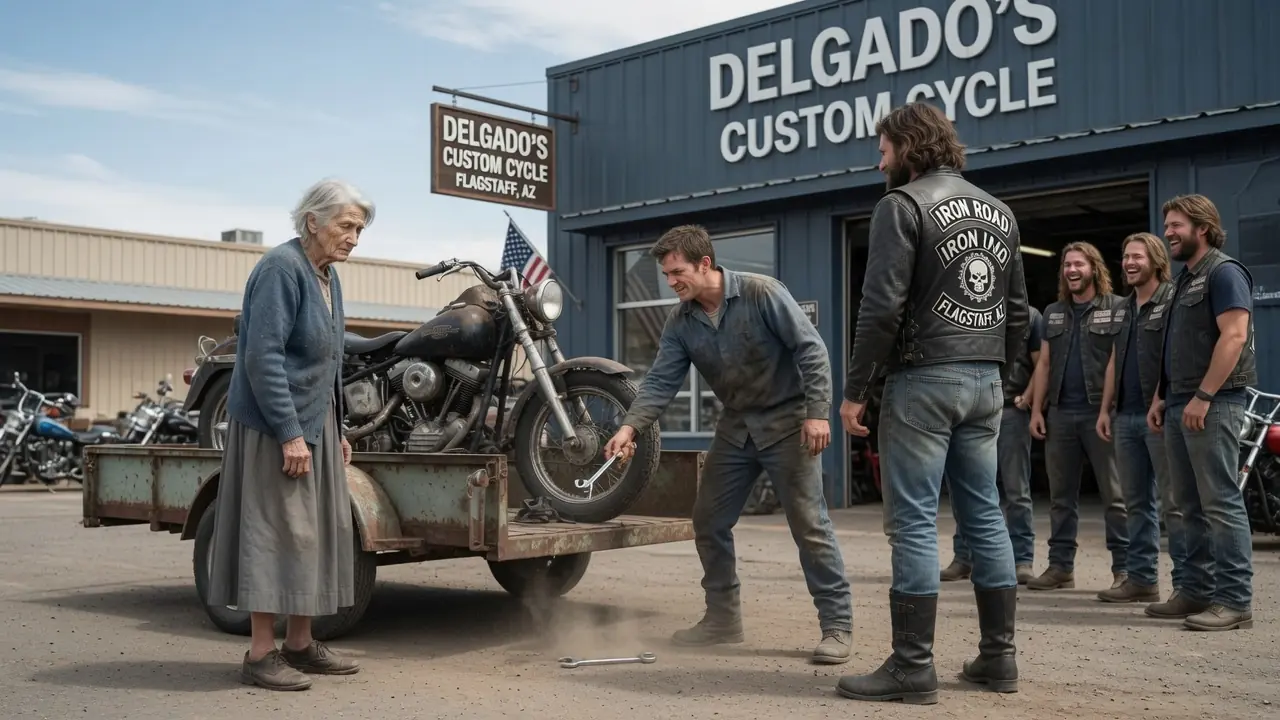
That's when Silass Renner rolled up his sleeve. On his forearm was a faded death's head skull. The same one they thought only a dead man wore. What that old veteran found hidden inside that gas tank two weeks later would silence an entire clubhouse. Now, let me back up a little because you need to understand who this man was before that morning.
Silass Renner lived on the north edge of Flagstaff in a room behind the VA hall that used to be a supply closet. Somebody there let him stay in exchange for keeping the boiler running and the mowers alive. He was 71 years old. He had two shirts, one coat, a cot, and a dog. That was the whole list.
That was everything he owned in the world. The dog's name was Diesel. Big Shepherd gray around the muzzle, missing his back left leg. Silass found him three winters back, half frozen under a highway overpass, the leg already gone to gangrene. The vet said, "Put him down. " Silass said no.
He paid for that surgery with money he didn't have, and he never once regretted it. Where Silass went, Diesel went. Simple as that. A limping old man and a limping old dog, walking the shoulder of the road every morning, keeping pace just fine, and neither one ever complained. Now, here's the thing about Silass.
The man could fix anything with an engine in it. Anything. Lawnmowers, generators, an old truck, a chainsaw, anything someone dragged in broken. He worked out back of the VA hall on a patch of gravel under a plastic canopy and men would bring him dead machines and he'd bring them back to life for whatever they could spare. $10, a sandwich, a pack of smokes he didn't even use. He didn't do it for the money.
He did it because his hands still knew how. And a man needs to be good at something. Even at 71, especially then, you'd watch him work and notice he never rushed. He'd sit with a broken thing a long while before he touched it, turning it over, listening the way a doctor listens to a chest. He said engines told you what was wrong if you shut up long enough to hear it.
Most men, he said, were too busy talking to ever hear anything. He didn't talk much about the war. The men at the VA knew he'd been in Vietnam, knew he had a Bronze Star and a Purple Heart in a cigar box under his cot, but he never showed them. Never told the stories. You'd sit next to him an hour and get maybe four sentences.
He noticed the old woman. He noticed the rusted out Harley on the trailer sitting under a tarp like a body. And he noticed how the young men in leather stood around it laughing. Let me tell you what he was looking at. The old woman was named Ruth.
She was 78 and she'd buried her husband 4 months earlier. His name was Harlan Cole, but nobody in that town had called him Harlan in 50 years. They called him Bishop. He'd started the local motorcycle club chapter back in the 70s, built it from six men and a garage into something the whole state knew. When he died, they gave him a funeral 300 bikes long.
The engines shook windows for a mile. People stood on the overpasses to watch it go by. But Bishop left almost nothing behind. No money, a rented house, doctor bills, and that one motorcycle, his first, the 1980s Harley he'd built with his own hands and ridden for 40 years before the cancer took his strength and parked it for good. It had sat under a tarp in his shed for his last 8 years.
Rust ate the tank. The tires rotted flat. The engine seized solid. Toward the end, he couldn't even walk out to look at it. And Ruth said that hurt him worse than the sickness did.
Ruth wanted it running again, not to sell. To give to their grandson, Danny, 17 years old, the last piece of the old man the boy would ever hold. So she'd been driving that trailer from shop to shop for 2 weeks. And every shop said the same thing. Scrap, too far gone, cheaper to buy new.
Bury it with him. That last one came from a kid, maybe 25, working the floor at Delgato, and the club riders who'd shown up to watch thought it was hilarious. These were the new generation, Bishop's Club, but not Bishop's men. Loud, young, quick to laugh, quick to spend money they had and money they didn't. Their president was a broadshouldered guy about 30 named Ryder.
And Ryder wasn't laughing exactly, but he wasn't stopping it either. He looked tired in a way young men aren't supposed to look like he was carrying something too heavy and too quiet to set down. That's when Silass crossed the road. Diesel limping right beside him. He didn't say much at first.
He walked up to the trailer and put his bare hand flat on the rusted tank the way you'd put a hand on a sick man's forehead. He stood there a while and then he said those six words. I can bring it back. The kid mechanic laughed first. "Grandpa, you can't even bring yourself back. " The riders roared.
Silass didn't flinch. He didn't get angry. He just reached down and rolled up the sleeve of his left arm slow, one fold at a time, until the forearm was bare. And the laughing stopped like somebody had cut a wire because there faded into old skin was a skull, a grinning death's head with two crossed bones beneath it. Every man there knew that mark.
It was inked on the back of Bishop's cut. It was carved on Bishop's headstone. They thought it was the club's mark. It wasn't. Not originally.
Ruth's hand went to her mouth. She stepped closer, staring at that tattoo like she was seeing a ghost. ""Where? " she said, and her voice broke. ""Where did you get that? "" "Same place your husband got his, " Silass said quietly. "A rice paddy outside Quang Tri, 1969. There were 11 of us wore that skull. Called ourselves the Reapers.
He looked down at Diesel, then back up at her. I didn't know Harlan was here. I didn't know he was anywhere. I thought all ten of them were dead. " The lot went dead quiet. Ryder took a step forward, looking at Silass's like he'd never really seen an old man before in his life.
"You knew Bishop? " Ryder said it wasn't a question exactly. I knew Harlan. Silass said Bishop came later. The man who pulled me out of that water and carried me two miles with a bullet in his own leg. That man I knew.
The one you buried I never got to meet. And that's on me. Now here's where it turned. Ryder looked at the bike. He looked at Ruth.
He looked at the young mechanics who'd called it scrap. 5 minutes ago and were now staring at their boots. And something moved behind his eyes because Ryder had grown up on stories about the Reapers. Every man in that club had. Bishop told them by the fire a hundred times about the 10 brothers he'd bled beside in a war older than any of them.
But Bishop never gave the 11th name. He'd get to that part and go quiet and drink, and nobody pushed him. Nobody dared. And here was the 11th name standing in a gravel lot with a three-legged dog and a hole in his shoe. "The shop says it can't be done, " Ryder said finally.
Best builders in the state looked at it. The best builders in the state didn't build it, Silass said. Harlan did, and I know how Harlan built things. Give me two weeks. Ryder crossed his arms.
"And what do you want for it? " Silass's thought about that. "Nothing, " he said. It's not mine to charge for. It's his. He nodded at the boy.
Danny standing behind his grandmother. Just get me a place to work and I'll get you the parts myself. Ryder should have said no. Any sensible man would have, but he didn't. He gave Silass the back bay of the shop, the one nobody used, and he gave him two weeks.
And he told the young mechanics to leave the old man alone. Then he walked off shaking his head like a man who just agreed to something he couldn't explain. That was the moment everything became real because now Silass had made a promise. And a man like Silass would rather die than break one. The parts were the problem.
That old Harley needed a rebuild top to bottom. New pistons, valves, seals, a magneto, cables, tires, the works, hundreds of dollars, and Silass had $11 and some change. He knew it. Ruth knew it. She offered him what little she had, a few crumpled bills from her purse, and he closed her hand around them gently.
"You've got a longer road ahead than I do, " he said. "Save it. " So the next morning, before anyone was awake, Silass took the cigar box out from under his cot. Inside were his medals, the Bronze Star with the little V for valor, the Purple Heart, a few ribbons, and a unit patch worn soft as cloth. He'd carried those for 50 years. Through every move, every hard winter, every night he had nothing else.
They were the only proof left that a younger man named Silass Renner had once done something that mattered. He held the box in his lap a long time in the dark. Diesel put his chin on Silass's knee the way he did when he could tell something was heavy. Then Silass stood up and put on his coat. He walked them down to the pawn shop on Route 66 and laid them on the glass counter.
The pawn broker was an older fella himself and he didn't want to take them. You don't sell these, he said. I've had guys come in drunk and sell these and cry in my parking lot a year later. I won't do it to you. I'm not drunk, Silass said.
And I'm not selling my war. I'm buying a man's memory back for his widow. There's a difference. He pushed the box an inch closer. "How much? " The broker looked at him a long time.
Then he asked one question, ""Whose memory? "" And Silass told him the short version. A brother from the war, a rusted bike, a widow driving its shop to shop. The broker listened without a word. Then he counted out $400, more than the medals were worth on any market, and wrote a ticket that said Silass had 90 days to buy them back. They both knew 90 days might as well be 90 years, but it let each man keep his dignity.
And sometimes that's the whole transaction. 90 days, the broker said, "I'll keep them in the back, not the case. The back. " Silass nodded and understood exactly what the man meant. Silass ordered the parts that afternoon. Then he started working nights.
Days he still ran the boiler and fixed the mowers at the VA. But when the sun went down, he'd walk across town with diesel, let himself into that back bay, and work until 2, 3 in the morning under a single hanging light. He tore that engine down to nothing. Cleaned 40 years of rust and sludge out of every passage, hand lapped the valves, freed the seized piston with heat and patience, and a language of small taps that only old hands understand. Diesel slept on a folded blanket in the corner while the old man worked.
And that was the whole of their nights for two weeks. And here's the thing he found as he went. Every bolt Harlan had ever turned. He turned it a certain way, torqued it a certain way, marked it with a little scratch so he'd know his own work. Silass recognized all of it.
It was like reading a letter written in a hand he hadn't seen in 50 years. He'd loosen a fitting and just stop because Harlan's fingerprints were right there in the metal. And for a second, his brother was in the room with him. The young riders started coming by to watch. First to laugh, then out of curiosity, then something closer to respect.
They'd bring him coffee he didn't ask for and stand at the edge of the light, not saying much. Ryder came almost every night. He'd sit on an oil drum and watch the old man's hands move. And after a while, he started asking questions. Real ones about Bishop, about the war, about the 11 men who wore the skull.
And Silass who never talked started to talk a little. He told Ryder how Harlan Cole was the loudest man in the platoon and the bravest. How he'd carry another man's pack for miles and never mention it. How the day Silass got hit, it was Harlan who came back through the fire alone against orders and dragged him out of that paddy by the collar. How Harlan had a bullet in his own leg the whole time and never said a word until they were both safe.
How they got split up in the hospitals afterward. And how in all the years since, Silass had believed his brother died in country. He'd grieved him for 50 years. And the whole time Harlan was two miles up the road building a life, telling their story by a fire. He never gave your name, Ryder said one night.
In 50 years, he'd get to you and stop. I know why, Silass said, not looking up from the engine. Because he thought I was dead, too. You don't say a dead brother's name out loud. It costs too much.
He wiped his hands. We were both grieving the same living man. That's about the saddest thing I ever heard, and it's about us. Ryder was quiet a while. Then he said something he hadn't said to anybody.
He told Silass the club was in trouble, deep trouble. And Silass just listened the way he listened to engines and didn't offer advice. And somehow that was the thing Ryder had needed most for a year. By the end of the second week, the bike was almost whole again. Silass had traded his medals for the guts of it and given his sweat for the rest.
The engine sat back in the frame, painted, torqued, waiting, new tires, rebuilt tank, sanded down to bare metal, ready for the last coat of primer. And on the 13th night, something happened that made everybody exhale. It was late. Ruth had come by and Danny and half the club. Silass connected the last fuel line.
Ryder poured in a fresh gallon and Silass swung his leg over that 40-year-old machine like a young man for just a second. He hit the starter. It coughed. It caught. And then that old Harley roared to life for the first time in 8 years.
And the sound of it filled the whole shop and rolled out into the parking lot. And Ruth put both hands over her mouth and started to cry because she knew that sound. She'd fallen asleep to it for 30 years. It was her husband's heartbeat. Alive again.
The young men whooped. Somebody clapped Silass's on the back. Danny sat down on an oil drum and just stared at the running bike with tears cutting clean lines down his face. Ryder poured coffee for everybody and for a few minutes it felt like the whole thing was over. Like the story had found its happy ending right there in a garage at midnight.
The door rolled up with a bang and cold air came in and a man none of them wanted to see was standing in it. His name was Cutter Voss. He was a collector and a dealer. The kind who circled dead men's estates like a buzzard, and he had a checkbook in his hand, and two of his own guys behind him. He'd heard the bike was running.
Somebody in town had talked. "Well, " Vas said, walking in slow, looking the Harley over. "Look at that. Bishop's first build restored. That's a museum piece now that he's gone. " He turned to Ryder, not to Ruth, not to Silass's, to Ryder.
12,000 cash tonight. And the whole room went still because here's what the young riders knew and the old ones didn't. The club was broke. Ryder had been carrying it on his own back for a year. The clubhouse mortgage.
Bishop's medical debts. The club had promised to cover. A dozen bills stacked in a drawer he couldn't bear to open. $12,000 would clear all of it. It would save the whole charter. It would take the weight off the man's shoulders that had bent him old before his time.
You see how the story just changed? A minute ago, it was about whether an old man could fix a bike. Now, it's about whether a grieving family gets to keep the only thing they had left or whether it gets sold out from under them for the price of somebody else's debts. It stopped being about pride. It became about what a man's memory is worth in cash and who has the right to sell it.
"It's not for sale, " Ruth said, her voice shook. It's Danny's. Ma'am, with respect, it's the club chapter that's underwater, Vos said, smooth as glass. And the way I hear it, Bishop's own hospital bills are riding on these young men's shoulders. 12 grand makes all of that disappear.
You want to keep a shiny toy or you want to honor the man by keeping his club alive? He held the check out toward Ryder. Your call, son. Ryder looked at that check. God help him.
He looked at it a long time. You could see the weight on him. A whole club, a year of drowning, a way out, held 6 in from his hand. He looked at Ruth. He looked at Danny.
He looked at Silass's. And in that one long look, you could see the whole war inside him. The honest man and the desperate one pulling in opposite directions and Silass wasn't looking at any of them. Silass had gone quiet and still staring at the gas tank. Because when he drained and rebuilt that tank two weeks ago, he'd heard something, a rattle, something loose inside it, wedged up in the top where the baffle was.
He'd meant to fish it out and forgotten in the rush of the rebuild. And now standing there with a buzzard trying to buy his brother's soul for $12,000. He remembered. ""Wait, " Silas said. Everyone turned. "Before anybody sells anything, " he said.
"There's something in this tank. Been in there the whole time. I want to know what it is before this man writes one number on that check. " Voss frowned. "It's a gas tank, old-timer. There's gas in it. " No, Silass said Harlan built this tank himself.
He was a machinist. And I know Harlan. A man doesn't put a false top in a fuel tank by accident. He was already reaching for his tools. Give me 10 minutes.
Ryder, to his credit, pulled the check out of reach of his own hand and stepped back. 10 minutes, he said. Put the money away, Vos. Nothing sells tonight. So, Silass drained the tank into a pan.
He took it off the bike, turned it over, and shone his light down into the filler neck, and there it was, tucked up behind the baffle where no fuel gauge would ever touch it. A slim cylinder of brushed stainless steel, machined smooth, sealed with a threaded cap and a bead of solder to keep it dry. Bishop's work. Nobody else could have made it. It was hidden the way you hide something you want, found only by a man who understands the machine well enough to take it all the way apart.
Silass's hands were shaking as he worked it loose through the neck. It took a while. The metal caught and he'd back it off and try again. Slow, careful, the way he did everything. Everybody watched.
Nobody breathed. Even Voss had gone quiet. Finally, it came free. Silass set it on the workbench and with a pair of pliers cracked the solder and unscrewed the cap. He tipped it and slid out a roll of paper tight and dry wrapped around something hard.
He unrolled it careful. There was money. A thick roll of $100 bills banded more than any of them expected. Later they'd counted at $9,000 cash. Bishop's whole secret savings put away a little at a time over years.
Hidden in the one place he knew no thief would ever look and no fool would ever find. There was a photograph old and cracked at the corners. Two young men in a war, arms over each other's shoulders, grinning at a camera 50 years dead. One was a young Harlan Cole. The other was a young Silass Renner.
On the back in pencil, worn nearly to nothing. Me and Reaper 11. The best man I ever knew. If you're reading this, brother, I found you at last. And there was a letter.
Silass's hands were shaking too hard to read it, so he handed it to Ryder. And Ryder read it out loud in that dead quiet shop. And by the end, there wasn't a dry eye under that roof. The letter said this. It said to whoever brings my old girl back to life.
It said, "If you got this far, you took her all the way apart, which means you're a real builder and not a man with only a wallet. And that's the only kind of man I'd trust with what's in here. " It said, "The money is for Ruth. It's not the clubs. It's not for bills. It's hers.
So, she never has to sell a thing to eat. Take care of it. " It said, "And the bike goes to my grandson Danny. Running or not at all. Never sell her. Some things aren't yours to sell. " And then the last part, Bishop must have written it near the end because the handwriting went thin and wandering.
It said, "There was an 11th reaper, man named Silass Renner. Saved my whole life just by being worth saving, and I lost him in the war and never found the body. And I couldn't say his name for 50 years because saying it made him dead. If he's still breathing somewhere, and God, I hope he is. Tell him Harlan never forgot.
Tell him I'm sorry I stopped looking. Tell him I'll see him on the other side of the wire. And tell him to fix the damn bike because I always said he had better hands than me. And I never once got to prove myself right. The shop was silent.
Silass stood there holding the photograph of two young men, and the old man's face just came apart. Quiet. No sound to it. Tears running down into a face that hadn't let itself cry in 50 years. Ruth crossed the floor and took his hand.
Danny was sobbing. Even the young riders, tough kids in leather who'd laughed two weeks ago, stood there wiping their eyes and not caring who saw. Cutter Voss put his checkbook back in his coat. He was a buzzard, but even a buzzard knows when he's standing on holy ground. "That bike's not for sale, " he said, mostly to himself.
I get it. I'm sorry I came. And he walked out into the dark and nobody stopped him and nobody ever saw him around Bishop's people again. Ryder handed the letter back to Silass with both hands like it was something sacred, which it was. He proved you right, Ryder said, his voice thick.
You fixed the damn bike just like he said you would. He always said it, Silass whispered, staring at the photograph. 50 years and he still believed it. Never even knew if I was alive. Now, let me tell you how it ended.
Because this is the part that matters most. The $9,000 went to Ruth. Every bill of it, just like Harlan wanted. It paid her rent for 2 years and put good food on her table and let her stop being afraid. And the club rider went home that night and figured out how to save the charter the honest way with a benefit ride and a poker run and a lot of hard work, the way Bishop would have done it.
They cleared the debt in 6 months without selling one thing that wasn't theirs to sell. Ryder said later it was the best thing that ever happened to him, getting talked out of that check. Said, "A man doesn't know how close he came to losing himself until somebody stops him. " The bike went to Danny, but here's what the boy did. He was 17, and he just gotten the last piece of his grandfather back, running and roaring and alive. And he looked at Silass Renner, that broke old man with the hole in his shoe, who traded his own war medals to make it happen.
And Danny said, "I want you to be the one who teaches me to ride it. " So that's what happened. All that summer, you'd see them out on the county roads, the old veteran and the young boy, the 17-year-old learning his grandfather's machine from the last living reaper. And the three-legged dog would ride in a sidecar the club built special. Ears back, tongue out, the happiest animal in Arizona. The club took Silass in, not as a hangaround, not as a prospect, as a brother.
They voted him in the first night, unanimous, and stitched him a cut with the death's head on the back, the same skull already faded into his arm, the mark he'd worn since before any of them were born. Reaper 11, Bishop's brother. They gave him the seat at the head of the table that had sat empty since Harlan died, and no one ever questioned it. And they got his medals back. Ryder went down to that pawn shop on Route 66 the very next morning and the whole club chipped in and the old broker had kept them in the case in the back waiting because he'd known he'd known that box would come home.
He handed them over and wouldn't take a dollar more than the loan. Told him he'd cry in my parking lot. The broker said, "Guess I was wrong about which kind of tears. " They gave Silass the cigar box back at the head of the table, and the old man opened it and looked at the Bronze Star and the Purple Heart. And then he closed it and slid it down to Danny. You keep these, he said.
"You keep the whole story, both of us. That's the only way it stays alive. " Silass never went back to the room behind the VA hall. The club had a spare room over the shop, and it became his and Diesel's. And he spent his last good years exactly where he belonged among men who loved him, teaching a boy his grandfather's trade with his brother's motorcycle roaring under him on open roads. He used to say the war took everything from him.
His youth, his friends, half his hearing, and the feeling in two fingers. And for 50 years, the memory of the one man who'd saved him. He thought he'd lost Harlan for good. But you know what? He was wrong about that.
Harlan was waiting for him the whole time. Waiting inside a rusted machine that everyone else called scrap in a sealed steel cylinder in a letter written by a dying man's hand. Every shop in town gave up on that bike. They saw rust and ruin and called it dead. Silass saw his brother's work and he knew.
He knew you don't give up on something a good man built. You take it all the way apart and you find what's hidden inside and you bring it back. That's what he did with the bike. That's what Harlan did with him. And that's the whole thing right there.
Some things aren't scrap. Some things are just waiting for the one person who still believes they can be brought back to life. Silass Renner believed it. He rolled up his sleeve and he put his hand on a cold gas tank and he said six words that started all of it. "I can bring it back. " And, brother, he did.