The billionaire was laughing when the boy told him there might be something wrong with the diagnosis. It was not a warm laugh, or even the weary laugh of a sick man trying to keep his spirits up. It was the sound of someone who had spent a lifetime buying answers and had come to believe that an answer without an expensive name attached could not possibly be worth hearing. Charles Whitmore stood in the lobby of the East Harbor Community Clinic, flanked by two security guards and a communications director with a camera crew, and looked down at a thirteen-year-old Black boy wearing worn sneakers and a blue shirt with one loose button. "What are you going to do," he asked, "fix my brain with that old computer?"
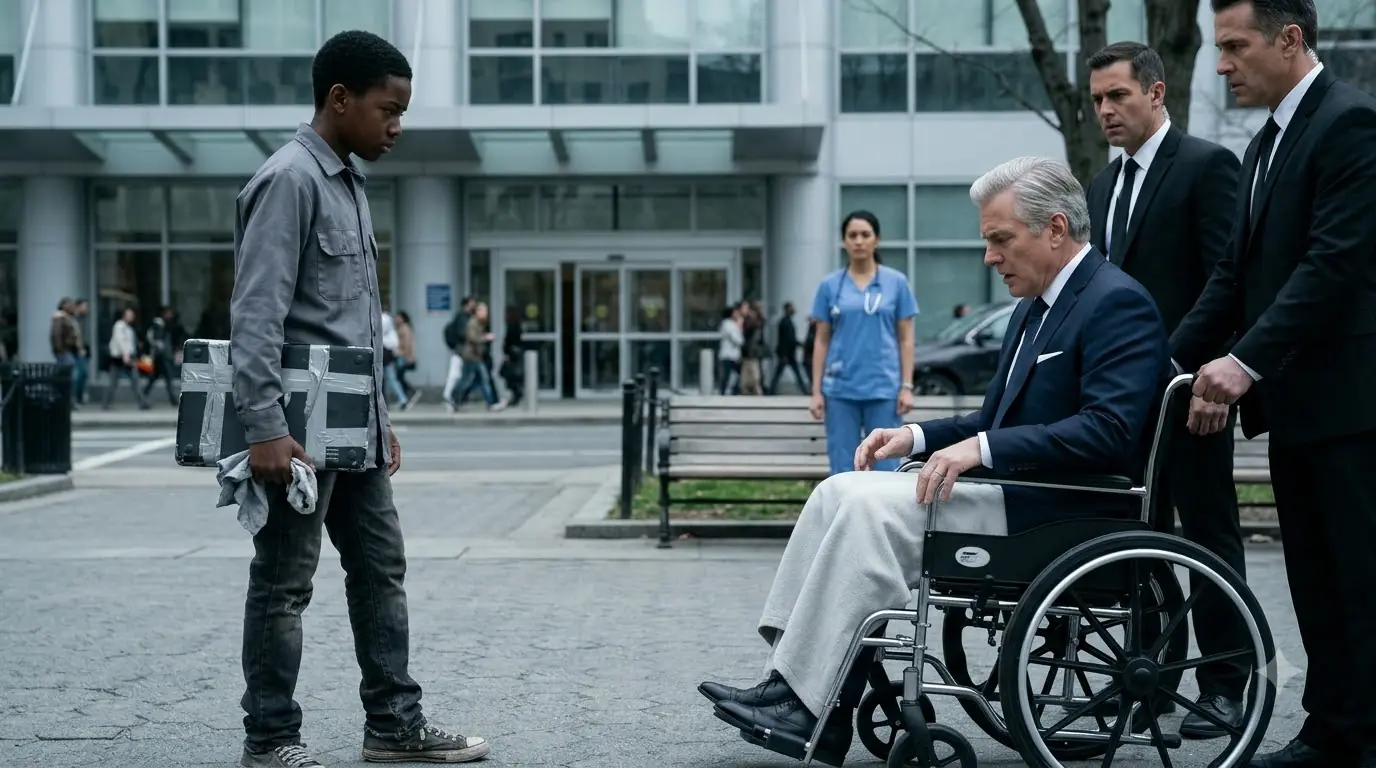
The boy, Noah Carter, held a battered laptop against his chest. A strip of silver tape covered the cracked corner of its case, and another held the charging cable in place. He had been trying to explain a discrepancy in the man's medical history, not claim that he possessed a miracle cure. But Whitmore did not listen long enough to understand the difference. He pointed at the laptop and said, loud enough for patients at the reception desk to hear, "I'll give you a million dollars if your little theory does one useful thing for me. A million. There's your chance to get out of whatever neighborhood you crawled out of."
Noah did not answer immediately. At the far end of the lobby, his mother stood with a cleaning cart she had brought in from the back hallway. She had been asked to cover an extra shift because one of the clinic custodians was sick, and there was a familiar exhaustion in her face. She looked at her son, then at the wealthy man, and Noah saw the question in her eyes: Was this worth responding to? He lowered his laptop and said, "I don't want your money, sir. I want somebody to look at the records before you decide there's nothing else to learn."
What happened afterward would travel much farther than the clinic's small waiting room. There would be an ambulance, an emergency physician, frightened security guards, a hospital investigation, and a video recorded by a camera that should never have been pointed at a patient in distress. There would be headlines describing a thirteen-year-old boy who had saved a billionaire, some of them accurate and many of them not. But Noah would remember the beginning differently. He would remember that the first thing he had asked for was not a million dollars. It was permission to be heard.
Two years earlier, when he was eleven, Noah had barely known the difference between a medical chart and a school health form. He had known almost nothing about neurology, and his laptop had still belonged to someone else. His world had consisted of the third-floor apartment he shared with his mother,