His name was Elijah Monroe, 13 years old, raised in East Baltimore by his grandmother Gloria, a woman who worked two shifts, hospital janitor by day, laundry service by night. She had one rule for Elijah, just one. You finish what you start. That was it. No motivational speech, no vision board, just that line every single morning before she left in the dark.
Elijah discovered math the way some kids discover music, by accident. He was nine, wandered into the Baltimore public library on a rainy afternoon, found a box of discarded textbooks selling for 25 cents each, picked up a calculus book because the cover looked interesting. He didn't understand a single page, so he started from page one, alone. By 11, he was teaching himself real analysis. By 12, he was solving problems on an online math forum under the username Baltimore Solver.
Graduate students, PhD candidates from MIT, Stanford, Princeton would post problems they were stuck on. And this anonymous account would crack them. Clean. Elegant. Sometimes in ways that textbooks hadn't considered.
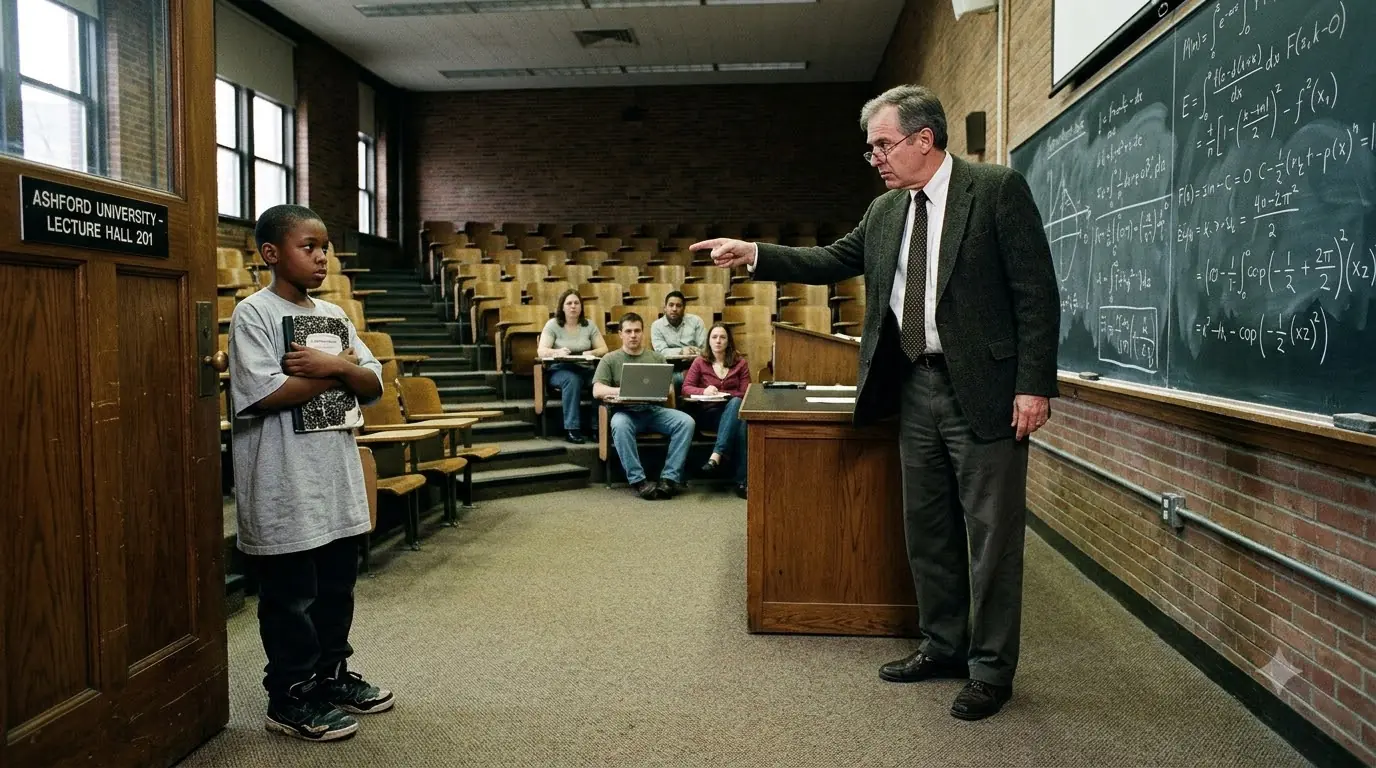
Nobody knew Baltimore Solver was a kid. A kid who did his proofs at a kitchen table under a yellow lamp at 2:00 in the morning. While his grandmother worked the night shift. A kid whose notebook had Spider-Man doodles in the margins right next to original theorems. That's who Elijah was.
A quiet storm nobody could hear yet. Now, let me tell you about the other side. Professor Gerald Whitfield. 58 years old. Tenured for 30 years.
Chair of the mathematics department at Ashford University in Boston. Published in every journal that mattered. Invited to every conference worth attending. He ran the department like a kingdom. And the annual mathematics showcase was his throne room.
The showcase was the biggest event on the department calendar. A public stage. 400 seats. Faculty, donors, visiting scholars, graduate students. Three rounds of increasingly difficult problems solved live on stage.
The winner earned department honors and a research placement. Careers were made on that stage. And Whitfield controlled every piece of it. He picked the problems. He picked the participants.
He picked the order. In 30 years, he had never once selected a student who transferred in from outside the Ivy pipeline. So, when Nina Vasquez, a 26-year-old teaching assistant, traced the IP address of Baltimore solver and discovered the anonymous genius was a 13-year-old eighth grader from Baltimore. She did what anyone with a conscience would do. She nominated Elijah for the Young Scholars Initiative.
A special program that granted one exceptional talent under 16 a seat at the showcase alongside doctoral candidates. The nomination went through. The university board approved it. Whitfield couldn't block it. But that didn't mean he accepted it.
In the faculty meeting, his words cut the air like a blade. This is an academic stage, not a children's talent show on television. We are not a circus. And I will not let my department become a sideshow for some feel-good diversity stunt. No one challenged him.
No one ever did. But the rules were the rules. Elijah was in. So, Whitfield did the next best thing. If he couldn't keep the boy out, he'd make sure the boy wished he'd never walked in.
He still controlled the problems. He still controlled the difficulty. And he had every intention of using both. Meanwhile, one more piece fell into place. The external examiner this year was Dr.
Caroline Dawson, 64, retired advisor to the Fields Medal Committee, a legend in the world of pure mathematics, quiet, observant, the kind of person who noticed everything and said almost nothing. Her presence raised the stakes for everyone, especially Whitfield. He wanted the showcase to reflect his department's prestige, his legacy, his standard. He had no idea that standard was about to be redefined by a boy who arrived at Boston South Station alone carrying a second-hand backpack and a composition notebook held together with tape. Nina picked him up at the platform.
He looked even smaller than she expected. Sneakers with the sole peeling, a shirt two sizes too big, bought by Gloria so he could grow into it. He looked up at the city skyline and said nothing. But inside that taped-up notebook were ideas that would bring a 400-seat auditorium to complete silence. The question was, would anyone let him get that far?
The day before the showcase, Whitfield held an orientation for all participants. Small lecture room. Six doctoral candidates sat in the front rows. Tyler Bradshaw, Rachel Foster, and four others. Confident, relaxed.
They belonged here and they knew it. Then the door opened. Elijah walked in. Backpack over one shoulder, that notebook in his hand. He was shorter than everyone in the room by at least a full head.
A few of the grad students glanced at each other. One almost smiled. Whitfield looked him over, top to bottom, slow, the way you'd inspect something unpleasant stuck to your shoe. Well, here he is, the experiment. Elijah found a seat in the back corner.
The chair was too tall. His feet didn't touch the floor. Whitfield addressed the room. The Young Scholars Initiative requires its candidate to pass a qualifying round before stepping onto the main stage. This ensures we don't waste the audience's time.
He paused, looked directly at Elijah. Especially when the candidate has no formal academic foundation whatsoever. Tyler Bradshaw watched from the second row. No hostility, no sympathy, either. Just curiosity.
The kind you'd give a strange animal at a zoo. One of the other grad students leaned to his neighbor. Didn't even whisper. Just said it out loud. Is this a joke?
Nobody corrected him. Whitfield continued. Tomorrow morning, seminar room C. I will administer the qualifier personally. Three faculty members will observe.
You will solve one problem. If you cannot, and I want to be clear about this, you will be escorted back to the train station in time for the afternoon departure to Baltimore. He smiled when he said Baltimore. Like the city itself was a punchline. Elijah didn't flinch.
Didn't react. Just sat there with his feet dangling off the chair holding his notebook. That evening, Nina found him in the guest dormitory sitting on the edge of the bed. Notebook open but untouched. Staring at the wall.
Hey, you okay? He didn't look up right away. When he did, his voice was small. Quiet. Not broken.
Just honest. They looked at me like I walked into the wrong building. Like I got lost and ended up here by accident. Nina sat down across from him. Then prove them wrong.
He shook his head slowly. I don't need to prove anything to anyone. I just want to do math. But after a long silence, he looked down at the notebook. Turned to a fresh page and started writing.
Not because he wanted to fight. Because his grandmother told him to finish what he started. And he hadn't started yet. Here's what Whitfield didn't know. That qualifier he was designing, the PhD level problem he planned to use as a wall, it was about to become a door.
Because the boy sitting on that too-tall bed in that empty dorm room had been walking through doors like that since he was 9 years old, alone, in the dark, with nothing but a 25-cent textbook and a yellow kitchen light. The only difference now was that tomorrow, 400 people would be watching, and the man holding the chalk had no idea what was about to happen in that seminar room. No idea at all. The next morning, seminar room C, small, cold fluorescent lights, no windows. Whitfield stood at the front, chalk already in hand.
Three faculty members sat along the wall, Dr. Elaine Prescott and two others. Tyler Bradshaw had asked to observe. Whitfield allowed it. Of course he did.
He wanted an audience for this. Elijah walked in at exactly 8:00, backpack on, notebook in hand. He looked around the room the way a kid looks around the principal's office. Not scared, but aware that nothing here was built for him. Whitfield didn't greet him, didn't say good morning, just looked at him and said, "Sit. " Elijah sat.
His feet swung above the floor. The chair was too high. Again, Whitfield turned to the board and began writing, slowly, deliberately, each symbol pressed hard into the surface, chalk squeaking against the slate. It was a modified Diophantine equation wrapped inside a real analysis framework. PhD qualifying level.
The kind of problem that made second year doctoral candidates sweat. He stepped back, admired his own work, then turned to Elijah. There, that's mathematics. He pointed at the board with the chalk like a weapon. Not the finger counting games they taught you at whatever crumbling public school you crawled out of.
Real mathematics. The kind that separates minds from mimics. Dr. Prescott shifted uncomfortably in her chair, but said nothing. Whitfield checked his watch.